of Books & Poems
PART 1:
REVIEWS OF ART HISTORY BOOKS
CHESS SETS, 1968
Marcel Duchamp, Artist & Chess Champion, letter of 23 June 1968
“Thank you for everything. Am delighted to have the book dedicated to me.”
Julian Levy, New York Dealer, letter of Aug. 5, 1968
“… well researched and elegantly written.”
Lucy Lippard, Critic, letter of Dec. 21, 1968
“… particularly enjoyed the last chapter.”
Paul von Khrum, “F. Lanier Graham. CHESS SETS” LIBRARY JOURNAL, Apr. 15, 1969
“Recommended… ”
“F. Lanier Graham. CHESS SETS” BOOKLIST & SUBSCRIPTION RECORD, May 15, 1969, p. 1051
“An appealing addendum to larger works…”
“…a concise, lucid history[that] has become a classic text among historians, players, and collectors.” – List, THE IMAGERY OF CHESS REVISITED, 2005
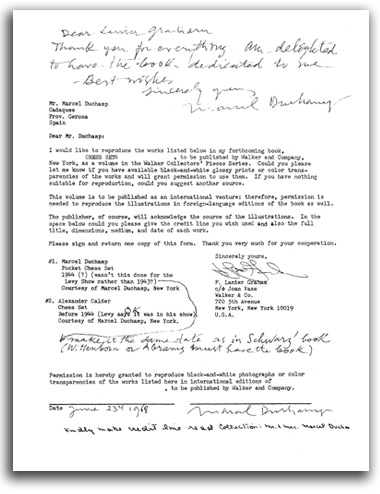
Click here for a closer view of this letter from Marcel Duchamp
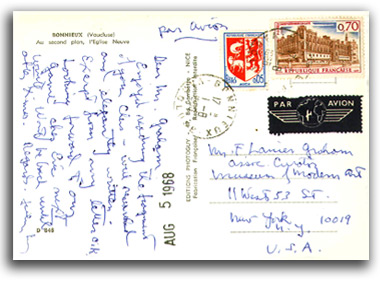
Click here for a closer view of this postcard
NOTE: Much of the information in the 20th century chapter of this book came from my conversations with Duchamp and Levy. Most of that chapter was reprinted (in facsimile) in THE IMAGERY OF CHESS REVISITED, New York: Noguchi Museum & Braziller, 2005
HECTOR GUIMARD, 1970
Ada Louise Huxtable,
“It’s a Long Way from 1900” NEW YORK TIMES, Mar. 22, 1970
“…the kind of scholarly documentation…that [has been MOMA’s] legitimate pride.”
CONNOISSEUR, Jun. 1970 [London]
“…an excellent catalogue…”
Francine Haber, “F. Lanier Graham, HECTOR GUIMARD” JOURNAL OF THE THE SOCIETY OF ARCHITECTURAL HISTORIANS, Dec. 1970, pp. 354-355
“…authoritatively explains…Guimard’s…Art Nouveau.”
THREE CENTURIES OF AMERICAN PAINTING, 1971
Alfred Frankenstein, “Three Centuries of American Painting”
SAN FRANCISCO CHRONICLE, Jun. 20, 1971, pp. 31-32
“…superbly weaves its story into the general fabric of American history…”
E. P. Richardson, Art Historian, letter of 9 Aug. 1971
“…handsome and impressive…”
James T. Flexner, Art Historian, letter of 17 Sep. 1971
“…very fine… I am much impressed…”
Ware Smith, “Three Centuries of American Painting”
SAN FRANCISCO REVIEW OF BOOKS, 1976, pp. 18-19
“No short book is filled with such a generous and sane perspective…”
Bernard Karpel, “Three Centuries of American Painting”
ARTS IN AMERICA: A BIBLIOGRAPHY, Washington, D.C.: Smithsonian Institution Press, 1979, Vol.2, #J 236
“…full of brilliant insights.”
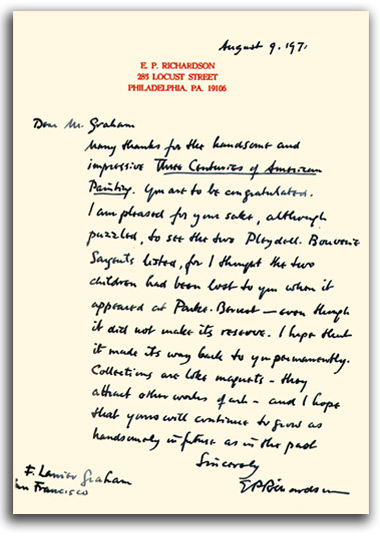
Click here for closer view of this letter
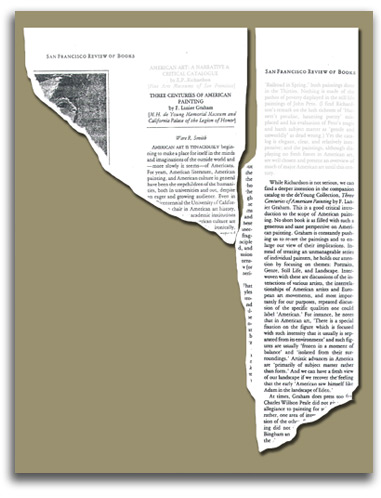
Click here for a closer view of this review
About the Reviewers:
Richardson was an Art Historian & Museum Director. He directed the Detroit Institute of Art and co-founded the Archives of American Art. Because of his pioneering monographs of the 1940s & ‘50s, he was widely regarded as the “Dean” of the scholarly study of American art history. He wrote the only textbook available at the time for a college course. I read all of his books in college. When we met in 1971 I was able to quote my favorite passages back to him. He had a wonderful smile. Ted was Mr. Rockefeller’s advisor and good friend for many years. But it was Mr. Rockefeller who made the final decisions on what would be acquired for his collection. Most of the meetings Ian and I had with Mr. Rockefeller during the early years of our long negotiation (1970-1975) included Ted.
THREE CENTURIES OF FRENCH ART:
SELECTIONS FROM THE NORTON SIMON INC.
MUSEUM OF ART & THE NORTON SIMON FOUNDATION, volume 1, 1973
Alfred Frankenstein, “Major French Art from the Norton Simon Museum” SAN FRANCISCO CHRONICLE, 22 Apr. 1973
“Graham…has written a most illuminating essay…”
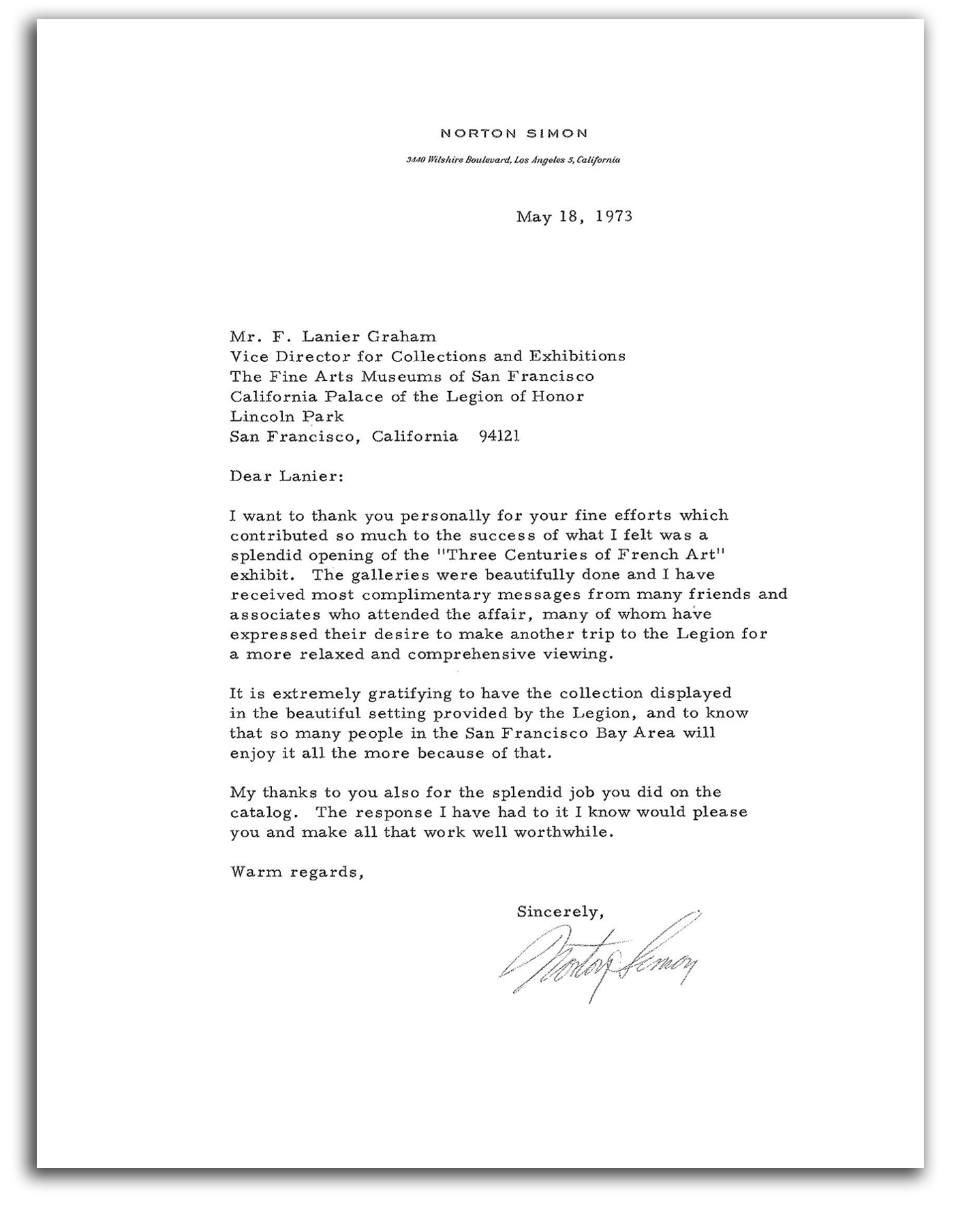
Click here for a closer look at this letter
Norton Simon, Director of Norton Simon Inc. Museum of Art, letter of 18 May 1973
Michel Laclotte, Directer of The Louvre, letter of 4 Jun. 1973
“excellent”
Pierre Rosenberg, Chief Curator of The Louvre, letter of 21 Jun. 1973
“superb”
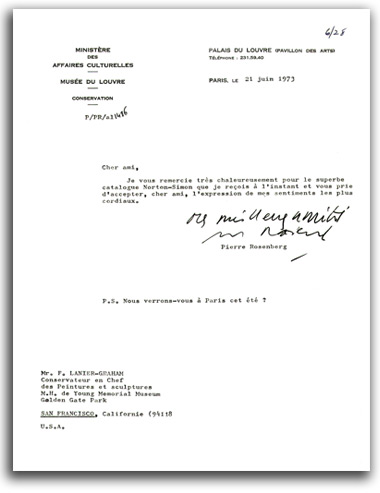
Click here for a closer view of this letter
CLAUDE MONET, 1974
Alfred Frankenstein, “Monets at the Legion…”, SAN FRANCISCO CHRONICLE, Jan. 27, 1974, p. 22
“Graham provides a particularly effective definition of the Impressionist process…”
THE RAINBOW BOOK, 1975
Joseph Campbell, Mythologist, letter of 1 Apr. 1975
“…really wonderful…”
Werner von Braun, Rocket Scientist, letter of 22 Apr. 1975 “It is not only unique in its presentation of a theme from so many angles, but also a goldmine of extremely interesting information.”
Bruce Evans, “THE RAINBOW BOOK”, MUSEUM NEWS, 1975
“When is an exhibition catalogue not an exhibition catalogue? … The Rainbow Book is more than an encyclopedia; it is an experience … a fascinating compendium…”
Thomas Albright in CURRENT, Jun.- Jul. 1975
“…surely the most bizarre publication ever produced [by] a major art museum.”
Faber Birren, Color Authority, letter of 24 Jul. 1975 “Thank you for humanizing the subject of color!”
William W. Quinn, Jr., “THE RAINBOW BOOK”, THE AMERICAN THEOSOPHIST, 1975
“Most refreshing…is its unpretentiousness. No ‘heavy’ occultism or recondite symbolism. … Using the adjective ‘beautiful’ to describe [it] does not make it… ‘phenomenal’ is a more accurate choice of words to describe this ‘book-art’… The book’s visual impact is…equalled by its outstanding content and organization… a prototype in the publishing trade.”
Marilyn Wright, “THE RAINBOW BOOK” NEW AGE JOURNAL, 1975
“It is a compendium or lore and information about color and light… . Not necessarily a book to read through [but] to dip into now and again. … As an object, the book is handsome [and the unusual spectral] printing can be viewed as a successful device to…enlarge…color awareness.”
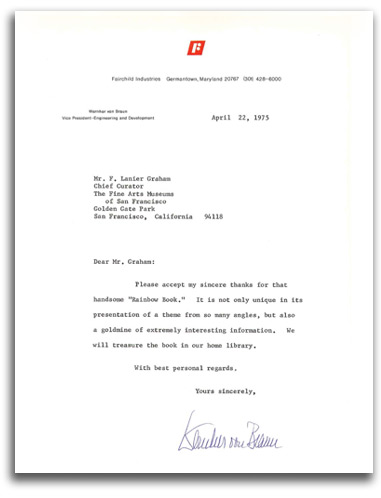
Click here for closer view of Werner von Braun letter
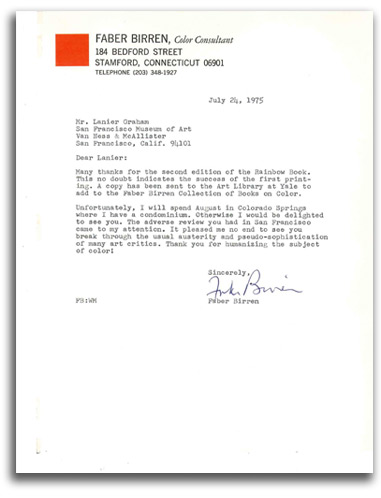
Click here for closer view of Faber Birren letter
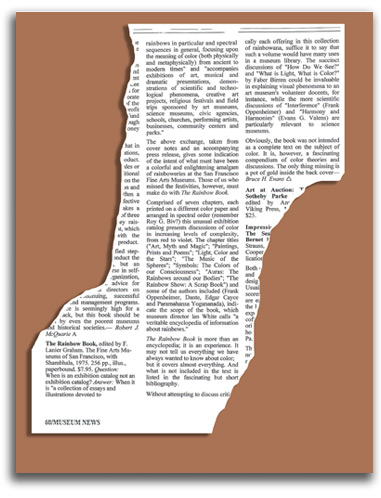
Click here for closer view of this review
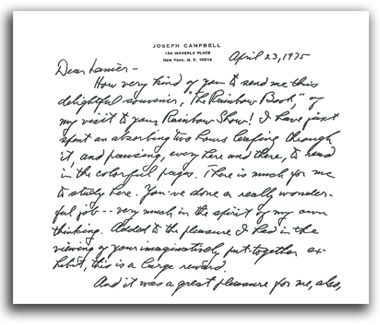
Click here for a closer view of this note from Joseph Campbell
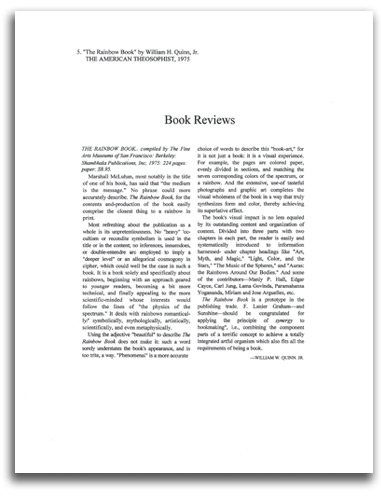
Click here for a closer view of this review article
About the Reviewers:
Von Braun was the best-known rocket scientist of the 20th century. He began his experiments in Nazi Germany but became an American after World War II. He designed early models of the Space Station, and led the work at NASA that landed the first man on the moon.
Campbell was the best-known mythologist in the United States. In his early work he argued that the greatest teachers of all spiritual traditions (Lao Tzu, Buddha, Jesus, Mohammed, et al.) were pointing us toward one thing: ENLIGHTENMENT, and how these Great Heroes travel similar paths to attain illuminated awareness and thereby enrich society. In the 1950s that position was considered very strange by most people and absurd by professors of Religious Studies. However, the newer discipline of Comparative Religion has given more respect to Campbell’s radical suggestion. Like Eliade, Campbell often isolated mythic symbols from their cultural context in order to point toward parallel meanings between and among societies. In academic circles, this way of thinking usually goes much too far from proper respect for regional meanings. Almost any form of “universalism” is rejected by academics in most universities. That made Campbell very much an “outsider.” Nevertheless, just as Huston Smith was instrumental in developing the disciple of modern Comparative Religion, Campbell was instrumental in developing the modern discipline of Comparative Mythology. Moreover, Campbell was an engaging storyteller and a stimulating lecturer. His books and videotapes started to be very popular with the general public after the 1988 PBS series with Bill Moyers called “The Power of Myth.” The book of the same title, under the general editorship of Jackie Kennedy, has sold millions of copies. Even among his detractors, Campbell will be remembered for elevating the term “myth” from a low level to a high level, and for changing the quality of the public dialogue about the nature of mythology. I had a number of stimulating conversations with Joe over the years, first in New York during the early ‘60s when I was a graduate student at Columbia. There he was called in by Meyer Schapiro to support my work when a professor who was less sympathetic to my “radical” interpretation of Minoan mythology wanted me to be thrown out of Columbia. His intervention helped. During the mid ‘70s we had lunch from time to time when he made his annual visits to California. At one of our lunches, I told Joe how I had summarized one of his core teachings. I did that by handing him a haiku I wrote to thank him for saving me from being thrown out of Columbia:
Myth is the matrix
of meaning. Without structure
all is without value.
THE SPONTANEOUS GESTURE:
PRINTS & BOOKS OF THE ABSTRACT EXPRESSIONIST ERA, 1987
Robert Motherwell, Painter-Printmaker, letter of 8 May 1985 “I think you are on to something when you talk about the ‘sublime’.”
Dore Ashton, Art Historian & Critic, letter of 17 Jan. 1986
“This book is very well conceived and more than that, important…”
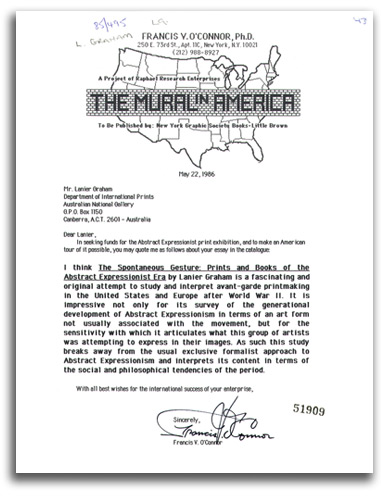
Francis V. O’Connor, Art Historian, letter of May 22, 1986
“…fascinating and original…”
Irving Sandler, Art Historian, conversation of 21 Aug. 1986
“The American history is well done. The European history is not only well done but was a revelation to me. … You have broken new ground. … remarkable…”
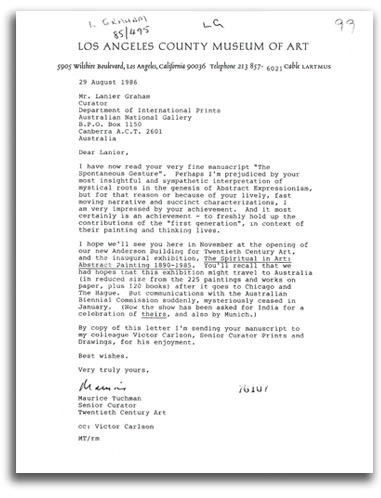
Maurice Tuchman, Curator, LACMA, letter of 29 Aug. 1986
“…most insightful. … I am very impressed.”
Daniel Abadie, Curator, National Museum of Modern Art, Paris, letter of 3 Sep. 1986
“A brilliant survey written with both expert knowledge and a remarkably balanced understanding of European and American Art.”
Paul Jenkins, Painter-Printmaker, letter of 10 Nov 1987 “…beautiful… . What I find special about it is the way it reveals the graphic intensity and uniqueness of each artist.”
Teruo Fujieda, Musashino Art University, Tokyo, letter of 4 Mar. 1988
“It helped me very much for my present work on Abstract Expressionism…”
Eugene V. Thaw, Collector & Dealer, letter of 18 Jan. 1988 “[The] treatment of the European vs. American postwar phenomena is exemplary and not found elsewhere.”
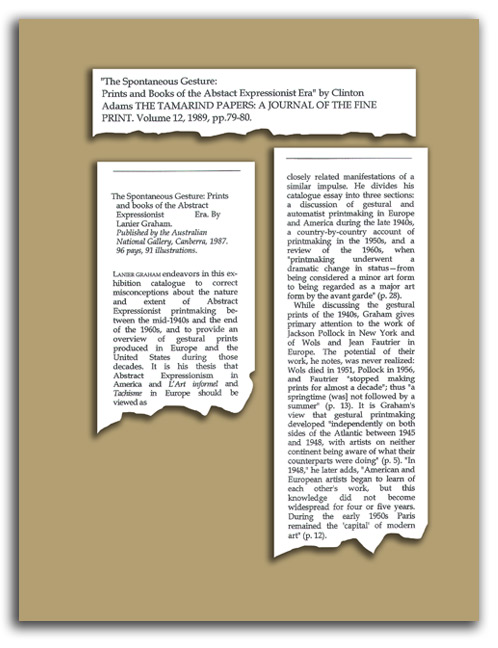
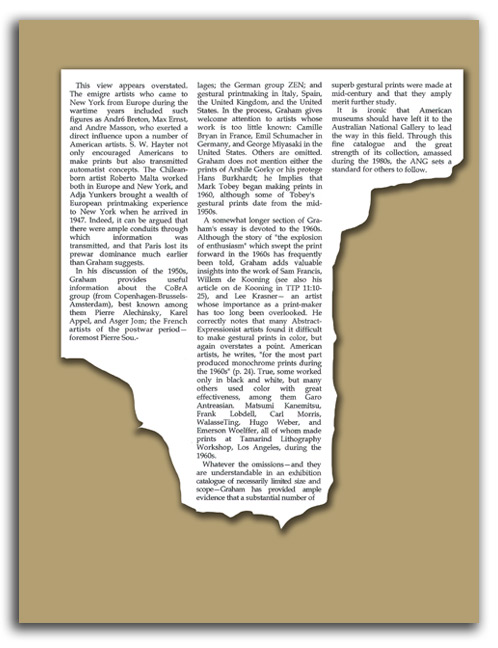
Clinton Adams, “THE SPONTANEOUS GESTURE” THE TAMARIND PAPERS: A JOURNAL OF THE FINE PRINT, 1989, pp. 79-80
“It is ironic that American museums should have left it to the Australian National Gallery to lead the way in this field. Through this fine catalogue…the ANG sets a standard for others to follow.”
Robert Rainwater, Curator, N. Y. Public Library, letter of 21 Sep. 1990
“…beautifully written and produced…”
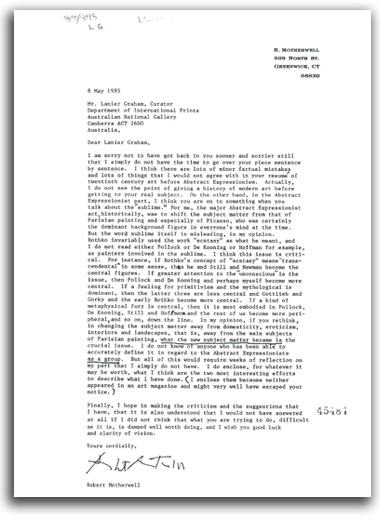
Click here for a closer view of this letter from Robert Motherwell
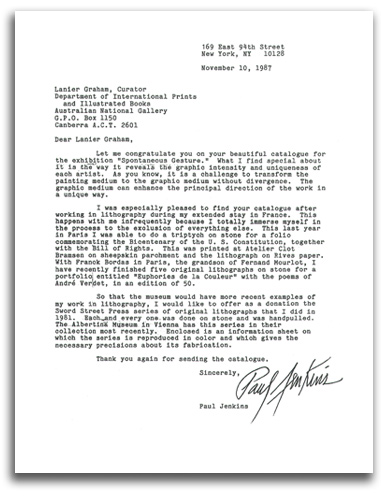
Click here for closer view of this letter
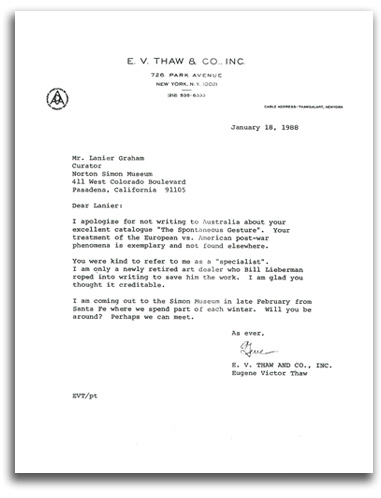
Click here for closer view of this letter
Click here for a closer view of this letter
Click here for a closer view of this letter
Click here for a closer look at this review
About the Reviewers:
Motherwell was a leading painter-printmaker of the New York School (a term he invented). Trained in philosophy, he also was a highly articulate spokesman for the movement, and a scholarly historian of Modernism as a whole. We had our first conversation in 1962 at American University in Washington. D. C., when I was in my junior year of college. I was studying at the School of International Service on a degree tract for becoming a Cultural Affairs officer in the Foreign Service. I had long been deeply interested in both art and spirituality, but had never connected them in a contemporary context. I was stupefied when Bob, at that first meeting, said to me: “Abstract art is a modern form of mysticism.” That was a life-changing moment. That single sentence gave me a whole new idea of what I wanted to do with my life. The next day I began a second major in Art History and decided to become a museum curator and a professor of Modern Art. We stayed in touch during my years at MoMA where he had a retrospective in 1965. His help as I struggled with the writing of THE SPONTANEOUS GESTURE during the 1980s was warmly welcomed.
Ashton began as a critic then became an art historian. She was a close friend of a number of the leading artists of the New York School. She was not afraid to be personal, and that opened her eyes to a world beyond Formalism. She may well be remembered as the most “humanistic” scholar of the time. She and Robert Rosenblum wrote the first authoritative books that focused on the spiritual aspects of contemporary art in the United States and Western Europe. When I was a student, her early books had a deep influence on me. She was articulating the luminous meanings behind abstract forms, at a time when most critics and art historians could not see beyond forms. Her 30 books constitute a matchless survey of the contemporary American art of her era. Our conversations and letters from the ‘60s through the ‘90s were a continuous inspiration.
Birren started as an artist. By the 1950s he had become America’s leading authority on color, both as a very productive theorist, author (over 20 books) and as a highly paid consultant to a wide range of manufacturers and hospitals, as well as the military. His advice helped many institutions with safety, morale, and productivity. His library of color books, preserved at Yale University, is probably the largest in the world.
Thaw, now retired, was a very successful dealer in New York. He also is widely respected as a scholar and as a collector. He is the author of many articles, and co-author of the Jackson Pollock catalogue raisonné. His distinguished collection of European drawings, from Old Master to Modern, has been donated to the Morgan Library.
O’Connor, an independent scholar, was the author of a major Jackson Pollock exhibition catalogue published by New York’s Museum of Modern Art, and was the co-author of the Jackson Pollock catalogue raisonné. In addition, he has done a great deal of work on the Mural Movement in the United States. He also is a critic and a poet.
Sandler wrote the most widely used textbook on American Abstract Expressionism, THE TRIUMPH OF AMERICAN PAINTING. That was not too boastful a title. Because of the “First Generation of the New York School” (Pollock and de Kooning, et al.), the capital of Modern Art did indeed move from Paris to New York. Sandler followed that opus with two more books that treated later generations of the New York School. I knew him slightly in New York during the ‘60s. We spent some quality time together when he visited the National Gallery Australia where he asked me to introduce his lecture. That week he kindly took the time to read the manuscript for THE SPONTANEOUS GESTURE.
Tuchman was a highly respected curator of Modern Art on the West Coast for many years. He did very innovative exhibitions. His last major project at LACMA was THE SPIRITUAL IN ART: ABSTRACT PAINTING 1890-1985. This remarkable exhibition and its publication sent tidal waves through the Art World. The result was a paradigm shift. Until then, Formalism had dominated the mindset of art historians and critics for most of the 20th century. The focus was on form. Little or no attention was paid to content. Little or no attention was paid to what artists said or wrote. Form WAS the content. My generation of art historians was the first of the contemporary era to question this lopsided assumption. We believed that to understand a work of art one must be aware of both form and content and how they relate. We interviewed artists and worked to excavate the documents that revealed what earlier artists said was the meaning of their work. A remarkable consistency of intention started to emerge during the research of the 1960s & ‘70s. It turns out that the animating impulse underneath much of Modern art as a whole, and almost all the abstract art of the most important painters, was a secular search for the sacred, a non-religious quest for the Transcendent. Tuchman summarized the powerful evidence and presented it to an astonished audience. Until then no professor of Art History could have lectured on Modernism from this perspective. The evidence was either unknown or too hard to believe. Tenure would have been at risk. After the Tuchman show, the evidence was crystal clear. A new vision of Modernism was born. It is true that very few of the great Modern artists were religious. However, they were seeking higher forms of awareness. Their quest for the Transcendent was a continuation of the type of seeking that has been central to spiritual traditions for thousands of years.
GODDESSES IN ART, 1997
Fr.M., “Des Déesses de Toutes Les Natures” LIBRE BELGIQUES, Aug. 16-17, 1997
“Fascinating and impassioned.”
Georgette Gouveia, “Age of the Goddess” USA TODAY, Dec. 21, 1997
“…a glorious book.”
Wendy Doniger, Mircea Eliade Professor of the History of Religions, University of Chicago, letter of 18 Jan. 1998
“What a gorgeous book! I did not think there was room for another book about goddesses, but yours is far and away the best…”
David French, Islamabad, Pakistan, on www.Amazon.com, 3 May 1998
“Graham is a lifetime student of spirituality who deeply understands what he studies – and is able to communicate that understanding with luminous words and images.”
WORDS OF WISDOM: A PUBLICATION OF WOMEN OF WISDOM FOUNDATION, Spring 1998
“… a scholar of international reputation [who] has written widely on world art and spirituality… . GODDESSES IN ART is praised around the world for its visual beauty and psychological depth.”
Broox Sledge of Book World on www.Amazon.com, Dec. 2000
“…one of the most fascinating volumes in our history…”
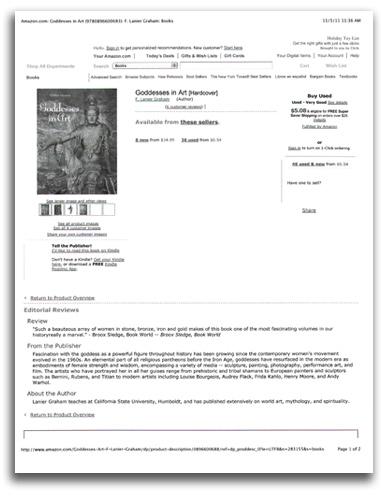
Click here for closer view of this document
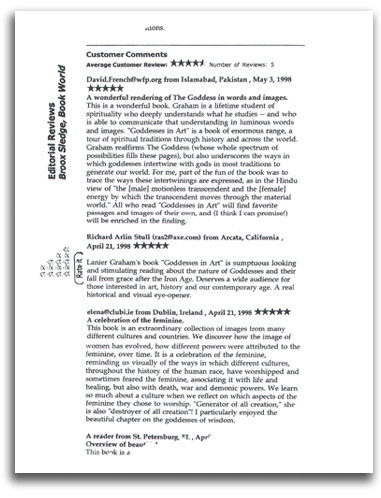
Click here for closer view of this document
GODDESSES IN WORLD MYTHOLOGY, 1997
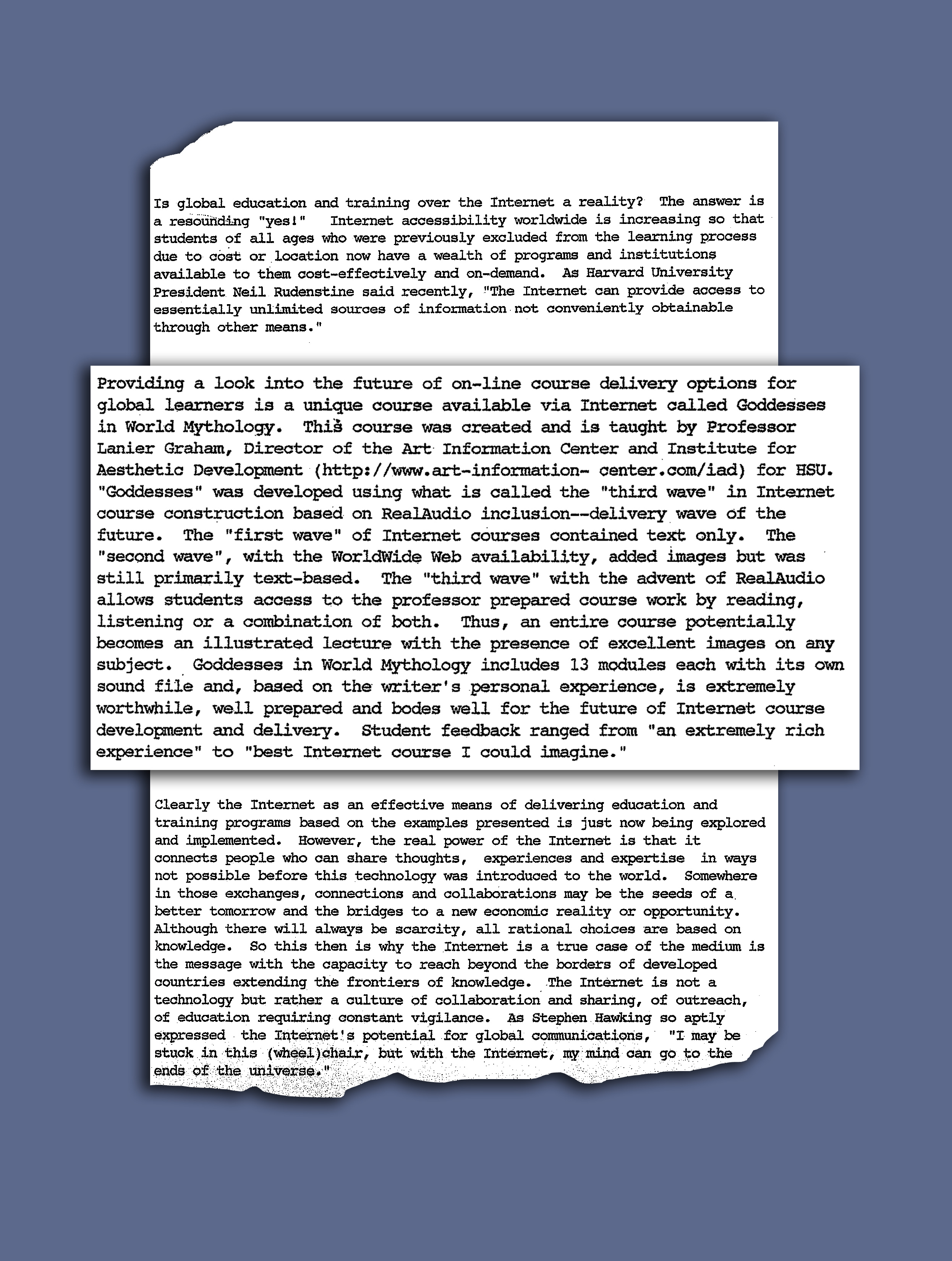
– Carolyn Manjourides, “GLOBAL EDUCATION & TRAINING OVER THE INTERNET: CONNECTING LEARNERS WORLDWIDE” in LINK-UP, May/June 1997
DUCHAMP-IN-A-BOX:
A Box-Valise filled with Genuine Duchampiana
Meticulously Replicated in 2-D, 3-D, A-V, & CD, Even, 2001
Review excerpts of 2001
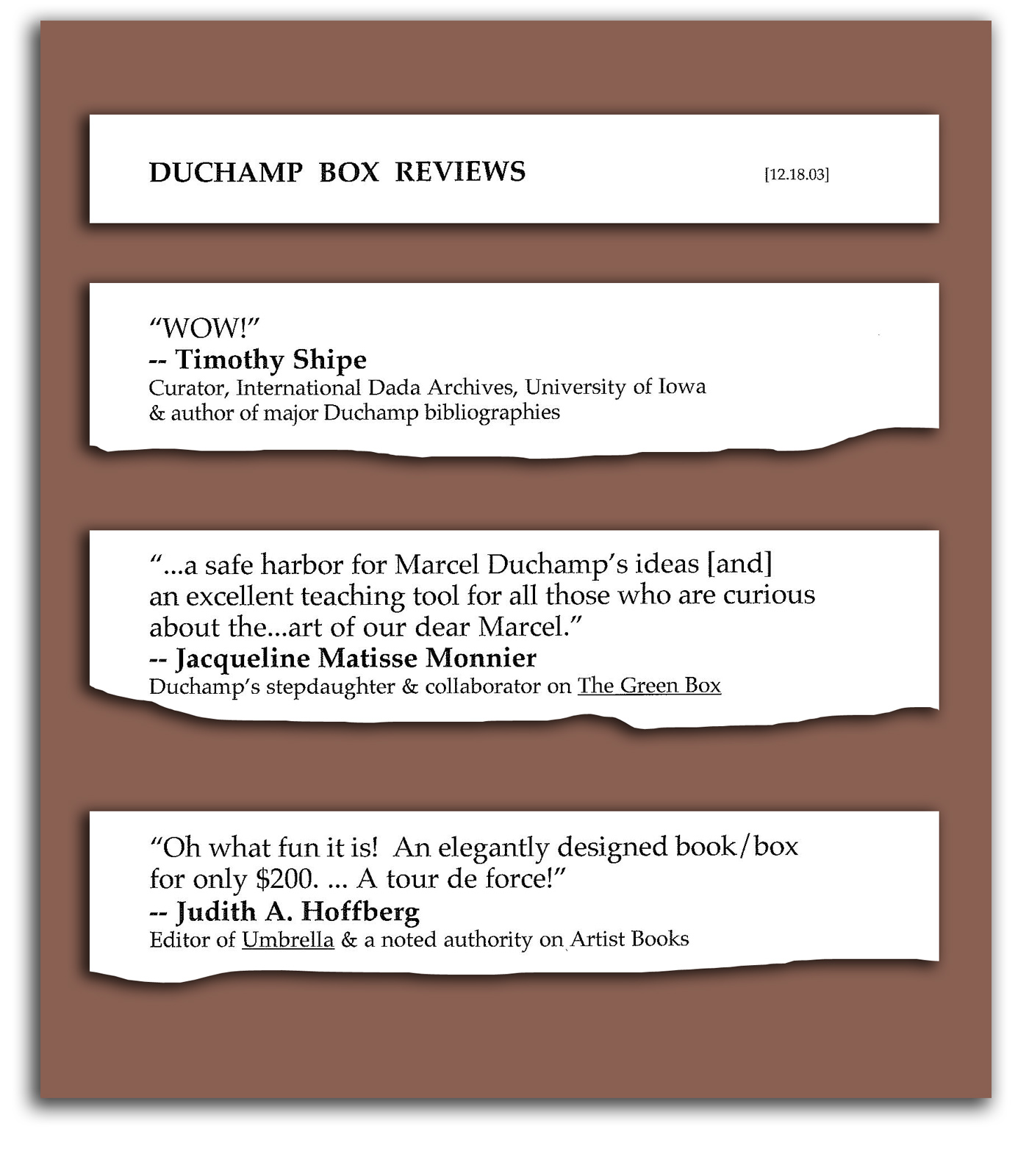
Click here for a closer view of these review excerpts
Duchamp review in UMBRELLA by Judith Hoffberg:
2003 Vol. 26, Numbers 3-4, p.106: DUCHAMP-IN-A-BOX
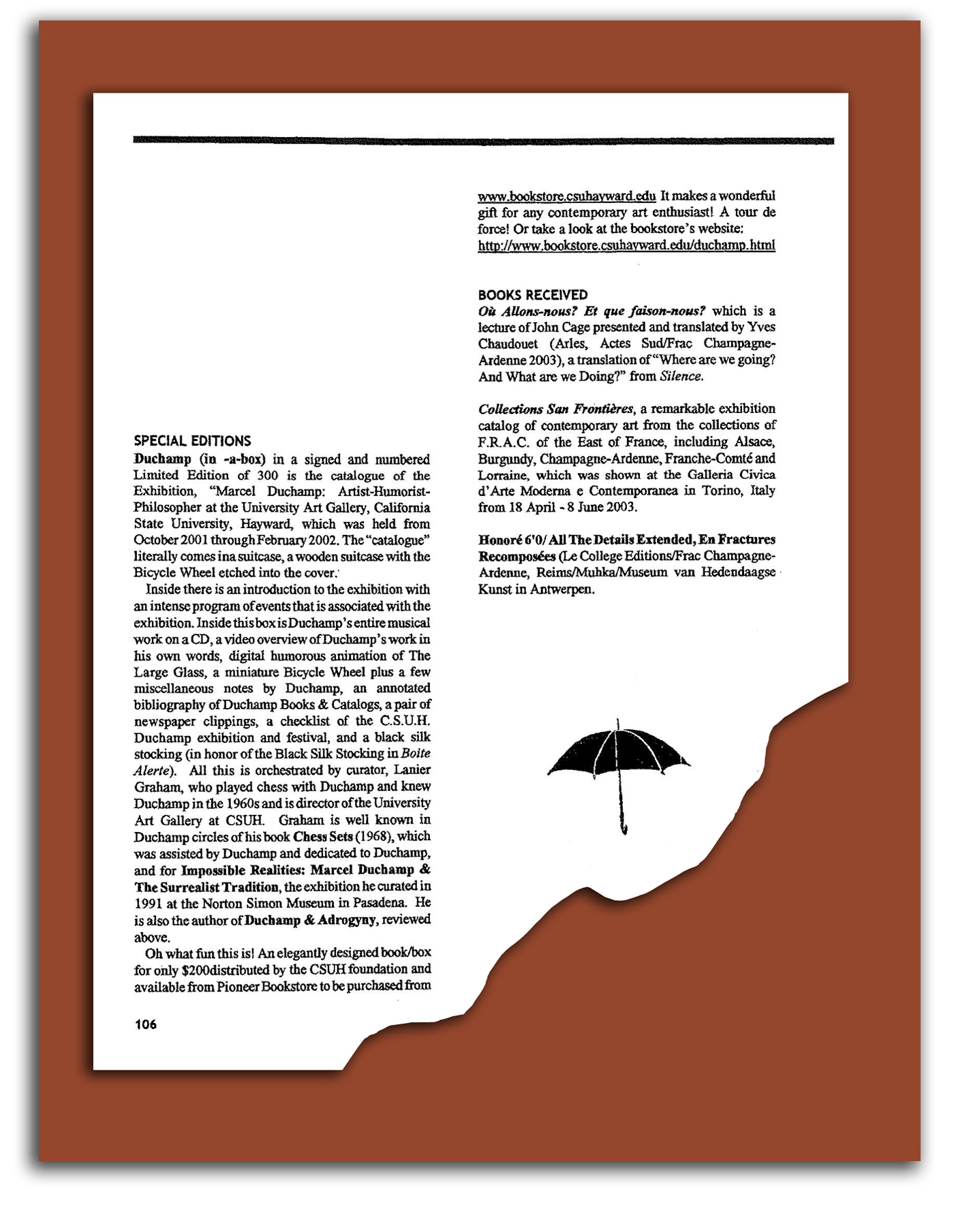
Click here for a closer view of this printed review
DUCHAMP & ANDROGYNY:
ART, GENDER, AND METAPHYSICS, 2003
Duchamp review in UMBRELLA by Judith Hoffberg:
2003 Vol. 26, Numbers 3-4, p.105
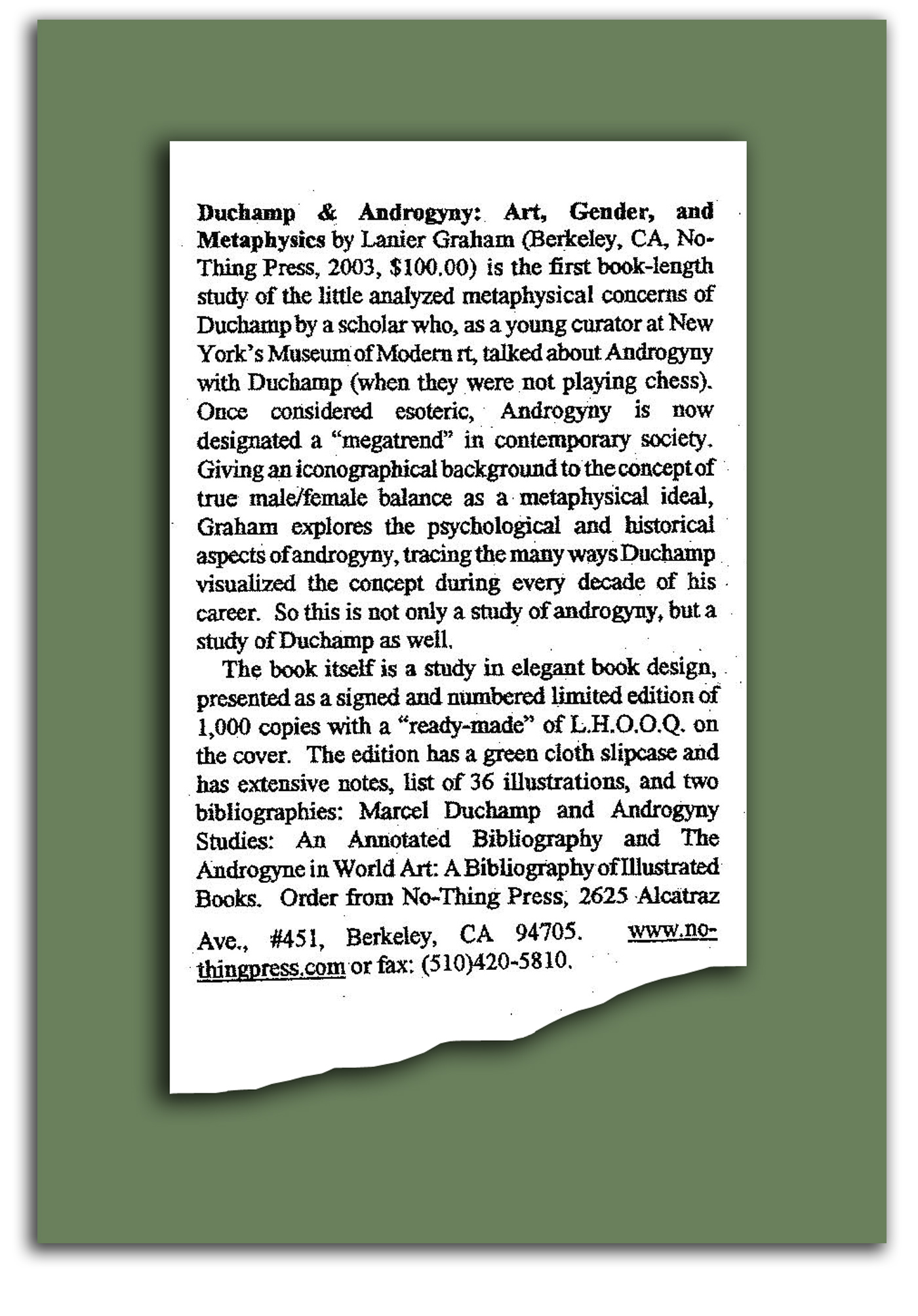
Click here for a closer view of this printed review
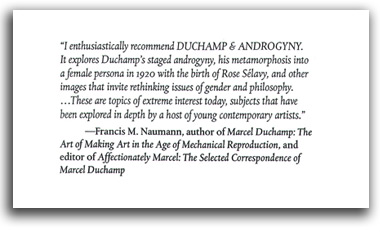
Click here for closer view of this review excerpt
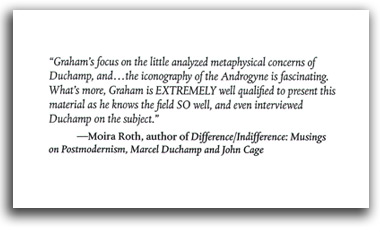
Click here for closer view of this review excerpt
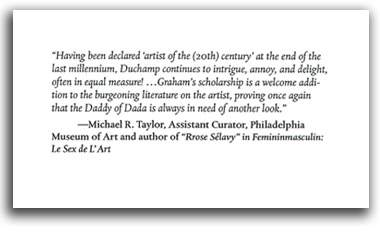
Click here for closer view of this review excerpt
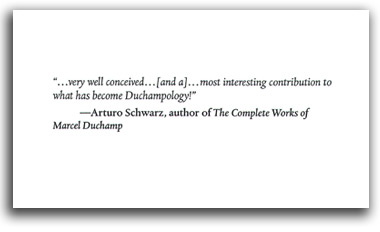
Click here for closer view of this review excerpt
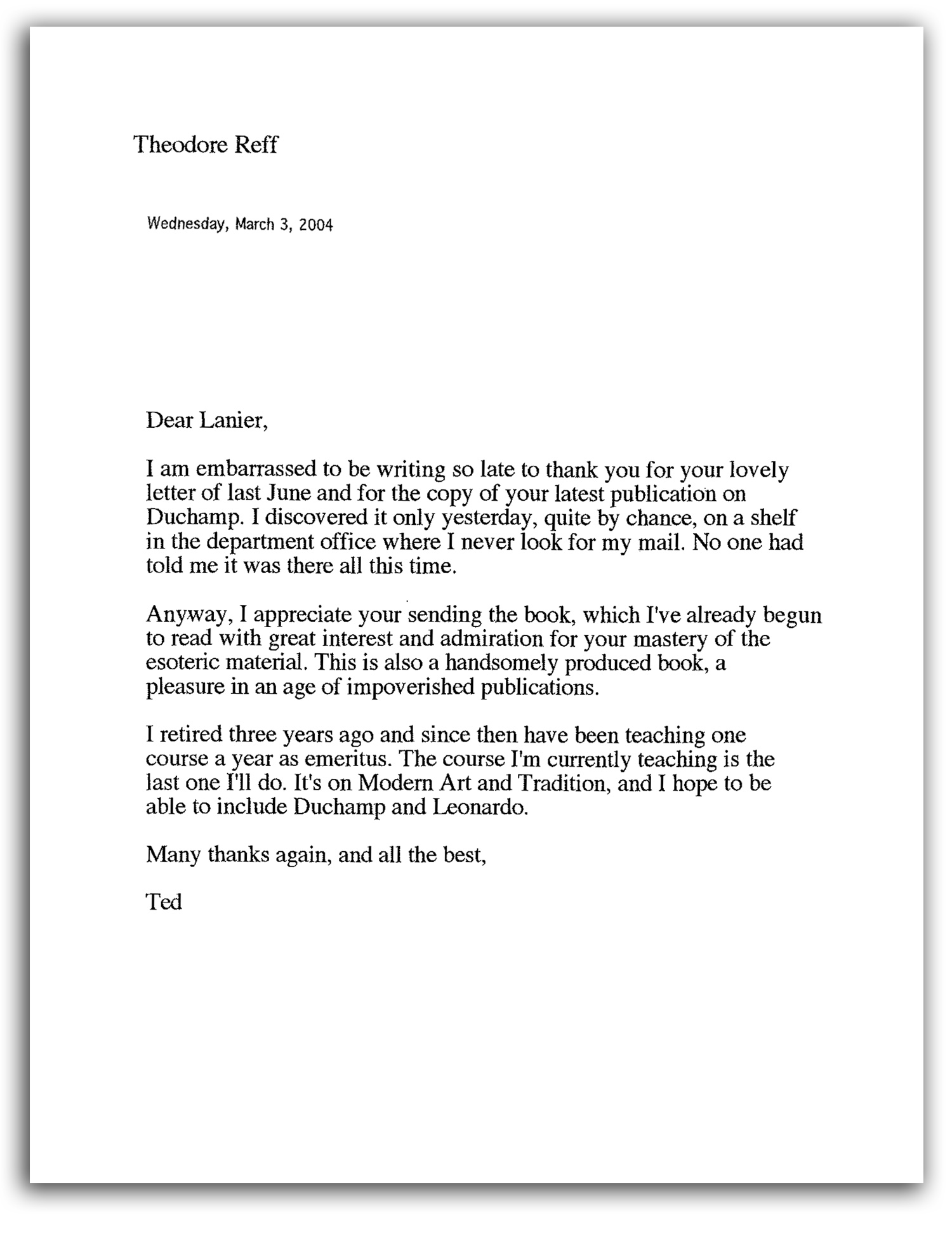
Click here for a closer view of this letter
ART IN THE UNITED STATES, COLONIAL TO MODERN, 2009
Email review by Wanda Corn
Robert and Ruth Halperin Professor Emerita in Art History
Stanford University
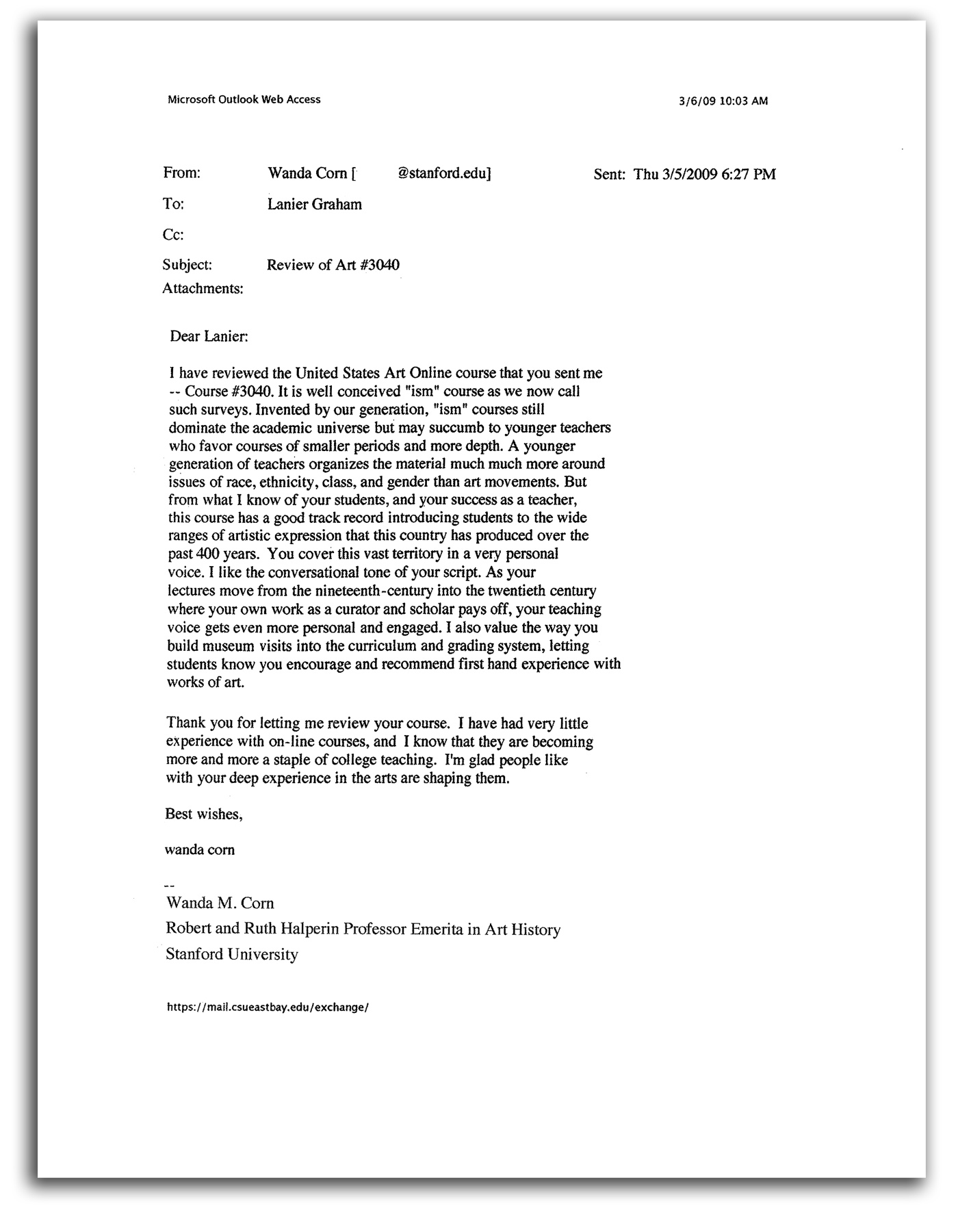
Click here for closer view of this email
BOOKS in PROGRESS:
ZEN & MODERN ART:
ECHOS OF BUDDHISM IN WESTERN PAINTINGS & PRINTS
Reviews of the working manuscript:
“There is a great deal of fascinating and convincing material here. … The influence and inspiration of Zen is even more significant than I had realized.”
~ Stephen Addiss, author of THE ART OF ZEN
“…better than good –- cool!”
~ David Chadwick, author of CROOKED CUCUMBER: THE LIFE AND TEACHING OF SHUNRYU SUZUKI
“ZEN & MODERN ART is a thoroughly researched, clearly written, and immensely valuable contribution to the understanding of art in the second half of the twentieth century. Graham’s skillful scholarship and sensitive insights will make this pioneering survey and inspiration to many who are looking for bridges between the East and the West.”
~ Jacquelynn Bass, author of THE SMILE OF BUDDHA: EASTERN PHILOSOPHY AND WESTERN ART FROM MONET TO THE PRESENT with a Foreword by Robert A. F. Thurman
IMAGES OF THE INFINITE:
SPIRITUALITY IN MODERN ART
Reviews of the working manuscript:
“I like IMAGES OF THE INFINITE very much. While the subject is profound, the treatment is credibly modest and – most important – personal. The refreshing use of personal encounters (with Marcel Duchamp for instance) gives the book a special character. Most writers today are so scholastic they are boring. Lanier Graham is not.”
~ Dore Ashton, author of THE UNKNOWN SHORE: A VIEW OF CONTEMPORARY ART, A READING OF MODERN ART, and editor of TWENTIETH-CENTURY ARTISTS ON ART
“Lanier Graham had the wit to realize, years ago, that great artists of our time lived nearby him and might just welcome a young scholar’s questioning. The result was extended interviews –- even friendships -– with Duchamp, Noguchi, Motherwell, and others who shaped the course of 20th century art. Now, as a mature scholar and teacher, Graham rediscovers in these exchanges grounds for the haunting thesis of his new book: that 20th-century art meant to be, and in part was, a spiritual art — an exploration of our own best possibilities.”
~ Roger Lipsey, author of THE SPIRITUAL IN TWENTIETH-CENTURY ART
PART 2: REVIEWS OF POETRY BOOKS
Note: As a rule, these poetry books appeared in very limited editions, often no larger than 10 or 20 copies for family and friends. All these “reviews” were personal communications from friends and/or fellow poets. Recorded are the date and place of the communication.
NATURE POEMS:
SONGS OF THE FOUR SEASONS, 1958 & 1963
“These are truly musical poems, and a credit to the blood he shares with Sidney Lanier.”
– Carl Sandburg, Connemara, Flat Rock, N.C. (1960)
ENLIGHTENING INSIGHTS, 1963
“Lanier Graham not only understands the Tao, intellectually,
he flows with it.”
– Master Ch’i, American University, Washington, D.C. (1963)
POP POEMS, 1966
“good stuff.”
– Frank O’Hara, Museum of Modern Art, New York City (1966)
RAINBOW HAIKU, 1974
“crystalline – post-meditative crystals.”
– Allen Ginsberg, Naropa Institute, Boulder, Colorado (1976)
HEAVY LIGHT:
HAIKU ON THE THEME OF MODERN PHYSICS
& ANCIENT WISDOM, 1978
“beautiful words and beautiful thoughts.”
– Frank Oppenheimer, physicist, educator & Founding Director of the Exploratorium, San Francisco. (1978)
“Clear as a bell!” David Bohm, Quantum Physicist (1978)
“HEAVY LIGHT is a brilliant collection of poems that is rich enough to be enjoyed by poets and scientists. They are being read and enjoyed by many members of the Physics/Consciousness Research Group. Each poem is a luminous particle that undulates in wave after wave of meaning.”
– Fred Wolf, physicist & author of TAKING THE QUANTUM LEAP: THE NEW PHYSICS FOR NON-SCIENTISTS, San Francisco (1979). Wolf won the National Book Award in 1980.
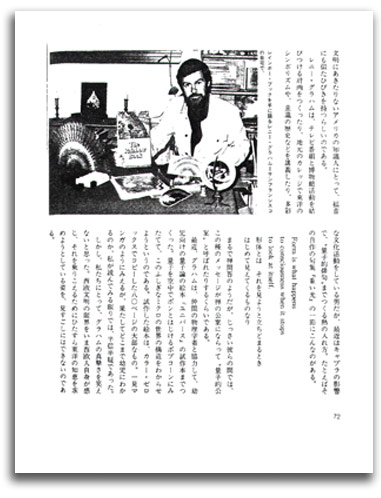
“HEAVY LIGHT brings the old Japanese haiku form into the world of modern physics. English-speaking poets have used the haiku form for many years, but never better than here. This book of wisdom poems, and Graham’s RAINBOW BOOK on the art, physics, and metaphysics of color, are very important manifestations of The New Dialogue between artists and scientists on the nature of consciousness.”
– Itsuo Sakane, Art & Science Editor for ASAHI SHINBUN, Tokyo, & author of KYOKAISEN-NO TABI [Traveling on the Borderline: Art, Science, & Consciousness]. Sakane published two of Graham’s haiku for readers of his Tokyo newspaper column in 1979. (San Francisco 1979)
Click here for closer view of this document
ELECTRO-MAGNETISM:
PHILOSOPHICAL POEMS ON COMPLEMENTARITY, 1981
“My brother [J. Robert Oppenheimer] and I often used to talk about complementarity. It is a very important concept in physics and in philosophy. But as a teacher, I found it is a difficult concept for students to understand. In this book of poems, Lanier Graham has written moving metaphors. I’m not sure who will like them more, scientists or poets. These little poems say a great deal. But they say it so simply that children can enjoy them.”
– Frank Oppenheimer, physicist, educator & Founding Director of The Exploratorium, San Francisco (1981)
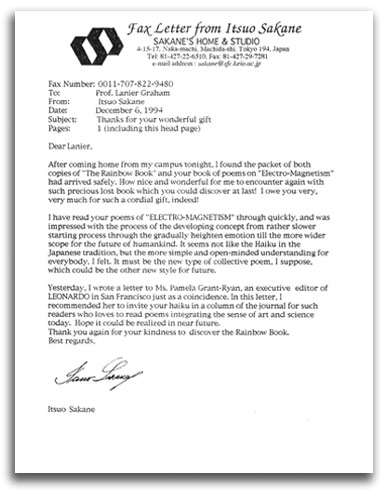
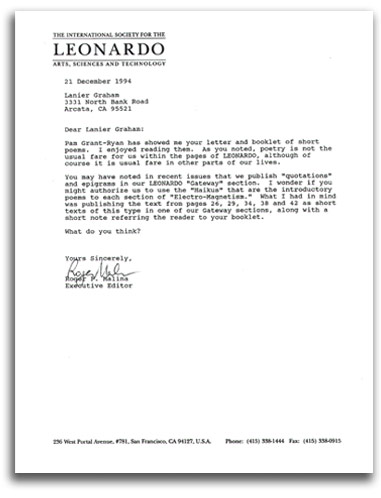
““I…was impressed with…the developing concept from rather slower…through the gradually heightened emotion till the…wider scope for the future of all mankind. It seems not like the Haiku in the Japanese tradition, but a more simple and open-minded understanding for everybody. It must be a new type of…poem…which could be [a] new style… .”
– Itsuo Sakane, Art & Science Editor of the ASAHI SHINBUM.
(Tokyo 1994
Click here for closer view of this document
Click here for closer view of this document
FRAGMENTS OF FEELING:
SELECTED SHORT POEMS BY F. LANIER GRAHAM, 1994
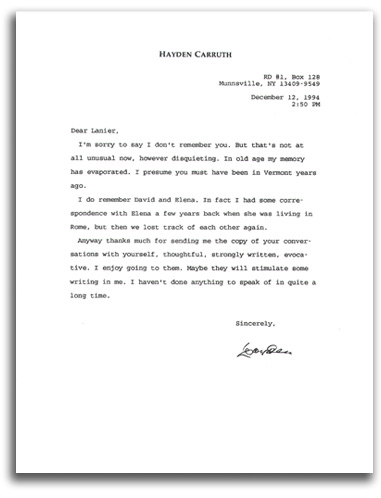
“…thoughtful, strongly written, evocative. I enjoy going to them. Maybe they will stimulate some writing in me.”
– Hayden Carruth, poet & editor of THE VOICE THAT IS GREAT WITHIN US: AMERICAN POETRY OF THE TWENTIETH CENTURY a widely respected anthology of American poetry. Carruth won the National Book Award in 1996. (Munnsville, NY. 1994)
Click here for a closer view of this letter
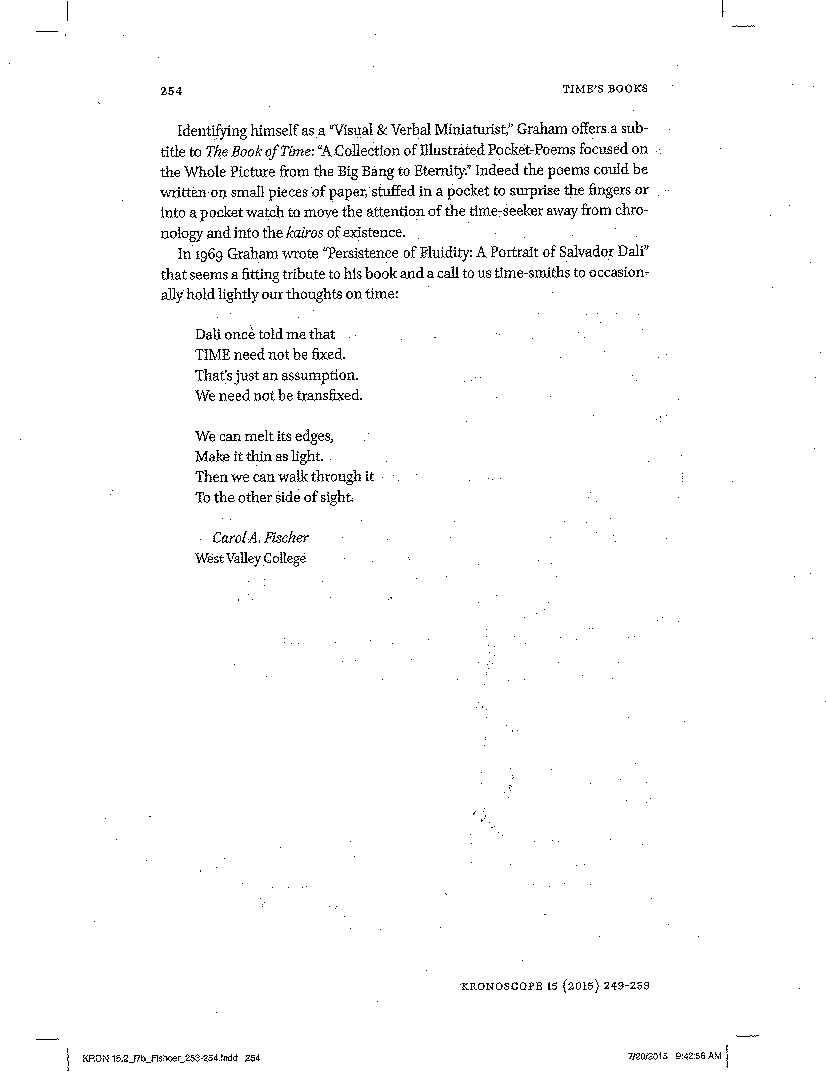
THE BOOK OF TIME:
A COLLECTION OF ILLUSTRATED POCKET-POEMS FOCUSED ON THE WHOLE PICTURE FROM THE BIG BANG TO ETERNITY, 2012
-Review in KRONOSCOPE: JOURNAL FOR THE STUDY OF TIME, Leiden, The Netherlands, 2015
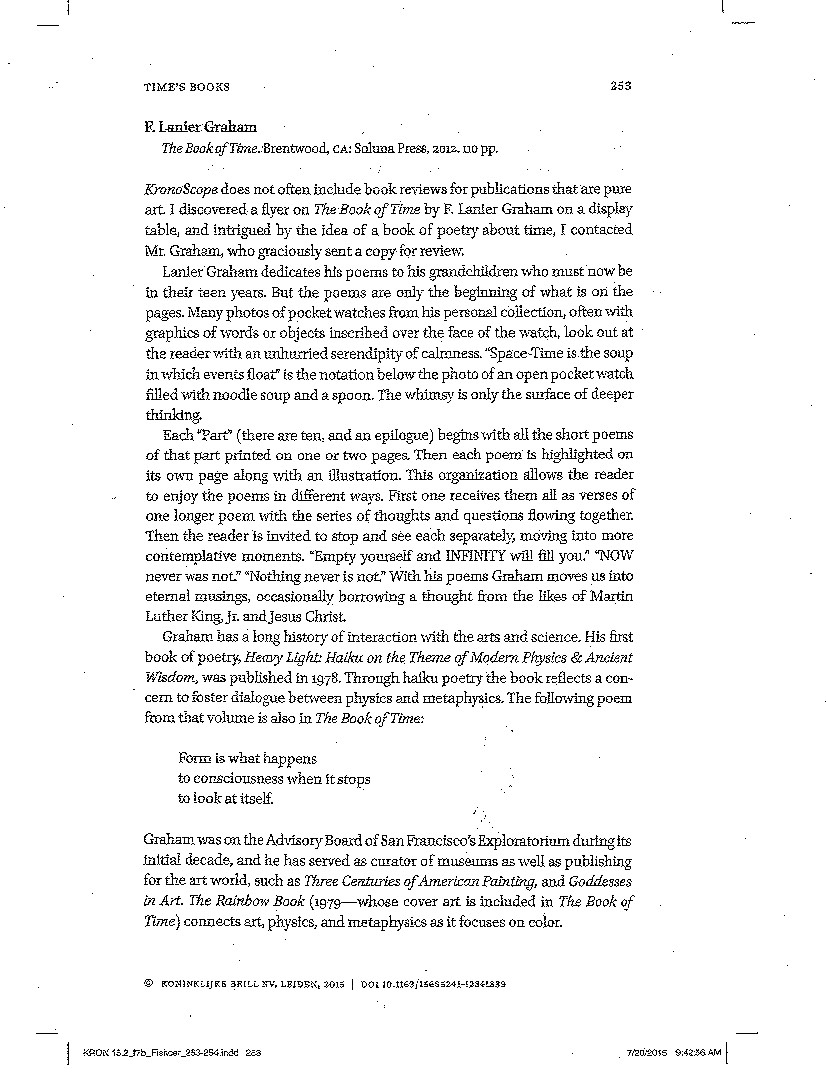
Click here for a closer view of this page