
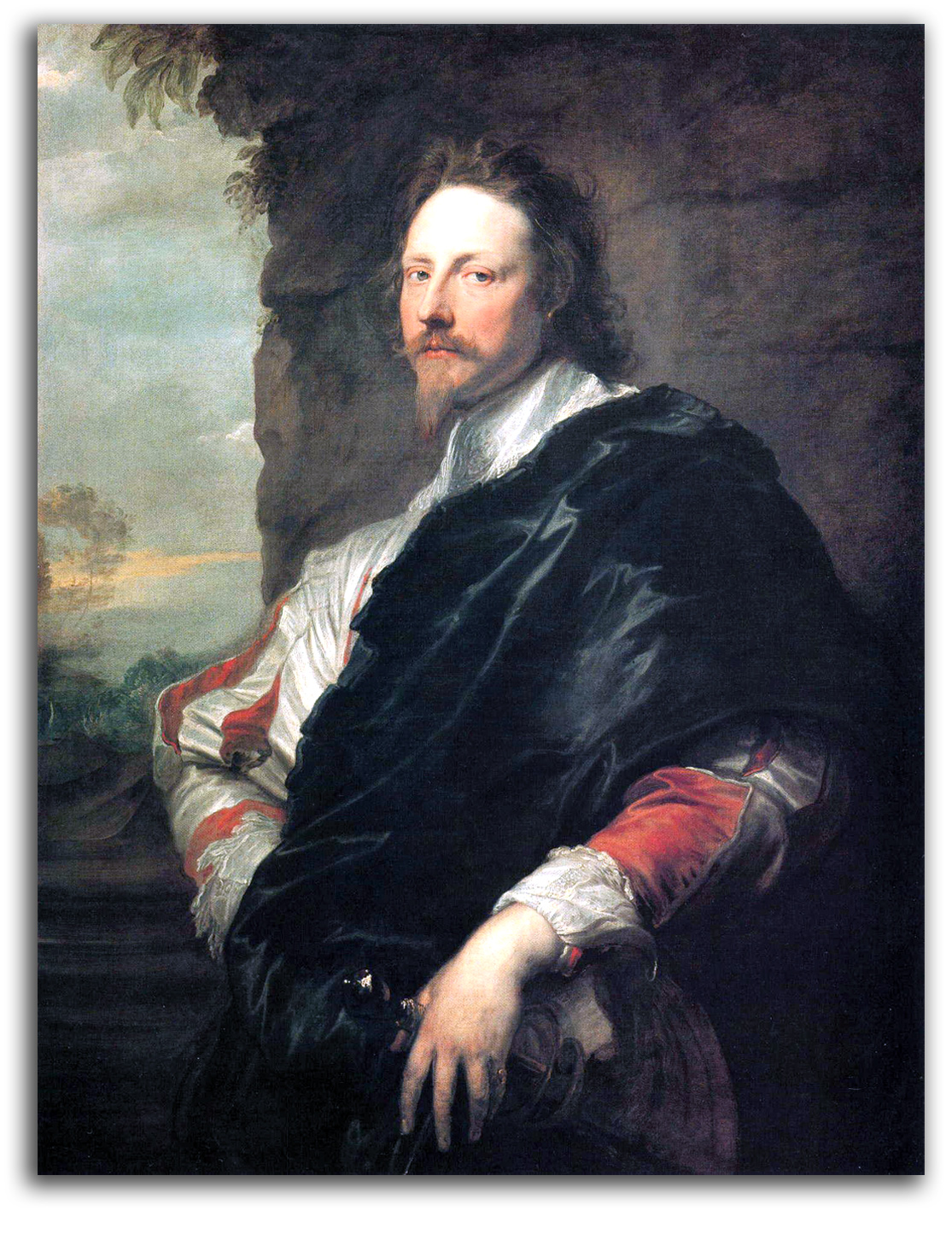
ANTHONY VAN DYCK
PORTRAIT of NICHOLAS LANIER
oil on canvas. c.1632
Collection: Kunsthistorisches, Vienna
Ex. Collection: King Charles I, & then Nicholas Lanier
click here or on portrait (above) for more detailed image

TABLE OF CONTENTS
17TH CENTURY ART:
An Introduction
PART 1 – LECTURES ON PAINTINGS
(Click here)
CARAVAGGIO: THE CALLING OF ST. MATTHEW
RUBENS : THE FALL OF THE REBEL ANGELS
RUBENS: PORTRAIT OF SUSANNE FOURMENT
REMBRANDT: ARISTOTLE CONTEMPLATING A BUST OF HOMER
REMBRANDT: SELF-PORTRAIT WITH A BERET & UPTURNED COLLAR
VERMEER: GIRL WITH A PEARL EARRING
VALAZQUEZ: PORTRAIT OF JUAN DE PAREJA
PART 2 – LECTURES ON SCULPTURE
(Click here)
GIAMBOLOGNA
BERNINI
PART 3 – LECTURES ON SYMBOLISM
(Click here)
Italian Renaissance Lectures at CSUEB
Symbols of the Transcendent, 2007
Click here to view these lectures in PDF format
PAGAN SYMBOLISM
Pagan Metaphysics lecture #1: The Geneology of Botticelli’s “Venus” 2007
Pagan Metaphysics lecture #2: The Philosophical Venus 2007
Pagan Metaphysics lecture #3: Venus, Mars, & Wisdom 2007
Pagan Metaphysics lecture #4: The Mystic Union of Mars & Venus 2007
CHRISTIAN SYMBOLISM
Christian Metaphysics lecture #1: The Crucifixion of Christ 2007
Christian Metaphysics lecture #2: Sophia – Holy Spirit 2007
Christian Metaphysics lecture #3: The Kingdom of God 2007
Christian Metaphysics lecture #4: Divine Light 2007
(All eight lectures available @WAP: Lectures/RENAISSANCE/cultural)
PART 4 – STUDIES OF NICHOLAS LANIER
(Click here)
PORTRAITS OF NICHOLAS LANIER
LIFE & WORK OF NICHOLAS LANIER
PART 5 – THE WORLD OF THE PORTRAIT MINIATURE
(Click here)
INTRODUCTION
OLIVER: FRANCES HOWARD
OLIVER: EMILIA LANIER [?]
NORGATE: JUDITH LANIER
RUBENS: SELF-PORTRAIT
VAN DYCK: CHARLES I & HENRIETTA MARIA
BEALE: NELL GWYNNE
VIGEE-LEBRUN: MUSE OF MUSIC
PART 6 – BAROQUE PRINTS
(Click here)
FLEMISH, 17TH CENTURY
DUTCH, 17TH CENTURY
FRENCH, 17TH CENTURY
FRENCH, 18TH CENTURY
ENGLISH, 18TH CENTURY
PART 7 – BAROQUE EXHIBITIONS
17TH CENTURY ART:
An Introduction
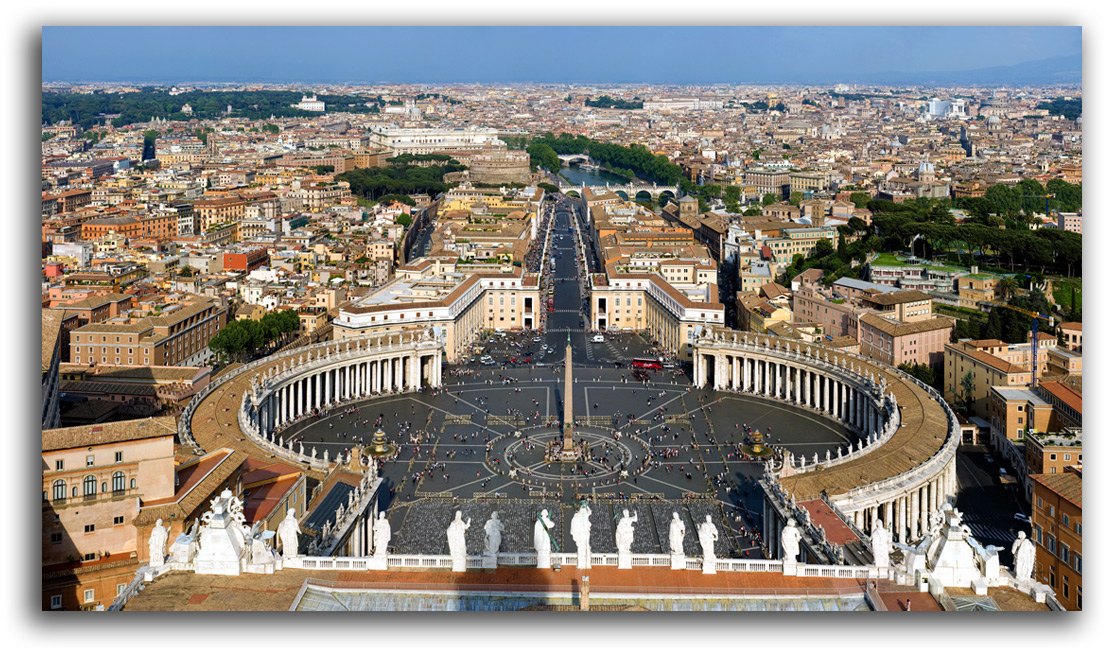
Modern view of St. Peter’s Square, looking East (image below faces West)
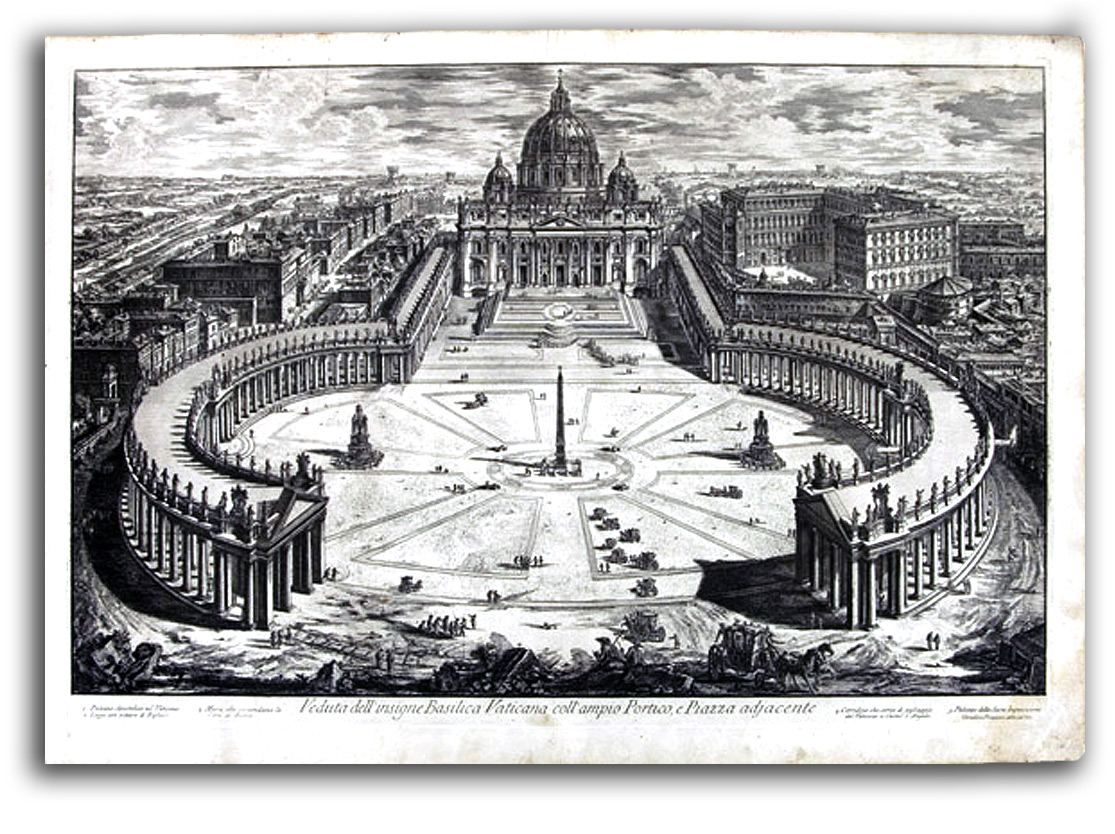
PIRANESI
St. Peter’s Square with Forecourt & Colonnades, Rome
Designed by Bernini, 17th century
Etching, 1775
Collection: Unknown
The 17th century continued many of the artistic ideals of the Renaissance, and developed many of its own. For example, the Renaissance goal of verisimilitude in painting (truth to life) reached new heights in the portraits of such masters as Rubens, van Dyck, Rembrandt, and Valazquez. Secular art became as important as religious art. Wars between nations were still common, but the great religious wars of Protestant vs. Catholic that tore Europe apart during the 16th century were drawing to a close. Both the Catholics and the Protestants created the standard architectural styles that are still revered today.
Science was setting down roots, but it was still a world dominated by intuitive perspectives. Non-spiritual materialism was not yet the dominant attitude. Most people were certain that the universe is alive, and there are spiritual forces behind all the motions of matter. It was angels who moved the planets and the stars. Witches were common. Isaac Newton (one of the greatest scientific minds of all time), for all his brilliant logic, also was an Alchemist.
It was not until the 18th century, during the so-called Age of Reason, that the scientific method began to replace ancient cultural assumptions based on tradition and faith. Emerging from this profound shift in consciousness came “modern” science, the Industrial Revolution, and a great deal of secular materialism. The universe became dead matter, whole populations moved from homes on the living earth to little urban boxes, and people no longer had so much faith in intuition. If it is not rational, said “modern” people to each other, it is not real.
Two very different art styles dominated the 17th century. The so-called Baroque style began in Rome at the start of the century and quickly spread to all parts of Catholic Europe. This style was encouraged by the Catholic Church because it embodied the new ideals of the Counter-Reformation. These new ideals were articulated at the Council of Trent (1545-63) that stated ecclesiastical art should appeal to the illiterate as well as the educated.
In response to the Protestant Reformation of the 16th century, the Catholic Church turned away from the witty artificial Mannerism that dominated most of 16th century art and appealed mostly to the aristocracy, and turned toward art and architecture that would appeal to all parts of society with strong clear narratives and dynamic forms in dramatic settings. All this was to engage the general population in direct emotional involvement.
The aesthetic of the new architecture was no longer the calm rationality of the Renaissance. Baroque architecture is robust. It is filled with very active details, rich dialogues of solids and voids, and large dynamic visual motions that envelop the souls of the faithful in the drama of sacred space.
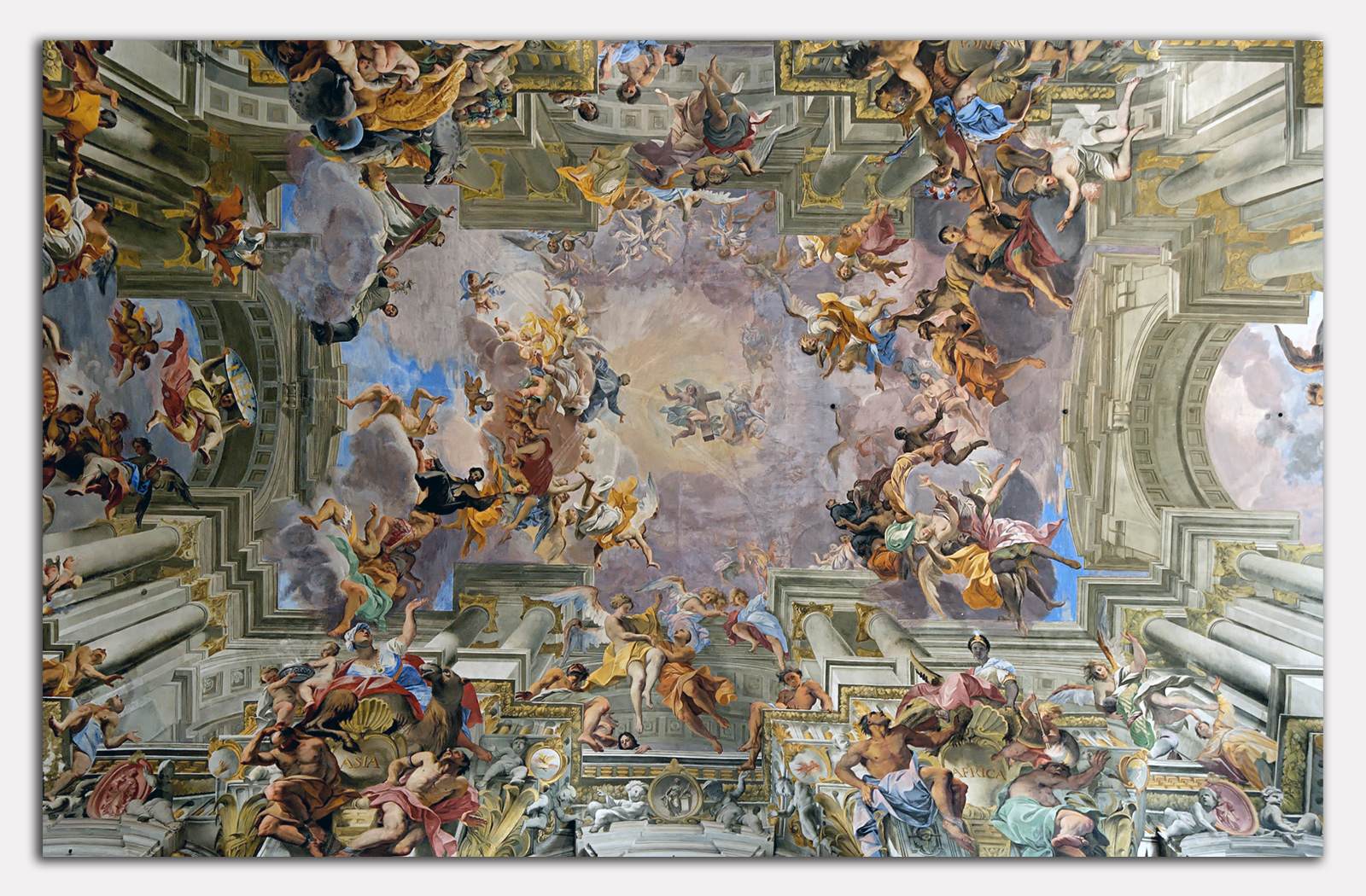
POZZO – Vaultignazo of St. Ignacious
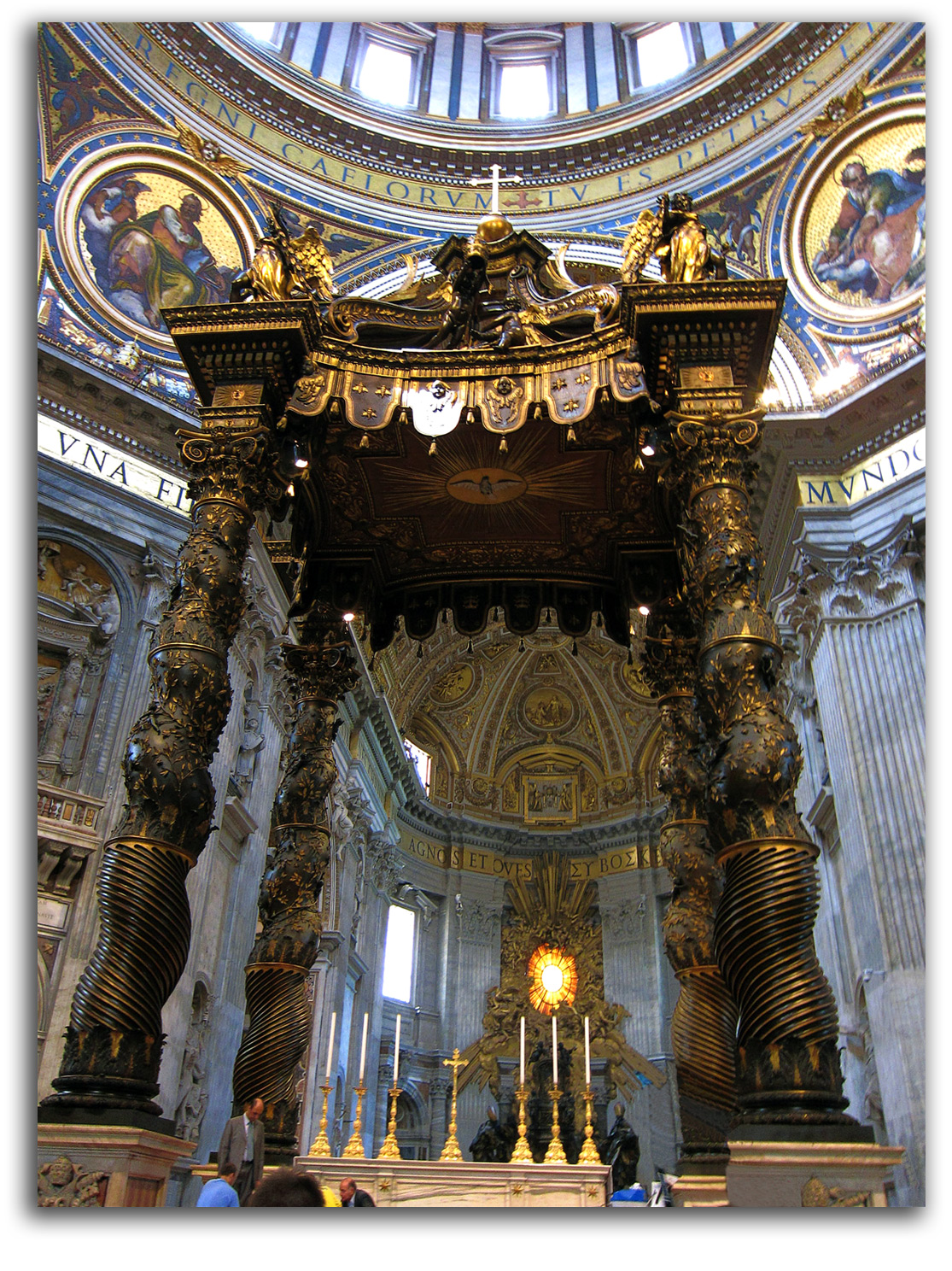
Swirling columns rise up to support exploding sculpture of emotional saints, and huge painted ceilings that look like they are rising to heaven. Bernini’s magnificent
BERNINI – High Altar and Baldacchino
colonnade around St. Peter’s Square in front of the Vatican is like the two great arms of Mother Church embracing Her children.
The Protestants in Northern Europe developed a very different style. The term “baroque” does not fit. In England, Holland, and Germany (and eventually North America), the churches have none of the paintings and sculpture that reminded Protestants of Rome and the hated Pope. These sacred spaces have been purified of Popery. The architecture is extremely simple. The blank walls are often pure white. The only “sculpture,” as a rule, is the Cross on the altar.
Rembrandt (inspired by the power of light as a metaphor for spirituality) was more “baroque” than most Northern painters – except for Rubens who was Catholic. Most of the Protestant painters and their middle-class patrons were content with the ordinary daily life of the secular world: simple still-life subjects, domestic scenes, perhaps a tavern or two, and quietly joyful landscapes. Here was a quiet naturalism born of modesty and a deep love of realistic detail. Vermeer’s spiritualized materialism one can touch and taste. The landscapes of Ruisdael and Hobbema one can smell.
To sum up: in the Protestant North, the attention of artists primarily was life on earth, the material world. In the Catholic South, the attention of artists primarily was on the heavenly. Any number of Catholic artists also painted secular subjects. However, the best work by many of them was produced when they were busy decorating churches with images to lift up the heart-minds of the faithful. This focus on the Transcendent was continued in the 18th century by masters such as Tiepolo. He was one of the last great Italian artists.
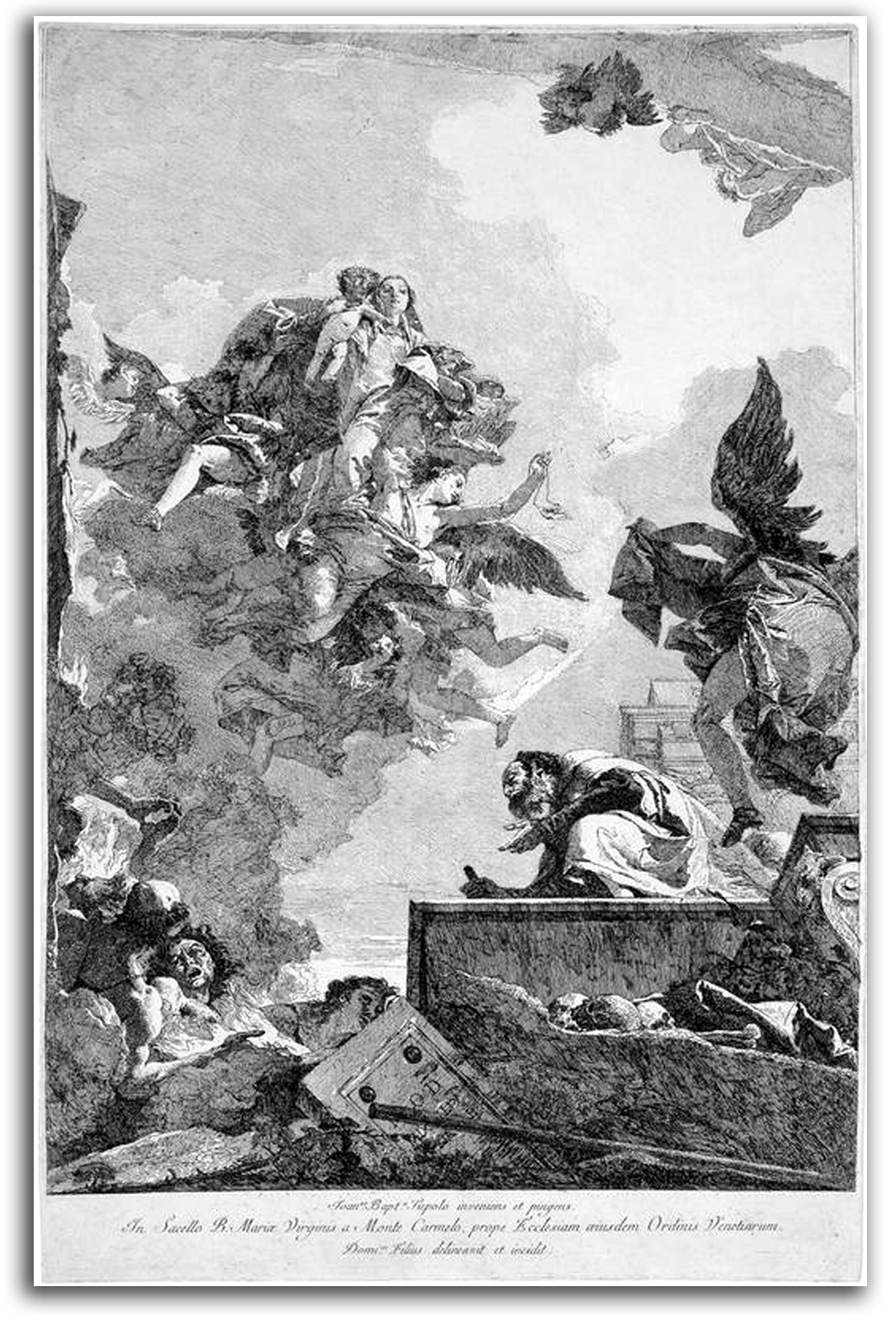
TIEPOLO (after)
The Apparition of the Virgin to St. Simon Stock
Painted c1740-49
Etching & engraving, ND
Collection: Unknown
NOTE: Giovanni Domenico Tiepolo was one of the best Italian painters of the 18th century, and one of the few artists of the era to use etching as an expressive medium rather than as a merely reproductive medium. This painting, like most of his best paintings, was made on a ceiling. The Divine Light “from above” permeates the scene. This print by his son captures a good deal of the origial luminosity.
PART 1 – LECTURES ON PAINTINGS
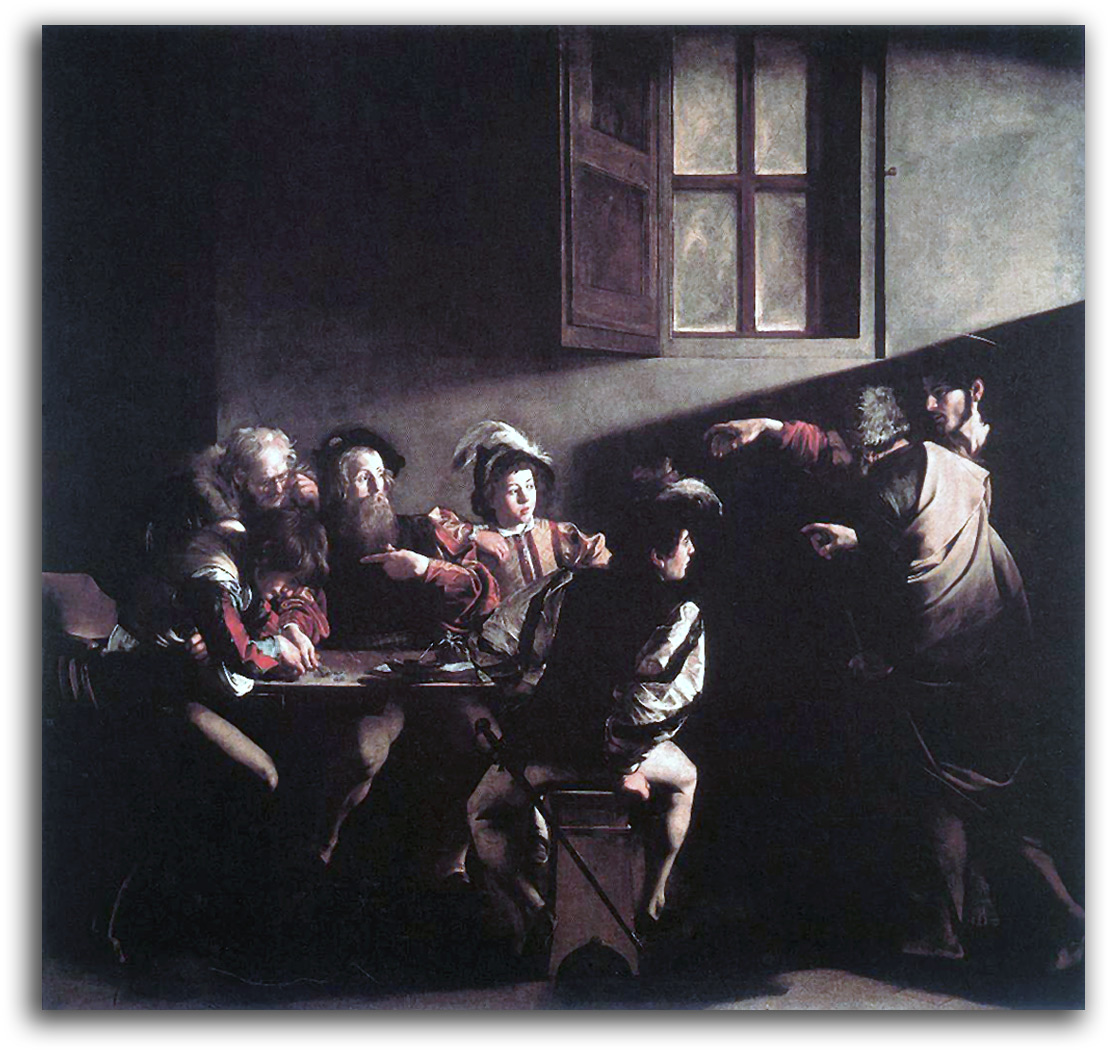
CARAVAGGIO
The Calling of St. Matthew, c1600
Collection: The Church of San Luigi dei Francesi, Rome
NOTE: Michelangelo Caravaggio (1571-1610) was not a polished person. He was crude, slovenly, hot-tempered, and often in street fights. What is important is that he channeled his first-hand knowledge of the ordinary world into an entire new kind of painting. He created a dramatic naturalism, both physical and emotional, that became a cornerstone of 17th century art.
The St. Mathew cycle for the church of the French was his first major commission (1599-1602). “The Calling” pictures the story of Mathew from the Gospel of Matthew (Matthew 9:9): “Jesus saw a man named Matthew at his seat in the custom house, and said to him “Follow me”… . The faces of the other tax collectors who have seen Jesus standing by St. Peter are illuminated by the bright light. Jesus is pointing at Mathew whose head is slumped over the table. In the next moment, he will raise his head, see Jesus, hear Jesus, and follow Him.
This was a radical painting for its time. Until Caravaggio, most paintings were still being done in a very unnaturalistic style that appealed primarily to an educated elite who liked artificiality. This so-called Mannerism dominated much of the 16th century. Caravaggio’s painting was painted “for the people.” The characters pictured at the counting table are of humble stock. The feet of Jesus are bare. The story is clear. The light is powerful – extremely powerful – a major “player” in this visual drama. Particularly dramatic is the contrast between light and dark with little of the traditional style of transitional tones. Many Baroque painters would follow Caravaggio’s lead in the use of these elements, especially his naturalism and his theatrical lighting. Those who admired his visual revolution include Rubens, Rembrandt, Bernini, and Ribera.
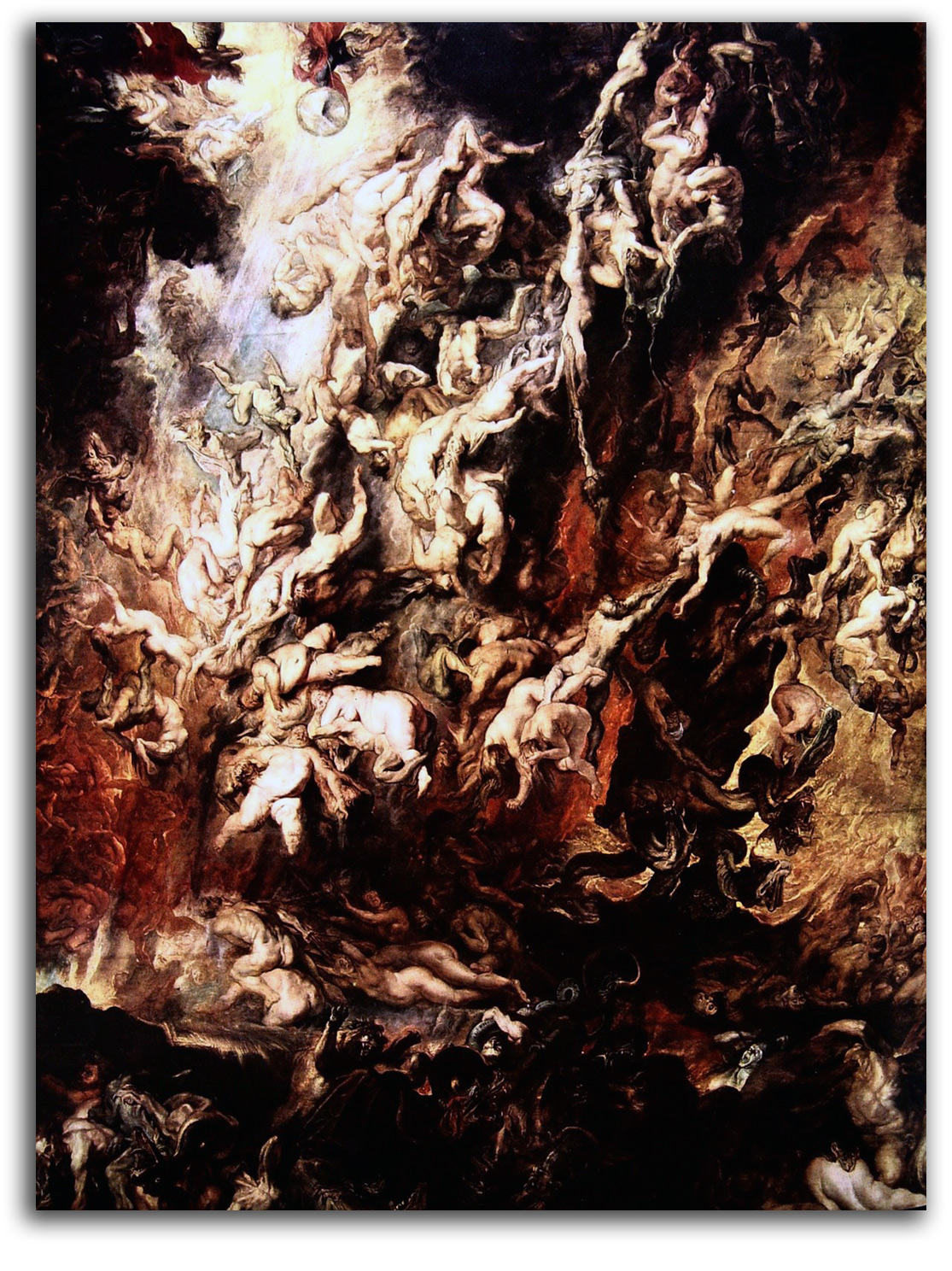
RUBENS
The Fall of the Rebel Angels, c1620
Collection: Alte Pinakothek, Munich
NOTE: Peter Paul Rubens (1577-1640) was the most gifted artist in Catholic Flanders for many years. He was a highly energetic painter-printmaker, a skilled diplomat, and a learned collector. The Baroque spirit of Italy he brought to the North. This monumental canvas of “The Fall” (112 x 88 in; 286 x 112 cm) is an overwhelming experience. It has all the drama that the Counter-Reformation Church was hoping to give to the faithful.
When I went to see this painting in Munich, what hit me first was the light – the drama of the light and the dark, a dynamic duality that is both compositional and symbolic. In the next moment the figures filled my eyes. I was stupefied by the power of this rushing flood of color, this gigantic waterfall of decaying flesh compelled by the power of the Sword of St. Michael to descend like crashing thunder down into depths of everlasting darkness, never again to see the infinite luminosity of the Divine.
I thought about the traditional teaching that even Angels have some ego left. That is enough to turn them away from God. Any amount of ego is enough for Satan to work on. Only the absolute extinction of ego enables an individual soul to merge with the universal soul, to “Come Home,” – to become “One with God.”
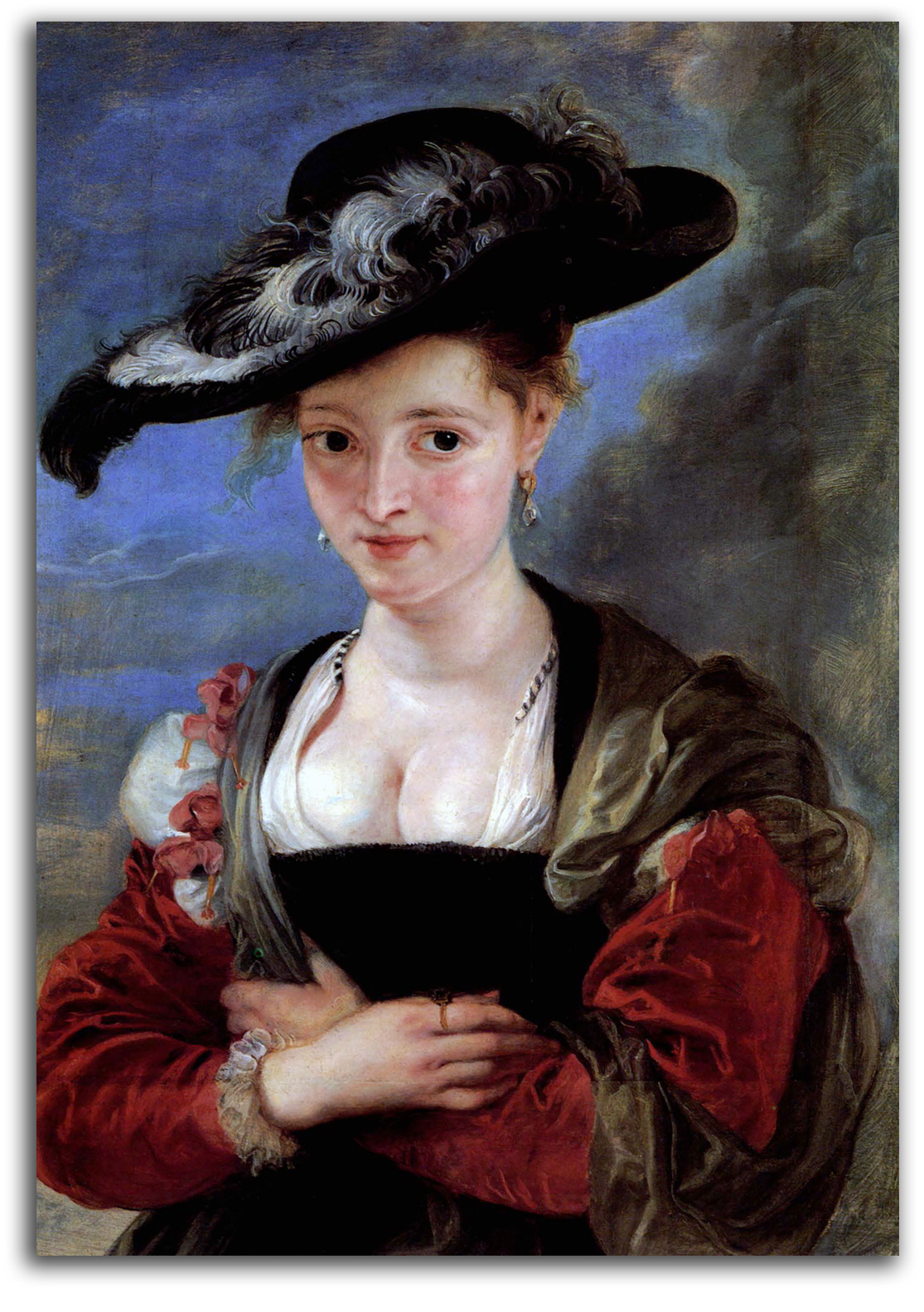
RUBENS
Portrait of Susanne Fourment
(aka The Straw Hat), c1622-1625
Collection: National Gallery, London
NOTE: Susanne Fourment was a relative of Rubens’ first wife, Isabella Brant, and the sister of Rubens’ second wife, Helena Fourment. Ruben’s love of flesh could (and often did) fill large canvases with vibrant nudes. The ample proportions of his nudes gave us the term “Rubenesque.” However, in this image of his sister-in-law, Ruben’s robust sensuality is restrained. The result is a charming image rather than an erotic image. This portrait is one of the most popular paintings in London’s National Gallery. (The hat actually is felt, not straw, but many still use this odd title. How this alternative title came to be is unknown.)
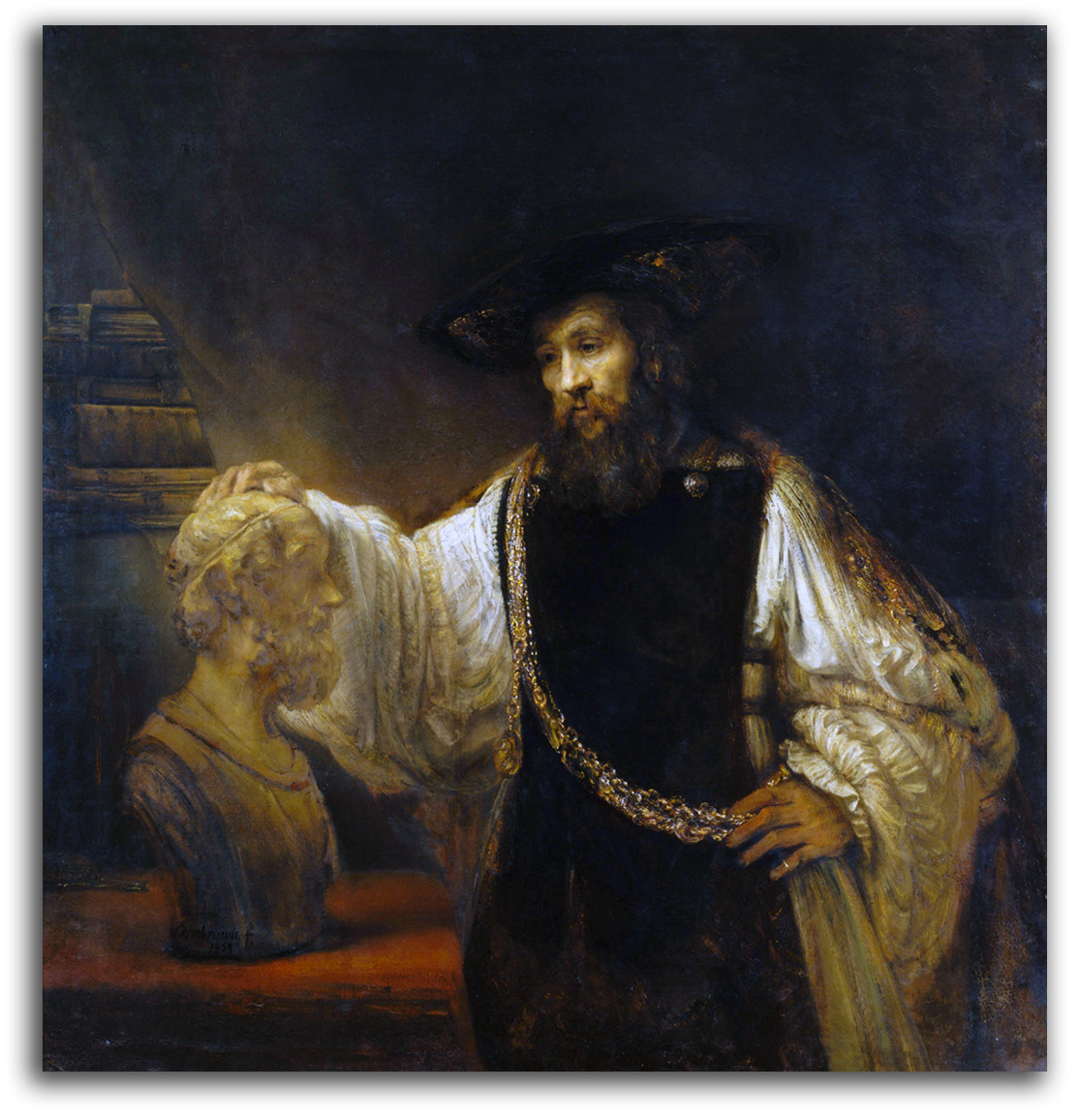
REMBRANDT
Aristotle contemplating a Bust of Homer, 1653
Collection: Metropolitan Museum of Art, New York
NOTE: Rembrandt van Rijn (1606-1669) is the most famous European painter of the 17th century, and one of the very few painters whose name has become a household word. He explored a vast range of subjects, and along with those subjects the entire range of human emotion. Few artists, if any, have given us a wider deeper visual encyclopedia of human feelings. He is best known for his portraits. Of special interest are his self-portraits as I will discuss in the next note. For now, let’s look at this imaginary portrait of a scene from Greek history that could have taken place in Athens over 2,000 years ago.
One of my professors at Columbia was Julius Held, an authority on Rembrandt. Held hired me to help him catalog the art collection of Columbia. His book on this painting is REMBRANDT’S ARISTOTLE AND OTHER REMBRANT STUDIES (1969). The Met had purchased this Rembrandt in 1961 for $2.3 million – a record for any public or private sale at that time. So it was a lively topic in the art world. When we were discussing this painting in 1964, Held pointed to a number of particulars, e.g., the gold chain is something Alexander the Great is known to have given to Aristotle in gratitude for being his professor. A medallion of Alexander hangs from the gold chain. Held noted that a similar gold chain was given by 17th century kings to their favorite painters, e.g., Titian, Rubens, and van Dyck. Rembrandt may have been thinking about both chains said Held.
Held also said the light flooding down past the dusty books to the head of Homer seems to suggest the vibrant superiority of the spoken words of the poet over dry printed pages. I reminded Held that this was the position of Plato, Aristotle’s professor, and the first philosopher to write books about philosophy after millennia of only spoken philosophy.
Held encouraged me to go further into the world of metaphor because that is where all great artists live. “Always ask,” said Held, “what is in the artist’s mind. And never stop asking this question. There may be a number of answers.”
So, what is Rembrandt picturing here? Is it a reflection on the relationship between painting and poetry? It is a contemplation of the relative value of material success that can result in gold and silk sleeves vs. spiritual values that can result in wisdom? It could be both.
These are two of the questions that Held put into my head that day. There were many more ways Held stimulated his students to think. He had an exciting mind, and we stayed in touch for years. As I left that particular conversation, and took the subway back to my apartment in Greenwich Village, another dynamic question came to mind.
Plato and Aristotle had long been my favorite Greek philosophers. In high school, I had written my Senior Essay on “The Encyclopedic Mind of Aristotle.” While writing that essay, on my bedroom wall I had taped a reproduction of Raphael’s great “School of Athens” mural that has Plato and Aristotle at the center. Plato’s hand points up to the sky symbolizing his “top down” approach to reality – from the metaphysical to the physical, from the general truth down to the particular manifestations of that truth. Aristotle’s hand points down to the earth symbolizing his “bottom up” approach to reality – from the study of particular truths up to a general truth.
With that image in mind, I wondered if Rembrandt might have been reflecting on the relationship between something like the Plato/Aristotle dialogue, or perhaps the relationship between the painterly logic of the mind and the intuitive knowledge of the heart.
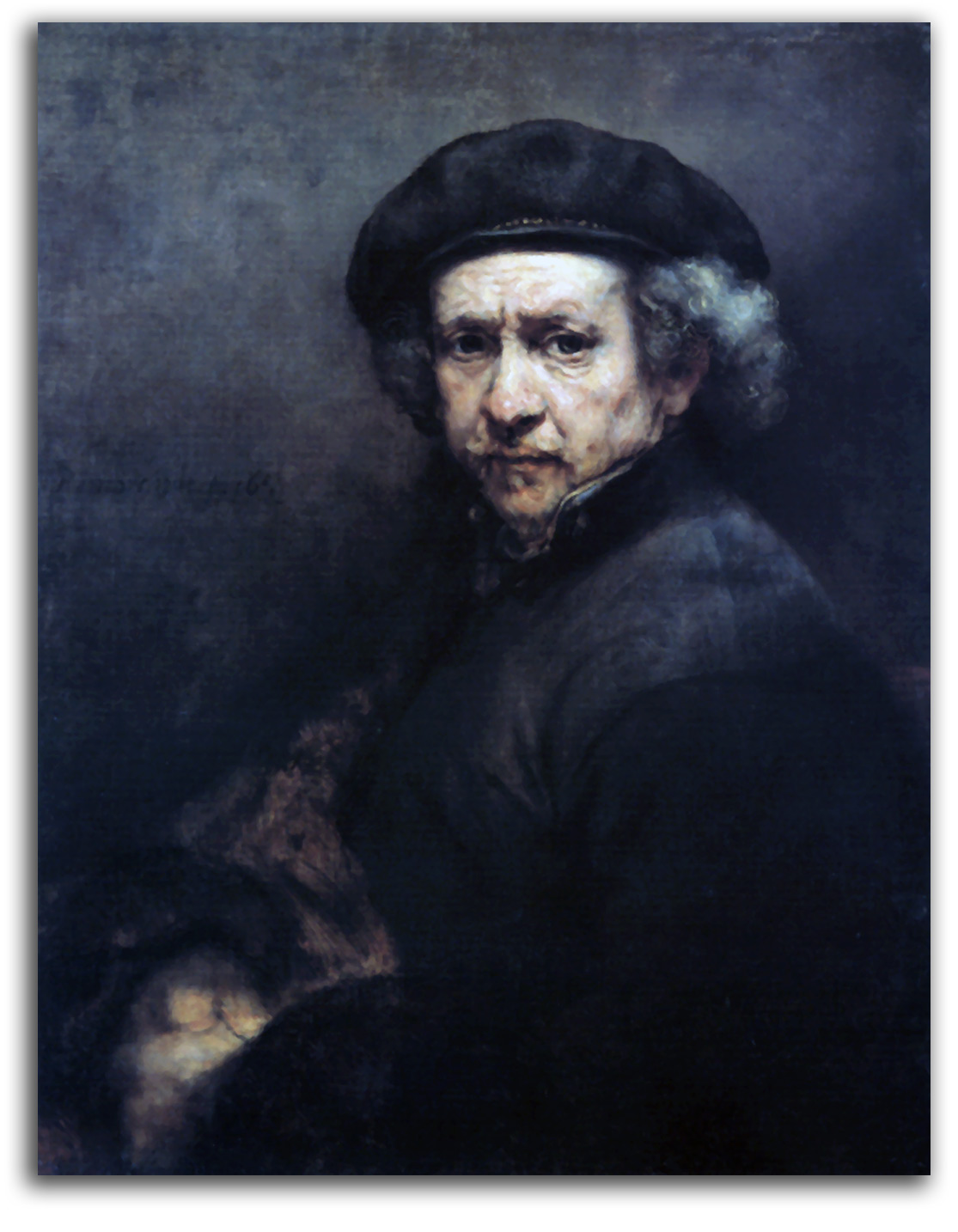
REMBRANDT
Self-Portrait with a Beret & upturned Collar, 1659
Collection: National Gallery, Washington, D.C.
NOTE: Rembrandt painted a great many self-portraits. How many? That depends of which art historian you listen to. Rembrandt attributions change rather often, especially from generation to generation. At present, you choice of answers ranges from about 50 to about 100 paintings, and at least 30 etchings.
No artist had ever made so many self-portraits. Why so many? Most scholars think it was a way of keeping a visual diary over the years, a mode of self-analysis and self-reflection. The term “self-portrait” did not yet exist, but these paintings are clearly explorations of the self. Some made in his younger years are rather silly. But many of the later ones are very deep probings of the human psyche.
Some scholars think a number of these paintings were ”tronies” – studies of particular emotions, or just window-displays of skill. That could be, but they are still pictures of an aspect of himself. In any case, the group of Rembrandt self-portraits as a whole constitutes perhaps the most complete “autobiography” ever painted.
When I was studying Art History as an undergraduate at American University in Washington, D.C. (1961-63), my primary “textbook” was the National Gallery of Art. There my favorite Rembrandt was (and is) this painting. Since then I have looked at many Rembrandt self-portraits in many museums, but this one still moves me more than any of the others. The clothing is a minor afterthought. Gone are the days of gold chains and silk sleeves. The whole story now is in the face. It is not a handsome face, but it is full of humanity. The thickness of the paint follows the lines of the emotions. Each brushstroke is not just an emotional representation; it is a sculpted expression. Nothing like this sculpted paint would be seen again until van Gogh.
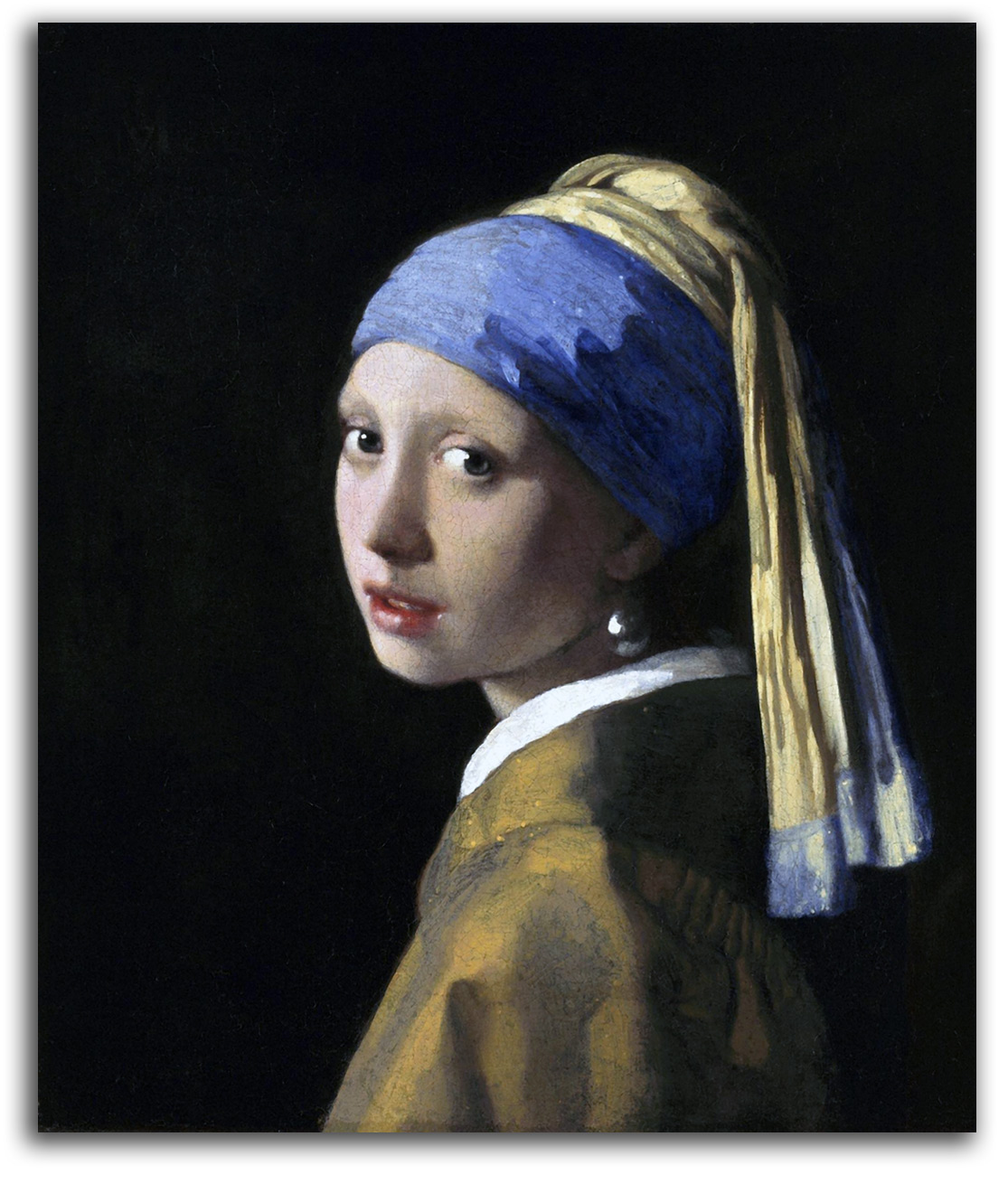
VERMEER
Girl with a Pearl Earring, c1665
Collection: Mauritshuis, The Hague
NOTE: Little is known about the life of the Dutch master Jan Vermeer (1632-1675). He lived quietly, had a large family, managed an inn, was respected in his hometown of Delft (but little known outside Delft), painted only a few paintings (very slowly), and died in debt. Only some 30 or so paintings survive. This is one of his most famous – a painting made even more famous by the finely crafted Hollywood movie of 2003 “Girl with a Pearl Earring.” One day over lunch in London, I discussed this legendary painting with my friend Bob de Vries, then the Director of the Mauritshuis in The Hague, where the painting resides. I recorded the conversation. His question to me was: “What is it about her that has made her known as the Mona Lisa of the North?” My reply:
Vermeer, as you know, is one of the greatest painters of all time. Like no other, he was able to replicate the world in ways that makes everything in the picture seem like we can touch it, taste it. And he did it all with light. Light caresses each face, each fabric with a glow. It’s as if he wove light into the fibers of the fabrics. Most of his scenes are “stop action” scenes – people captured in a moment of thought between motions. We are left with a mood, a generalized atmosphere in a generalized light, but not always a specific feeling because there usually is so much else in the painting – a rich visual environment that takes much of our attention. This girl is isolated, suspended in the very instant of an arrested movement. We see her just as she has just turned to look right at us. This makes the moment more intimate and more dynamic. The instant is electric and brightly lit. Moreover, our master of physical reality also was a master of psychological reality. It is this combination of physical and metaphysical “realism” on this portrait that takes your breath away. Leonardo, as you know, said the painter should reveal the mind of the sitter. Yes, that’s all very well, but few can do that. Vermeer could. This young lady is thinking, is about to speak – thoughtful words, caring words. These are eyes that are intelligent, eyes that love. Vermeer has captured the sweet soul of this young girl – a soul as luminous as a pearl.
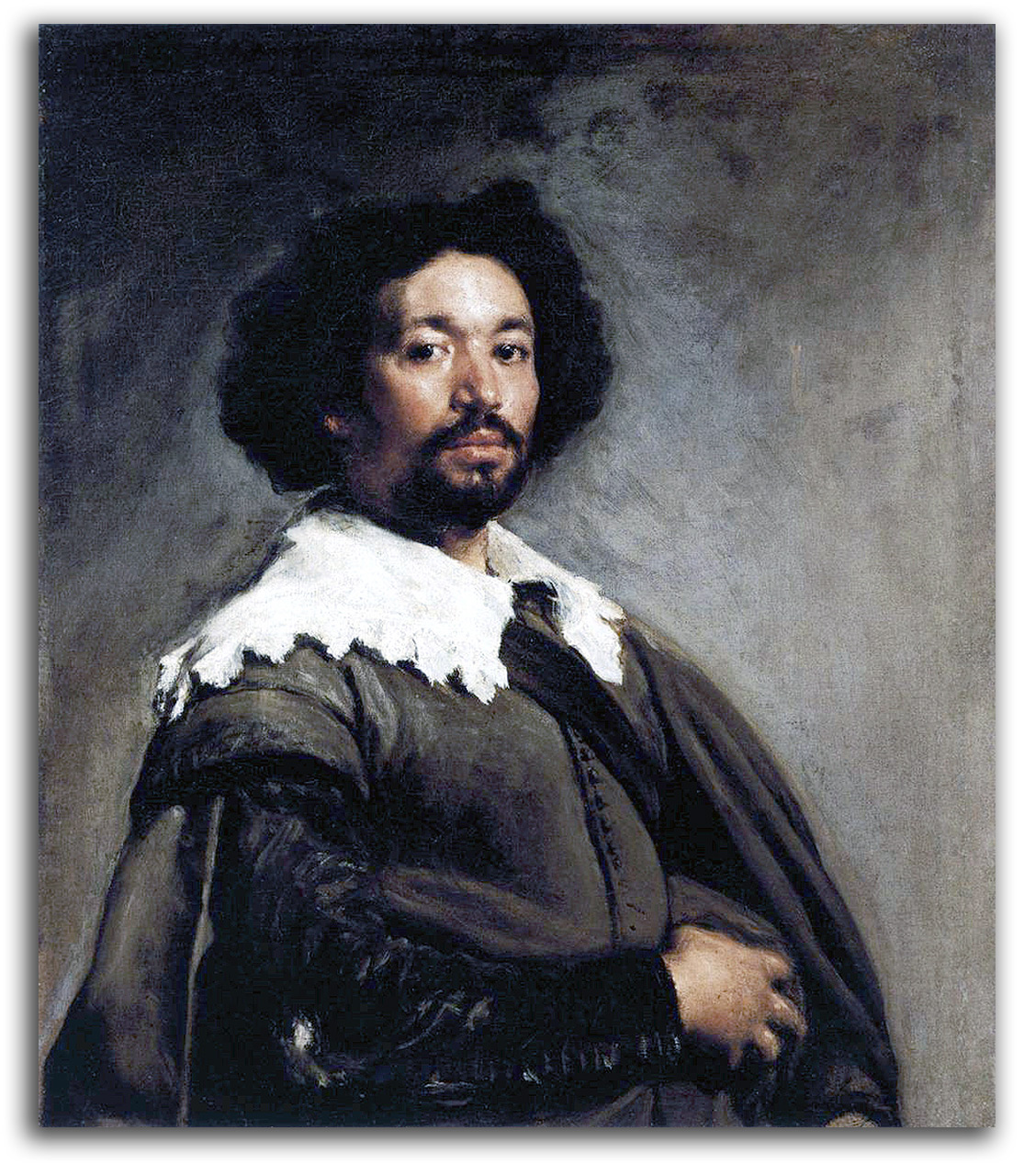
VELAZQUEZ
Portrait of Juan de Pareja, c1650
Collection: Metropolitan Museum of Art, New York
NOTE: Diego Valázquez (1599-1660) certainly was one of the “top 10” painters of the 17th century. Arguably, he was one of the “top 10” painters of all time. Born in to the lesser nobility, during the 1620s he rose to prominence quickly in the court of King Philip IV. He was one of the first painters ever to be knighted, along with Rubens and van Dyck. He was a great master of Realism – a dramatic Realism that was a major influence on the birth of modern art. The most important bridge from traditional art to modern art was the work of Manet in the 1860s. The most important influences on Manet’s work were Courbet and Valázquez. 20th century painters, including Picasso, Dali, and Bacon, continued to honor him.
Every student of art history knows his most famous masterpiece, “Las Meninas” (Maids of Honor) of 1656 – a painting as complex as a stage production. When I went to see it in the Prado, I stood for as long time fascinated by the interplay of form and story.
In 1971, the world became aware of another masterpiece when New York’s Metropolitan Museum of Art acquired this “Portrait of Juan de Pareja.” The matchless Realism that developed in the hands of European portrait painters during the 17th century included both the representation of both physical reality and psychological reality. This painting is a prime example. The subject is his assistant, a dark skinned man of Moorish descent, and a slave whom Valázquez set free. When it was exhibited in Rome in 1650, the response was recorded by a biographer. The portrait “was generally applauded by all the painters of different countries, who said that the other pictures in the exhibition were art but this one alone was ‘truth’.”
The Met could have purchased any number of great paintings that year. This choice was both educational and political. Director of the Met at that time was Thomas Hoving. I knew Tom. I had worked for him during the summer of 1962. On the negative side, he was opinionated and arrogant. On the positive side, he turned the stodgy old Met from a white, upper-class, highly elitist “men’s club” into a socially responsive institution. He bent over backwards to bring people of color into the Met. One of the things he did was pay a record price for this handsome person of color – a slave who had been freed.
PART 2 – LECTURES ON SCULPTURE
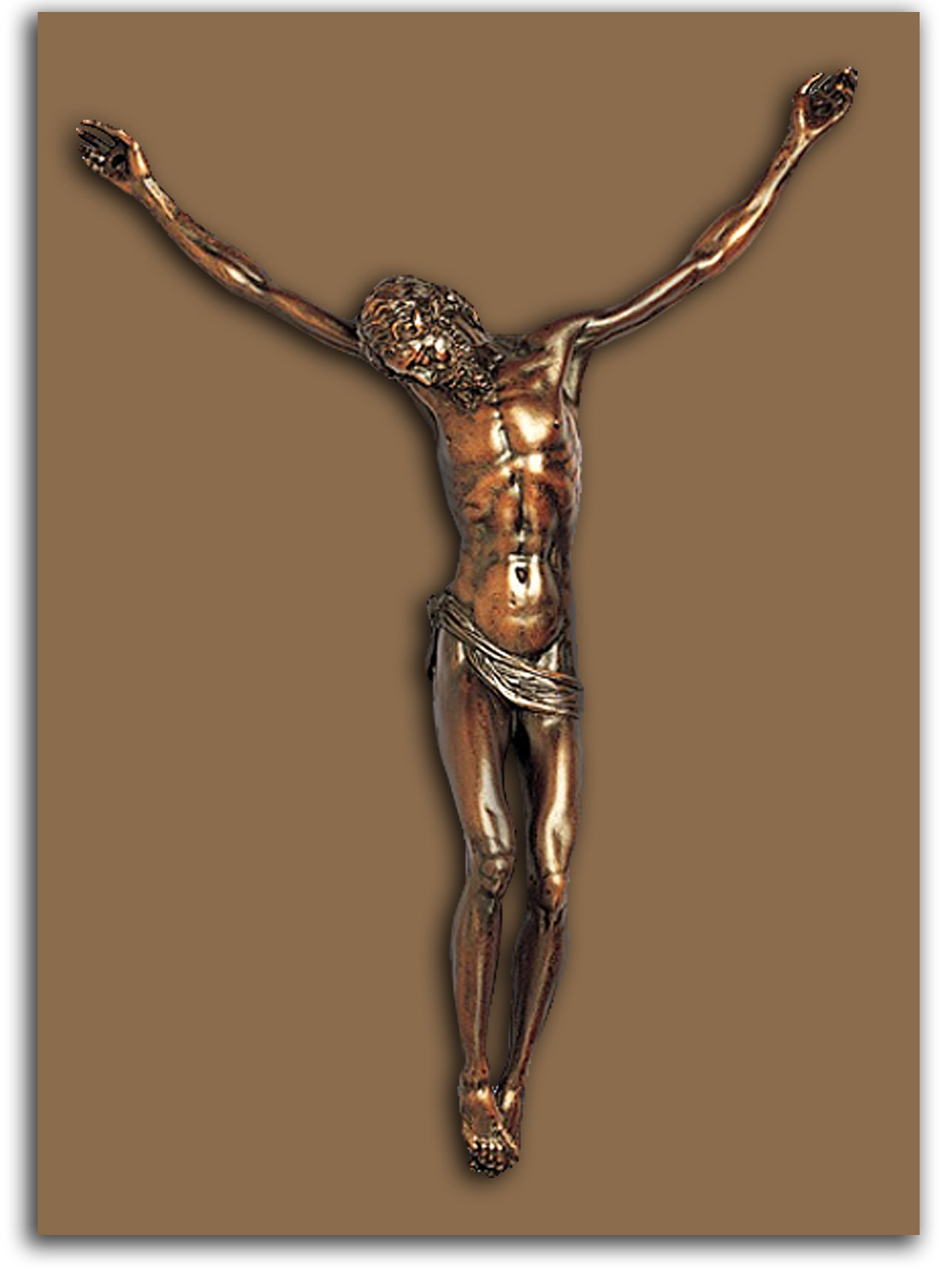
GIAMBOLOGNA
(aka Jean Boulogne and Giovanni da Bologna)
CRUCIFIX
Conceptualization: Italy, by Giambologna, late 15th century
First casting: Italy, by Giovanni Susini, c.1600
Realization of this replica: United States, late 20th century
Editioned by the Metropolitan Museum of Art, New York
bonded bronze; hand patinated
Collection: IAD 2012
NOTE: It was in Florence that the technique of bronze-casting reached its height during the Renaissance. There were important bronze castings during the 15th century, but the first great master of this technique as a continuing process was Giambologna. The artistic quality of this figure is excellent. He made it an industry. The patina has the kind of fine finish for which Giambologna was famous all over Europe. However, the composition has some of the weaknesses that are characteristic of the Mannerist style that dominated European art during the Late Renaissance in the second half of the 16th century. There was a profound balance of dynamic energies in the art of the High Renaissance, a well-measured harmony of form that was inspired by the art of Greece and Rome. After about 1520 (when Rome was sacked by Germans), there was a loss of confidence in Classical aesthetics. Mannerist art moved away from Classical art toward ideals that have a smooth stylistic elegance which the Italians called maniera, and the French maniere. Perhaps because it was an era of constant warfare, with little emotional stability of any kind, there is often a deliberate disbalance in the visual arts, together with oddly twisted details, and either a strange overall anxiety or almost no emotion at all. Typical also are strange, unnatural proportions such as the length of the arms on this crucifix. (They could reach below his knees!) Modern viewers are often left with an experience of superficiality. This bronze body of Christ is long on style but short on content. Do you see agony or pathos?
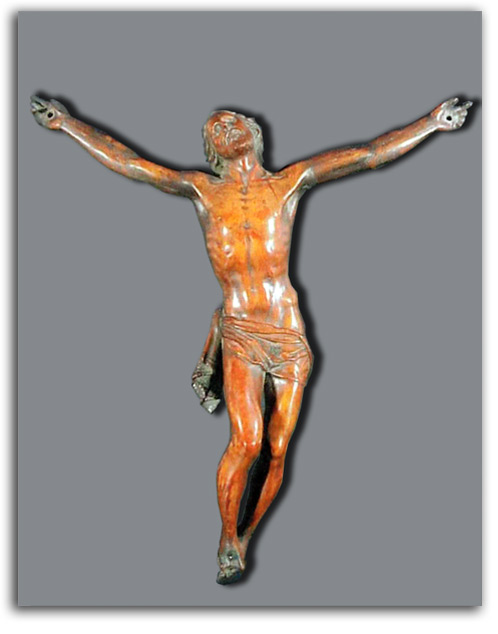
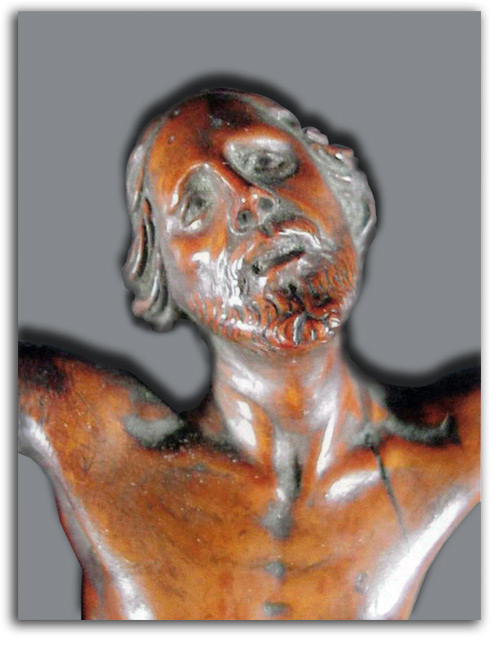
BERNINI, manner of
“CRUCIFIX” c.17th/18th century
Boxwood
Collection: FLG
NOTE: Giovanni Lorenzo Bernini (1598-1680) was the most important European sculptor of the 17th century, indeed the greatest European sculptor between Michelangelo and Rodin. He learned some important spatial lessons from Giambologna, but this deeply religious man took figuration to higher levels of visual expression and deeper levels of emotional reality. He rose rapidly in the estimation of the most powerful of patrons in Rome and was knighted in 1621. His mythological figures (such as Apollo & Daphne, 1621-22) have a remarkable reality of flesh and feeling inside spatial configurations of the most dramatic moment of their legendary stories. As an architectural sculptor, Bernini is best known for the remarkable colonnade that embraces Piazza San Pietro in front of St. Peter’s Basilica (symbolic of how Mother Church embraces the faithful), and for the towering baldachin inside St. Peter’s over the Main Altar and on top of the tomb of St. Peter (1623-34). As a narrative sculptor, he is best remembered for his astonishing “St. Theresa in Ecstasy” (1647-52). Never has spiritual ecstasy been rendered so fully. Rudolph Wittkower, the 20th centuries most respected authority on Bernini (and my advisor at Columbia), pointed out that this work is a great deal more than “sculpture” in the usual sense. It is a profound unity of painting, sculpture, architecture, and light. Bernini was the last great “universal genius” produced by Italy. Many crucifix figures were made under his inspiration during the 17th & 18th centuries. This is one of them. Bernini’s composition has such force that it became the prototype for millions of crucifix figures in the following centuries. The s-shape of the body quietly spirals upward to where the head lifts dramatically toward Heaven. Here is Divinity-Made-Human. The body is a beautiful as life itself. The contorted face is that of a dying God-Man who was both. His human side is experiencing the last moment of anguish before returning to the Divinity from which he came, before severing the last shred of human ego and thus merging with the endless blissful Sea of Eternity. One can hear that final cry of agony: “Why hast thou forsaken me?”
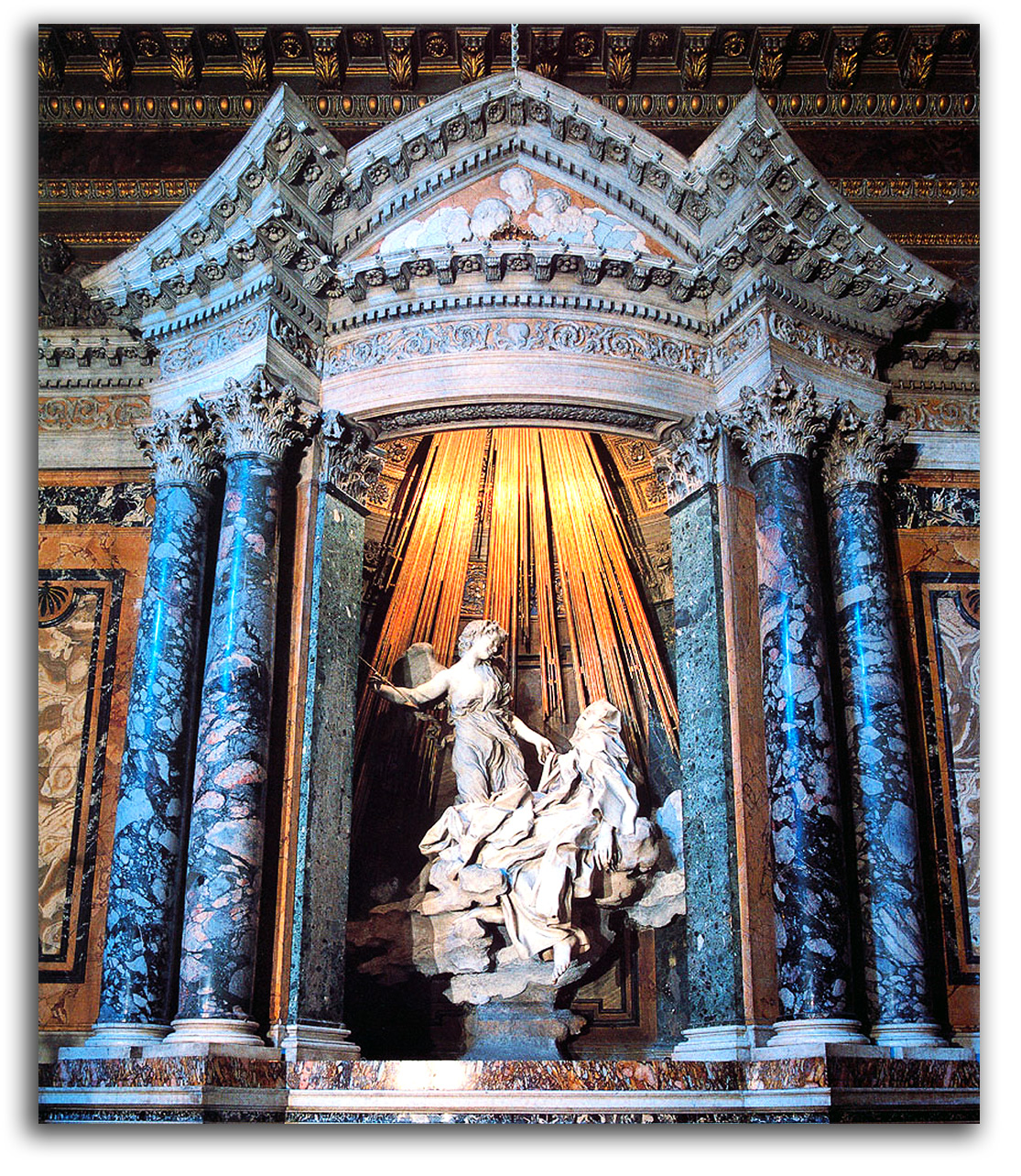
BERNINI
The Ecstasy of St. Theresa, 1647-52
Collection: Church of Santa Maria della Vittoria, Rome
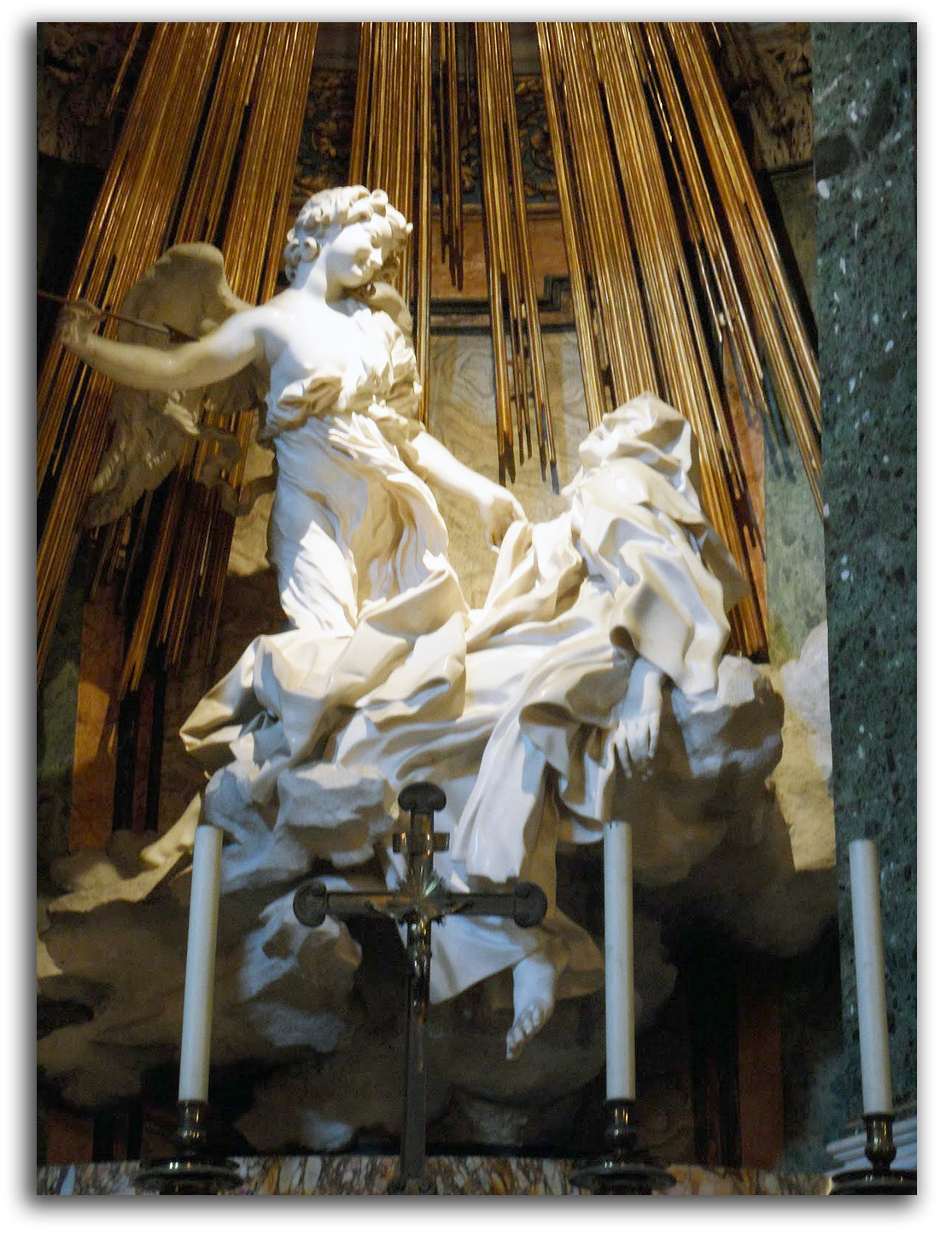
NOTE: This sculptural group of a swooning nun and an angel is Bernini’s most famous group, and arguably the greatest sculpture of the Baroque era. Depicted is Santa Theresa of Avila (1515-1582), a Spanish Caremelite nun who had recently been canonized in 1622. In her autobiography she describes the religious ecstasy she experienced during an encounter with an Angel:
I saw in his hand a long spear of gold, and at the point…a fire. He was thrusting it into my heart. When he drew it out, it left me all aflame with a great love of God. The pain was so great that it made me moan; and yet so surpassing was the sweetness of this great pain that I could not wish to be rid of it. My soul can now be satisfied with nothing less than the presence of God. The pain was not physical but spiritual, although the body participated in the experience.
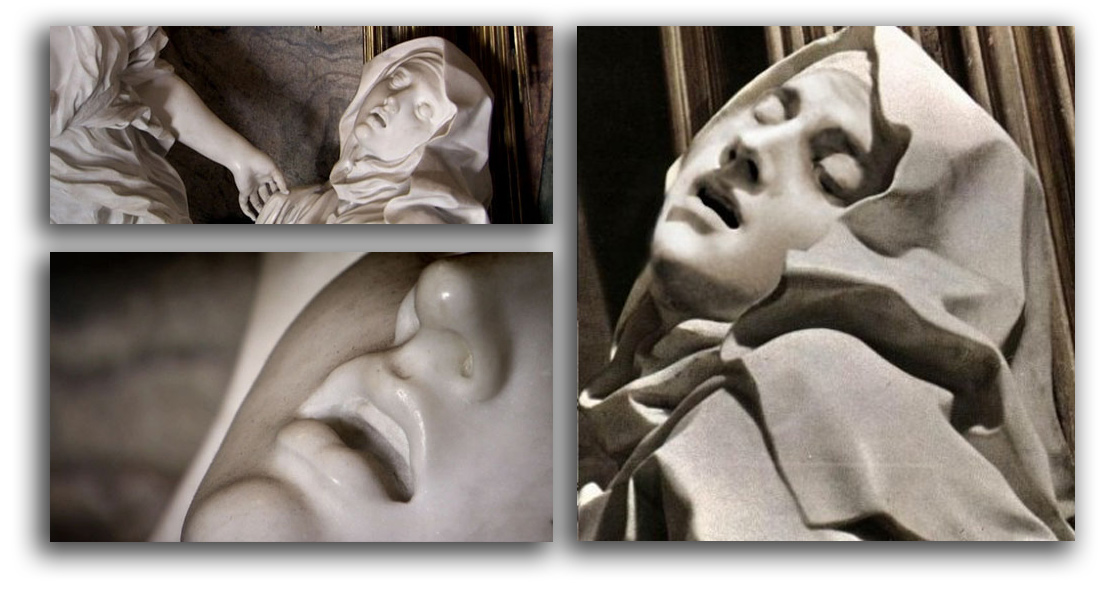
In the opinion of many, this is the greatest expression of ecstasy in the whole of Western art. Her body is not on earth but on a cloud. Her face is a face that has left selfhood far behind and united with the Transcendent. The flowing garment is a dynamic explosion of spiritual energy reverberating with both cosmic power and astonishing grace.
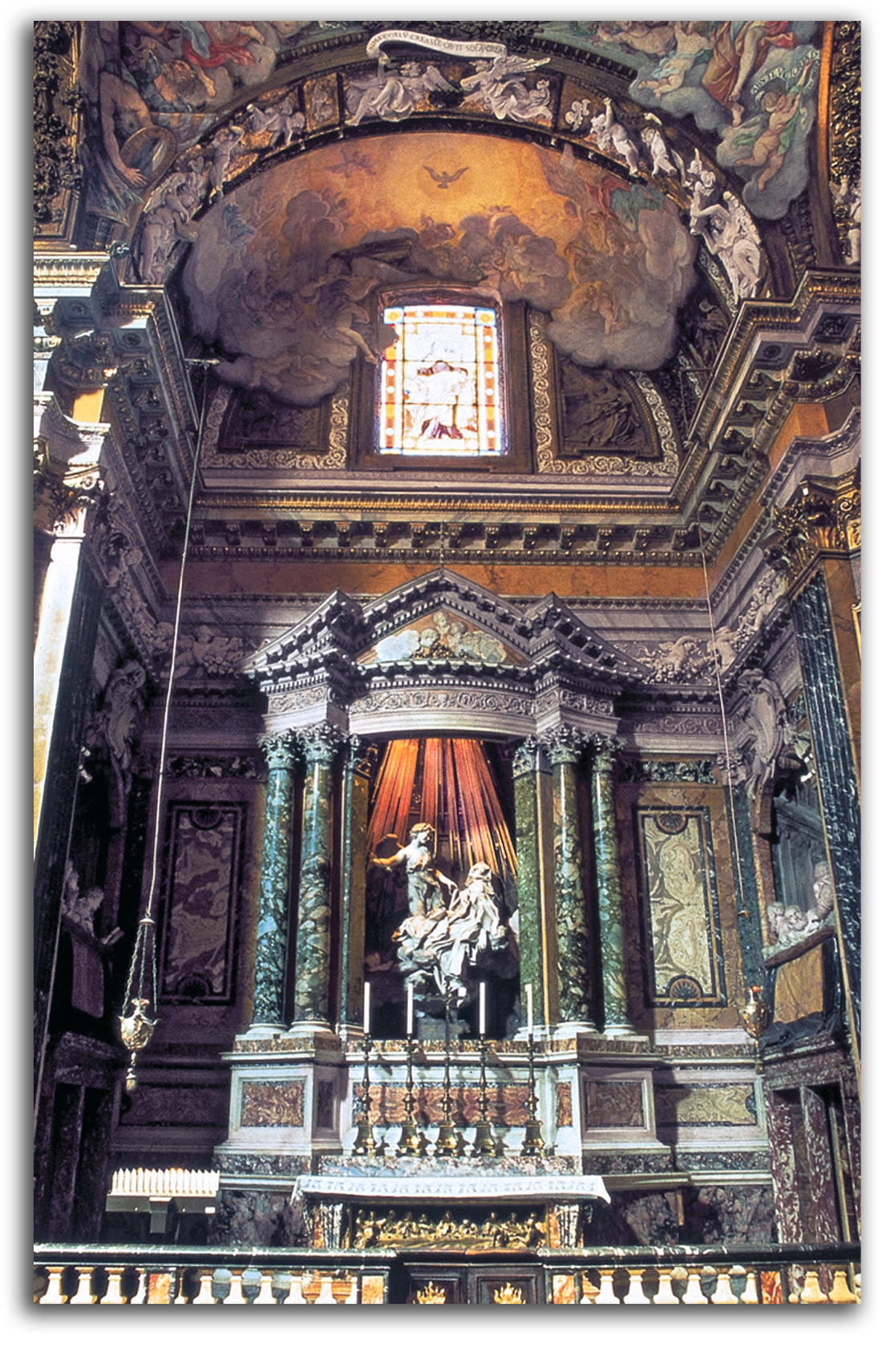
BERNINI – ‘Ecstasy of Saint Teresa’ in the Church of Santa Maria della Vittoria, Rome
Rudolf Wittkower (one of my professors at Columbia) was a leading Bernini authority. In our conversations, he stressed the totality of Bernini’s concept. The scene is presented as if on a stage. The chapel was commissioned by Cardinal Cornaro. Life-size images of his family are seated in boxes to the left and right of the stage witnessing the miraculous event. They are rendered in a much more realistic manner than the abstract figures on the stage. These mere mortals are living in the material world, the world of color. The saint and the Angel are pure white, luminously white. They are in another world. The golden beams of symbolic light that shines down on the divine scene are made even more powerful by the actual light that pours down from the actual sky through a hidden opening in the roof.
Wittkower regarded as shallow-minded those who think this depiction of ecstasy is a sexual orgasm. He said he could understand this interpretation from those who have experienced only physical ecstasy. If the only kind of transcendent moment one has known is sexual, he said, all images of ecstasy probably looked sexual. However, he continued, there have always been those in both the East and the West who have been able to attain spiritual ecstasy – usually by means of prolonged meditation. It was this kind of intense meditation that Bernini himself practiced – the meditative practices of St. Ignatius Loyola. Bernini was a deeply religious man. Professor Wittkower concluded that conversation with these words: “Such people become aware of spirit and matter as one united reality.”
PART 3 – LECTURES ON SYMBOLISM
Italian Renaissance Lectures at CSUEB
Symbols of the Transcendent, 2007
Click here to view these lectures in PDF format
PAGAN SYMBOLISM
Pagan Metaphysics lecture #1: The Geneology of Botticelli’s “Venus” 2007
Pagan Metaphysics lecture #2: The Philosophical Venus 2007
Pagan Metaphysics lecture #3: Venus, Mars, & Wisdom 2007
Pagan Metaphysics lecture #4: The Mystic Union of Mars & Venus 2007
CHRISTIAN SYMBOLISM
Christian Metaphysics lecture #1: The Crucifixion of Christ 2007
Christian Metaphysics lecture #2: Sophia – Holy Spirit 2007
Christian Metaphysics lecture #3: The Kingdom of God 2007
Christian Metaphysics lecture #4: Divine Light 2007
(All eight lectures available @WAP: Lectures/RENAISSANCE/cultural)
PART 4 – STUDIES OF NICHOLAS LANIER
PORTRAITS OF NICHOLAS LANIER:
An Illustrated Checklist, 1961, 1966, 2010
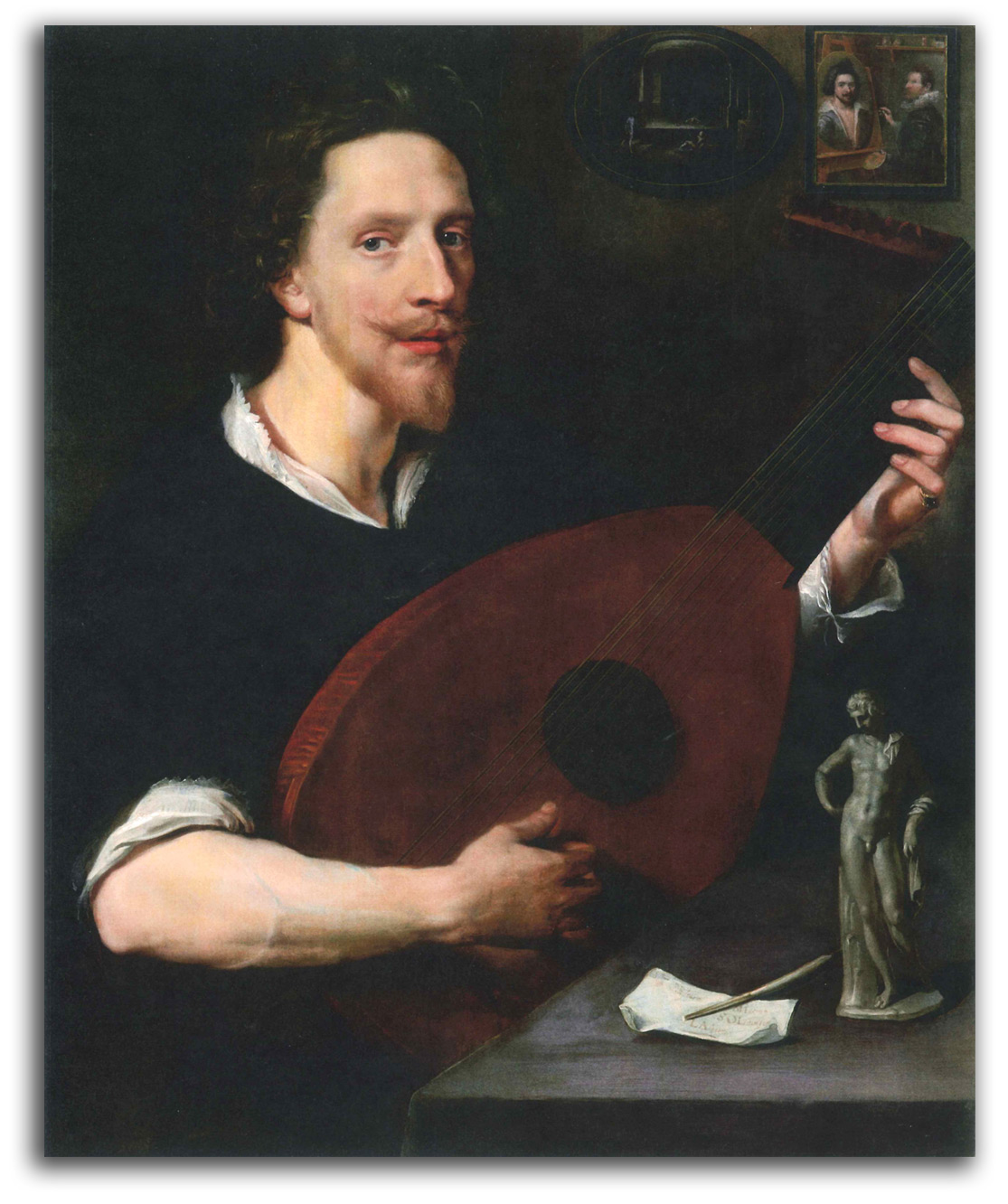
1 ISAAC OLIVER (c1565-1617)
Portrait of Nicholas Lanier with a Lute, 1613
Collection: Weiss Gallery, London
Source: NICHOLAS LANIER (1588-1666): A PORTRAIT REVEALED, Weiss Gallery, London [Feb. 2010]
The identification of the sitter in this portrait as NL was made by Oliver Miller, Keeper of the Queen’s Pictures, and has been widely accepted. The lute was NL’s primary instrument. The ancient statuette clearly represents his parallel knowledge of visual art. The owner asked me if I accept the identification as NL and I do.

2 ISAAC OLIVER (c1565-1617)
Portrait of Nicholas Lanier, by 1617. Miniature painting
Former Collection: King James II of England [LOST]
Source: Lionel Cust, DNB, 1892
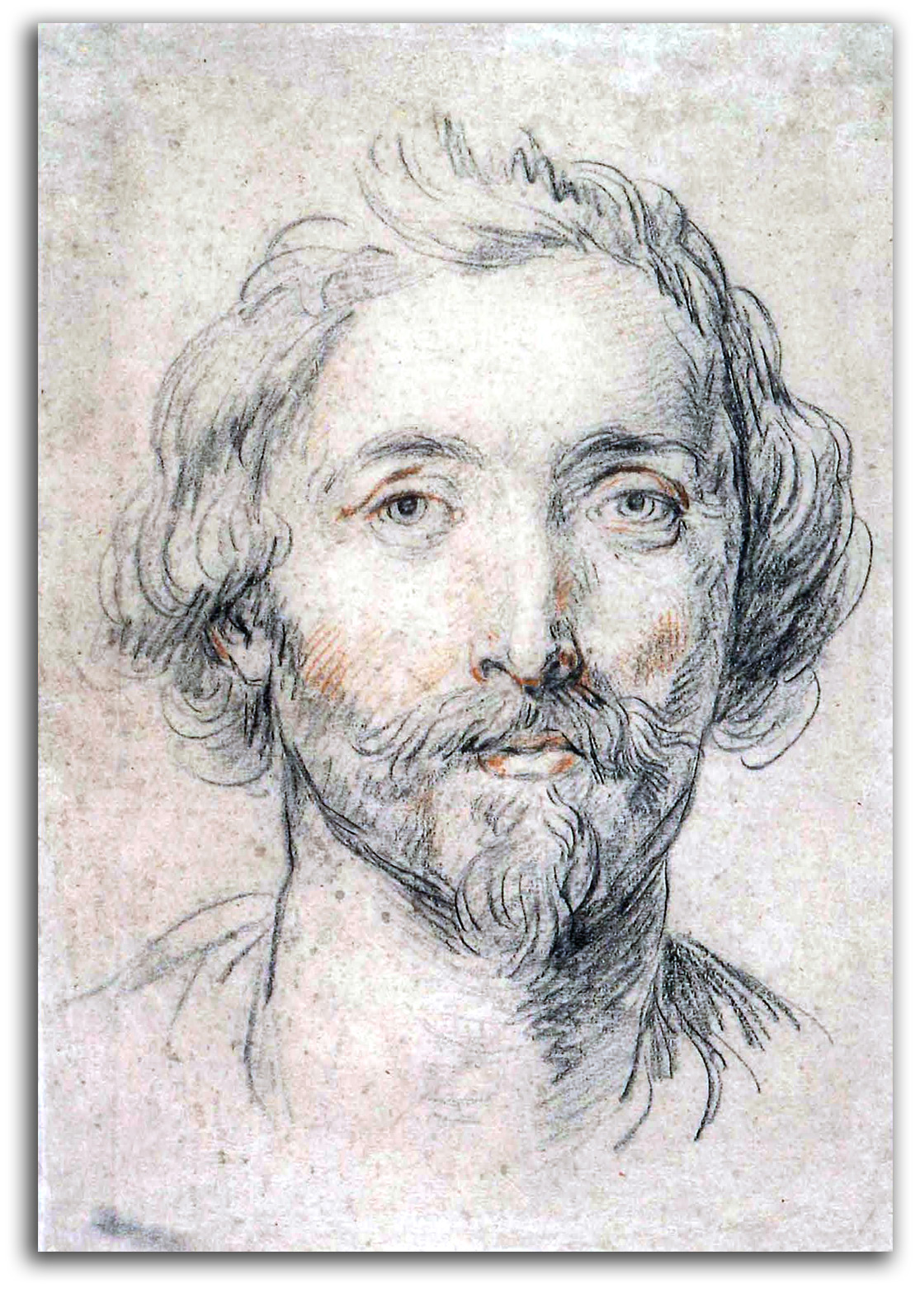
3 GUIDO RENI (1575-1642)
Portrait of Nicholas Lanier [?], c1625-28. Drawing
Collection: Los Angeles County Museum of Art
Source: S. E. James, “Reni’s Drawing of Nicolas Lanier,” APOLLO, Oct. 1996; Bruce Davis, MASTER DRAWINGS IN THE LOS ANGELES COUNTY MUSEUM OF ART, 1997.
See also Barbara Lyon Harrison, THE LANIERS AND THEIR WORLD, 1559-1645, 1995. (BLH is the mother of SEJ. )
NOTE: Reni started in the workshop of the Carracci, and became a major figure in Italian High Baroque. There is reason to believe NL collected some of Reni’s drawings in Italy during the late 1620s. If this is NL, and it seems to me to be, it probably was then that Reni did this drawing. Whether or not an oil portrait followed this drawing is not known.
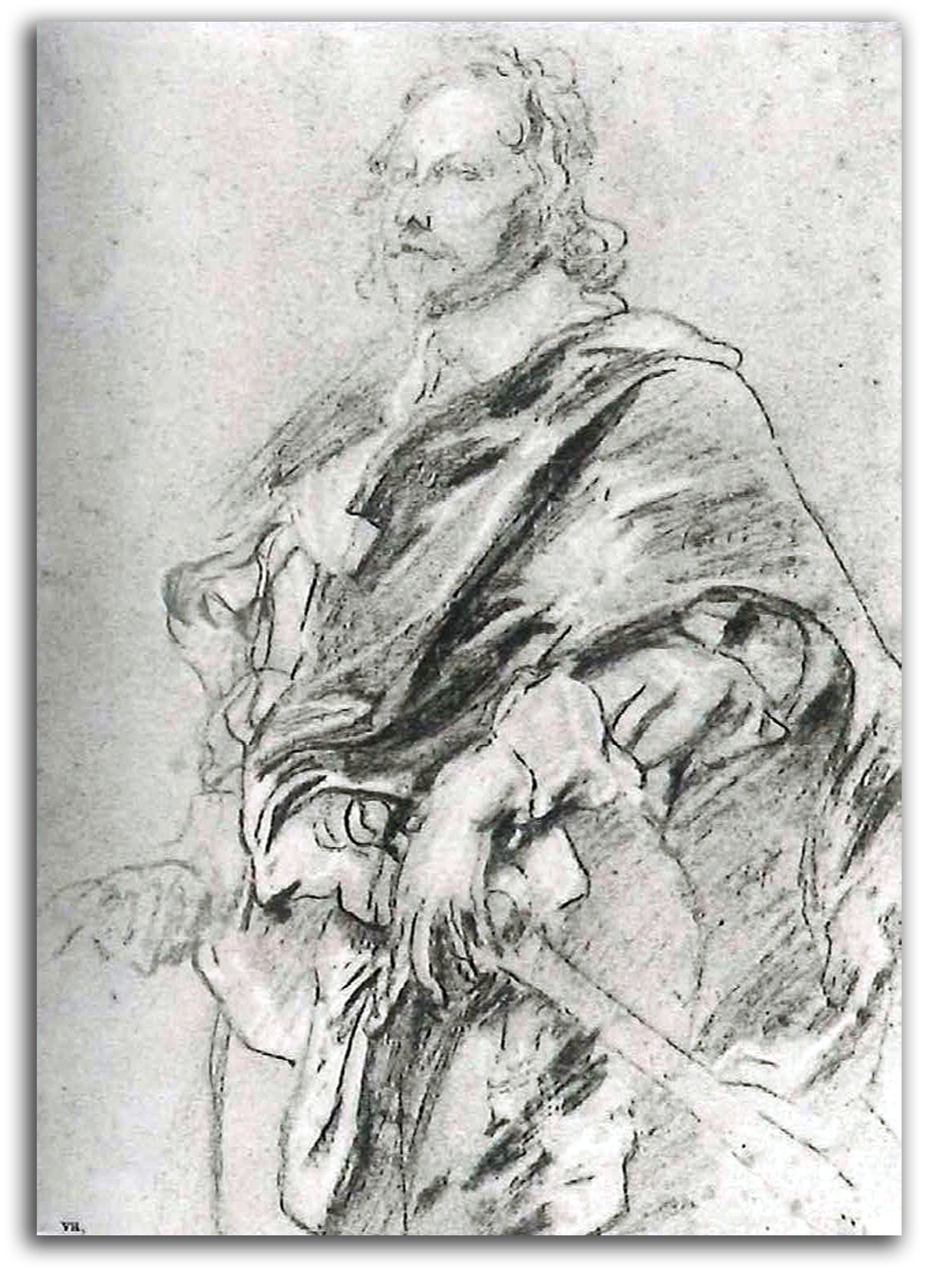
4 ANTHONY VAN DYCK (1599-1641)
Portrait of Nicholas Lanier, c1628. Chalk drawing
Collection: National Gallery of Scotland, Edinburgh
Source: Oliver Miller, THE AGE OF CHARLES I, Tate Gallery, London, 1972;
NICHOLAS LANIER (1588-1666): A PORTRAIT REVEALED, Weiss Gallery, London, [2010]
NOTE: I discussed this drawing with Sir Oliver at the 1972 exhibition. He told me that van Dyck rarely worked from drawings. The fact that this drawing exists indicates he took the painting of this portrait very seriously. By his own testimony, NL sat for this portrait a very long time.
5 ANTHONY VAN DYCK
Portrait of Nicholas Lanier, c1628
Collection: Kunsthistorische Museum, Vienna
Ex. Collection: King Charles I, & then Nicholas Lanier
click here or on portrait (above) for more detailed image
NOTE: Because of 17th century evidence, it is widely accepted that it was seeing this handsome portrait that caused Charles I to ask van Dyck to be his Principal Painter. When the royal collection was sold in November of 1649, NL purchased this portrait for L10. Eventually it ended up in Vienna. The date of about 1628 was set by Oliver Miller, England’s leading authority on van Dyck, and has been generally accepted.
Some interesting words that NL himself said about this portrait have survived. It was in a conversation NL had with Sir Peter Lely. Lely was the Principal Painter to Charles II, and the leading portrait painter of the Restoration period. His conversation with NL was recorded in a notebook kept by Lely’s friend Charles Beale and published in the VERTUE NOTEBOOKS, vol. IV, Walpole Society, Oxford, 1936, pp. 168-69. NL told Lely that he sat to van Dyck for seven days, both morning and afternoon, and was only permitted to see the work at the end of that time. Lely went on to remark that when Charles I saw this portrait he determined to invite van Dyck to be his Principal Painter.
6 ANTHONY VAN DYCK
Portrait of Nicholas Lanier as
“David Playing the Harp before Saul,” c1630s (by 1641)
Collection: [LOST]
Source: Lionel Cust, DNB, 1892
7 JAN LIEVENS (1607-1674)
Portrait of Nicholas Lanier, c1632-1635
Collection: [LOST]
NOTE: Lievens was a friend of Rembrandt and worked in a somewhat similar style. Lievens worked in England between 1632 and 1635.
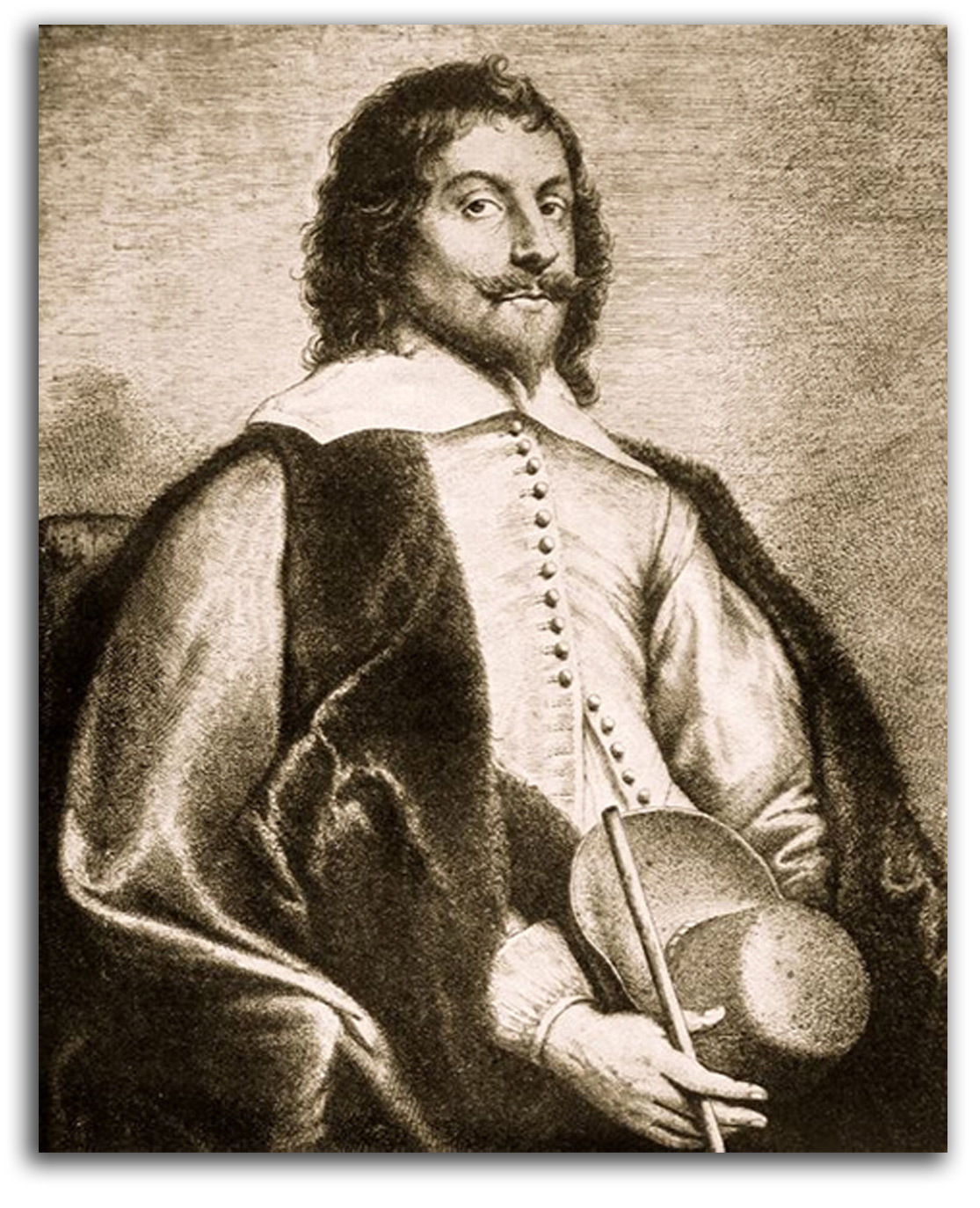
8 LUCAS VOSTERMAN (1595-1675), after LIEVENS
Portrait of Nicholas Lanier, 1630s. Engraving
Collection: National Portrait Gallery, London
Numerous variations by other engravers; see NPG online
NOTE: Vosterman was one of the most gifted engravers of the age. He worked for Rubens as his primary engraver, and then for van Dyck, as well as for the Earl of Arundel and Charles I. That Vosterman was working from a painting by Lievens is noted in the caption printed under the original engraving.
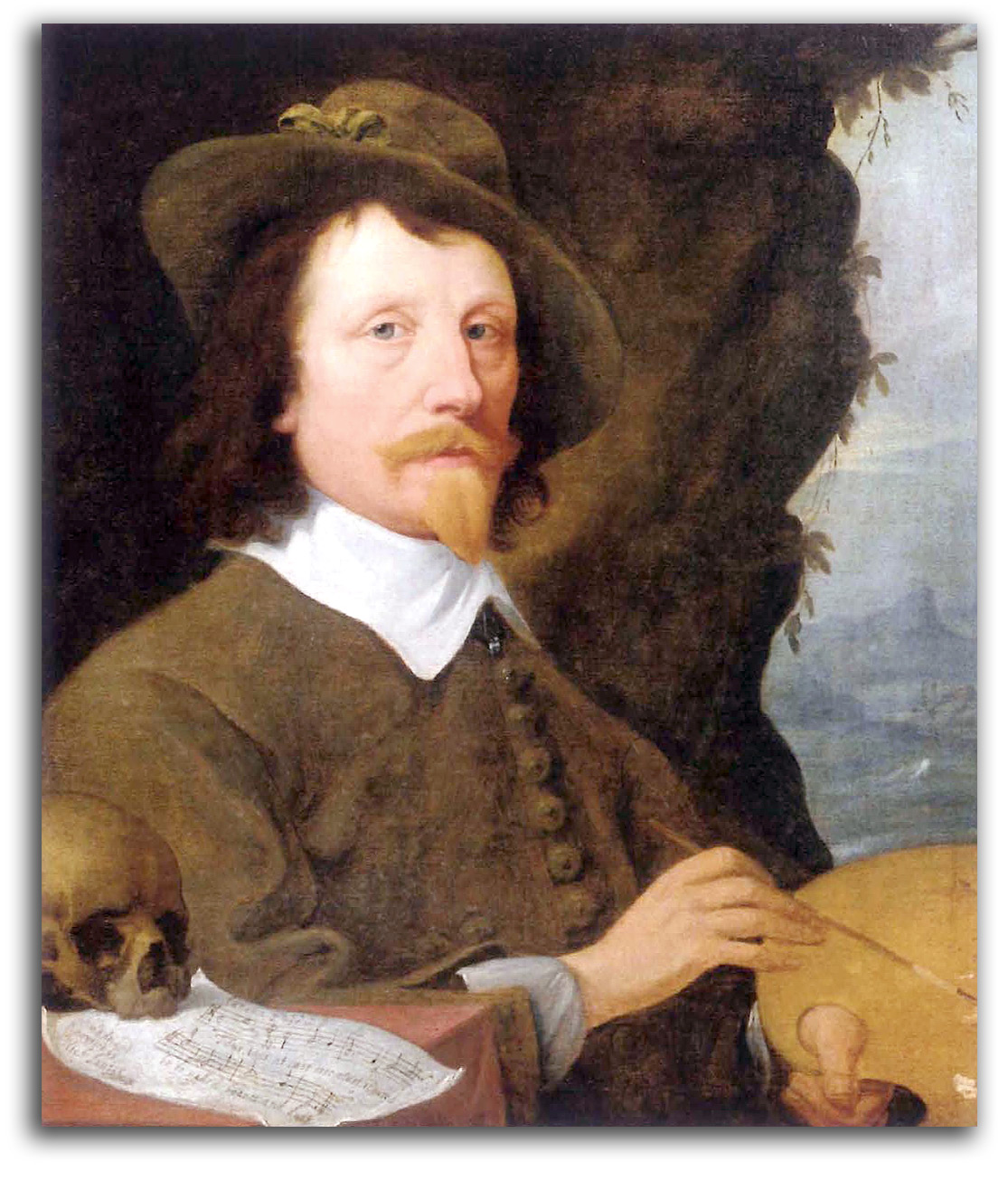
9 NICHOLAS LANIER (1588-1666)
Self-Portrait painting with a Sheet of Music & a Skull, c1630s
Collection: Music School, Oxford University, England
NOTE: There are a number of records of NL’s work as a painter, including works in the Royal Collection. This self-portrait is the only painting of his that is known to have survived. It appears to have been done under the influence of his friend van Dyck. The background seems to have been taken from van Dyck’s portrait of Lanier. The skull is a traditional symbol to remind all of life’s impermanence. The sheet of music under the skull (also reminding us of “dust to dust”) probably also are compositions by NL. He was a poet – a poet of musical lyrics – also well as a composer/musician/singer. This portrait is usually dated to the 1640s when NL surely was with the king in Oxford, and because the painting is now at Oxford. There is some evidence that NL was made a Doctor of Music and a professor at Oxford during that period. However, to me, the age of this face seems a good deal younger than that. The shape of the face, the general positioning of the pose, and the style of the clothing are all quite like that of the Lievens/Vosterman portrait. Indeed, the face is not far from the van Dyck portrait which is thought to be from about 1628 but could possibly be as late as 1632. The sporty hat also suggests the happy days of the 1630s rather than the sad days of the 1640s when England was engaged in Civil War. So I date this portrait to the 1630s. It was engraved by Caldwell in Hawkins, HISTORY OF MUSIC, vol.3, p. 380.
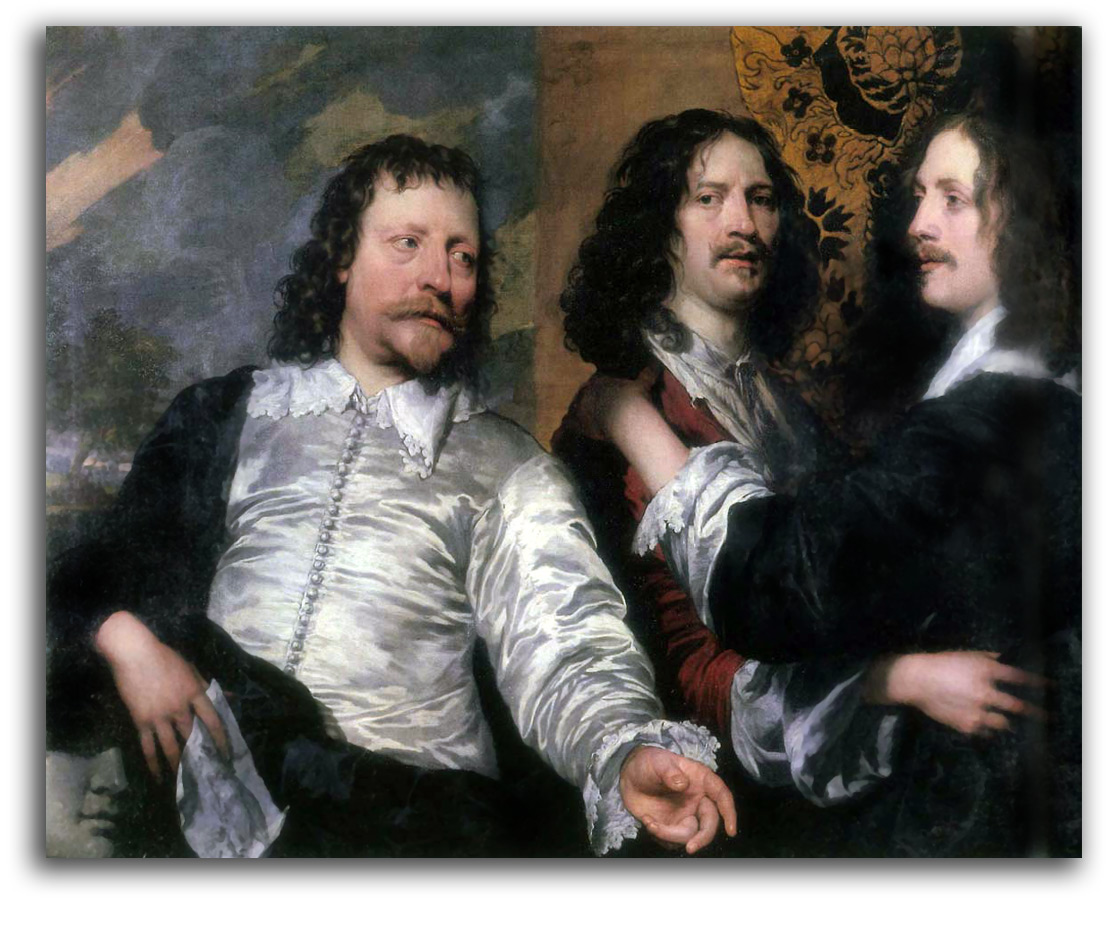
10 WILLIAM DOBSON (1611-1646)
Allegorical Portrait of Pleasure and Virtue, c1645
Collection: The Duke of Northumberland
Alnwick Castle, Northumberland, England
NOTE: William Dobson was the most gifted native-born English painter of the 17th century. After van Dyck died in 1641, Dobson became the Principal Painter of Charles I whose Civil War capital was Oxford. At Oxford, Dobson painted many fine portraits of those who remained loyal to the king especially the Cavalier soldiers. He often used objects to symbolize the interests of his sitters. Few royalists survived the crushing army of the Puritans that descended on Oxford, defeated the king’s army, and cut off the head of the king. NL escaped to the continent. In 1646 Dobson died in poverty at the age of 36. On the anniversary of his birth in 2011 there were a number of exhibitions and a BBC profile – “The Lost Genius of British Art: William Dobson.” His best known self-portrait is within this three-part portrait from about 1645, just before his world collapsed. Dobson is in the center. On the right is Sir Charles Cotterell, the youngest of his patrons. On the left, occupying half of the painting, (probably) is NL holding an Old Master drawing. This identification has been widely accepted. The identification was first proposed by Malcolm Rogers in his William Dobson, 1611-46: The Royalists at War, National Portrait Gallery, London, 1983. On the website of “The Dobson Art Trail” is this note on the painting:
The painting symbolizes a popular philosophical debate in which the artist is asked to choose between Pleasure and Virtue. … Lanier, in his flashy clothes, represents Pleasure, concealing a bust of Apollo.
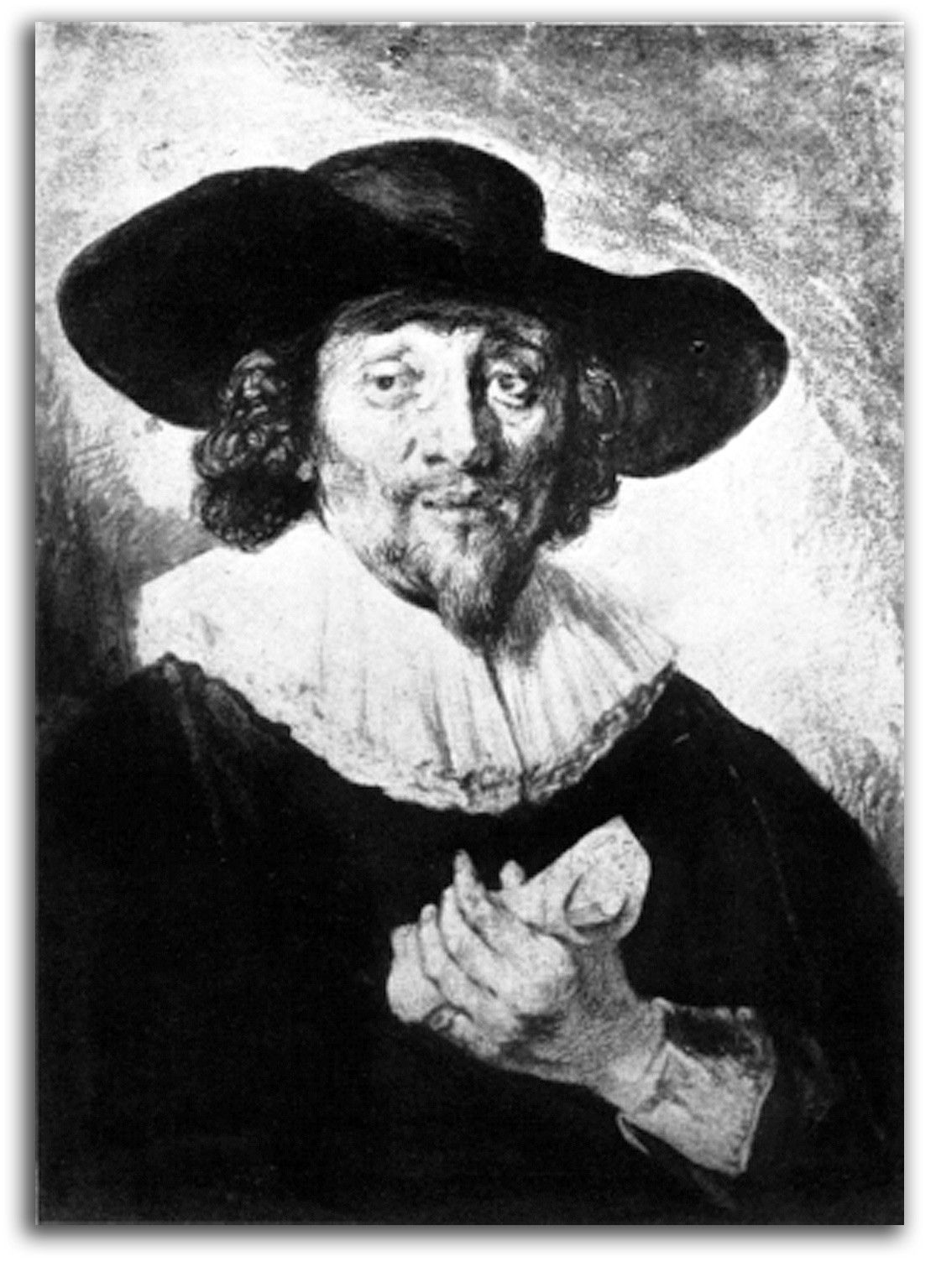
11 Attributed to REMBRANDT VAN RIJN (1606-1669)
Portrait of Nicholas Lanier [?], c1633 [?]. Chalk drawing
Collection: Staedelisches Kunstinstitute, Frankfort
NOTE: This highly detailed drawing relates to the oil portrait recorded in the next entry is a black & white chalk drawing with wash. Both this drawing and the painting were identified as NL for the first time by André de Hevesy, “Rembrandt and Nicholas Lanier, BURLINGTON MAGAZINE, Dec. 1936. Since that time, both the identification of NL and the attribution of the two works to Rembrandt have been questioned by some. The matter requires further study. In a related article, the attribution of the painting to Rembrandt is accepted by a major Rembrandt authority, but not the drawing. See Julius S. Held, “Rembrandt and Nicholas Lanier,” BURLINGTON MAGAZINE, Dec. 1936. Held did not deny the possibility that the sitter is NL, but points out that the hand with the scroll of music is a clumsy bit of painting that must have been added by someone else. I discussed this point with Held (one of my professors at Columbia), and I agree about the hand. Thus the Frankfurt drawing would have been made after the painting, not before. Who made the drawing is unclear. Any number of scholars have accepted the painting (or most of it) as Rembrandt’s work.
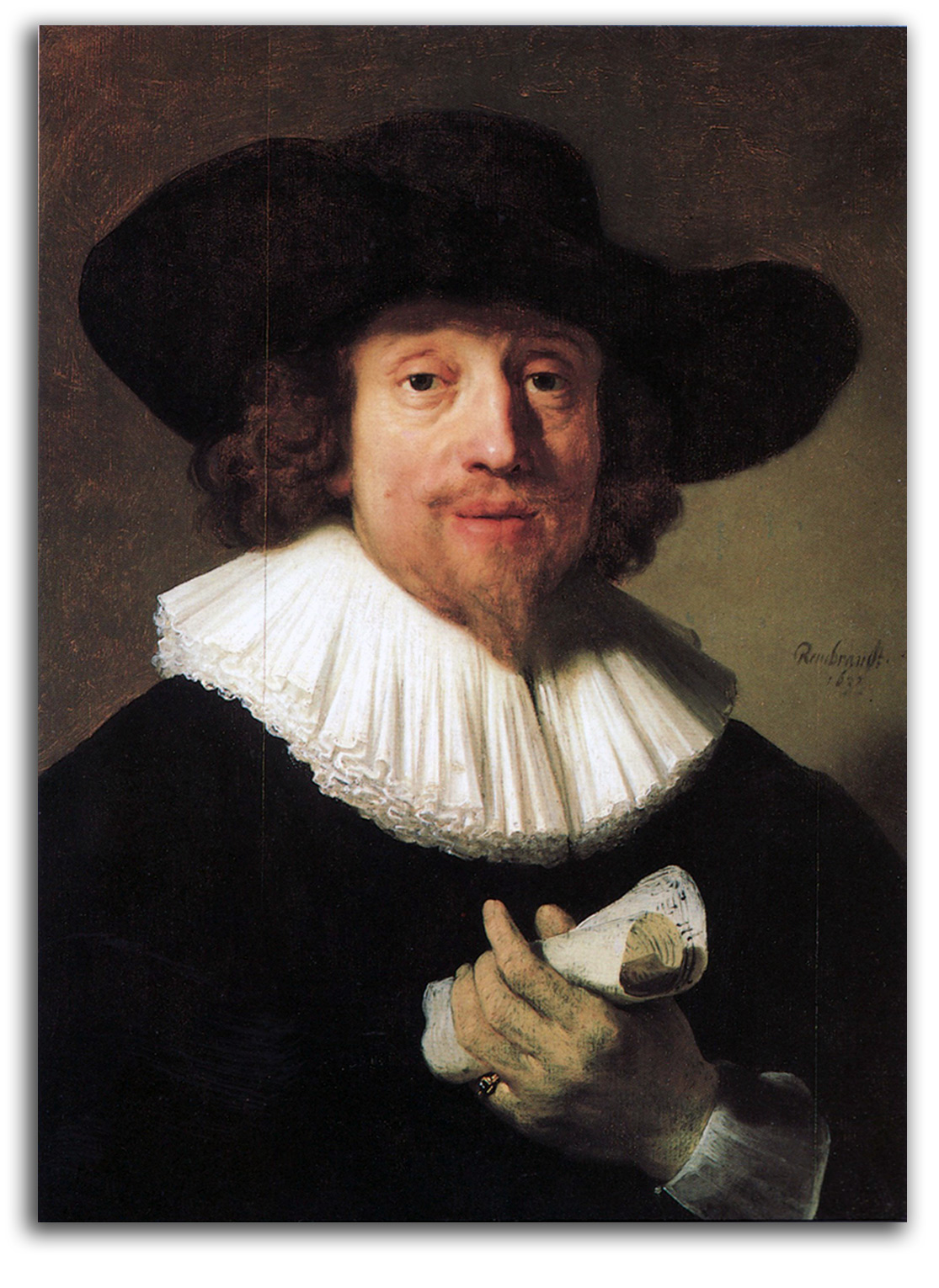
12 Attributed to REMBRANDT VAN RIJN (1606-1669)
Portrait of Nicholas Lanier [?], dated on the canvas 1633
Collection: Corcoran Gallery, Washington, D.C.
NOTE: Some scholars think this is NL, but some do not. Identification of a sitter without documentation is difficult, and highly subjective. The identification was first proposed by André de Hevesy, “Rembrandt and Nicholas Lanier,” BURLINGTON MAGAZINE, Oct. 1936. At first glance, the date on the canvas of 1633 does not seem to match NL’s age. If the van Dyck portrait is from about 1628, NL would have been about about 40 at that time. The person in this Rembrandt portrait seems to be older than 45, but perhaps not. Van Dyck was famous for flattering his sitters, including taking years off their age. On the other hand, Rembrandt did not flatter. Perhaps this is what NL actually looked like in 1633? The face in the Rembrandt does seem to have NL features, but they appear to be those of a man even older than the man in the Dobson portrait which surely dates from about 1645 (NL left England in 1645. Dobson died in 1646). Therefore, I am inclined to date this Rembrandt portrait to the 1640s or 1650s. The traditional attribution to Rembrandt, which is accepted by many, has been questioned by some. The style certainly is quite like that of Rembrandt. However, he was the leading Dutch portrait painter of his time, and many artists imitated his style. Could this painting be by another artist in the 1640s or 1650s, when NL is known to have been in Holland? Could the “signature” of Rembrandt and a perhaps false date have been added to the canvas? Or could the date actually be 1653 and not 1633? The shape of the collar does not provide a solid clue because both thick stiff collars and thin flat collars were in fashion at the same time in Holland for several decades (much longer than in England and France) up through the 1660s. NL stayed with the English court in exile on the continent, where he also was active as a collector, when he could, and as a dealer for the income. His letters to his Dutch friend Constantin Huygens speak of very hard times. NL happily returned to England in 1660 at the start of the Restoration when he was restored to his position as Master of the King’s Musick under the new king, Charles II.
LIFE & WORK OF NICHOLAS LANIER
NOTE: Nicholas Lanier (1588-1666) was a prominent member of the court of King Charles the First (1600-1649) where a late phase of the Renaissance flourished in England. As a composer and musician, he was Master of the King’s Music. He collaborated with Ben Jonson and Inigo Jones on masques (as a composer, musician, singer, and set designer), and is credited with composing the first English opera. His singing voice was celebrated in a poem by Robert Herrick in the following lines:
Then if thy voice commingle with the string,
I hear in thee rare Lanier to sing.
He is also credited with composing the first English opera. He also was a painter, poet, and art collector. He is considered one of the first, and possibly the very first Englishman to collect Old Master drawings, especially those of 16th-century Italians. When buying paintings for the king, he bought drawings for his own collection. He engraved and published a number of these drawings himself. As the king’s curator, he is best remembered for selecting and arranging for the acquisition of the legendary “Mantuan Purchase.” This extraordinary collection of Renaissance Italian masterpieces is widely considered the most important purchase of paintings made in the Western world until the 20th century.
This portrait is the reason Van Dyck was invited to move to England. When King Charles saw this elegant portrait (of a man who resembled the king), King Charles asked Van Dyck to be his court painter. An unusually large number of Nicholas Lanier portraits survive, including ones attributed to Isaac Oliver, Guido Reni, Jan Lievans (Rembrandt’s friend), and Rembrandt himself. There also is a self-portrait at Oxford University. My 1966 biographical study of this ancestor was the standard reference for many years. A much more complete biography was published by Michael I. Wilson in 1994. The largest archive of the American and European branches of the Lanier Family is at Johns Hopkins University in Baltimore.
NICHOLAS LANIER
Nicholas Lanier: a Bibliography, 1959
Nicholas Lanier & his Family: a Genealogy, 1961
The Etchings of Nicholas Lanier: a Catalogue, 1962
The Discovery of the “Missing Link” between the English Laniers
& the American Laniers in the 17th century,
with an Archive of Original Documents, 1963
[DONATED TO THE LANIER ARCHIVES,
JOHNS HOPKINS UNIVERSITY, BALTIMORE]
NOTE: My discovery of the “first American Lanier” (after years of research in the U.S., England, and France) was very important to all who work on the genealogy of the Lanier family. My finding were first published in Louise Ingersoll, LANIER: A GENEALOGY OF THE FAMILY WHO CAME TO VIRGINIA AND THEIR FRENCH ANCESTORS IN LONDON, 1965. This monumental book of 696 pages has been the standard reference ever since. Mrs. Ingersoll and I were introduced by Duncan Phillips in the summer of 1963. She was very kind to name me first in her list of acknowledgements.
How van Dyck came to England & his Portrait of Nicholas Lanier, 1965 & 2000
(@WAP: Per/MUSE)
Nicholas Lanier & ARTEMESIA GENTILESCHI: A Love Affair, 1966 & 1994
NOTE: Artemisia Gentileschi (1593-c1656) was an Italian painter, and is the most famous woman painter of the 17th century. What she had to overcome in order to be accepted as an artist was enormous. It is little wonder that she painted many strong women. When I began my study of Baroque art in the 1960s, she was little known. Now she is the subject of a great deal of scholarly and popular literature. Her self-portrait was (and still is) in England’s Royal Collection. It is not clear if their intimate relationship took place in Italy during the later 1620s, or during her stay in England (1638-42), or both. For the document that records their relationship and a discussion of it, see Michael I. Wilson, NICHOLAS LANIER: MASTER OF THE KING’S MUSICK, 1994, p. 109, note 49. The affair was noted by R. Symonds, a loyal member of the King’s Lifeguard from 1643 to 1646. He made reliable notes on many topics.
[M.A. THESIS, COLUMBIA UNIVERSITY]
MASTER OF THE KING’S MUSICK (1994)
by Michael I. Wilson – A Review, 1994
SUMMARY: THE EARLIER LIFE & WORK OF NICHOLAS LANIER (1588-1666), the Columbia University M.A. thesis that I wrote in 1966, has been the standard biographical reference for many years. However, it was limited to his activities in the visual arts. So my wife properly called it “half a biography.” Happily, we now have a full biography of this “Renaissance Man” – musician, composer, singer, musical administrator, poet, painter, art director, curator, collector, and professor.
This book was written by Michael Wilson of the Victoria & Albert Museum where he was Chief Cataloguer of the National Art Library. Happily he also was qualified to deal with the musical side of NL’s life. (I was not.) The world of music was NL’s primary world. He was a musician at court under James I and then a tutor to Prince Charles who became King Charles I in 1625. One of the new king’s first acts was to appoint NL Master of the King’s Musick. NL was the first to hold this prestigious office.
As a composer, NL is best known for the masque music he composed. In the 1613 Somerset Masque (celebrating the marriage of the Earl of Somerset & Lady Frances Howard), NL wrote and sang what is regarded as the “First English Opera” – in other words, the first recitativo performance. This was surely inspired by the musical innovations Monteverdi in northern Italy where NL visited in 1610. NL also was involved with “The Vision of Delight,” a masque performed on Twelfth Night 1616/17. It was organized by the Earl of Buckingham (later the Duke of Buckingham) in honor of Pocahontas.
Another notable masque was Ben Jonson’s “Lovers Made Men” (1617). Jonson himself noted that: “The whole masque was sung (after the Italian manner) stylo recitativo by Master Nicholas Lanier, who ordered and made by the Scene and the music.” That is the first known reference to NL as a visual artist. That NL was a practicing painter of note by the mid 1620s is shown by a record of his paintings of “Six French Ladies” in the collection of the Duke of Buckingham. [Wilson, p. 76-77] As for his training in the art of music, that would have come from his father and uncles all of whom were royal musicians. As for his training in the art of painting, that may well have come from Isaac Oliver and Edward Norgate (his brother in law).
NL’s remarkable gifts as a composer, lyricist, musician, and singer received praise from some of the greatest poets of the age, from Ben Jonson and John Donne to Robert Herrick. Herrick wrote in a poem addressed to Henry Lawes:
Then if thy voice commingle with the string,
I hear in thee rare Lanier to sing.
Viscount Falkland wrote these lines:
Now all is lost that is upon me placed,
As he a pheasant had, that had no taste,
As if Laniere should to a deaf one sing,
Or I should Helen to a blind man bring.
[Wilson, p. 80, note 31 on Donne; p. 137-38 on Falkland; and p.140 on Herrick]
As an art historian, I would have preferred more information on the many paintings and drawings that NL collected for the king, for Lord Arundel, and for himself. After all, the paintings he selected and arranged for Charles I to buy from Mantua (primarily Italian artists of the Renaissance) is considered the greatest single purchase of the pre-modern era. When the king was killed and his collection sold, the biggest buyers were French and Italian. What they purchased became the foundation of the Louvre and the Prado. There are many words about the deal in this book, but there is no list of acquisitions. Moreover, NL is thought to be the first English collector of Old Master drawings (with the possible exception of Lord Arundel) particularly artists of the Italian Renaissance. There is no list of acquisitions in the book.
In a book with many reproductions, it also is surprising that not a single piece of his music is reproduced. As for genealogy, the author thanks me for having unraveled this complicated body of information in my 1966 study, but does not illustrate the family tree with a chart of any kind. That is unfortunate, and leaves readers guessing.
Nevertheless, I admire how broadly the author casts his net in an effort to give us a balanced picture of the era as a whole. Thanks to him, we know a good deal about that music world and that art world as well as the political world that enveloped both. At the center of it all was Charles I, whose taste in art was widely considered exceptional. Rubens, for example, stated in a letter of 1625: “…the Prince of Wales is the greatest lover of painting in the world.” It was to this remarkable collector that NL was “Closet-Keeper” (that is Curator) during the Golden Years of early English collecting. [Wilson, p. 149]
Whatever his gifts as a connoisseur, as a king, Charles was arrogant and politically clumsy. He was asserting the Divine-Right-of-Kings in a nation that no longer believed in that ancient doctrine, a nation that was ready for the middle-class to take over control of government. The result was a Civil War. The middle class won the war under Oliver Cromwell, and chopped off the head of the king in 1649. NL continued to serve the royal family during their exile on the Continent, then returned with them to England in 1660. He resumed his position as Master of the King’s Musick, and held that post until his passing in 1666.
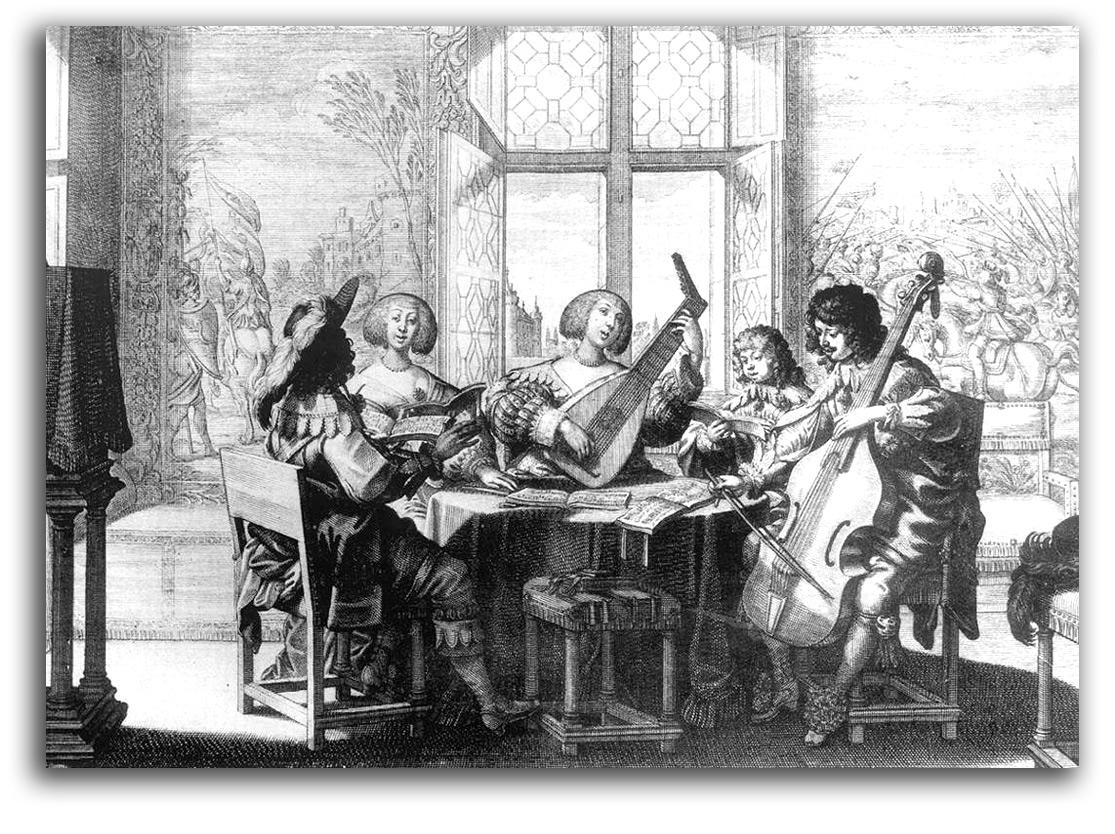
BOSSE – A Sense of Hearing
On the whole, the book is a noble effort to bring into focus a complicated life. During his twilight years, there are entries in the diary of Samuel Pepys that record musical evenings that Pepys enjoyed in the company of an old but still vigorous NL. In conclusion, here is the final reproduction from the book – a look at how NL probably spent the leisure hours of his last years. It was a life well spent. He left the world a better place. [For a more detailed review of this book, see Ian Spink’s review in MUSIC & LETTERS, Aug. 1995. To hear several of NL’s songs being sung, visit YOU TUBE ]
Interwoven Destinies:
A Chronology of Lord Arundel, Van Dyck, & Nicholas Lanier
in 17th century England, 2000
(@WAP: Per/MUSE)
Giorgione Paintings collected by Nicholas Lanier, 2011
(@WAP: Per/MUSE)
PART 5 – THE WORLD OF THE PORTRAIT MINIATURE
INTRODUCTION
OLIVER: FRANCES HOWARD
OLIVER: EMILIA LANIER [?]
NORGATE: JUDITH LANIER
RUBENS: SELF-PORTRAIT
VAN DYCK: CHARLES I & HENRIETTA MARIA
BEALE: NELL GWYNNE
VIGEE-LEBRUN: MUSE OF MUSIC
INTRODUCTION
The roots of the portrait miniature lie in the illuminated manuscripts of the Middle Ages. The first known independent miniatures were painted in France. Best known is the work was by Netherlandish painters working in France during the 1520s: Jean Clouet (died c1540), his son Francois Clouet.
Miniatures rapidly became popular among the nobility. They were particularly useful as a way of introducing potential husbands and wives to each other over long distances. It may seem difficult to believe, but quite a few marriages were settled on the basis of such images.
In England the tradition was begun by Han Holbein and firmly established by Nicholas Hilliard during the Elizabethan era. He was followed by Isaac Oliver and his son Peter Oliver during the early Stuart era. Most miniatures were painted with watercolor on vellum, and later on ivory, starting in the 18th century.
In the 18th century, fine miniatures were produced by Francois Boucher, Jean-Marc Nattier, J.-H. Fragonard, Rosalba Carriera, and a few by Madam Vigée Lebrun (Click here). During the 18th century, the taste for miniatures spread from the upper classes to the middle classes. In the American colonies, miniatures were painted by the leading portrait painters of the period including J. S. Copley and C. W. Peale. During the 18th and early 19th century, some of the best miniaturists made replicas of large paintings by Old Masters, e.g., Titian’s “La Bella.” [Click here/RENAISSANCE STUDIES].
During the mid 19th century, the development of photography drastically reduced the desire for portrait miniatures, and the art form virtually disappeared.
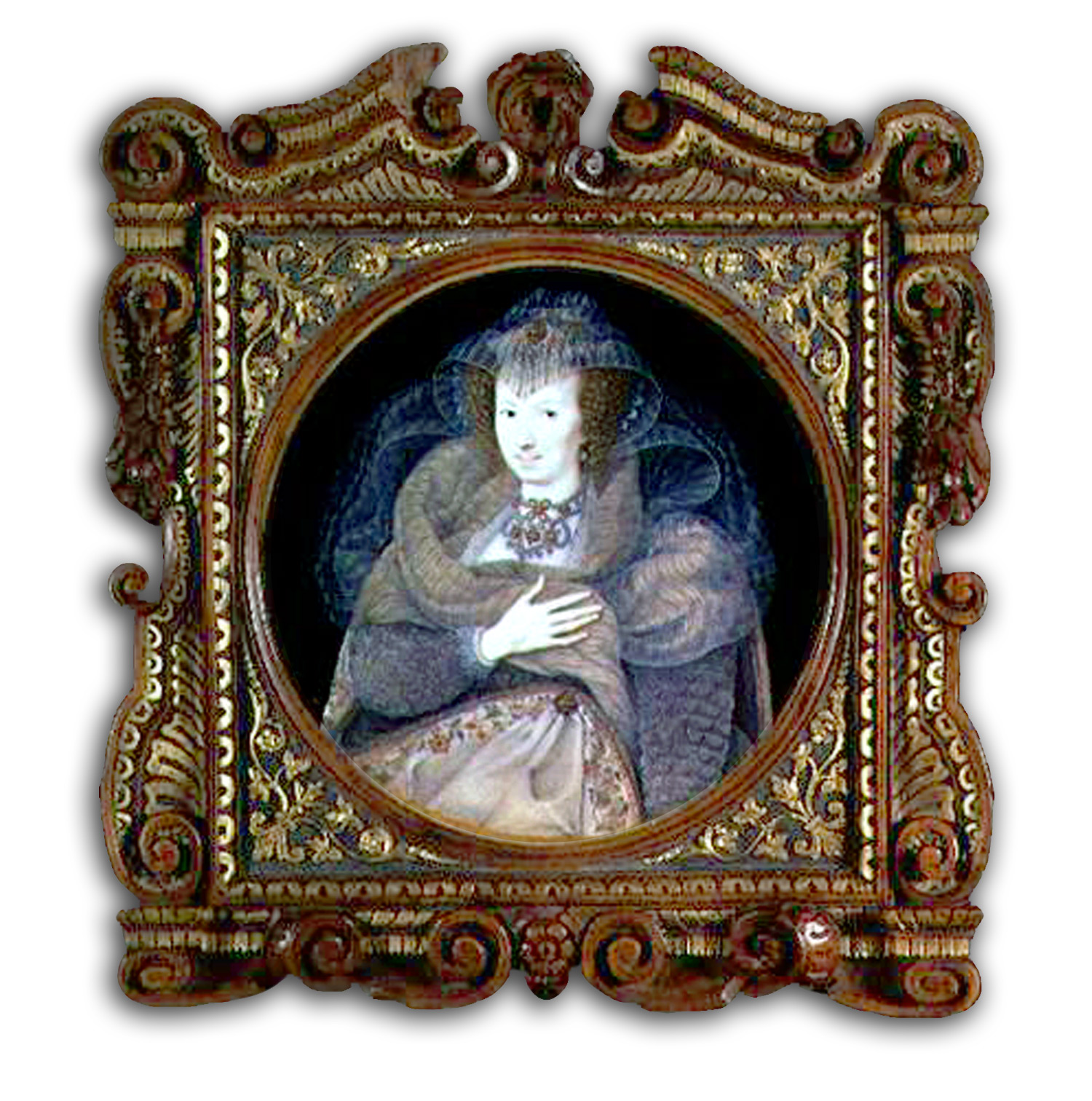
Portrait of Frances Howard,
Countess of Essex & Somerset
by Isaac Oliver, c1596-1600
watercolor
Collection: Victoria & Albert Museum, London
NOTE: Frances Howard was a celebrated beauty. She dazzled the court of Elizabeth I and James I with her beauty and her charm. Her first marriage, at the tender age of 13, was to Robert Devereux, 3rd Earl of Essex who was 14. She later fell in love with Robert Carr, First Earl of Somerset.
Carr was a special favorite of James I who was delighted Robert and Frances wanted to marry. With royal support, she arranged to have her marriage to Essex annulled. (Witchcraft was said to have been involved.) Robert and Frances were married on Boxing Day 1613. It was a very festive event. A masque was performed with music by Nicholas Lanier and Giovanni Coperario.
The happiness of the couple did not last long. In 1615, they were implicated in the murder of a man who had opposed their marriage, judged guilty, and sent to the Tower until their pardon by King James in 1622. The Countess died at the age of 42. Their only child, Lady Anne Carr, also a great beauty, married the Duke of Bedford.
Isaac Oliver, who specialized in miniatures, was one of the great portrait painters of the age. This portrait of the Countess has long been recognized as one of his finest masterpieces. The subtle shading suggests influence from Oliver’s visit to Italy in 1596. Her billowing veils were very fashionable at the court of Elizabeth I.
P.S. For portraits of English Laniers by Isaac Oliver, see below: a full size portrait Nicholas Lanier (1613) now in the Weiss Gallery, London; a miniature portrait of Nicholas Lanier in the collection of James II (now lost); and a miniature portrait possibly of Emilia Lanier in the FLG collection. Nicholas Lanier was very fond of miniature paintings, an intimate form of portraiture that did not become an independent art form until the 16th century. When Lanier was in the service of Charles I (son of James I), starting in 1625, one of his curatorial positions was Keeper of the Miniatures.
I tried to purchase this portrait of the Countess at auction for San Francisco in 1971, but was outbid by the V&A. When I discussed the symbolism with Graham Reynolds (the V&A’s distinguished curator of paintings and the winning bidder at that auction), he told me the “hand-over-heart” gesture indicates that this portrait was a private love token.
It is a curious coincidence that I inherited from my great aunt, Mary Munds, a reproduction of a print that is a portrait of Frances Howard as Countess of Somerset. The family tradition that Aunt Mary related to me is that NL had fallen in love with her. Aunt Mary was told this by her grandmother, Mary Theodora Lanier (Mrs. Sidney Cooke Lanier). MTL, a poet herself, got the story from her nephew, the beloved Southern poet-musician and professor
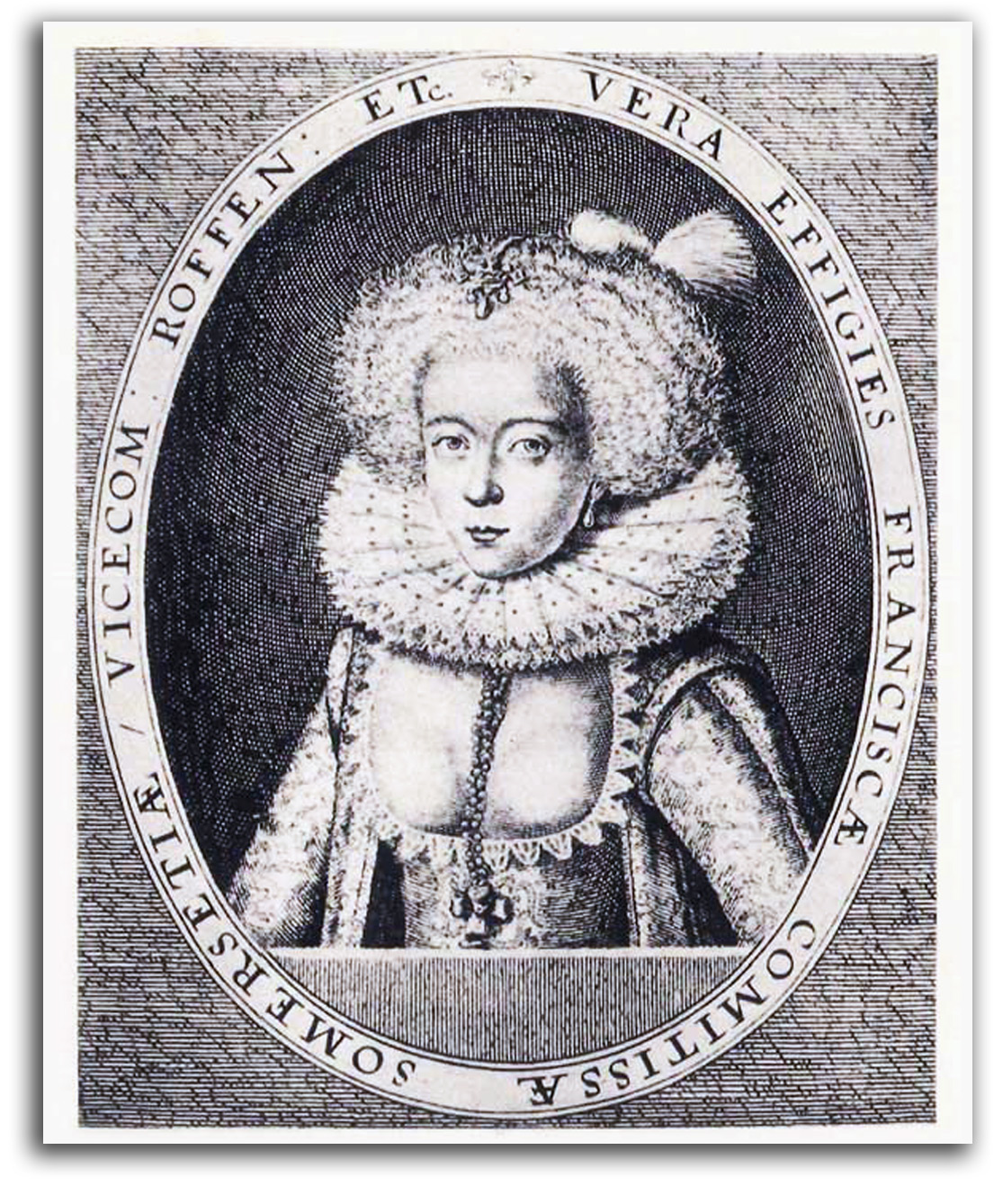
Frances Howard
Sidney Lanier. [For their relationship, see my “Sidney Lanier and his Montvale Muse: the Story of Two Poets;” @WAP: lectures/THE LANIERS.] Sidney Lanier spent a good deal of time studying his Renaissance ancestors in England, while preparing his lectures on Shakespeare at Johns Hopkins University. He was convinced that his musical blood came from them. What document he uncovered about NL and the Countess is not known. It is known that NL performed at her wedding to Somerset in 1613, but that is all that is known as a fact.
It may seem strange that such stories survive for centuries, but it does happen. NL’s affair with Artemisia Gentileschi also is recorded in the “book of history.” [For the Gentileschi document, see Michael I. Wilson, NICHOLAS LANIER: MASTER OF THE KING’S MUSICK, 1994, p. 109, note 49. The affair was recorded by Richard Symonds, a loyal member of the King’s Lifeguard from 1643 to 1646. He made reliable notes on many topics.]
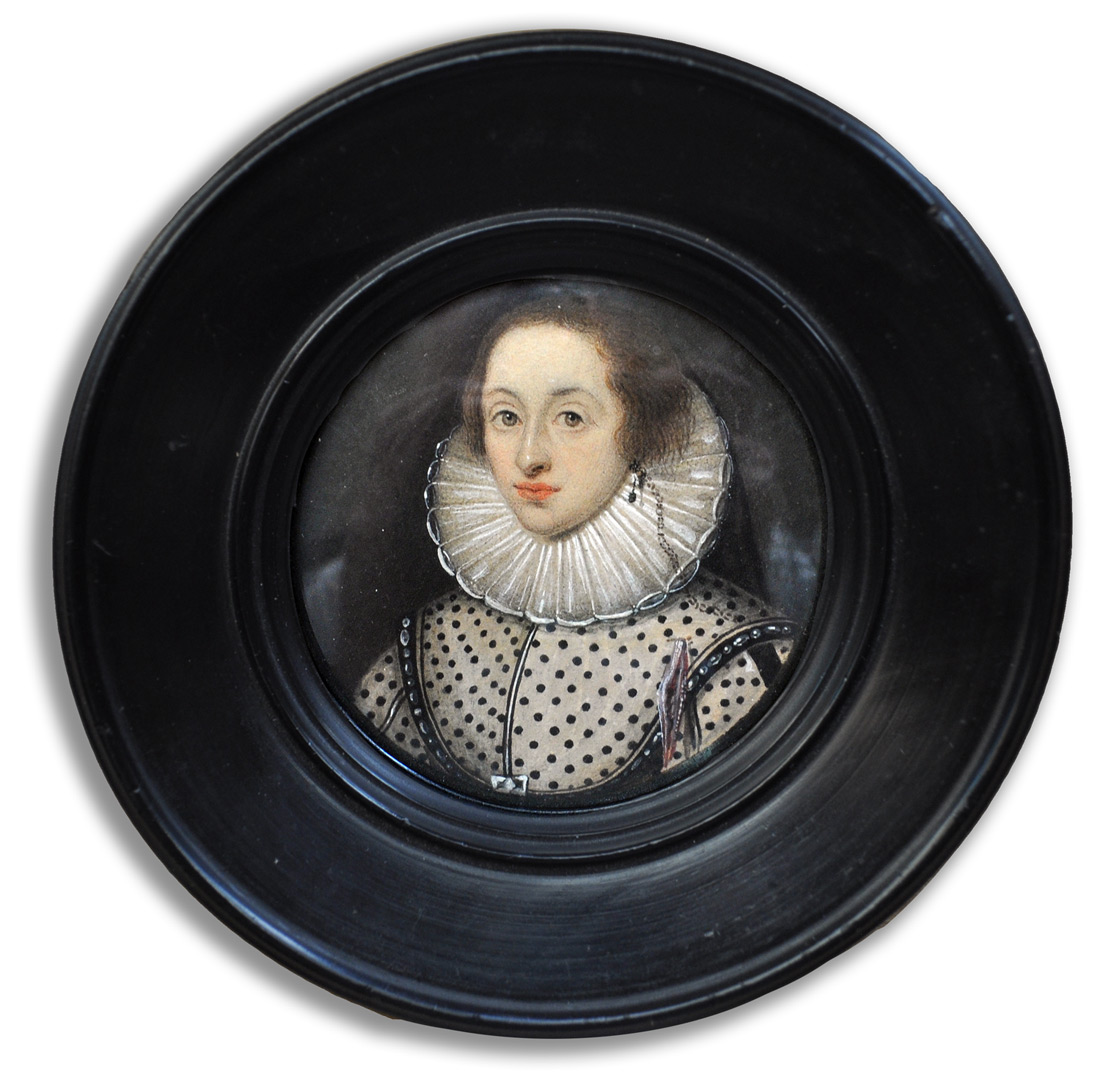
Portrait of Emilia Lanier [?] [sometimes Aemilia Lanyer]
Circle of Isaac Oliver, c.1600
watercolor
Collection: FLG
click here or on image for more detailed view of above portrait
NOTE: Attributed to the circle of Isaac Oliver who was close to the Laniers, at least as a family friend and perhaps as a cousin. Edward Norgate, another miniature painter of the time and a good friend of Van Dyck, was married to Nicholas Lanier’s sister Judith. Oliver spoke of Norgate as his “cousin,” but that was a common figure of speech for close friendship at the time, and may or may not have indicated a blood-tie, or a tie by marriage. Many of members of the Lanier family in 16th-century & 17th-century England were musicians, artists, and art collectors. Their American descendents have continued to love music and the arts.
Emilia Bassano (1569-1645) better known as Emilia Lanier (sometimes Aemilia Lanyer) was the daughter of a royal musician but was given a Humanist education and lived quite well as the mistress of Lord Hunsdon, first cousin of Queen Elizabeth and patron of Shakespeare’s theater company. After that affair, she married in 1592 Nicholas Lanier’s uncle, Alfonso Lanier (died 1613), who also a royal musician and later a Captain in the military company of Sir Walter Raleigh. A good deal of scholarly literature has been devoted to her work in recent decades because she was the first female poet to be published in England. Her book, SALVE DEUS REX JUDAEORUM (Hail, God, King of the Jews), was published in 1611. Her sophisticated poetry has a strongly feminist bent. In accord with the noted Shakspearean scholar A. L. Rowse, it has been widely accepted for some time that Emilia also was Shakespeare’s lover, that is to say the “Dark Lady of the Sonnets.” Recently, some have gone farther and suggested she was Shakespeare’s literary collaborator. Michael Posner and John Hudson even claim she wrote many if not most of Shakespeare’s plays! This miniature portrait has been in my family for generations. It was given to me by my grandmother, Alberta B. Lanier, who received it from her mother-in-law, Mary T. Lanier. This was the only early family portrait in the collection she gave me for which Grandmother did not have a name. The oral history she conveyed to me is that the sitter was a member of the Lanier family in Elizabethan England and that she wrote poetry. Mary T. Lanier felt certain that she had inherited her poetry blood from this Elizabethan poet. At the time, I wondered if she might be Judith Norgate, Nicholas Lanier’s sister, who was known to be a painter of miniatures but perhaps also a poet? In the 1970s, the work of Rowse inspired my tentative identification with Emilia Lanier. There are no other portraits that certainly are of Emilia. Therefore, my attribution must remain tentative until further study.
EMILIA LANIER & SHAKESPEARE:
Facts & Theories about their Intimate Relationship, 2000 & 2010
NOTE: She was an important poet of the English Renaissance – the first professional woman poet in English history. It has long been thought that she was Shakespeare’s “Dark Lady of the Sonnets.” Recent scholarship has suggested she also was Shakespeare’s collaborator. Some have even proposed that she was Shakespeare. One may not find this theory convincing, but the evidence is interesting for the light it throws on cultural history. She was married to Nicholas Lanier’s uncle Alfonse. He was first a royal musician and then a captain in the Irish Navy, serving under Sir Walter Raleigh.
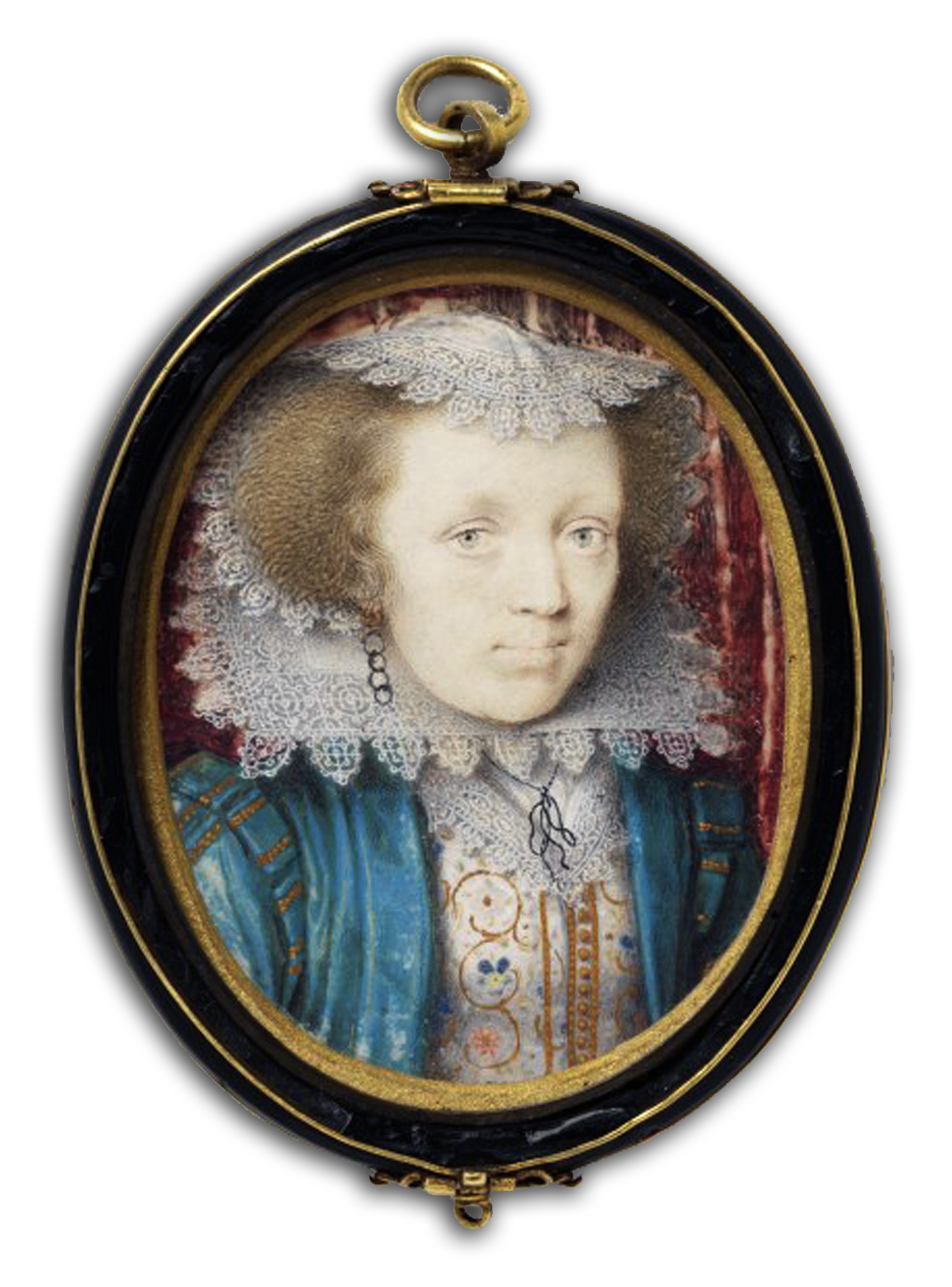
Portrait of Judith Lanier
by Edward Norgate, c1616-17
watercolor
Collection: Victoria & Albert Museum, London
A second version is in the Huntington Library, San Marino
NOTE: Judith Lanier (1590-1618) was the sister of Nicholas Lanier. Like her husband, she was a painter of miniatures, according to a conversation I had with Graham Reynolds, the distinguished curator who assembled the matchless collection of British miniatures at London’s Victoria & Albert Museum. She married Edward Norgate (1581-1650) in 1613. He was a royal musician on the lute and the organ. He also was a highly respected miniature painter, as well as an illuminator and calligrapher of official letters, and the author of MINIATURA, or the ART OF LIMNING which was written about 1627-28. That was (and still is) the best known book on miniature painting of the era. Its focus was on techniques. He was well connected with rich and powerful friends. He provided curatorial services for Lord Arundel and Queen Henrietta Maria. He also was a friend of Rubens, and of van Dyck who stayed at his home in 1632 when he first arrived in England, before moving to his permanent home.
The Norgates had three children before her untimely death in 1618. One daughter, Frances, became a painter of miniatures, according to Graham Reynolds. Another daughter, Elizabeth Richards, was a friend of John Evelyn, famous for his diary. For a letter to Elizabeth from her uncle Nicholas Lanier, see Wilson, p. 228.
PS. While I was curator of the Norton Simon Museum in Pasadena, my wife and I often visited the Huntington Library. There I was delighted to discover a replica of this portrait of Judith also by Edward Norgate. I am now hunting for paintings by Judith and her daughter Frances.
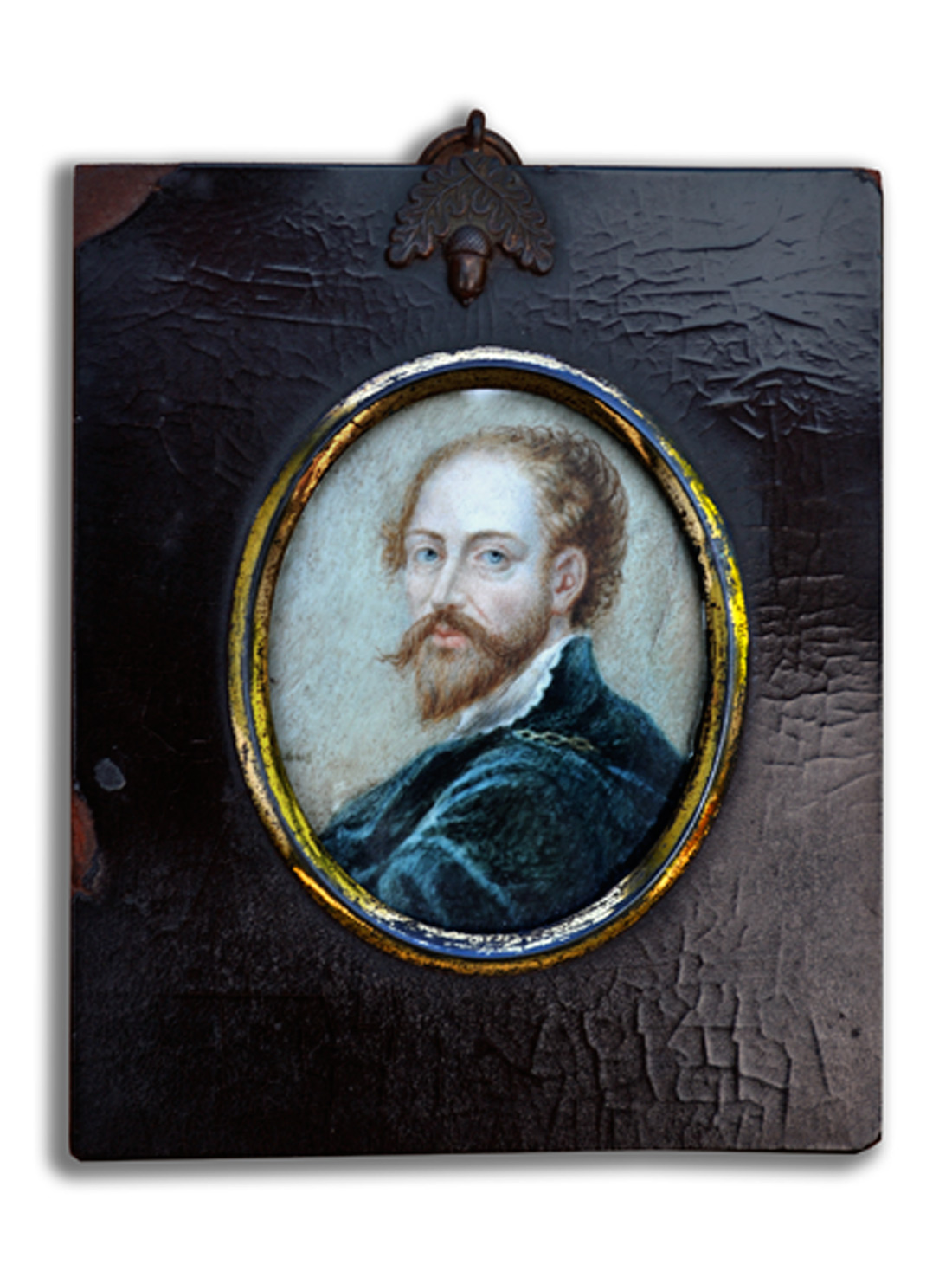
RUBENS (after)
SELF PORTRAIT
Conceptualization & realization by Rubens: 1604
Realization of this miniature replica: c17th/18th century
watercolor
Collection: FLG
Click here or on self-portrait (above) for more detailed image
NOTE: Rubens (1577-1640) was a Flemish master who became the most widely celebrated painter of the Baroque era in Northern Europe. He was raised Catholic and had a Humanist education, then worked as a younger painter in Italy where he was deeply influenced by the Venetians especially Titian, as well as by the expressive forms of Hellenistic sculpture particularly the famous “Laocoon and his Sons.” His mature work is a dynamic fusion of intensely energetic forms, rivers of vibrant color, and rich sensuality. Few artists had a greater influence during the 18th & 19th centuries, up to the time of Delacroix and van Gogh. Rubens also was a diplomat, a scholar, and a collector of note. He employed a large workshop to execute major commissions from numerous royal and noble individuals. He also directed a studio full of engravers to promote his work. His most famous student was van Dyck. Rubens received knighthoods from the King of Spain and the King of England. The history of artists being regarded as “artists” rather than mere artisans began with Leonardo, Raphael, and Leonardo during the High Renaissance. However, it was not until the early 17th century that painters such as Rubens and Valasquez were honored with knighthoods. This miniature replica of a self portrait is dated on the back 1604. In it we see the young Rubens during his apprenticeship in Italy where he decided to model himself on Titian. It was meaningful to Rubens that he was born shortly after Titian died. This handsome miniature seems to date from the late 17th or early 18th century.
(@WAP)
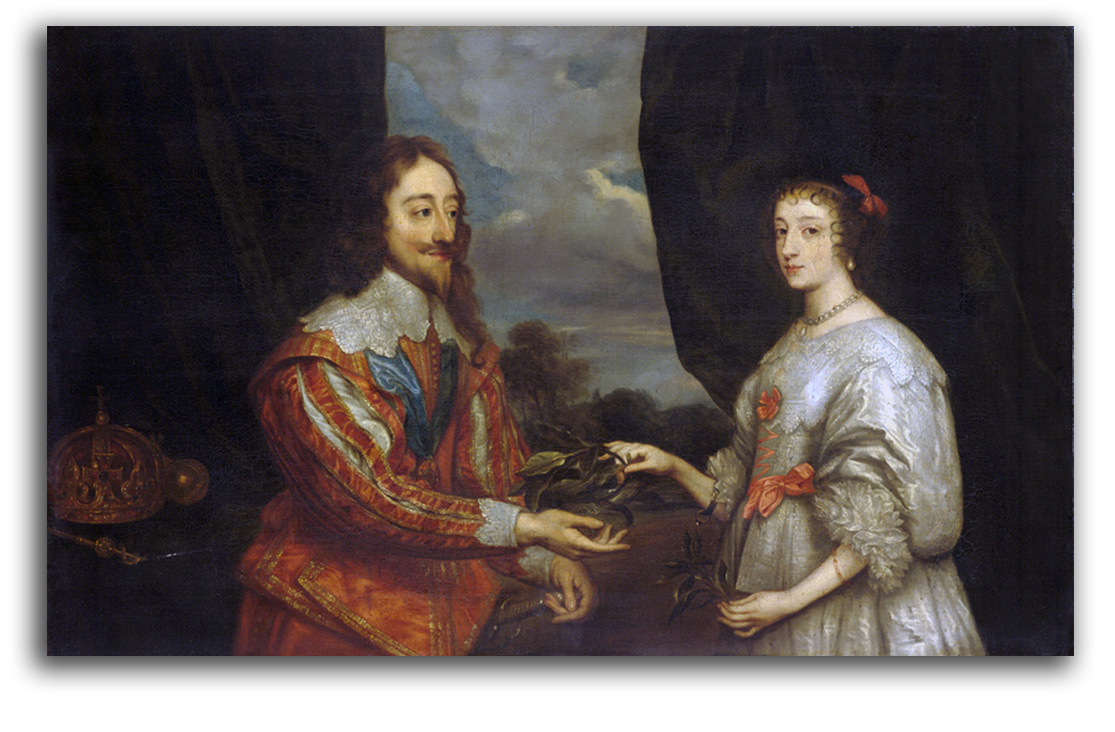
Portrait of King Charles I & Queen Henrietta Maria
after Anthony van Dyck, c1632
Collection: Philip Mould Gallery, London
NOTE: Charles I (1600-1649) and Henrietta Maria (1609-1669) ruled over the Golden Age of early English art collecting. The primary royal painter during the 1630s was van Dyck. This miniature is a scaled down replica of a van Dyck painting that the Queen commissioned for her cabinet room in Somerset House in 1632. That was the year that van Dyck settled in England. Notice how soft and fluid the clothing became during the second quarter of the 17th century. The hairstyles of both men and women also became quite fluid. It was a graceful age, and van Dyck (in the minds of many) was the most graceful portrait painter who ever lived.
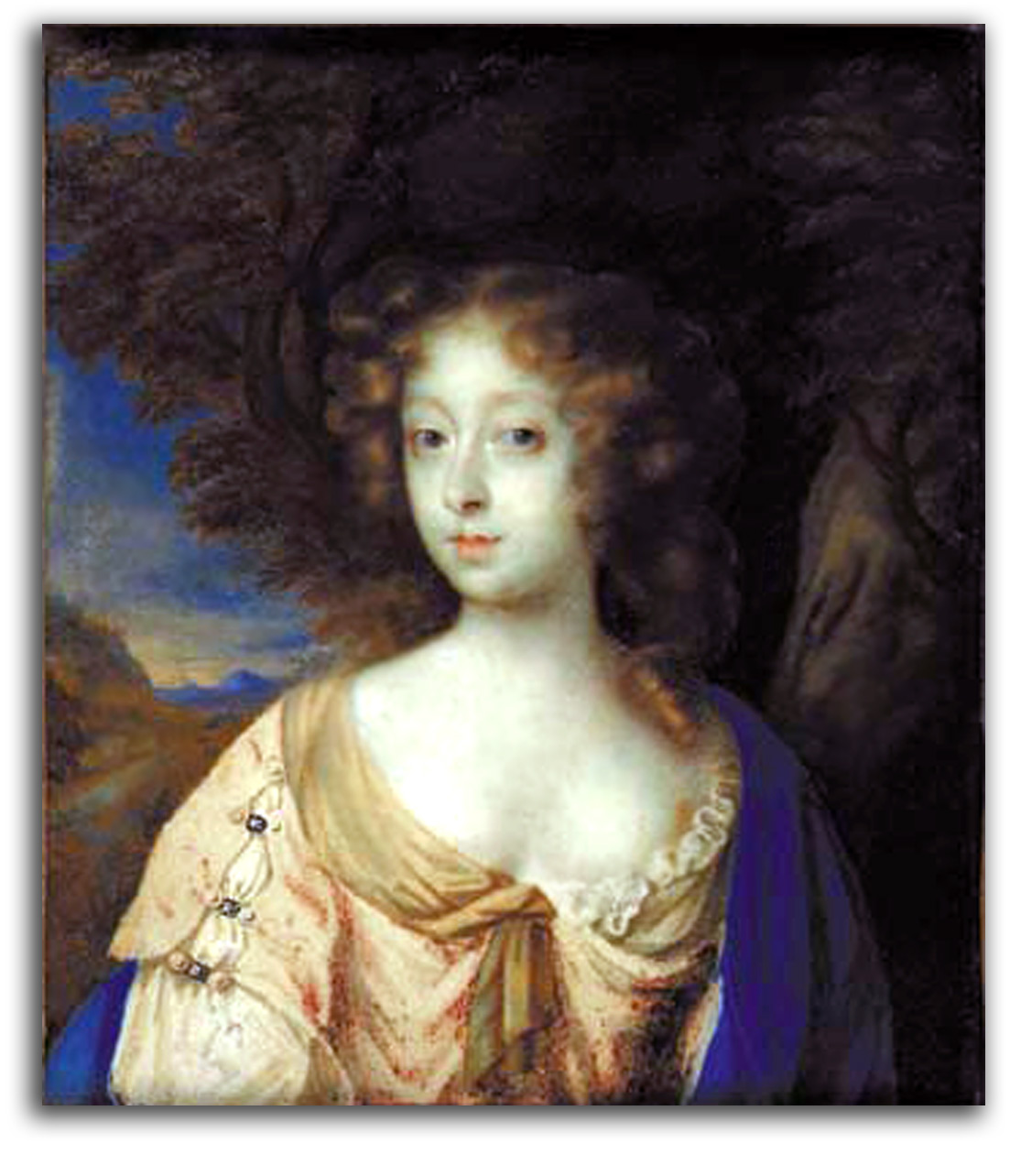
MARY BEALE
Portrait of Nell Gwynne, c1670
Private Collection
NOTE: Mary Beale (1632-1699) was a popular English portrait painter during the late 17th century. The first professional English female painter, she was introduced to many sitters by her friend, Sir Peter Lely, Principal Painter to King Charles II. Her husband Charles, who worked as her assistant, also kept extensive records and a detailed journal. As a result, Mary Beale’s work probably is better documented than any other artist in Stuart England. An early Feminist, she said: God created Eve as “a wife and friend but not a slave.” Her social ideal of gender balance was “true friendship.” Nell Gwynne (1650-1687) was the mistress of the king, and a celebrated beauty.
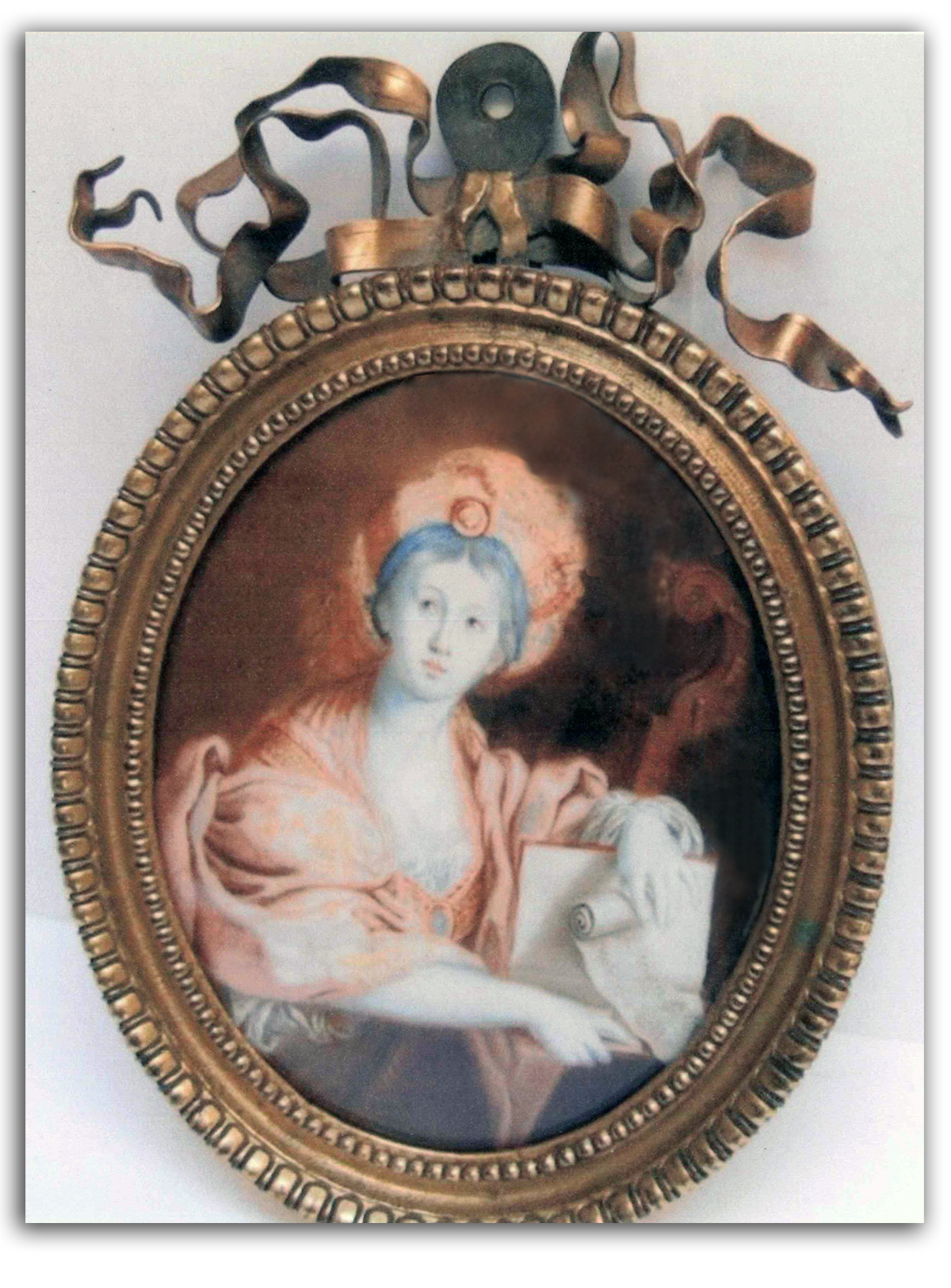
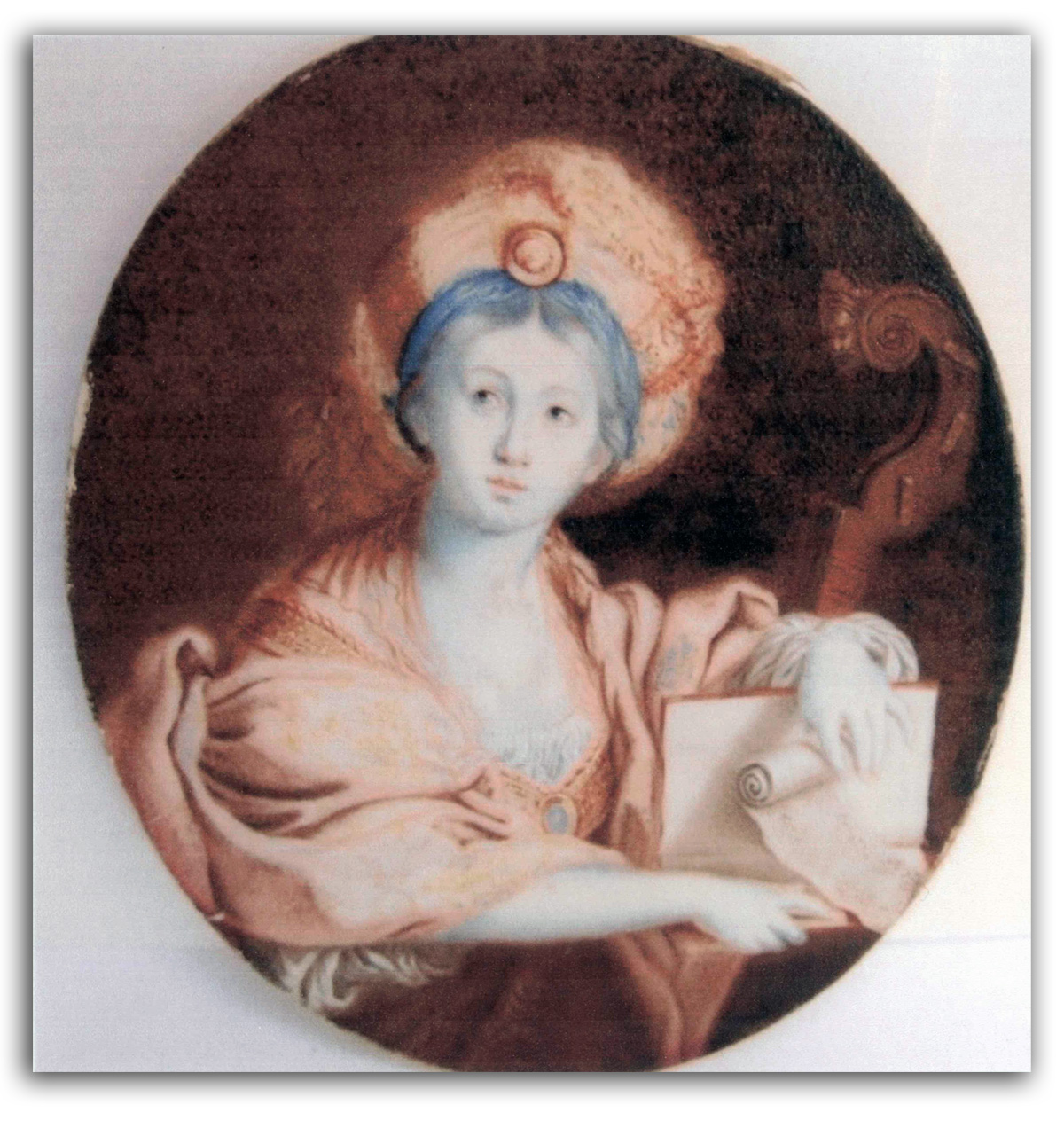
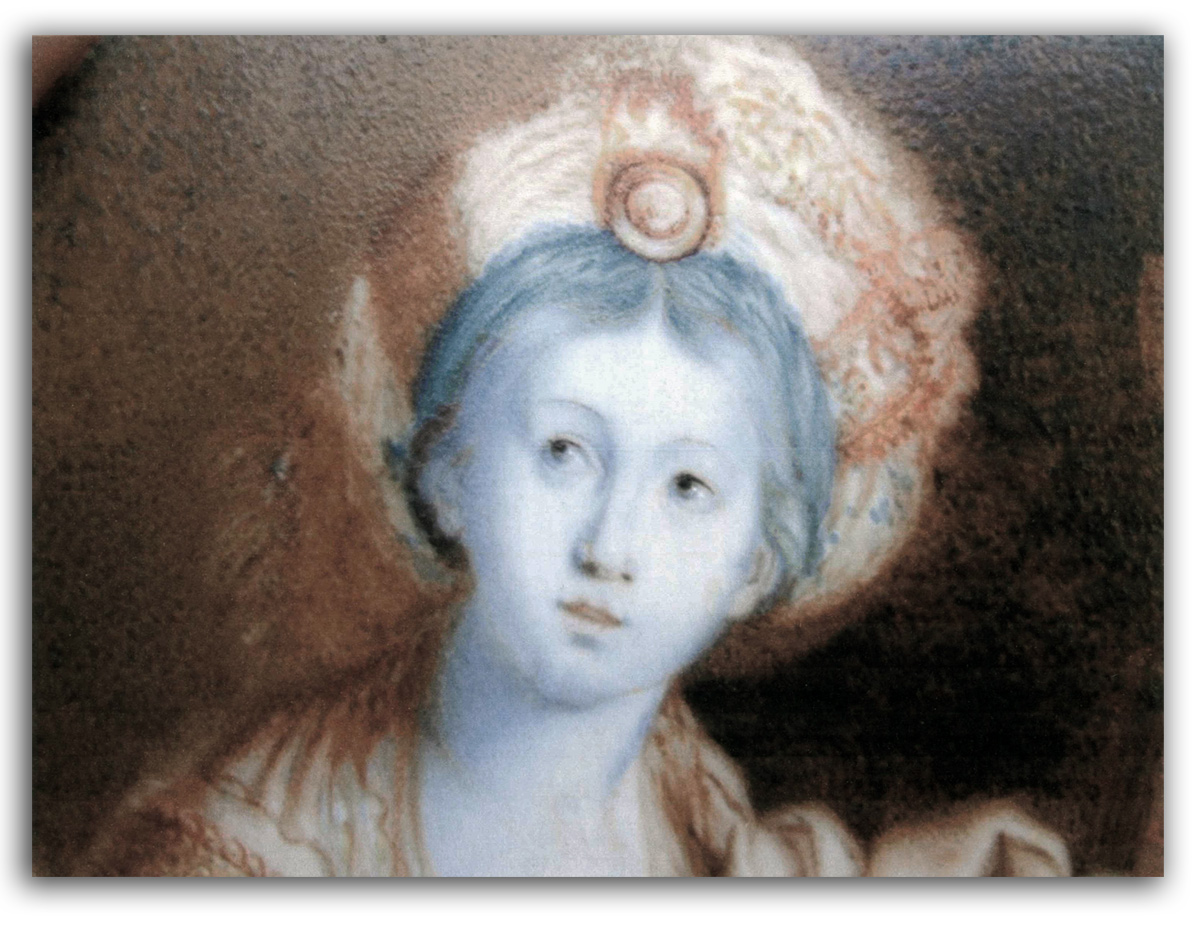
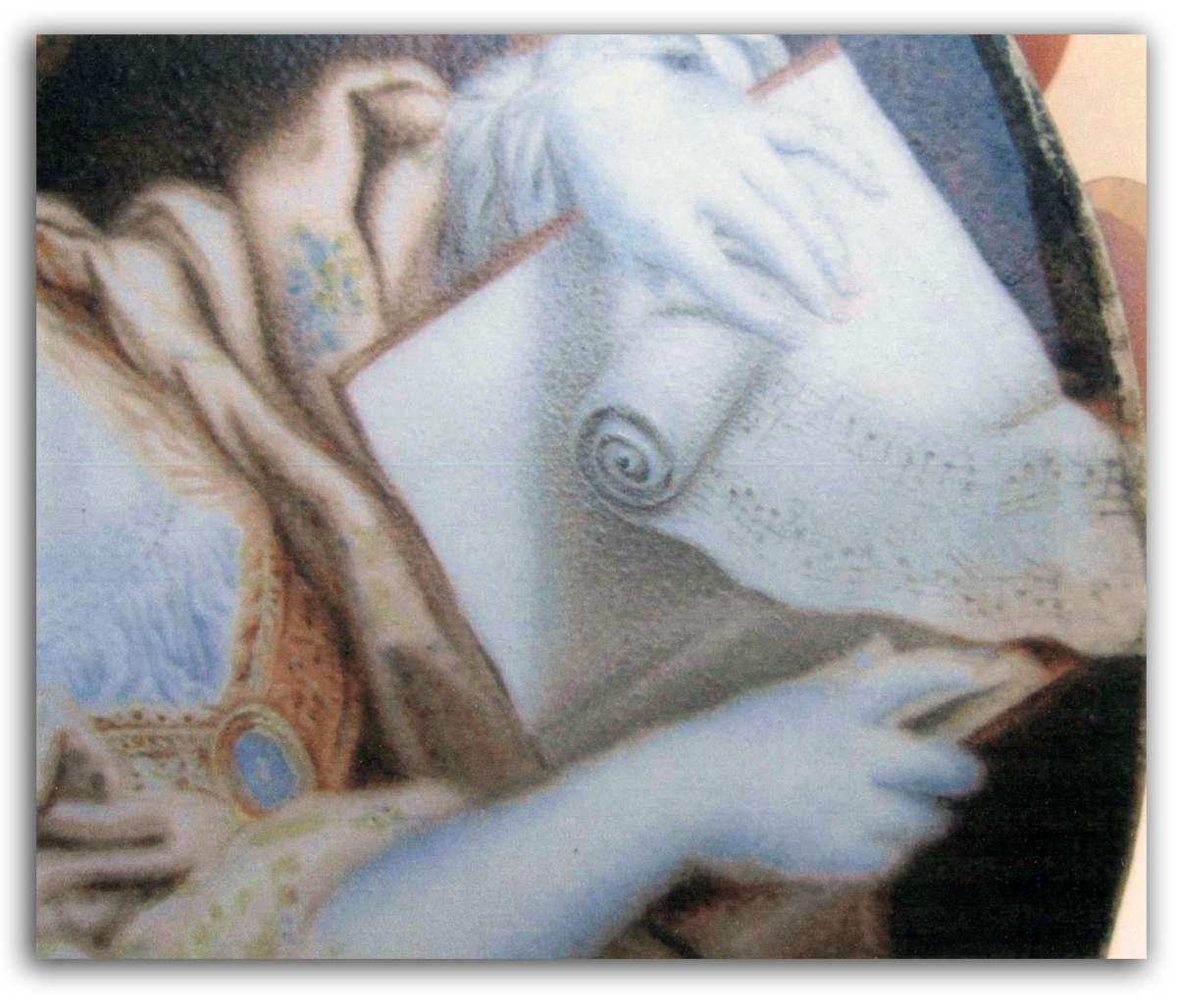
THE MUSE OF MUSIC by Marie Louise Elizabeth Vigée-Lebrun (?)
NOTE: Lebrun is widely considered the most important woman painter of the 18th century. This miniature appears to be by an artist in her circle. Whether it is by Vigée-Lebrun herself or not remains to be determined.
PART 6 – BAROQUE PRINTS
17th century Flemish:
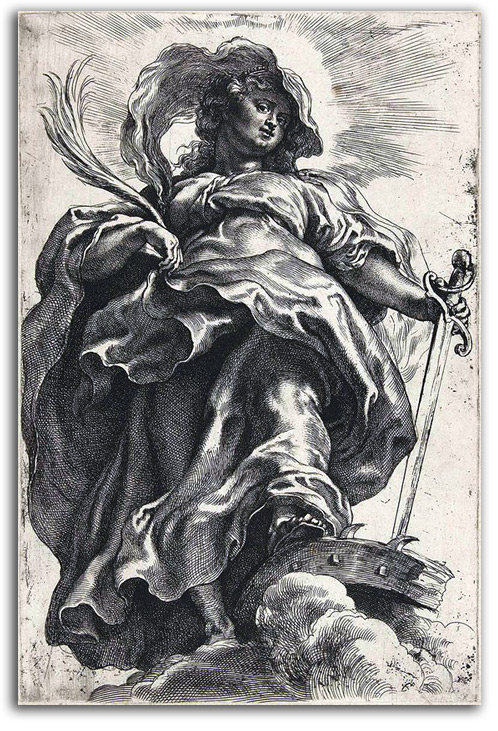
RUBENS
ST. CATHERINE OF ALEXANDRIA
c.1620. Etching & engraving
Collection: FLG
NOTE: Rubens had a large workshop of engravers making prints after his designs. He can be credited with the general composition of many of the plates but not for any of the execution. This “St. Catherine” is the only etching Rubens is known to have made himself. Following Christian tradition, she is standing over the spiked wheel on which a pagan Roman emperor attempted to torture her to death in the 4th century. Following her prayer, the wheel broke, and the emperor had to settle for having her beheaded. Rubens has given us not only a story but a story wrapped in an vivid expression of the meaning of the story. This is an explosive figure of a Transcendent spirit who has triumphed over torture, a spirit who has moved beyond ordinary humanity to an illuminated state of Grace. This Transcendent condition of the soul is what the halo symbolizes in the sacred art of the West and the sacred art of the East. It is typical of Baroque art to be activated by swirling masses, as if being blown by the wind. This convention is dramatic and thus emotionally engaging which is what the Catholic Church during the Counter Reformation wanted its art to be. The dramatic “wind” blowing form into place also was thought of as the Divine Spirit moving earthly matter into purposeful positions.
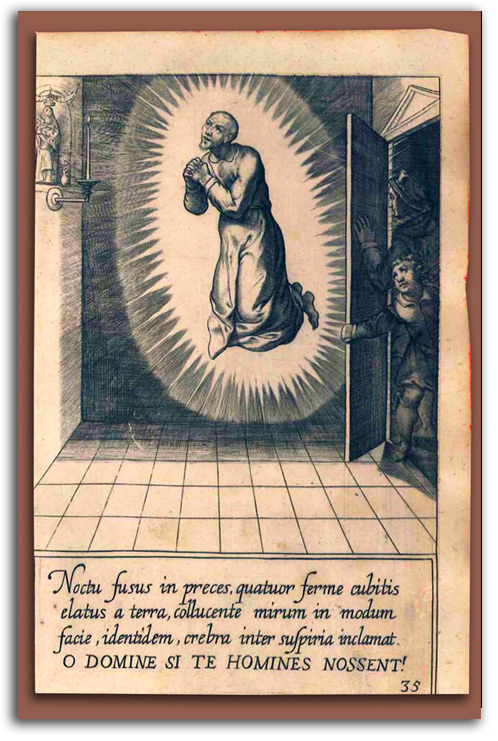
RUBENS Studio (Cornelius Galle)
ST. IGNATIUS LOYOLA IN PRAYER
1609. Engraving
Collection: FLG
Ex. Collection: Mrs. ADR Lanier
NOTE: Within the extremely diverse work of Rubens one finds the wide range of artistic quality characteristic of prominent studios during the Renaissance and Baroque eras when many artists used any number of assistants. Consider his portraits of Saints. Rubens, who was a devout Catholic, took a special interest in St. Ignatius Loyola (1491-1556), a Spanish knight from a Basque family who founded the Jesuit Order. His painted portrait by Rubens is now in the Norton Simon Museum. In 1609, the year Loyola was beatified, Rubens produced a sumptuous book called Vita Beati. P. Ignatii Loiolalie [Life of the Blessed Father Ignatius Loyola, Founder of the Society of Jesus]. It was illustrated with 81 plates designed by Rubens and engraved under his direction by artists in his workshop. In a way, the whole book is a “portrait” of Loyola, with the plates portraying moments in his life. This particular plate was engraved by Cornelius Galle. It pictures Loyola with a luminous full-body aura in an altered state of prayerful meditation uniting with the Transcendent. This engraving is typical of the kind of portrait that became quite popular in books of the 17th century. It is a competent illustration. However, it does not do more than convey the idea of a reality. It does not evoke inside the viewer an empathetic experience of that reality, unless there is a sympathetic response to the idea itself rather than its visual expression. In short, the plate is flat – both visually and emotionally. Such a plate is typical of the workshop of a major artist. However, a plate done by Rubens himself can evoke a rich empathetic experience because it is a synthesis of a meaningful idea with a strong visual expression of the spirit of that idea. For example, consider “St. Catherine of Alexandria” (the following image), etched by Rubens himself.
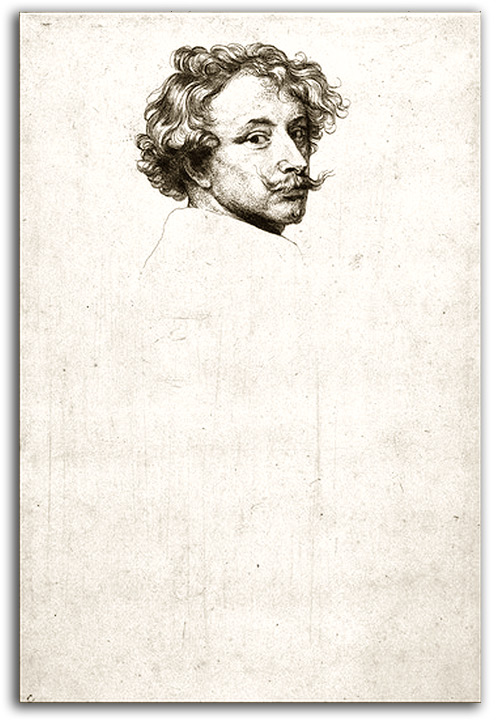
VAN DYCK
SELF PORTRAIT c.1630
Etching
Collection: FLG
NOTE: There were many good artists working under or with Rubens, but the Flemish genius who stood out over all the others was Anthony van Dyck (1599-1641). In the 1630s (probably at the suggestion of Nicholas Lanier) he became the court painter of King Charles I of England, the leading art collector of his age. Van Dyck painted some of the most graceful portraits ever made. The output of his studio was enormous. Assistants did much of the work, but the faces usually were by the master himself. He received a knighthood and was the dominant influence of British painting for the next two centuries. Like his master, van Dyck lived in Italy as a young man and was deeply influence by Titian. Perhaps van Dyck’s best known portrait is his spectacular rendering of Charles I standing in front of his horse in the Louvre, but many major museums proudly display a van Dyck. He also was a printmaker. During the 1630s, in a series called Iconography, he took the art of the printed portrait to a new level. The series was devoted to half-portraits of distinguished contemporaries – artists, scholars, solders, and statesmen. Many think there has never been a finer series of printed portraits. Each was begun by van Dyck as a drawing or an oil sketch, and sometimes as an etching, and then was completed by a collaborator as an engraving. Of the plates that survive in the form of an original etching, the most famous is this self portrait. The plates for the series, which first appeared in an edition of 80 and eventually numbered over 200, were collected by the Louvre. They have been reprinted from time to time. Van Dyck and Rembrandt were the most brilliant etchers of the 17th century, and perhaps of all time. Only the etchings of Whistler and Picasso usually are discussed in the same conversation.
17th century Dutch:
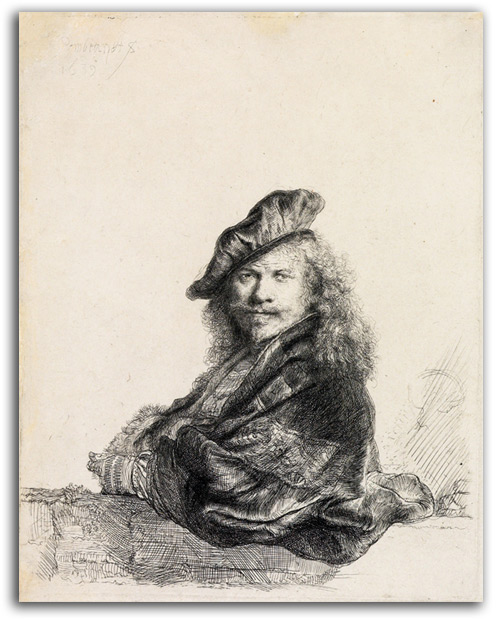
REMBRANDT
SELF PORTRAIT LEANING ON A SILL
etching. 1639 (signed)
Collection: FLG
Ex. Collection: Metropolitan Museum of Art, New York
NOTE: Today, the best-known artist of the 17th century is the Dutch master Rembrandt van Rijn (1606-1669). He is arguably the greatest portrait painter of all time. His name, and only a handful of other artist names, have become household words. As a painter of portraits, and as an “illustrator” of Bible stories, his use of light to articulate aspects of psychology and the depth of his humanity have never been exceeded. He also was a printmaker. No prints have been more avidly collected by a greater number of enthusiasts. If van Dyck was an etcher of consistent compositional structures and remarkable simplicity, Rembrandt was an etcher of enormous variety and often haunting complexity. This particular print is often considered the greatest of his early self portraits. He continued to explore this thing called “self” in a very long series of paintings and prints for the rest of his life. That series is arguably the most complete “self portrait” ever made by an artist. The fact that the Met had a collection of Rembrandt etchings made from his original plates in modern times was first told to me by A. Hyatt Mayor, curator of that print collection, when he was my professor at the Institute of Fine Art, New York University in 1966. They were later put up for sale. I purchased this impression at the Met in 1980. A Rembrandt portrait that many think is of Nicholas Lanier is in the Corcoran Gallery in Washington, D.C.
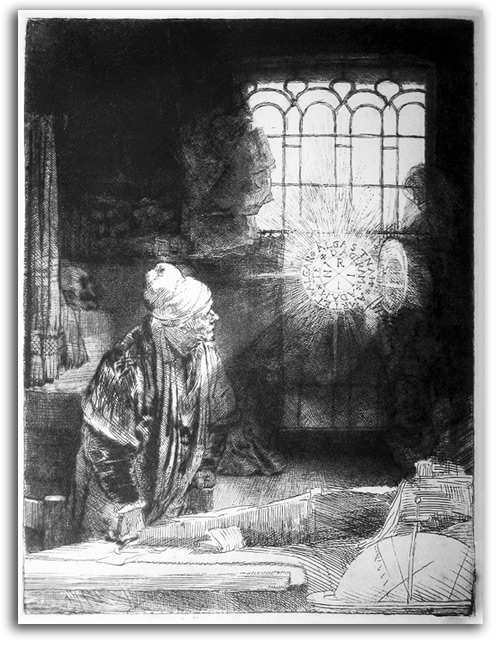
REMBRANDT
THE ALCHEMIST (aka FAUST). c.1650
Etching
Collection: FLG
NOTE: Rembrandt eventually had an international reputation as an etcher. The meaning of most of his portraits and narratives is clear. But this famous print is mysterious. Scholars have debated its meaning for centuries. An old man in a dark room looks up from his writing desk, pen in hand, and sees a luminous disc inside of which are words. The meaning of those words is a mystery. Most of the room is imprecise – the table, the books, the globe; but the words are quite precise. The whole scene is a mystery, and that may well have been just what Rembrandt wanted it to be. The title published in the 17th century was “The Practicing Alchemist.” Only in the 18th century did it start being known as “Faust.” To the uninitiated, Alchemy was little more than efforts by greedy people to turn lead into gold. There were such people during the Middle Ages and the Renaissance. However, true Alchemy was a meditative tradition within Christianty that had parallels with Asian yoga. During the 16th & 17th centuries, true Alchemy was a special interest of leading figures of the time including Sir Isaac Newton. By means of spiritual practices, one attempts to transcend lead-like selfishness and attain the Transcendent state of Golden Consciousness.
[For further details, click here for “The Mystic Ladder: Parallel Stages of Consciousness in Alchemy & Tantra.”]
The legend of Faust probably was based on the life of J. G. Faust (c1480-1540) who was an alchemist and magician in Wurttemberg. In Goethe’s play/poem Faust (which occupied much of his life), the central character makes a “deal with the Devil.” For a number of years, Faust gets what he wants and then must surrender his soul to the Devil. If the subject actually is Faust, the scene probably is when a good angel warns Faust not to sign up with the Devil. What is the Devil actually? In a number of spiritual traditions, the Devil is understood to be one’s ego – selfishness personified.
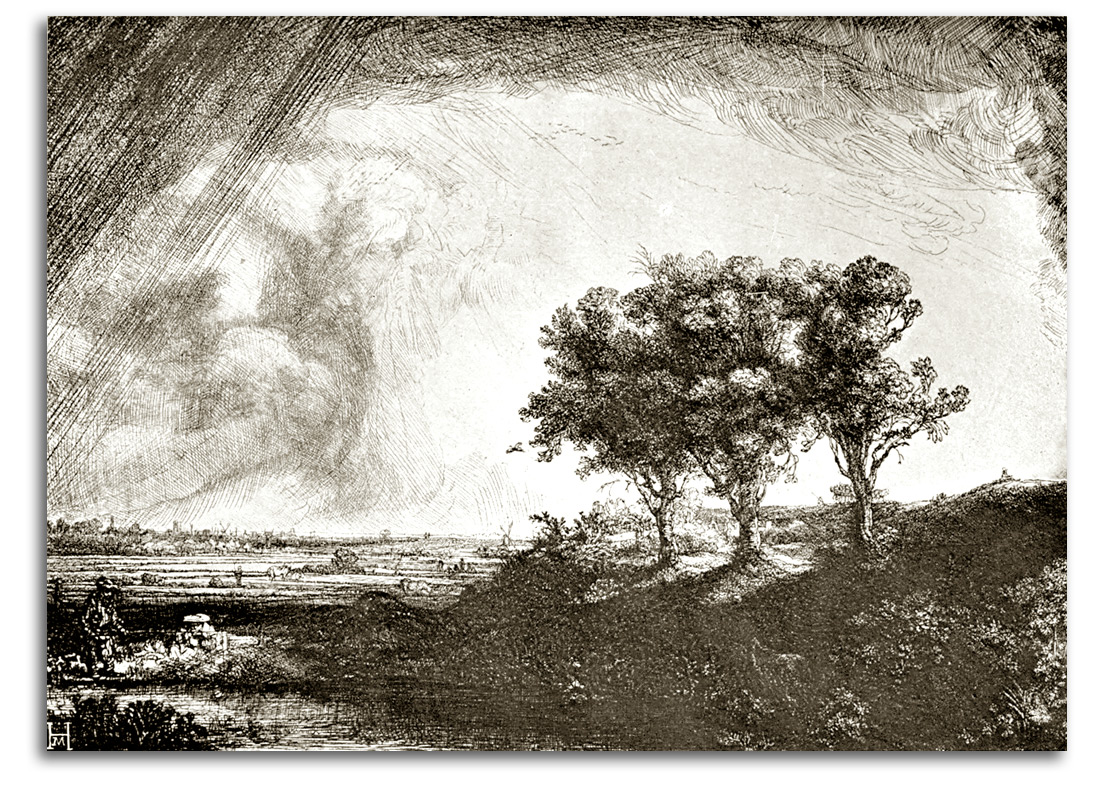
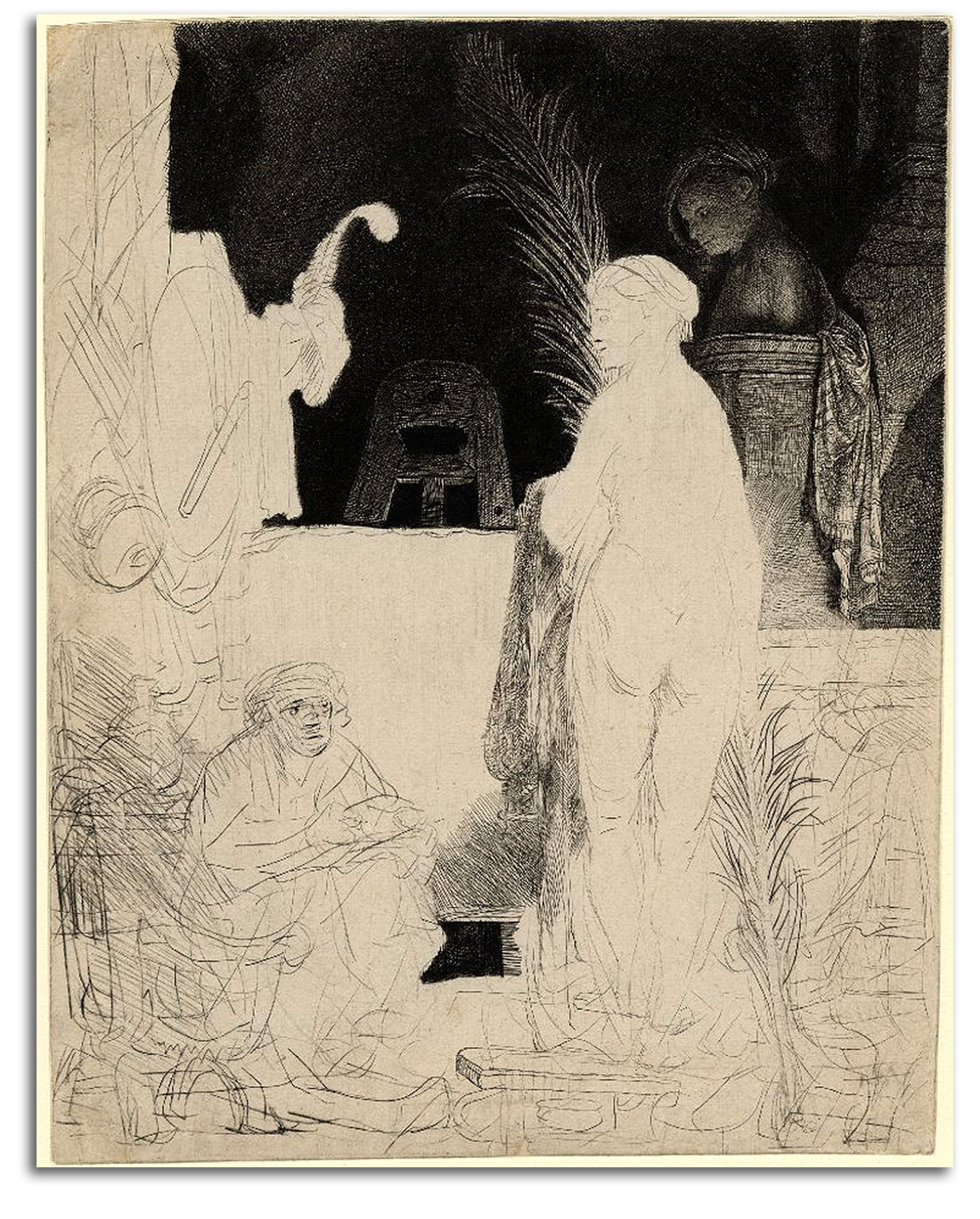
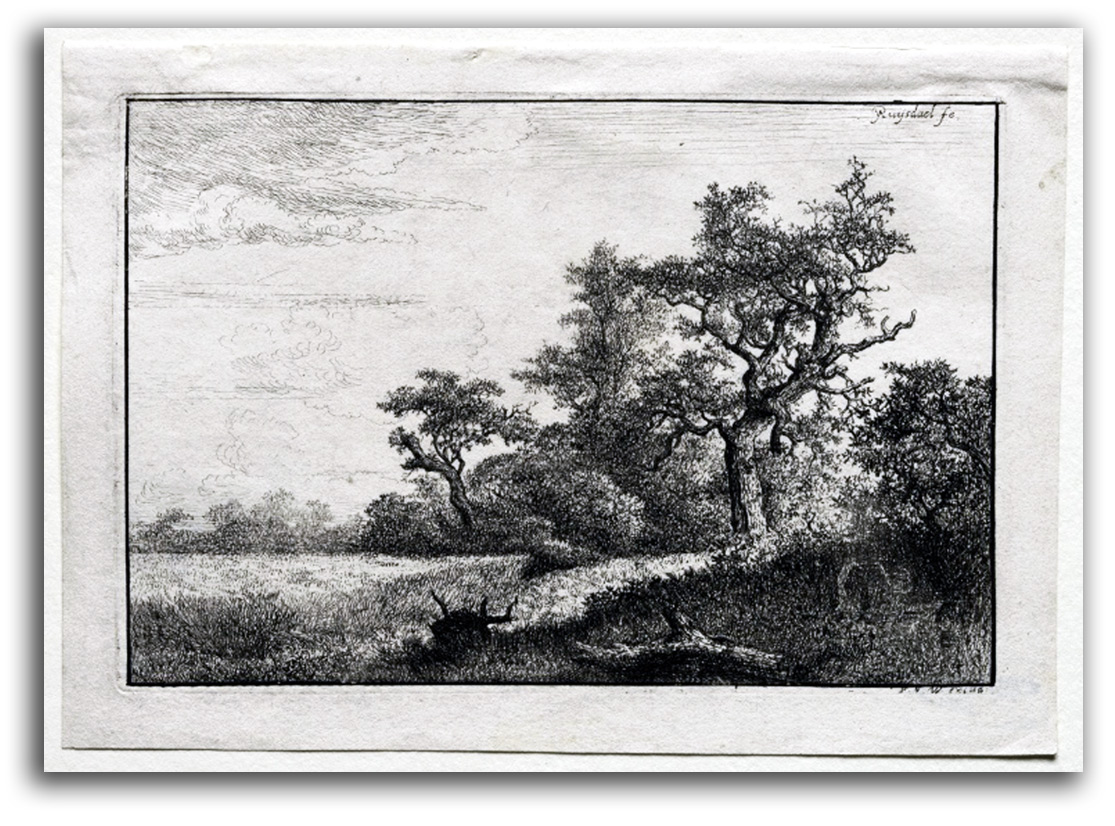
The Wheatfield (Field boadered by Trees) etched
c1646-55
Replica wood engraving, 1891
Collection: IAD (2012)
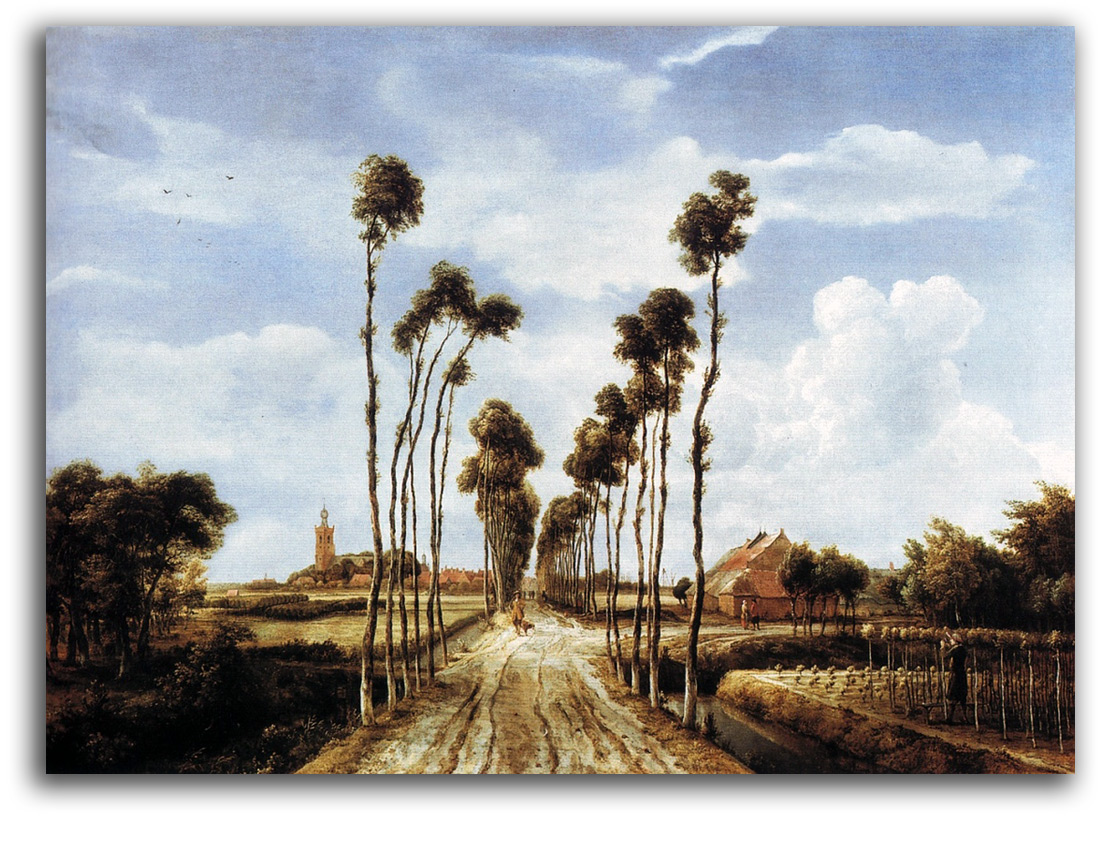
HOBBEMA (after)
The Avenue at Middelharnis (painted 1689)
Poster
Edition of the National Gallery, London
Collection: IAD (2012)
NOTE: Meindert Hobbema studied under Ruisdael and continued Ruisdael’s love of trees in the open air. When I was looking for a scholar to catalogue the Dutch paintings in the Fine Arts Museums of San Francisco, I asked the advice of a friend – the highly respected Dutch curator, Robert de Vries, Director of the Royal Picture Gallery at the Maurithuis in The Hague. When we talked about this painting, he told me the view towards the little village in South Holland has changed very little. This painting is in his words: “both simple and majestic.” This canvas is not only Hobbema’s best known painting. It may well be the best known of all Dutch landscape paintings. In some magical way, Hobbema has made the material ethereal.
17th century French:
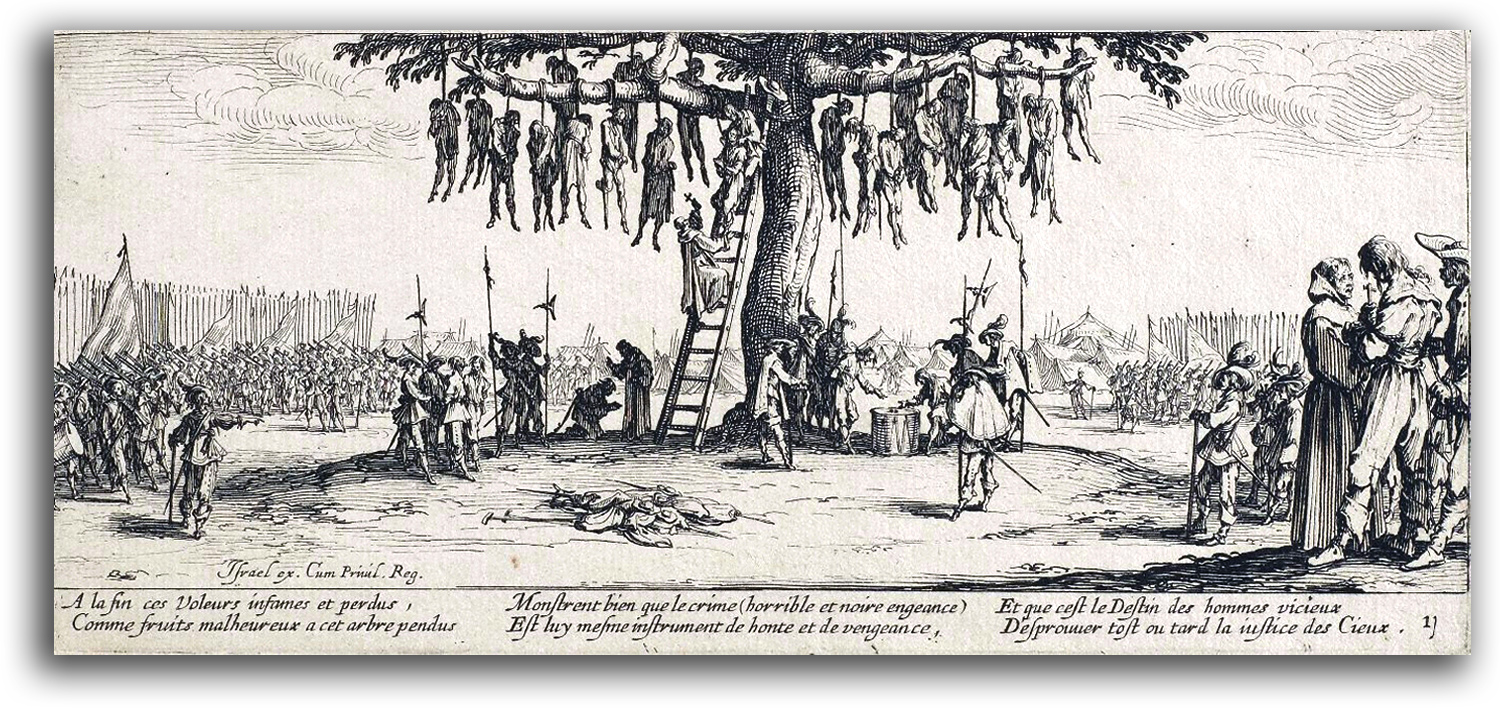
CALLOT
The Hanging, c1633
Original Etching from
LES MISERES ET LES MALHEURS DE LA GUERRE, 1633
Collection: FLG
NOTE: THE MISERIES OF WAR is Jacques Callot’s most famous work. The bloody Wars of Religion had been going on for years in the countryside of his native Lorraine near Nancy. For him, the horrible realities of war had a kind of normalcy. Callot made some 1400 etchings and a number of important technical innovations to the technique of etching. Most importantly, he recorded the daily life of soldiers, and clowns, and beggars with such psychological depth that his work was studied by many who came after him including Rembrandt and Goya.
(@WAP)
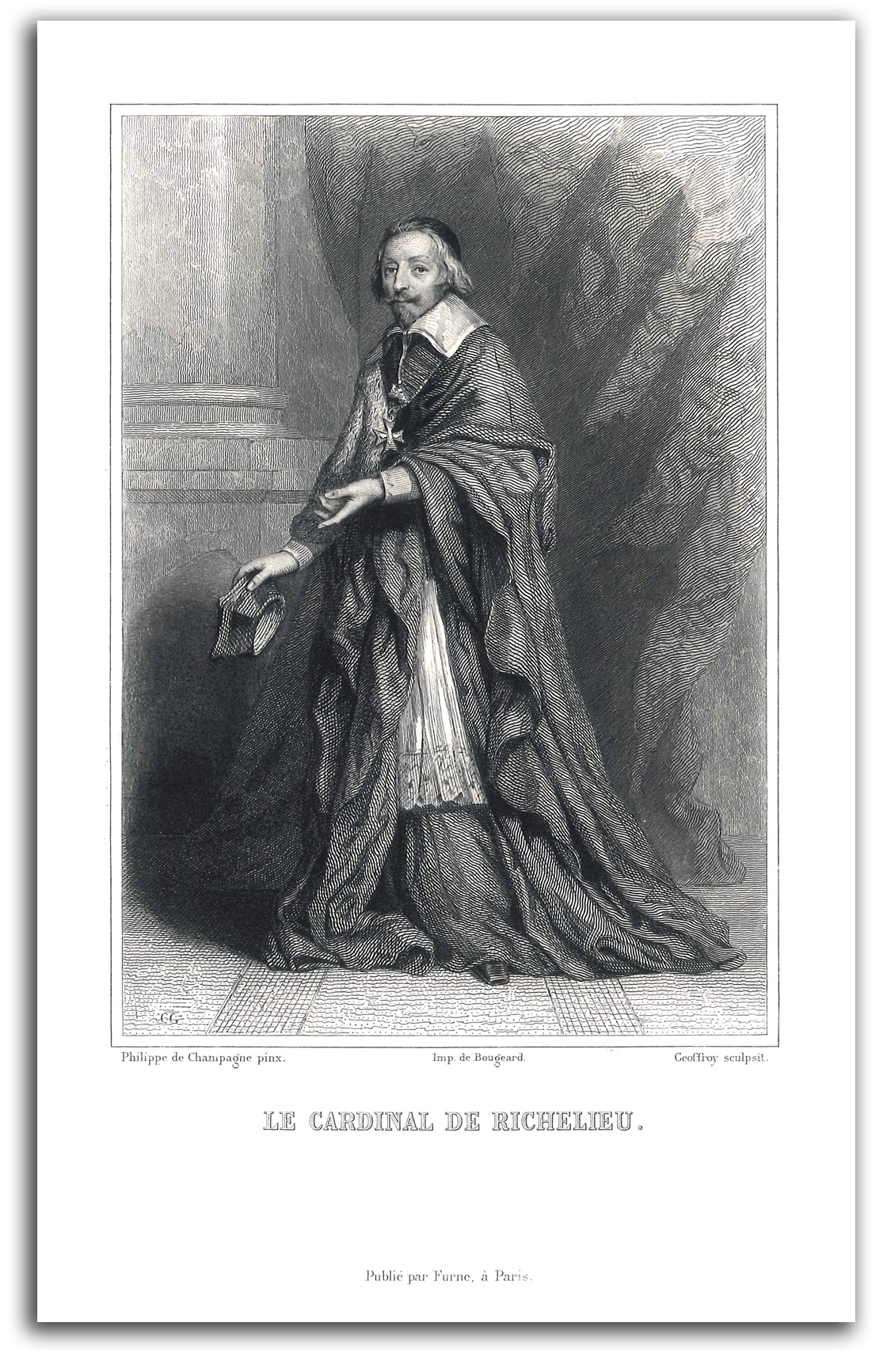
CHAMPAIGNE (after)
Cardinal Richelieu (painted c1640)
Etching by Geoffroy, 1853
Collection: IAD (2012)
NOTE: Philippe de Champaigne was a Flemish-born Frenchman who worked under Poussin during his early years. He became one the best of the many fine French potrait painters of the 17th century. This portrait is one of his best known works. The Cardinal was the chief minister of King Louis XIII and governed France with an iron fist from 1624 until his death in 1642. In effect, he was the first modern Prime Minister. He raised taxes on the poor (not the rich), fought wars, crushed revolts, and centralized the power of the king over the nobles. Richelieu also was a major art collector and patron. He founded the Académie Francaise. In 20th century popular culture, he usually is a major villain in film versions of “The Three Musketeers.” The original painting of about 1640 is in the National Gallery, London.
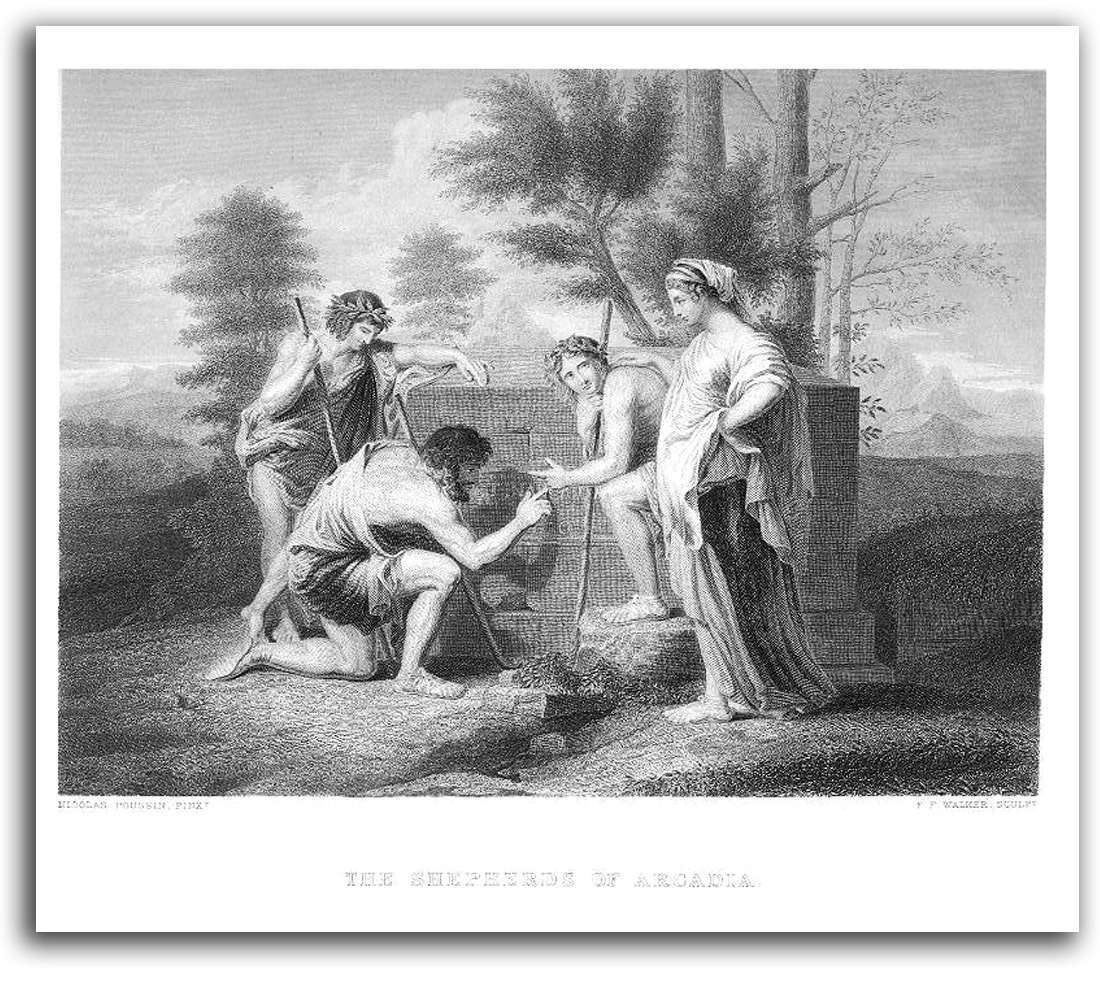
POUSSIN (after)
The Sheperds of Arcadia (painted c1638)
Engraving by Walker, c1870
Collection: FLG
NOTE: Arcady in ancient Greece was said to be the only place where there were no cities. It was thought to be a kind of utopia, a paradise. These Arcadian sheperds and a sheperdess gather around a tomb which is inscribed with these Latin words: Et in Arcadia ego. That may be translated as: “Death is even here in Arcadia.” This is one of Poussin’s best known images. In his characteristic manner, the composition is as solid as geometry, as solid as the block of stone being examined. Many feel that human figures had never before been arranged with such exacting logic, except perhaps in the work of Leonardo. In this sensitive engraving, the engraver has taken the liberty of interpreting the scene in a dramatic way, playing down the surroundings in order to place emphasis on the two interlocking geometries – the block and the group. The original painting is in the Louvre.
(@WAP)
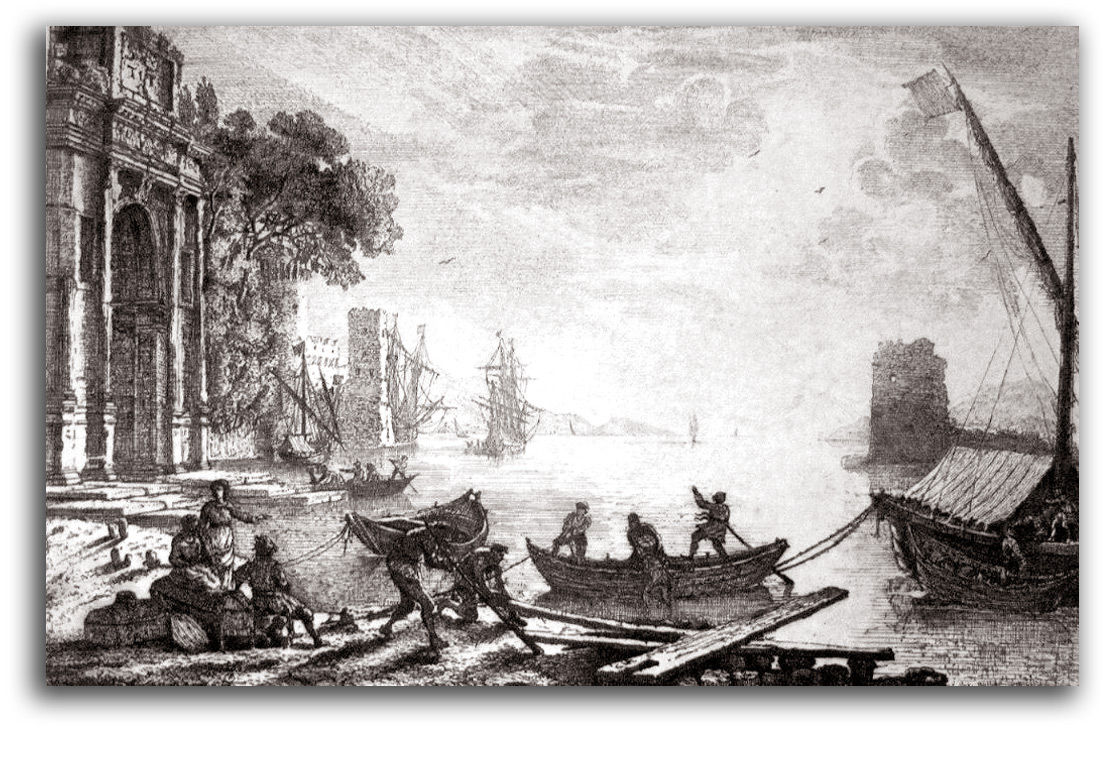
LORRAIN
Harbor Scene with Rising Sun (Le Soleil Levant)
Etching, 1634
Collection: IAD
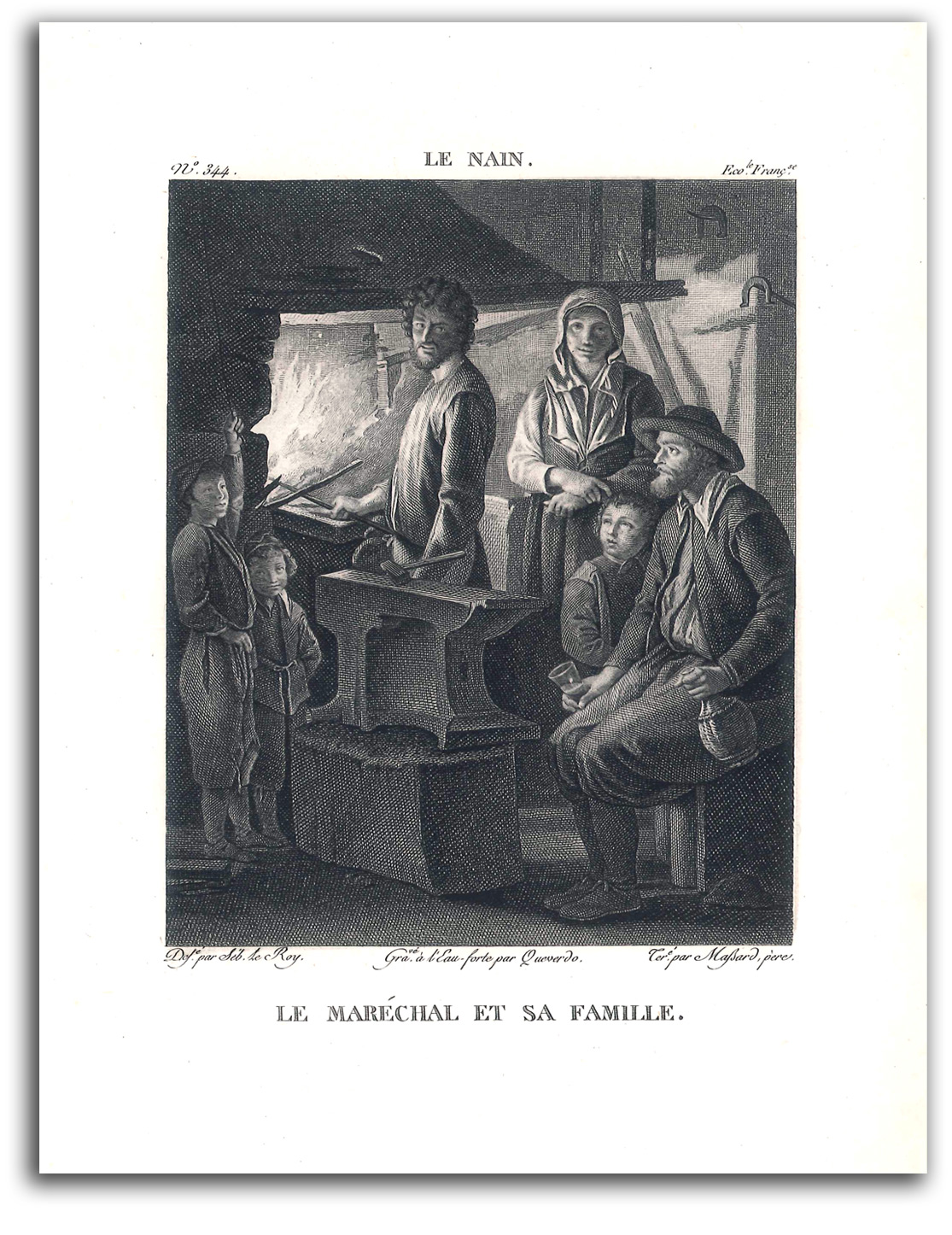
LE NAIN (after)
The Blacksmith & his Family (painted 17th century)
Engraving, 19th century
Collection: IAD (2012)
NOTE: Louis Le Nain and his two brothers were not interested in mythology or puffing the ego of nobles. His focus was on the contemporary realities of working class life. This part of society had rarely been painted. He gave to these people a dignity never seen before. Le Nain would continue to be admired for centuries as a pioneer of Realism.
18th century French:
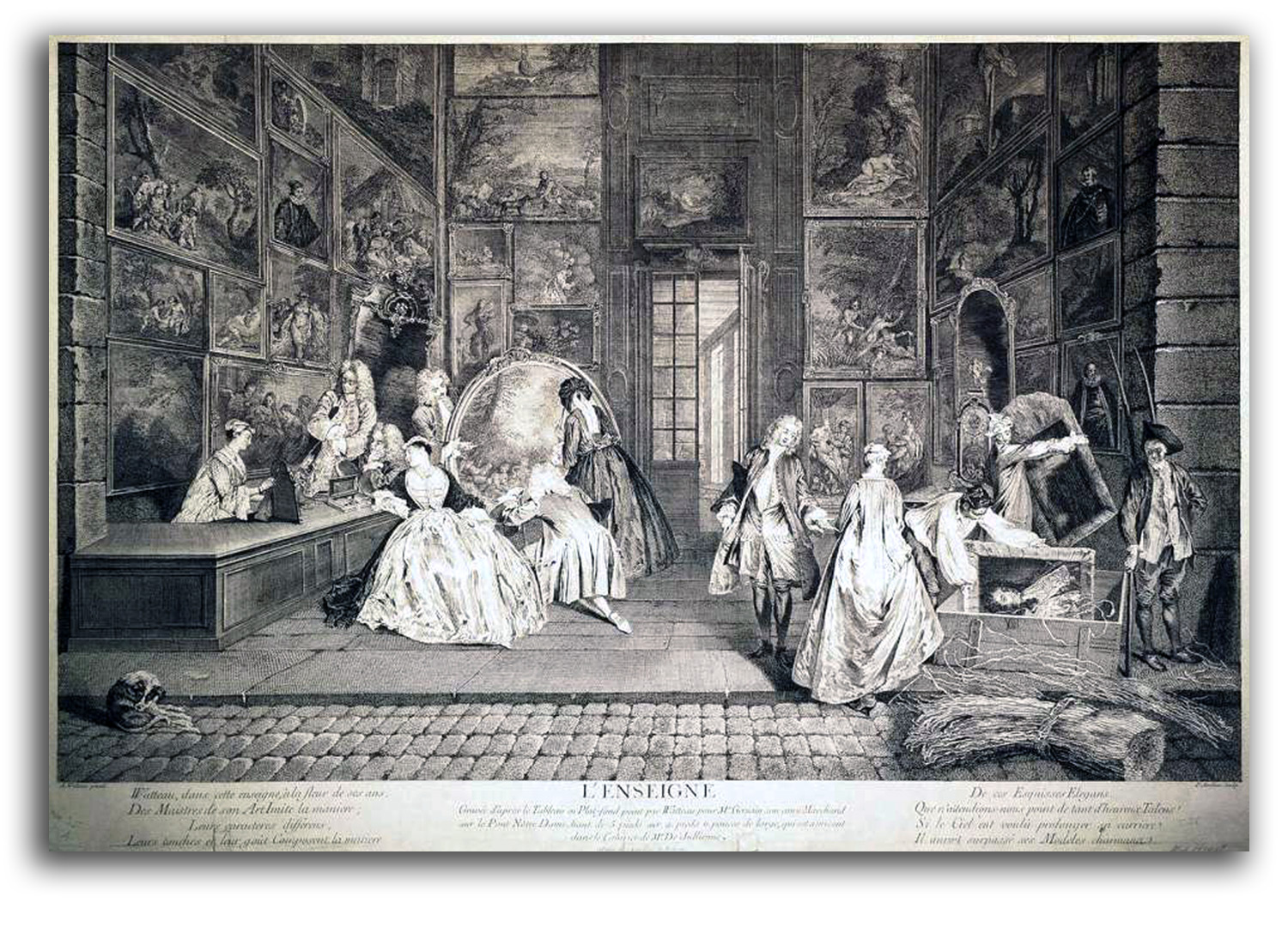
WATTEAU (after)
Gersaint’s Art Gallery (aka The Shop Sign of Gersaint)
Painted c1720
Etching by Aveline, 1732
Collection: Unknown
NOTE: During much of the 18th century, France was the dominant power in Europe, both militarily and culturally. King Louis XIV during the later 17th century had made France a superpower. Many other nations copied its architecture, paintings, and clothes. French became the international language of Europe. The style that dominated the 17th century in Europe was the Baroque. Visually, to simplify, that means a few large forms moving slowly through space. The style that dominated the 18th century in France was the Rococo. Visually, to simplify, that means a multiplicity of small forms moving rapidly. Rooms became smaller. Colors and moods became lighter. One wonders of these patrons had a care in the world other than their attachment to superficiality. They were living in a dreamland.
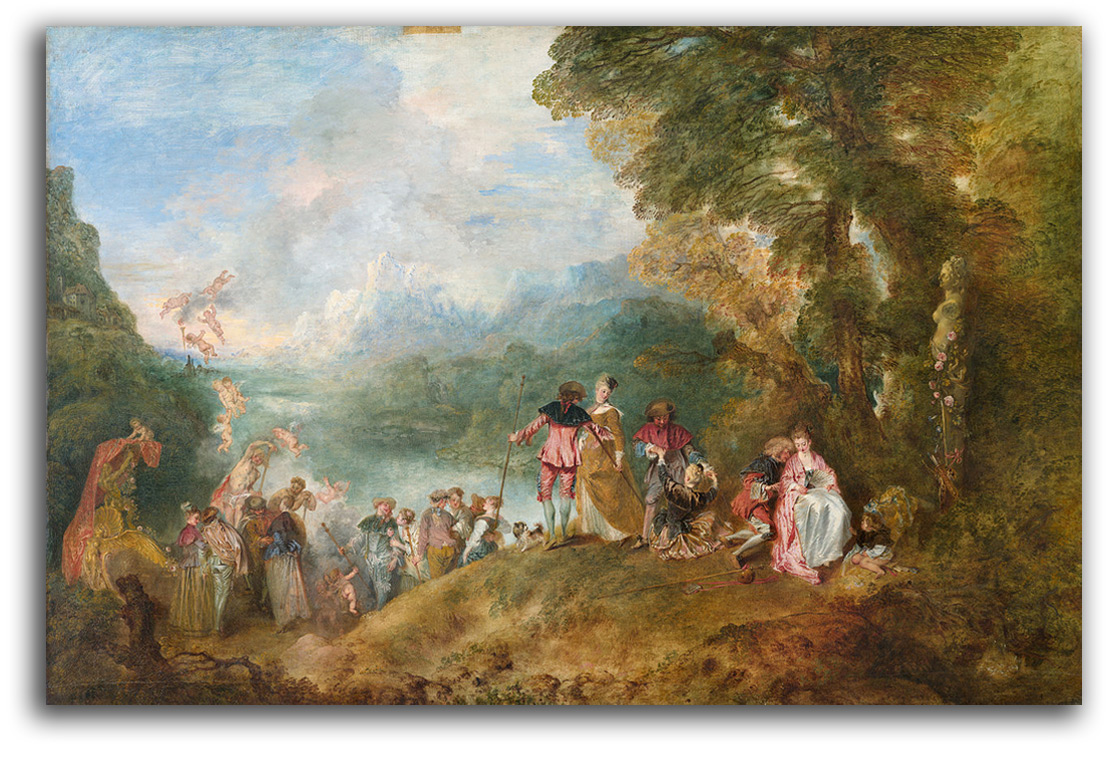
WATTEAU – Embarcation for Cythera
Collection: The Louvre
The leading painters in France included Watteau, Boucher, and Fragonard. All three also engraved their paintings themselves, from time to time. Antoine Watteau was the first great French artist of the era. His work was so popular that after his death, over 600 of his works were made into prints. That formed an almost complete record of his work. He established the early Rococo style that was followed during most of the rest of the century. This picture (painted to be a sign outside Gersainst’s gallery) was his last major composition. It shows King Louis XIV packing his art collection.
The Rococo style was designed for the pleasure of the upper classes whose lives were focused on self-indulgence and conspicuous consumption. Watteau’s graceful compositions are as fluid as the silks that his men and women wear. Many in the upper classes of this period contributed nothing to society, and they paid no taxes. Some, such as the philosophes, however contributed a great deal by creating plays, novels, poetry, encyclopedias as well as the scientific and increasingly democratic ideals of the Enlightenment. The economic strength of the middle classes (the Third Estate) grew dramatically over the century and eventually overthrew the king and the decadent nobility in the Revolution of 1789.
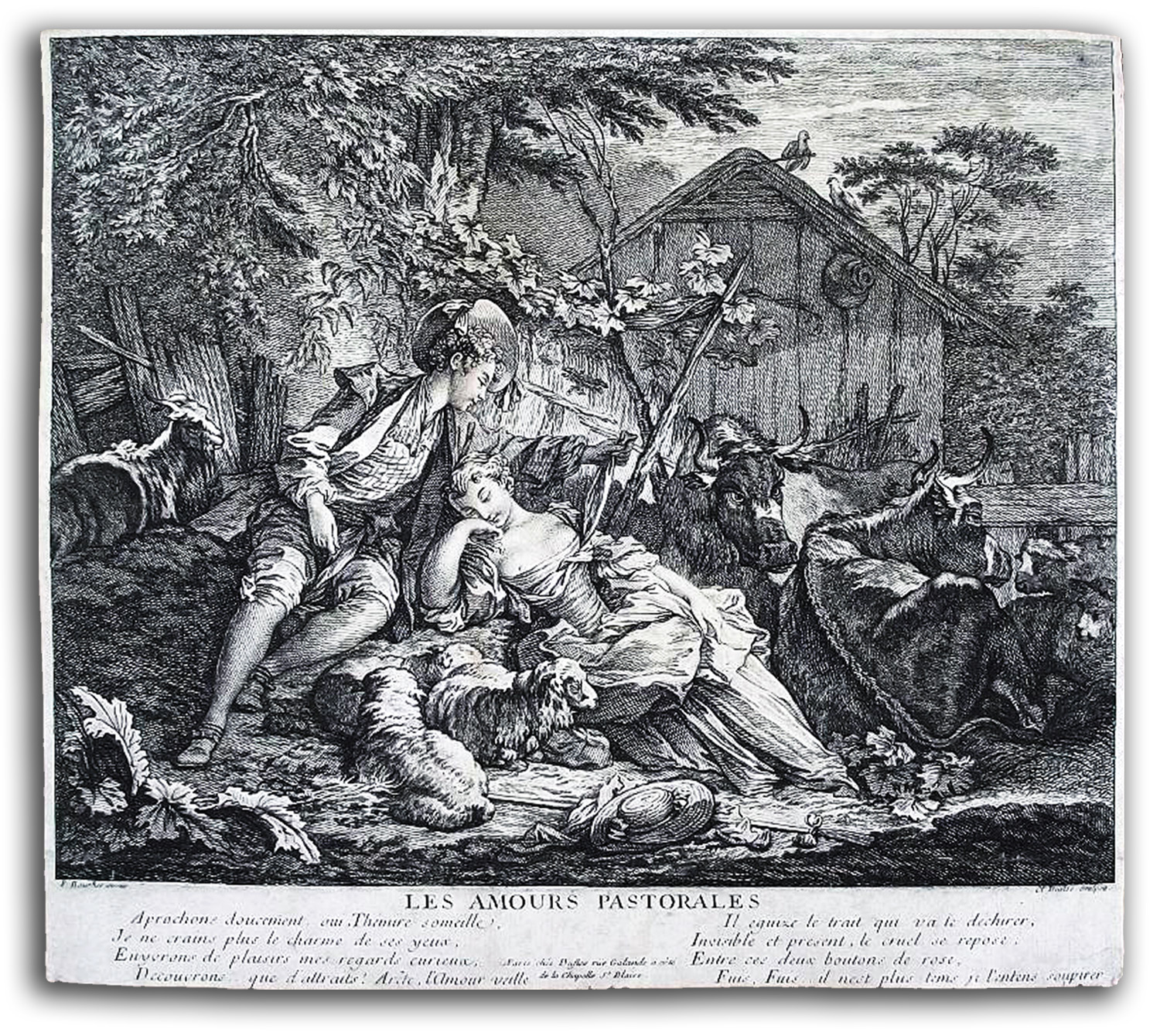
BOUCHER (after)
Pastoral Love
Etching by Duflos, 18th century
Collection: IAD (2012)
NOTE: Francois Boucher was the leading master of the mature Rococo during the middle of the 18th century. He worked in many media: painting, drawing, prints, tapertries, porcelain, stage design, and costumes. He had much to do with the spread of the Rococo to most of Europe. Highly favored by King Louis XV and Madame de Pompadour, he became Director of the Royal Academy. This contemporary 18th century etching by Duflos one of the best of Boucher’s etchings. The subject of rustic lovers is a fantasy genre that Boucher invented.
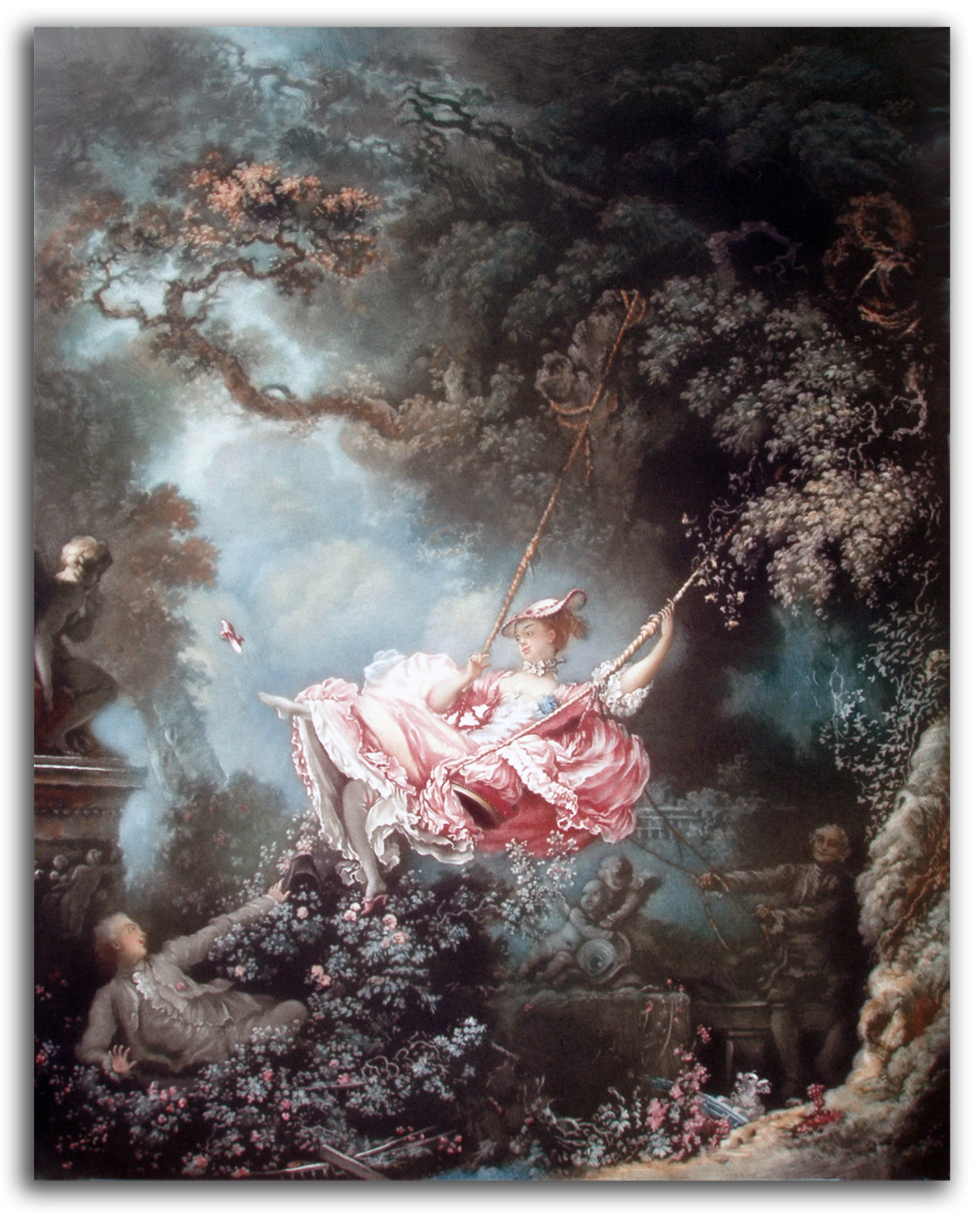
FRAGONARD (after)
The Swing (painted 1765-70)
Etching, ND
Facsimile etching by Molnar, c.1955
Collection: IAD (2012)
NOTE: Jean-Honoré Fragonard was a gifted painter-printmaker of the late Rococo. Exuberant, hedonistic, and energetic, he produced over 500 paintings. He studied under Boucher who let him make replicas of his paintings. He later became very successful in the pleasure-loving court of King Louis XV. His favorite theme was love. The painting of “The Swing” is now in the Wallace Collection in London. It probably is Fragonard’s best known painting. His highly theatrical subjects may seem silly to modern eyes, but his perfumed pictures were a mirror of his times. Those who defend “Frago” point out that he used his versatile brush better than any other painter of the age. His brushwork was indeed much admired by Daumier and Renoir. He also was able to change with the times, and made Neo Classical paintings after about 1780, and even shared a studio with his friend David, leader of the Neo Classical Movement of the late 18th century. During this period, his earlier shallow libertine eroticism changed dramatically. His late allegories of love expressed a new Romanic vison of love as a mystical experience. Fragonard had a second career as the first curator of the Louvre after it became a public museum following the Revolution of 1789.
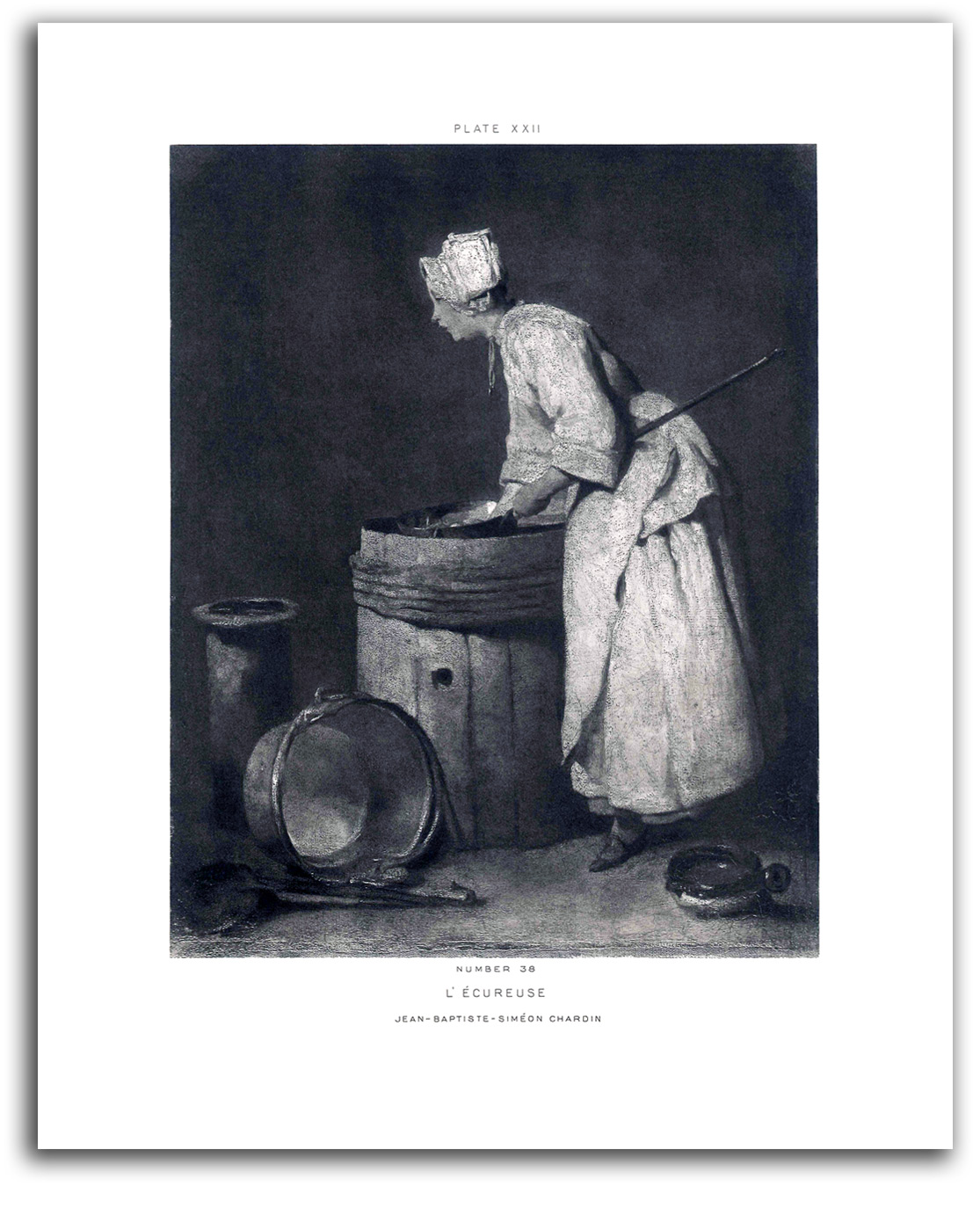
CHARDIN (after)
Scullery Maid (painted 1738)
Gravure, 19th century
Collection: IAD
NOTE: Not every French painter of the 18th century was dedicated to making pastry-like frivolities for the decadent aristrocracy to consume. The growing middle class found a hero in the paintings and prints of J.-B.-S. Chardin. He was deeply dedicated to family values (especially those of the working class), and to an extremely skilled form of still-life painting that inspired later French painters up to the time of Manet, Cézanne, Matisse, and Braque. The scullery maid assisted the kitchen maid in the great houses of the time, doing most of the cleaning. She was the lowest ranking of all the household maids. In Walt Disney’s 1950 film, Cinderella was a scullery maid. The very personification of industrious sincerity, Chardin had a second job as curator of the annual salon. The original painting is in the Hunterian Art Gallery, Glasgow.
18th Century English: HOGARTH & GAINSBOROUGH
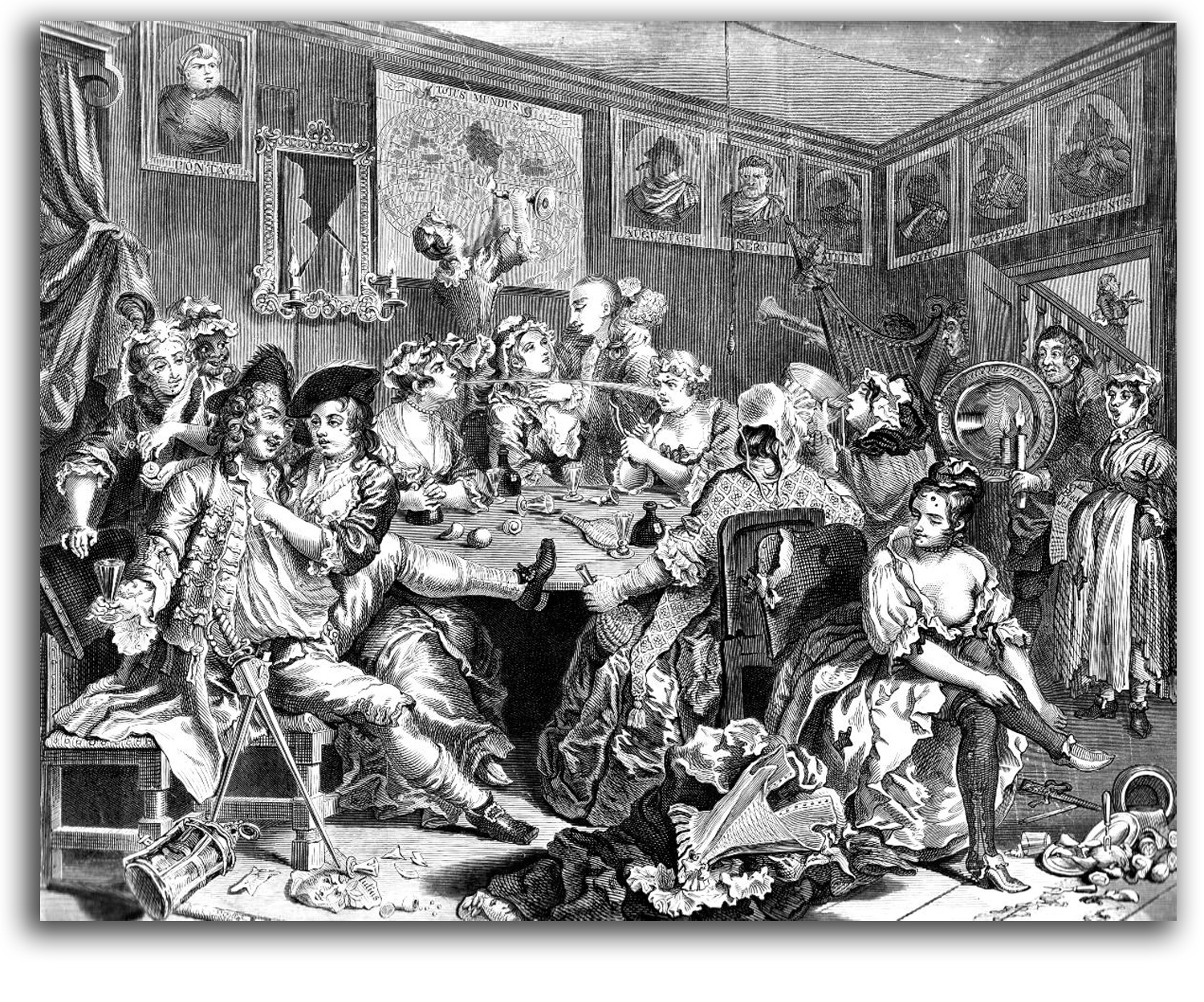
HOGARTH
The Tavern Scene (painted 1732-33)
Engraving, Plate 3 of 8 from A RAKE’S PROGRESS, 1735
Collection: Unknown
NOTE: William Hogarth was an English printermaker, story teller, and social critic in the early 18th century. Since printmaking began, it has served more often than not as a way of telling stories. The earliest handmade prints told religious stories silently. Since the advent of the printing press in the middle of the 15th century, the Western World has been enriched by billions of illustrated books, periodicals, and newspapers. Hogarth published his story-books as portfolios of engravings such as A HARLOT’S PROGRESS (1731), A RAKE’S PROGRESS (1735), and INDUSTRY AND IDLENESS (1747). These were lively satirical critiques of immoral living rendered as if they were dramatic scenes on a stage. He quickly came to be regarded as a genius. He also was a painter of considerable skill. Many of his prints were first paintings. However, his fame rests on his prints. Among other things, Hogarth is credited with inventing sequential art in the Western World. In Modern times, this way of telling stories in a visual manner became comic strips, graphic novels, photo-essays, and the filmmaker’s storyboard.
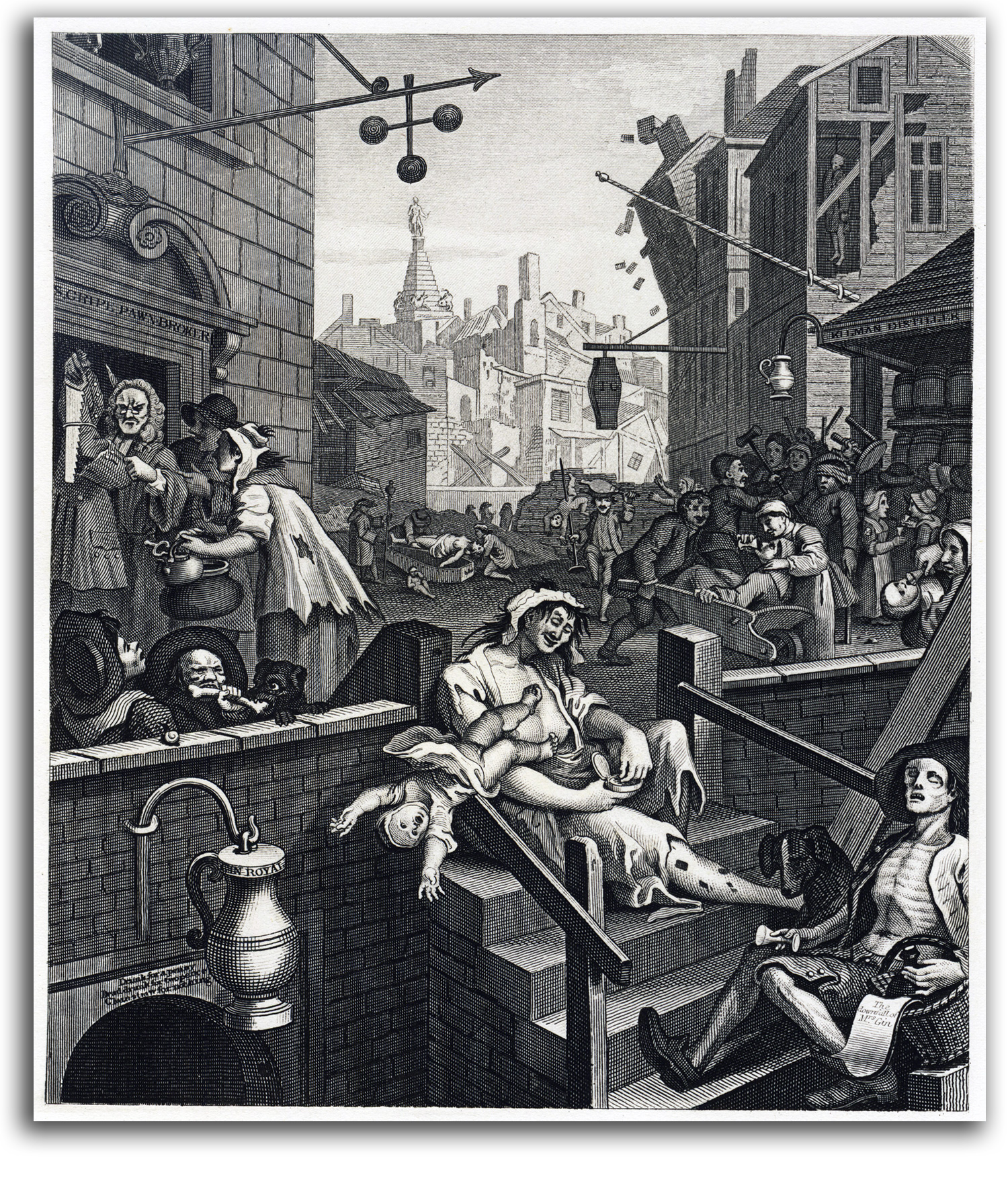
HOGARTH
Gin Lane, 1751
Engraving
Collection: Unknown
NOTE: Hogarth was not merely a humorist. He was out to improve society. His engraving “Gin Lane” (in which a drunk mother’s child falls to its death) helped to get passed a law restricting the use of gin.
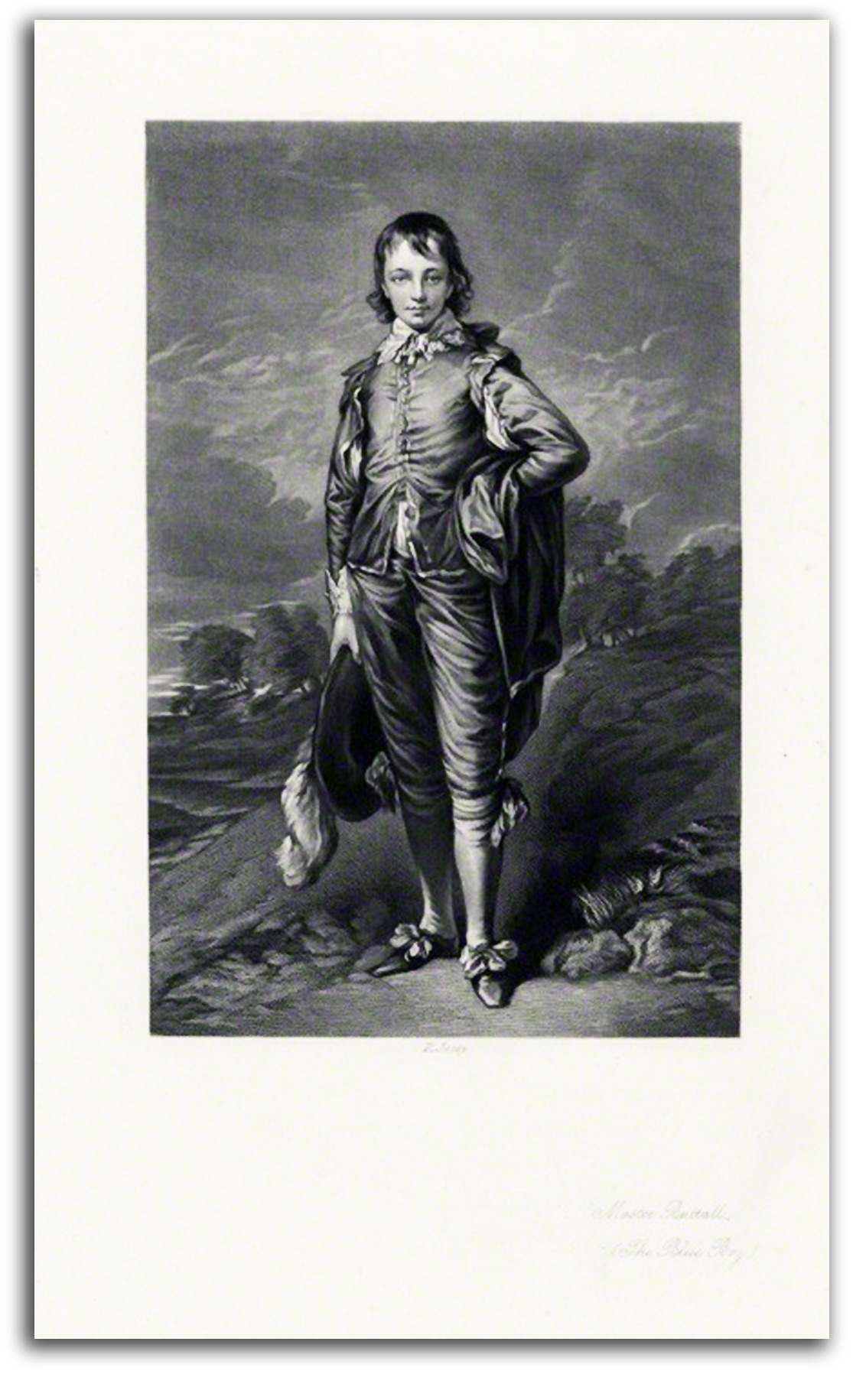
GAINSBOROUGH (after)
The Blue Boy (painted c1770)
Mezzotint by Crawford, 1922
Collection: Unknown
NOTE: Thomas Gainsborough was one of the most gifted portrait painters in 18th century England. He worked in the tradition of van Dyck. “Blue Boy,” who is wearing 17th century clothing, was a special homage to van Dyck. It is Gainsborough’s most famous painting, and perhaps the most famous painting of 18th century Europe. The painting is in the Huntington Library, San Marino, California. An endless number of prints, posters, and postcards have carried this iconic image. This 1922 mezzotint print is how many first “saw” Blue Boy. The painting had been purchased by the railroad magnate H. E. Huntington in 1921 for a record price. Before being sent to its new home in California, it was honored by a special showing at the National Gallery of Art in Washington, D.C. This print was made to celebrate the acquisition.
Part 7. BAROQUE EXHIBITIONS curated by FLG
FLEMISH PAINTINGS, 15th to 17th Centuries, 1972
THREE CENTURIES OF FRENCH ART
FROM THE NORTON SIMON COLLECTIONS,
Volume 1 [17TH & 18TH centuries} 1973:
Catalog Notes & wall labels for:
- Poussin
- Claude
- Moillon
- Monnoyer
- Largilliere
- Rigaud
- Watteau
- Pater
- de la Tour
- Chardin
- Fragonard
THE THREE MARYS by Rubens, 1973
(Simon Collection). De Young Museum wall label
TITUS by Rembrandt, 1973
(Simon Collection). De Young Museum wall label
STILL-LIFE by Zurburan, 1973
(Simon Collection). De Young Museum wall label
THE NEW FRENCH 17th-CENTURY GALLERY
at the California Palace of the Legion of Honor, 1974
[FLG DESIGN]
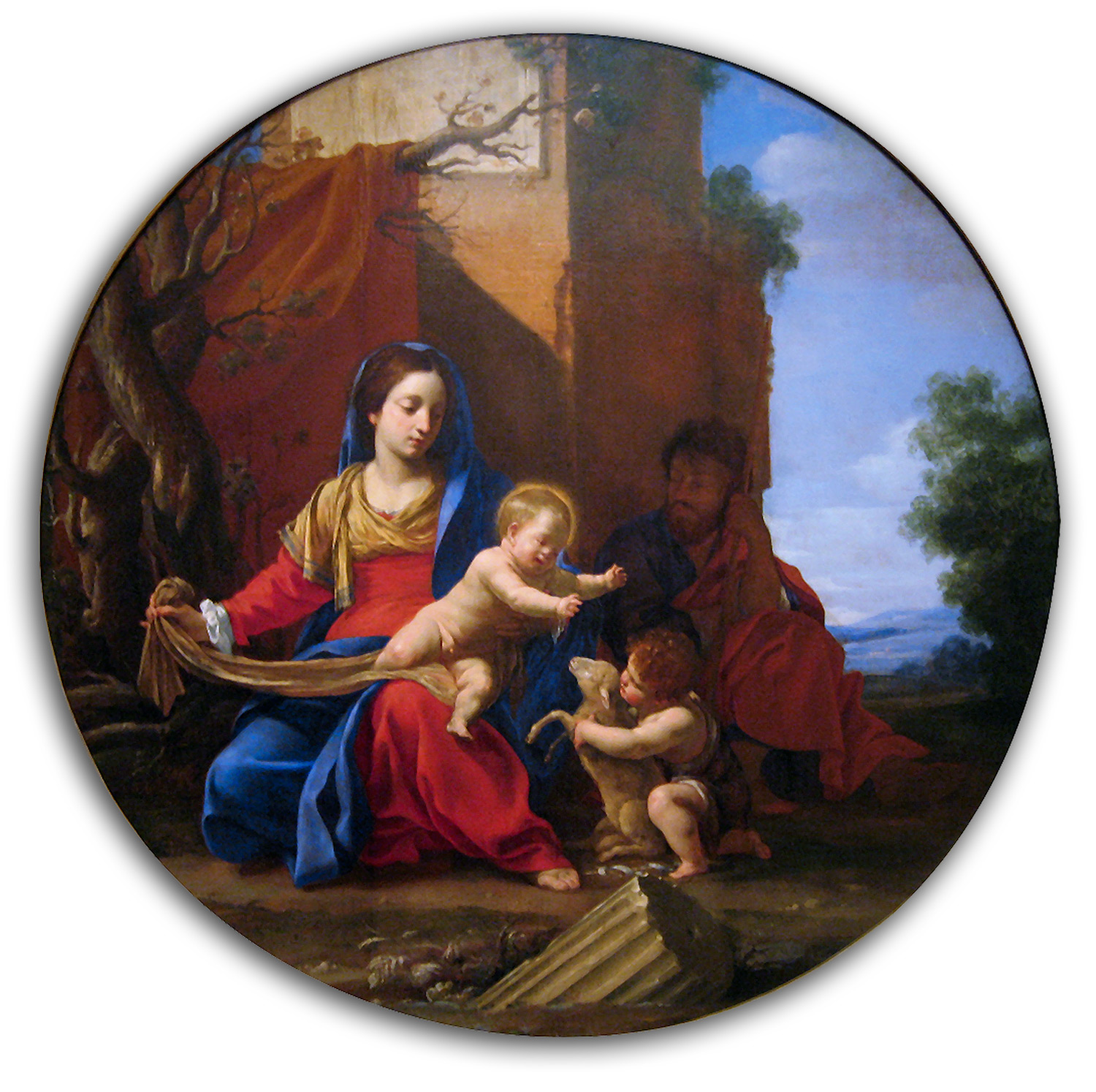
VOUET
THE HOLY FAMILY
Collection: Fine Arts Museums of San Francisco
THE HOLY FAMILY by Vouet:
A Baroque Masterpiece for the Legion of Honor, 1974
[FLG ACQUISITION]
Old Master Prints: Durer & Rembrandt, 1980
The Alchemical Prints of Robert Fludd, 1981