(before 1988)
PUBLICATIONS of
SUN MOON PRESS, WASHINGTON, D.C.
& HAND MADE PRESS, NEW YORK CITY
BOTTICELLI’S ILLUSTRATIONS FOR DANTE, 1963
Published for the East-West Gallery, Dupont Circle, Washington, D.C.
LEONARDO’S BOOK ILLUSTRATIONS
& The Symbolism of Platonic Solids, 1963
Published for the East-West Gallery, Dupont Circle, Washington, D.C.
(& 1984)
ANCIENT GREEK COINS from the Collection of F. L. Graham, 1964
Published for the Slideroom Gallery, Columbia University, New York City
PORTRAITS OF NICHOLAS LANIER:
An Exhibition of Photographs, 1965
Published for the Slideroom Gallery, Columbia University, New York City
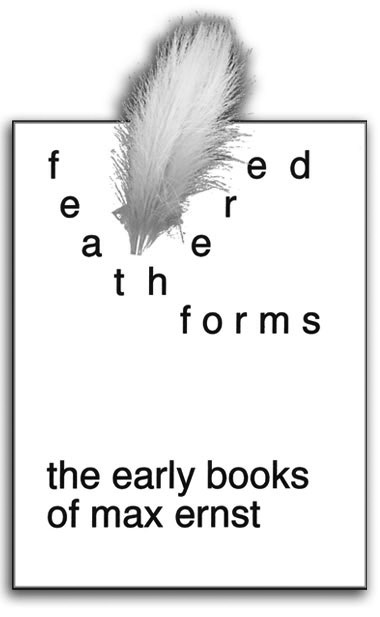
FEATHERED FORMS:
The Early Books of Max Ernst, 1967
Published for the Garden Gallery, 41 Grove Street
Greenwich Village, New York City
NOTE: In the library of Kenyon College in the fall of 1958 I discovered the Dada Movement and the technique of collage. I fell in love with both instantly. My favorite collage artists were (and still are) Max Ernst and Kurt Schwitters. As soon as I could I started to collect Illustrated Books by Ernst that I still treasure. I met Max at his Jewish Museum exhibition in 1966. We hit it off. His bright blue eyes burned holes right through me. Experiencing that feeling reminded me of the story of when Confucius met Lao Tzu. Confucius is said to have reported: “I have seen Dragon Eyes!” I had begun a handmade book called The Sin of 100 Debts (in homage to his “graphic novel” La Femme 100 Tetes) using some of his collages linked with some of my poems. I asked his permission to print the combination. Max said: “Perhaps. First recite a few of your little poems.” I did and named the matching collages. He lit up, nodded “yes,” and the project became a little green book in 1967. Why green? Because, Max and I agreed that green is the color of Alchemy. (My Duchamp book also is green for the same reason.) In the meantime, I curated a small exhibition of Max’s books in my Garden Gallery in Greenwich Village with loans from my friend George Wittenborn, New York’s #1 dealer in used art books. The show was called “Feathered Forms: The Early Books of Max Ernst.” Max liked both projects and gave me in gratitude some pages torn from his graphic masterpiece Une Semaine de Bonté, including (at my request) a page-print of one of his best Androgynes. I later lent that finely feathered wo-man to exhibitions at the Norton Simon Museum of Art (1991), and at the University Art Gallery of CSU East Bay (1999).
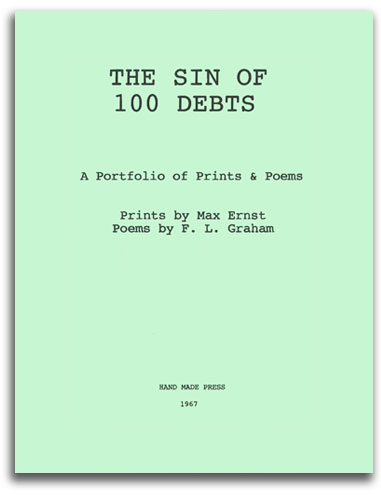
THE SIN OF 100 DEBTS:
A Portfolio of Prints & Poems
Prints by Max Ernst. Poems by F. L. Graham, 1967
Click here to view entire contents of “Sin of 100 Debts”
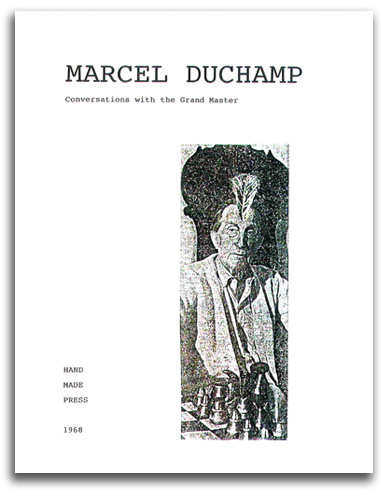
MARCEL DUCHAMP:
Conversations with the Grand Master 1968
Published for the Beaux-Arts Gallery
20 West 76th Street, New York City
NOTE: Duchamp had become a hero to me because of the sparkling luminosity of his mind. As I got to know him, I also came to love the warmth of his heart. Alfred Barr, my mentor at MoMA, gave to Marcel as a present one of my MoMA chess sets in 1967. Alfred had blessed that object by approving that it enter into the Permanent Collection of MoMA, and that it be editioned as MoMA’s first commercial object. Marcel liked the design so much he told Alfred he wanted to meet me. That was an invitation I could not refuse. Chess had been my favorite game for many years, but I had never expected to be playing end-games with a Grand Master! I had long wanted to write a book about chess set designs. Marcel favored the project and gave me wonderful information about designs he had developed and about designs by a number of his friends, including Ernst, Tanguy, Man Ray, Noguchi, and Calder. Some of those sets surrounded us in his living room. He also helped me understand more deeply the Alchemical symbolism of the Androgyne. That “teaching” was a major development in my study of sacred symbolism. My book, Chess Sets, came out in 1968. It was dedicated (with his permission) to Marcel. I later curated two Duchamp exhibitions – one at the Norton Simon Museum (1991), and another at CSUEB (2001). In 2003, as my last tribute to the Grand Master, I publishedDuchamp & Androgyny: Art, Gender, and Metaphysics. Marcel died (laughing) in 1968. I made this memorial portrait of Marcel for Teeny. For a long time I carried her “thank you” telegram in my pocket.
The most important words Marcel said to me were about philosophy in general and Androgyny in particular. I had pressed him on Androgyne symbolism in part because I had been a student of Alchemy before becoming a student of Buddhism, and in part because I was struck my how often the Androgyne appeared in the work of many Surrealists. With his permission, I published parts of our conversations in this 1968 brochure and again in my 2003 book Duchamp & Androgyny: Art, Gender, and Metaphysics. Here is part of how one conversation went.
FLG: May we call your perspective Alchemical?
MD: We may. It is an Alchemical understanding. But don’t stop there. If we do, some will think I’ll be trying to turn lead into gold back in the kitchen [laughing]. Alchemy is a kind of philosophy, a kind of thinking that leads to a way of understanding. We may also call this perspective Tantric (as Brancusi would say), or, as you say Perennial. The Androgyne is not limited to any one religion or philosophy. The symbol is universal. The Androgyne is above philosophy. If one has become the Androgyne one no longer has a need for philosophy.
PS: This brochure has been quoted or cited in quite a few Duchamp studies because it helps to clarify his relationship with philosophical Alchemy and with the concept of Androgyny. The most recent citation was in Marcia Brennan, CURATING CONSCIOUSNESS: MYSTICISM AND THE MODERN MUSEUM, MIT Press, 2010.
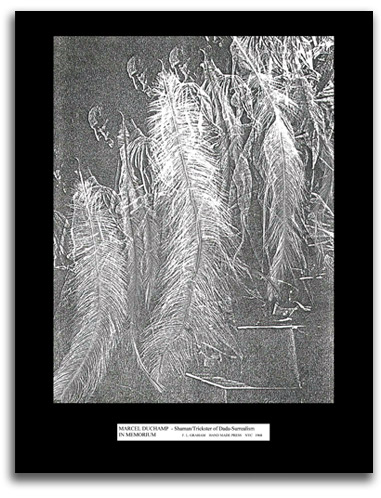
MARCEL DUCHAMP:
The Shaman/Trickster of Dada-Surrealism
IN MEMORIUM, 1968. Broadside #1
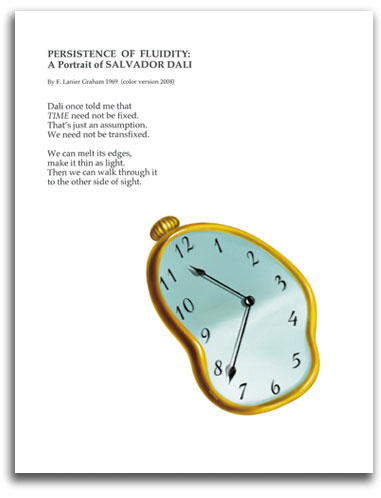
THE PERSISTENCE OF FLUIDITY:
A Portrait of Salvador Dali, 1969. Broadside #2
Click here for close-up view of Dali broadside
NOTE: Dali and I met in 1969 at his New York hotel. I asked for the meeting because I knew he loved Guimard, and wanted him to write something in time for my MoMA exhibition. He wanted to and did. I had thought him to be a madman. But it turned out that was just an act. He actually was a calm, thoughtful gentleman when he was not performing. The richest part of our conversation was about time. I told him of how, to “free myself from the prison of mechanical time,” I smashed my watch on the path to Old Kenyon (1959). “Wonderful!” he shouted throwing his hands in the air. Then he spoke of “fluid time – melted time,” using many of the words I captured in this little poem that I wrote right after our meeting. He came to the Guimard opening (March 1970) with a beautiful blonde dripping from each arm. Our first exchange that evening was traditional and formal; he thanked me for the poem I had written the day we met (“Persistence of Fluidity”). Our second exchange was a Surrealist performance. As I was giving him a tour him a tour of the show, he fell to his knees in front of Guimard’s magnificent cane. With hands folded in prayer and quivering, he begged me: “Please let me eat this cane!”
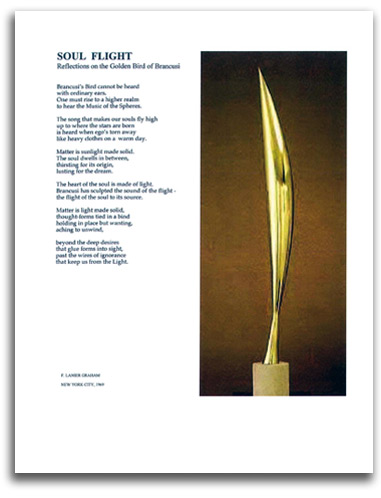
SOUL-FLIGHT:
The Golden Bird of Constantin Brancusi, 1969. Broadside #3
Click here for close-up view of Brancusi broadside
NOTE: When I was in high school Brancusi became my favorite sculptor. In some ways he still is. In 1956, seeing a photograph of “Bird in Space” in LIFEmagazine left me astonished. I sat on the floor dazed for a long time. I started learning about Brancusi’s spiritual philosophy during a stimulating conversation at Kenyon with Mircea Eliade (a conversation of February 1960 recorded in my book Duchamp & Androgyny).
Brancusi did not give his famous Bird the title of “Bird in Space,” and he did not like that title at all. His title was “Bird of the Ether.” He was disappointed that people thought the subject matter of this sculpture is an ordinary bird (or an ordinary airplane or an ordinary anything) flying through ordinary space. In his statements Brancusi is quite clear that the subject is the flight of the soul up to a higher realm, a realm called the Ether, a realm which is beyond space & time. By definition, this realm is “transcendent.” It transcends space & time. Both Brancusi, and his good friend Duchamp, were not religious. However, they had a metaphysical view that regards the material world as a condensation of the etheric world. In Duchamp’s “Large Glass” the whole ‘story’ illustrated in this composition condenses from ‘nothing’ into something, or rather ‘descends’ from an etheric cloud. Duchamp made a very naturalistic etching in 1968 called “The Bride Stripped Bare” in part as an ‘explanation’ of the very abstract image of The Bride in the “Large Glass.” This etching is a realistic image of a nude woman enveloped by a vaporous aura, or rather materializing out of an etheric cloud. One might say it is a “Nude Descending” from the etheric realm.
Conceived as an invisible, non-material something that fills the universe, the Ether was an accepted aspect of 19th-century physics. Light ‘obviously’ needed something to travel through. In the early 20th century the concept of Ether went out of fashion. But it did not entirely disappear. Some, including Einstein, wanted to keep some version alive. Recently, the concept of Ether has started to make a comeback among physicists. Now-a-days I am proposing to my friends in the physics community that the very new concept in astrophysics of “Dark Energy” (which is not so much dark as it is not-visible) should be called Ether.
The metaphysical view Brancusi and Duchamp shared is widely known as “Perennial Philosophy,” and is a common feature in the world’s great Wisdom Traditions. More often than not, the general structure of this metaphysical view in traditional philosophy is that the material world which we perceive inside the sphere of space & time is made up of four Elements: Fire, Air, Earth, Water. These are not the elements of modern science but rather a description of the four conditions of all matter: solid, liquid, etc. Where does matter come from? It descends from (or condenses out of) the invisible, infinite, non-material Ether, which is called the 5th Element or the Quintessence. Our senses are geared to deal with the experience of matter, and our left-brain rationality is able to put our sense-experiences into some kind or order. But that is the limit of the usefulness of those faculties. Traditional philosophers of the East & West consistently state that intuition is more important than reason. Brancusi and Duchamp and all the Surrealists agreed. Only the intuitive side of our mind, which we become aware of by means of our right-brain, is able to raise our awareness to a higher level of consciousness, to attain consciousness of the Transcendent. The teaching in the Wisdom Traditions is that only when our intuition is as strong as our rationality do we become conscious of the etheric realm, and the realms beyond that. When I asked Duchamp why Ernst made the Queen in his chess set larger than the King, he replied: “Because intuition is superior to reason. Is it not?” When I quoted this to Bill Hayter, England’s highly respected Surrealist (and a teacher of Zen philosophy to Pollock, de Kooning, and others during the 1940s), he smiled and said: “Of course! Dadaism, Surrealism, and Abstract Expressionism are all forms of spontaneous unreasoning.”
This poem was written after visiting the Brancusi exhibition at the Guggenheim in 1969. Thereafter I continued to read every Brancusi book I could get my hands on. I was particularly struck by how much Brancusi loved the Tibetan teachings of Milarepa whose book lived on a table by his bed. Brancusi apparently introduced many Paris artists to Tibetan Buddhism. I dreamed of doing a Brancusi show at the Norton Simon Museum when I started working there in 1987, bringing together for the first time the three “Birds” of Brancusi’s Indian Temple project. Two I had just left at the National Gallery of Australia. The third was starring at me in Simon’s collection. But that was not to be. At least I was able to install Simon’s “Bird in Space” in a way I thought Brancusi would have liked. Years later my curatorial dream of placing the three Indian Birds together was realized in a Philadelphia exhibition. The spirit of Brancusi is never far from me. Haunting marble replicas of his “Maiastra” and “Egg” still surround me every day at my desk.
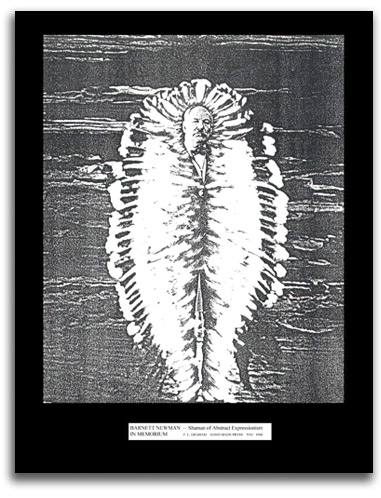
BARNETT NEWMAN:
The Shaman of Abstract Expressionism
IN MEMORIUM, 1970. Broadside #4
Published for the Arts+Crafts Gallery
Russian Hill, San Francisco [Appendix to Hand Made Press]
NOTE: I met Barnie at the home of Gov. Nelson Rockefeller in 1968. Because we had a mutual friend in Barbara Reise, that first conversation was very warm. (I recorded it in my journal.) We saw each other a number of times after that in New York, London, and Paris. In each of those cities we just bumped into each other on the street and stopped for coffee and a chat. Some of our favorite conversations were about how modern symbolism continues the transcendental symbolism of shamanism and the Egyptians. He had a joyful smile and was the most positive personality in the first generation of the New York School. Our last get-together was after his Knoedler show in March 1969 when he and his wife invited me to dinner. I cried when he died. Annalee was very supportive of what I later wrote about the philosophy behind his work as I was preparing THE SPONTANEOUS GESTURE: PRINTS & BOOKS OF THE ABSTRACT EXPRESSIONIST ERA. I made this memorial portrait for Annalee.
for two Newman letters, click here
PUBLICATIONS of MUSEUM OF MODERN ART,
NEW YORK
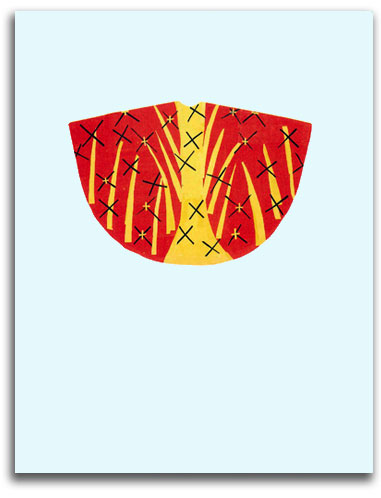
MATISSE CHAUSABLES, 1965
(exhibition postcard portfolio / full checklist)
NOTE: These religious vestments worn by priests during rituals were designed by Matisse for a Roman Catholic chapel in Venice that he designed. The chapel was built and outfitted between 1949 and 1951. Matisse called it his “masterpiece.” Many agree. He was responsible for every aspect of the architecture and design of he building. When asked if he believed in God, Matisse replied: “Only when I’m working.” In short, like most Modernists he was not a religious man. However, a secular sense of the sacred pervades his art and his writings. This exhibition was directed by Arthur Drexler. The job he assigned me was to compile the checklist for this portfolio of postcards and to supervise its production.
As Drexler’s assistant on this project, it was a joy to finally hold in my hand something by Matisse. He had been my favorite painter since high school. I went on to collect many of his prints & books as soon as I could afford it. There has always been a Matisse or two on one of my walls. The one up now is a signed “Blue Nude (Flowing Hair).” I curated an exhibition of Matisse paintings and prints at the Norton Simon Museum of Art in 1989 (to which I lent his color lithograph of “The Dance.”) That exhibition received high praise from John Elderfield who invited me to advise on which livres d’artistes to select for his gigantic Matisse exhibition at MoMA in 1992 (because I had catalogued all of Matisse’s books). John and I share a deep love for the great colorists of the 20th century. He later asked me to advise him on which prints to select for his de Kooning exhibition at MoMA in the Fall of 2011, the opening of which Gloria and I attended. John agreed with me that “Litho #1 (Waves #1) is Bill’s greatest print. It was given a place of honor in the MoMA show.
LUDWIG MIES VAN DER ROHE: DRAWINGS, 1966
(exhibition brochure / full checklist)
NOTE: MoMA has the world’s largest collection of Mies drawings. This brochure was a checklist the first exhibition of those drawings. The exhibition was directed by Arthur Drexler and assisted by FLG.
~ GKS
NOTE: I had hoped to meet Mies while compiling the catalogue data for this brochure and arranging for the conservation and framing of all the drawings we owned at the time, but it did not happen. What is important about this Drexler exhibition is that it convinced Mies and Phyllis Lambert that MoMA was serious about the place of Mies in history. What followed was the donation of the Mies Archive to MoMA.
LOUIS I. KAHN, 1966
(exhibition brochure / full checklist, with illustrations)
NOTE: Kahn is widely considered the most important American architect of the second half of the 20th century. This brochure was an illustrated checklist of his first retrospective. Arthur Drexler who planned the show fell ill, so the task of curating the exhibition fell to Ludwig Glaeser & FLG who wrote the checklist. Assisting was Vincent Scully.
~ GKS
NOTE: Working with Kahn in preparing for this exhibition was a special experience. It soon became clear that he was a poet-philosopher as well as an architect. Here are two of the things he said to me that I will never forget. “Yes architecture is all about form and space, but mainly it’s about the light that is defined by formed space. Architecture is carved light.” “I like what you said about the Salk plaza. The flowing water moving toward the sea does symbolize hope moving toward the dream. Salk spoke about hope that way, and that’s what those guys are doing there, working toward cures, moving toward the realization of dreams.” For me the Salk Institute is Kahn’s greatest work of art. I describe it to my students as the greatest American building of the later 20th century, the modern “Parthenon of the United States.”
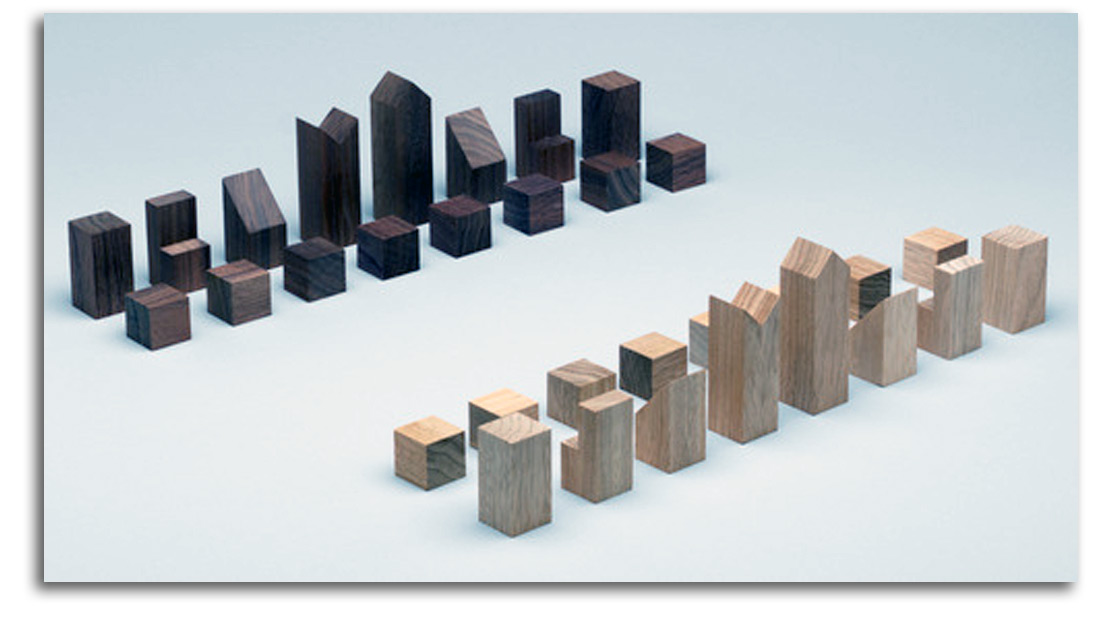
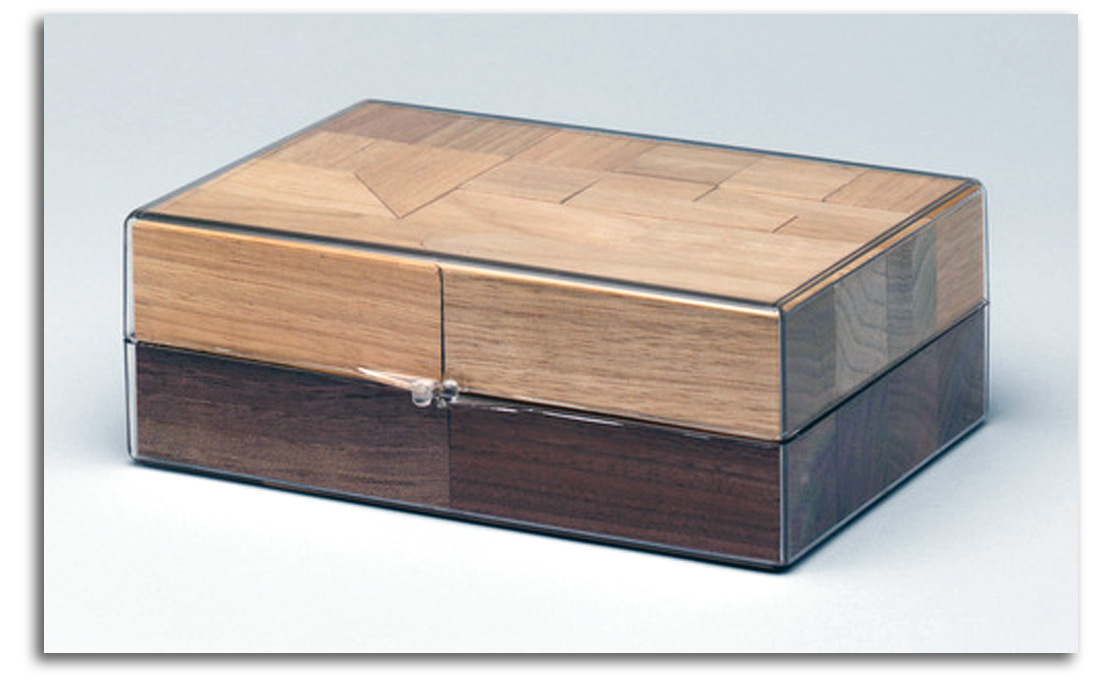
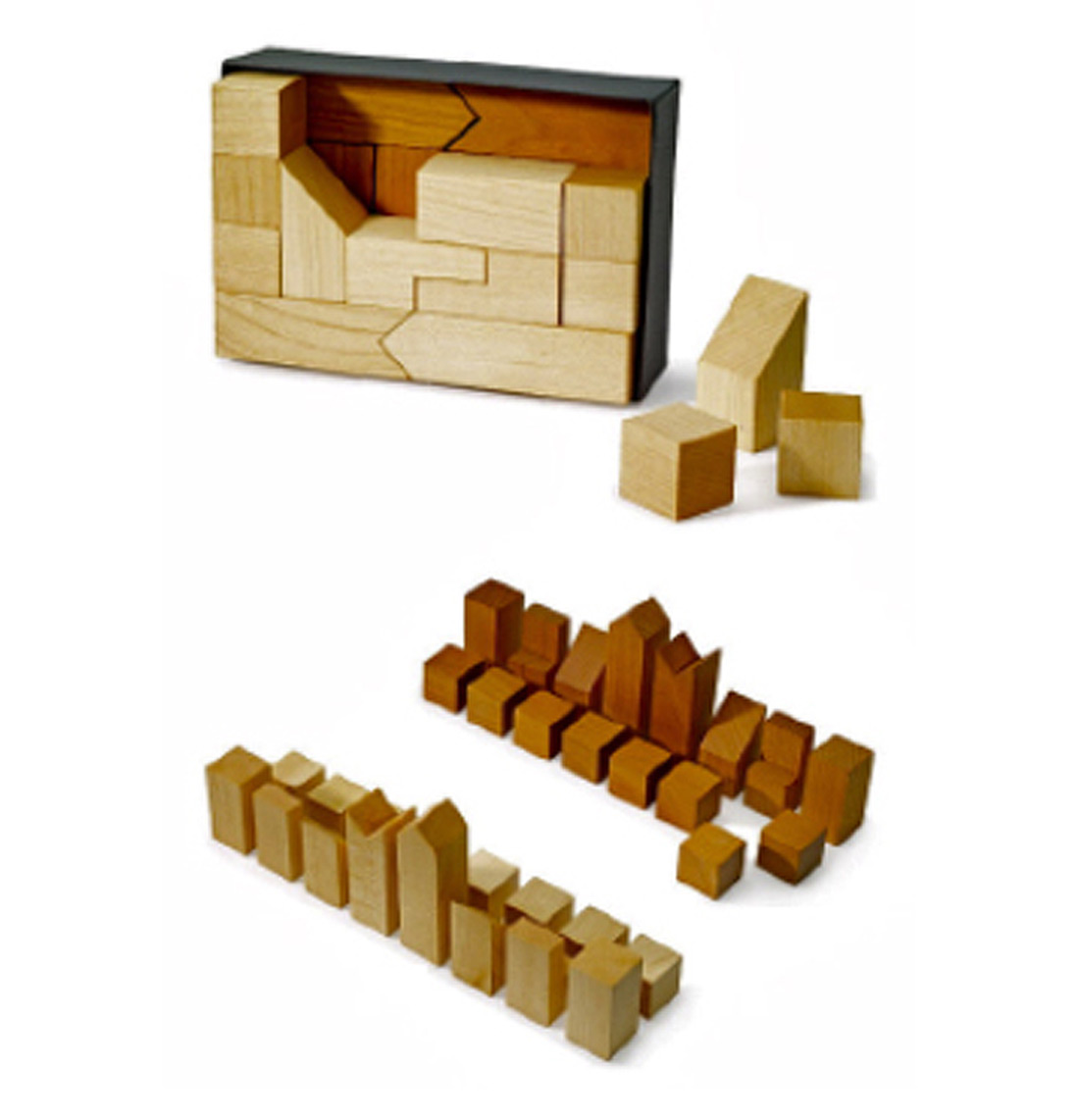
CHESS SET; A NOTE BY THE DESIGNER, 1968
(brochure in the box with the chess set)
1st Edition, 1968
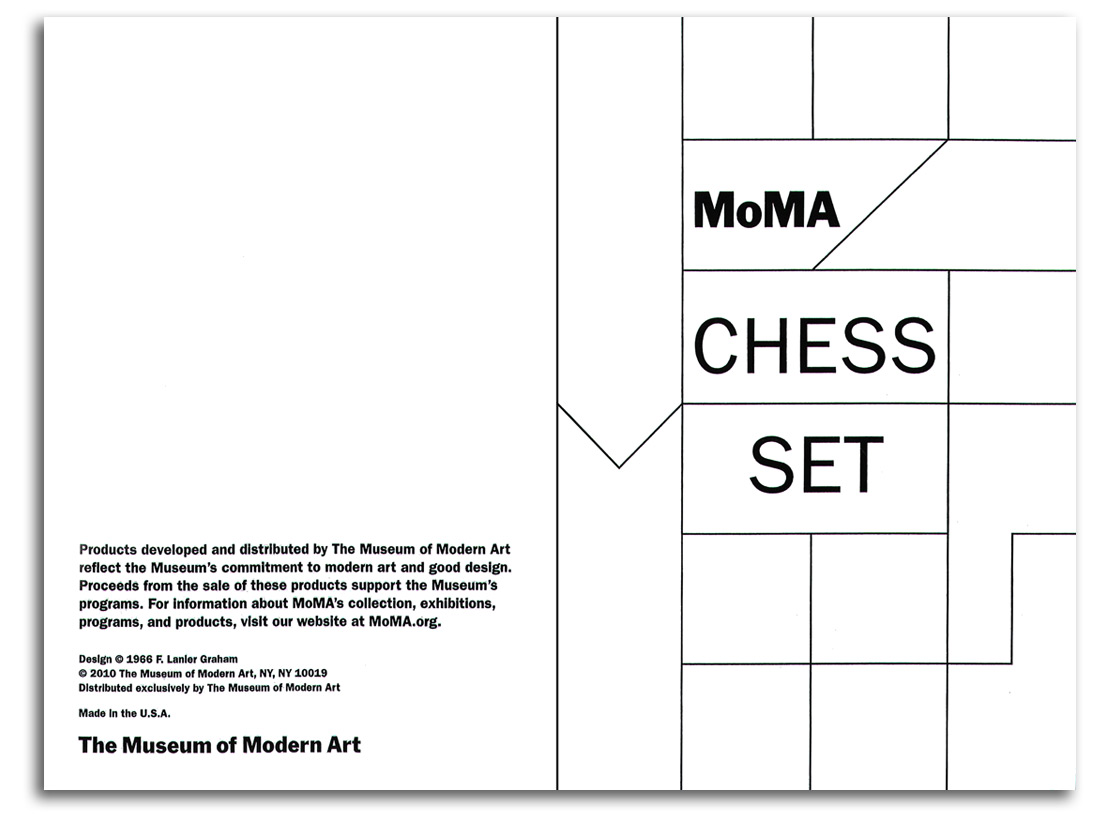
CHESS SET
2nd Edition, 2010
Related photos from the MoMA site:
PUBLICATIONS of FINE ARTS MUSEUMS
OF SAN FRANCISCO (FAMSF)
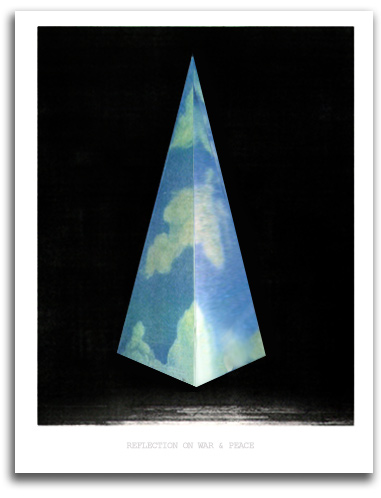
REFLECTION ON WAR & PEACE, 1970
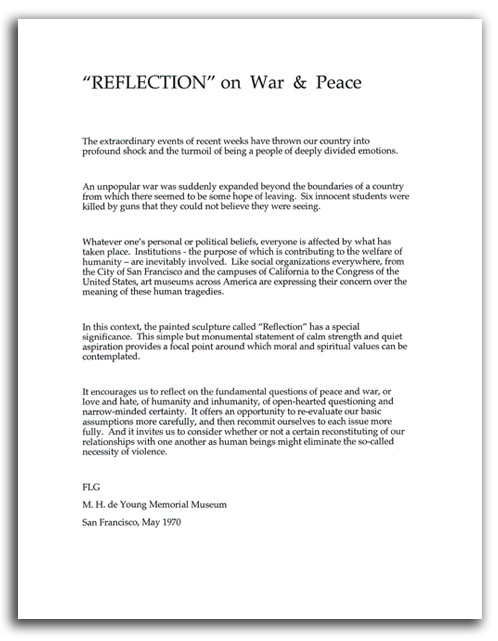
NOTE: This exhibition consisted of a dark meditation room with a single light falling on a pyramid painted with clouds. The show was a response to the massacre of students at Kent State and the invasion of Cambodia that dramatically expanded the Vietnam War. It was Graham’s first exhibition in San Francisco.
The exhibition was controversial. It was at the height of the Vietnam War, and the nation was bitterly divided. Many thought art museums should say nothing about it. Art museums were widely regarded as “above” such things. Graham disagreed. He argued that art museums are places were people reflect on the highest hopes and deepest values of humanity. He felt museums should also be engaged in discussing how such core values are operating in the contemporary world and not just the past. The position he took in presenting the “War & Peace” exhibition was not for or against. Instead, he advocated serious “reflection” on what was going on. What he created was a special space for meditating on the questions involved. In a city as liberal as San Francisco, Graham’s exhibition was better received than it would have been in other cities. ~ GKS
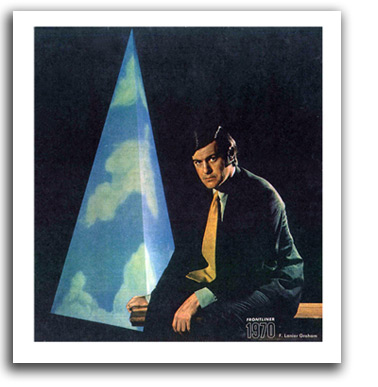
Cover of the Sunday Magazine of the SAN FRANCISCO EXAMINER, May 1970.
The cover story started with the “Reflection on War & Peace” exhibition then went on to be a long profile of FLG in his new position as Chief Curator of the de Young & Legion of Honor Museums.
THREE CENTURIES OF AMERICAN PAINTING, 1970
THREE CENTURIES OF FLEMISH PAINTING, 1971
THE ARMAND HAMMER COLLECTION, 1972
NOTE: Many of the bibliographic citations to this publication are incomplete or inaccurate. In part this is because it was not a regularly scheduled publication. It was put together in an odd way and in a great rush at the insistence of Dr. Hammer. The format was a portfolio assembled with plates published by the National Gallery in Washington, D.C. in 1970. The introduction, a biographical profile of Dr. Hammer, was written by FLG but “signed by Ian White.” ~ GKS
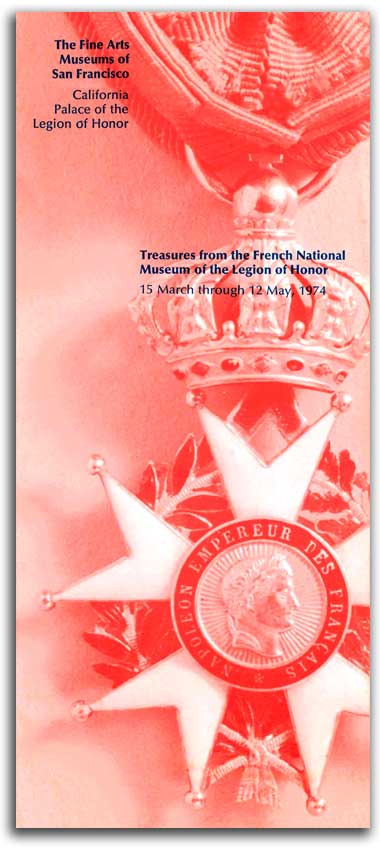
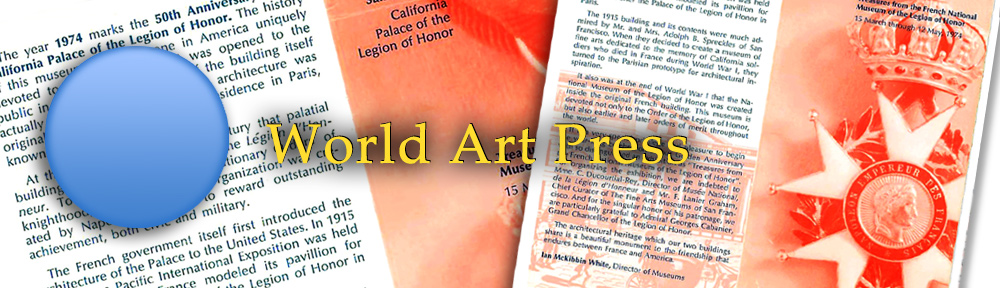
TREASURES FROM THE FRENCH NATIONAL MUSEUM OF THE LEGION OF HONOR
by Mme. Ducourtial-Rey 1974
NOTE: In 1970 FLG was invited to be Chief Curator of the California Palace of the Legion of Honor in San Francisco, in large part because he was a respected historian of French art. This museum, a memorial to the California soldiers who died in World War I, has housed fine art since 1924. Marshal Foch attended the groundbreaking ceremony. The building is a replica of the 18th century Hotel de Salm. In 1804 Napoleon made the Hotel de Salm the headquarters of the newly established Légion d’Honneur. The French building and the American building share a special history. President Charles de Gaulle visted the CPLH in 1960. President Georges Pompidou visted the CPLH in 1970. FLG also was appointed Vice Director, and Curator-in-Charge of Paintings & Sculpture, when that museum and the de Young Museum merged to become the Fine Arts Museums of San Francisco. Many of Graham’s efforts were designed to enrich the French traditions of the CPLH. He designed a masterplan for the merging city museums that made the California Palace of the Legion of Honor the only museum in the U.S. dedicated exclusively to French art. Graham used endowment funds to acquire masterpieces for each of the new chronological galleries: An Ecole de Fontainbleau “Venus & Cupid” for the new Renaissance Gallery, a Vouet for the new Baroque Gallery, a remarkable Monet “Water Lilies” for the new Impressionist Gallery. And finally a beautiful cast of Maillol’s “l’lle de France.” This acquisition extended into the 20th century the museum’s famous collection of French sculpture. At the heart of this collection are major pieces by Rodin, all from the master’s hand. Many museums have posthumous Rodin casts. All the San Francisco pieces by Rodin (bronze, marble, or plaster) are original. They were acquired directly from Rodin through the agency of Loie Fuller.
In 1973 FLG negotiated & curated “Three Centuries of French Art from the Norton Simon Collections” at the CPLH. Mr. Simon was a major collector of French art. His auction purchase of a Renoir for $1.5 million (U.S.) in 1968 is often considered the start of the contemporary million-dollar art market. The CPLH show was the first public presentation of the best-known part of Simon’s celebrated collection. The exhibition was widely considered one of the most important of the time. The show and Graham’s scholarly catalogue were very well received nationally and internationally. It was particularly admired by Michel Laclotte, Director of the Louvre, who was assisting in many ways the CPLH, “America’s French Museum.” Locally, Graham’s catalogue was used at California State University, Hayward, to teach the history of French art.
In 1974 “America’s French museum” celebrated its 50th Anniversary with many ceremonies. In attendance were senior dignitaries from the Ordre national de la Légion d’honneur. At the heart of the 1974 exhibition program were Monet paintings (centering of the newly acquired “Water Lilies”), French Impressionist paintings from the collection of Mrs. Florance Gould (negotiated & curated by FLG), and “Treasures from the French National Museum of the Legion of Honor” (negotiated & curated by FLG) with an Introduction by Mme. C. Ducourtial-Rey, Director of the National Museum of the Legion of Honor, who lent many masterpieces from that museum for the 50th Anniversary of its “sister” institution. The exhibition was opened by Admiral Georges Cabanier, Grand Chancellor of Ordre national de la Légion d’honneur. ~ GKS
SEVEN MASTERPIECES OF FRENCH PAINTING
FROM THE COLLECTION OF MRS. FLORENCE GOULD, 1974
NOTE: This also was a portfolio with an introduction written by FLG but signed by “Ian White.” The show was negotiated and curated by FLG.
PUBLICATIONS for
MARIN HEADLANDS ART CENTER
GOLDEN GATE NATIONAL RECREATION AREA,
MARIN COUNTY, CALIFORNIA
ANSEL ADAMS:
Photographer of Nature, 1982
NATURE SYMBOLIZED:
Turn-of-the Century Book Bindings, 1982
SYMBOLS OF THE EARTH SPIRIT:
Shamanism, Taoism, Hinduism, & Buddhism, 1982
SYMBOLS OF THE SKY SPIRIT:
Judaism, Christianity, & Islam, 1982
THE IMAGE OF NATURE IN MODERN ART, 1983
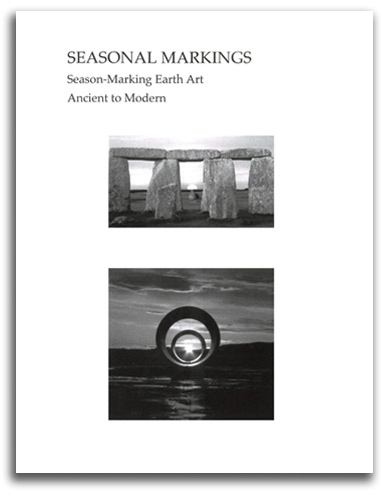
SEASONAL MARKINGS:
SEASON-MAKING EARTH ART, ANCIENT TO MODERN, 1983