Essays on World Architecture
& Spiritual Symbolism
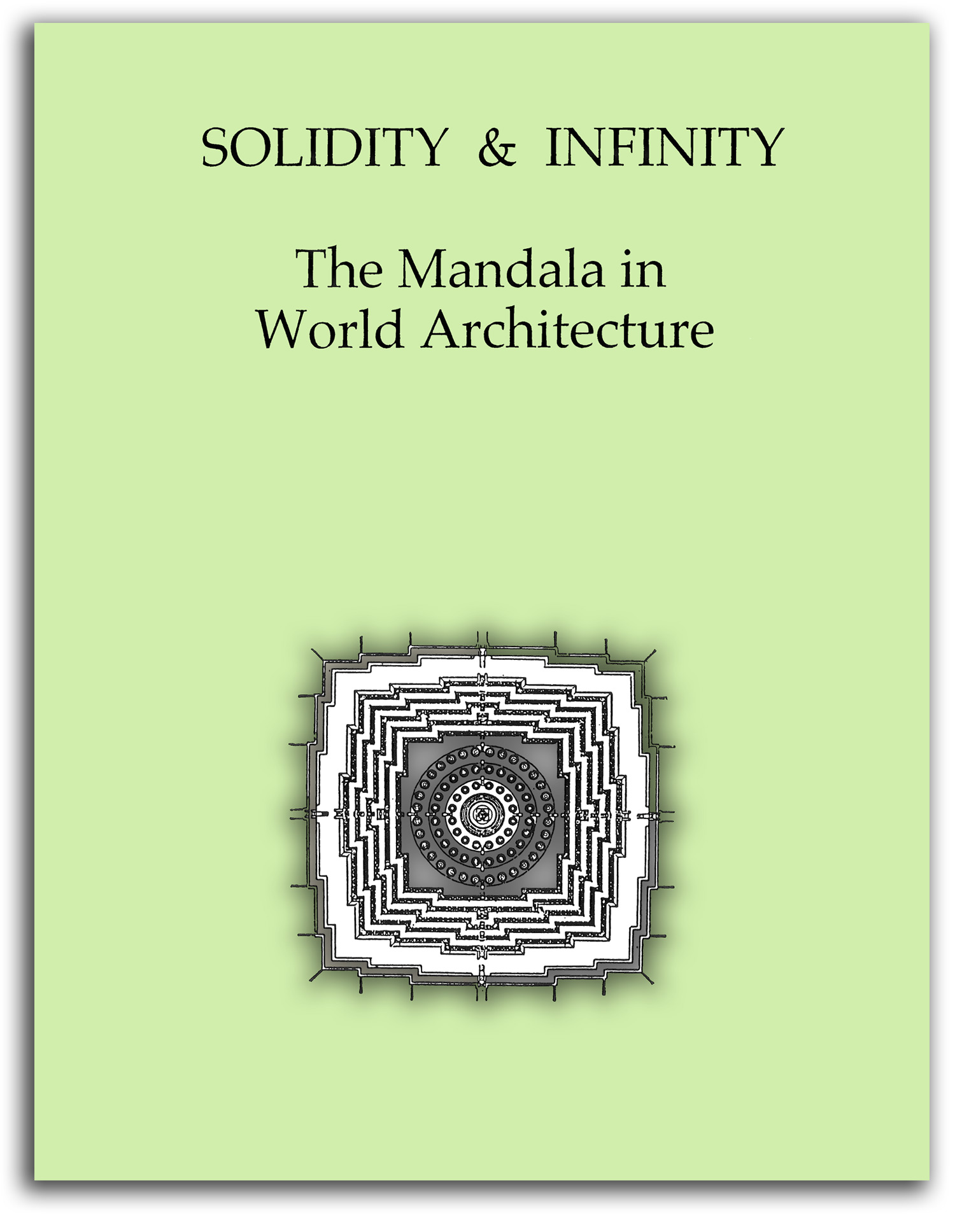
(Click here to view Part One of this title in PDF format)
(Click here to view Part Two of this title in PDF format)
Vol. 1 THE SYMBOLISM OF LEONARDO DA VINCI
1964a Leonardo’s ‘Vitruvian Man’ & the Philosophy of the Golden Proportion 1964b Leonardo’s Neo-Platonic Geometry: A Study in Universal Symbolism
Vol. 2 ART NOUVEAU SYMBOLISM OF HORTA & GUIMARD
1965a Victor Horta’s Art Nouveau Symbolism [Columbia University paper]
1965b Hector Guimard’s Art Nouveau Objects in the MOMA Collection
1965c Installing Hector Guimard’s ‘Metro’ in MOMA’s Sculpture Garden
Vol.3 DRAWINGS BY MIES, CORBUSIER, & KAHN
1966a Mies van de Rohe Drawings [MOMA exhibition checklist]
1966b Corbusier Drawings at Columbia University: A Technical Report [requested by J. M. Fitch]
1966c The Architecture of Louis I. Kahn [MOMA exhibition checklist]
Vol.4 CONTEMPORARY DESIGN & FUTURE DESIGN
1967a 2001: The Architecture of the Future [PBS TV Program]
1967b The Design Collection: Recent Acquisitions [MOMA press release]
Vol.5 CHESS SET DESIGN & SYMBOLISM
1967a The Architecture of Chess Set Design
1967b Chess Set Designs by Lanier Graham
1967c Chess Set: A Note by the Designer [MOMA brochure]
1967d Speaking of Chess: A Conversation with Marcel Duchamp
Vol.6 THE ICONOGRAPHY OF INFINITY IN MODERN ARCHITECTURE
1968a Guimard, Symbolism, & the Architecture of the Infinite
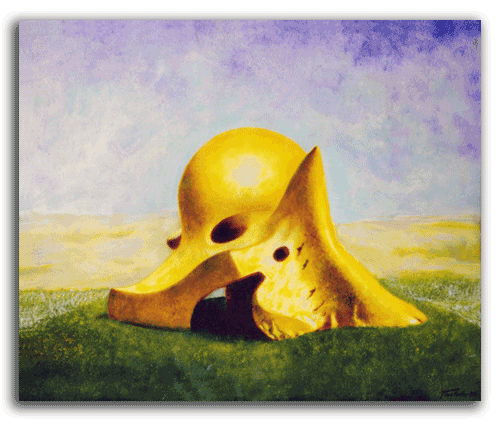
GOLDEN CATHEDRAL by Hermann Finsterlin. 1955 (signed)
(Based on his original design of the 1920s)
Oil painting on board. Collection: Canadian Center for Architecture, Montreal
Ex. Collection: Hermann Finsterlin
Gift of FLG & GKS, 1992
Cf. Franco Borsi, HERMANN FINSTERLIN, Firenze, 1969,
p. 200, color plate 28
1968b Finsterlin, Expressionism, & the Architecture of the Infinite
1968c Kiesler, Surrealism, & the Architecture of the Infinite
1968d Brancusi’s Temples & the Architecture of the Infinite
Vol.7 THE ENDLESS HOUSE: Then & Now
1969a From Kiesler to Urethane Foam [Georgia Tech. lecture, Atlanta, 1969, invited by James Grady]
Vol.8 LECTURES ON THE SYMBOLISM OF GUIMARD
1969b Prose-to-Poetry: The Influence of Viollet-le-Duc on Guimard [CAA paper, Washington, D.C., 1970, invited by Peter Selz]
1969c The Early Domestic Architecture of Hector Guimard [Victorian Society lecture, New York,1969, invited by H. R. Hitchcock]
1969d Abstract Naturalism: The Art of Hector Guimard [Museum lectures in San Francisco & Toronto, 1970]
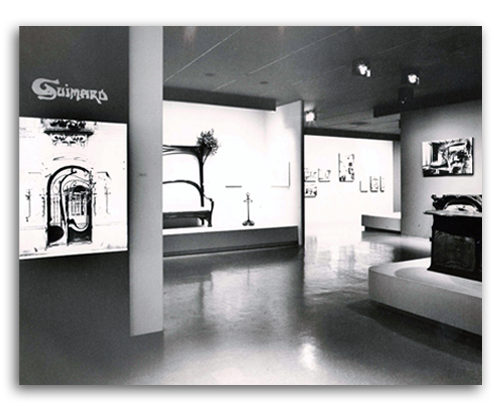
HECTOR GUIMARD show at MoMA, 1970. Design by FLG
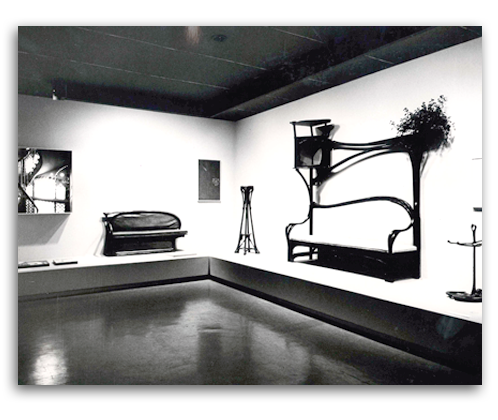
HECTOR GUIMARD show at MoMA, 1970. Design by FLG
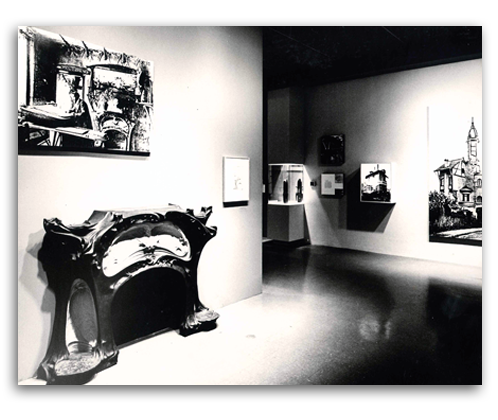
HECTOR GUIMARD show at MoMA, 1970. Design by FLG
Vol.9 ARCHITECTURAL REVIEWS
1970a The Guimard Show [The MOMA scrapbook of clippings]
1970b The Bauhaus Book [Review in PROGRESSIVE ARCHITECTURE]
NOTE: This was the first Guimard retrospective ever presented. The work involved locating the finest examples in the United States and France, negotiating a deal with French museum officials for loans, and in the design of the installation relating objects with architectural photographs. The exhibition was very well received and set a new attendance record for MoMA. FLG’s catalogue was the first book on Guimard. There would be many more.
It took about 5 years to gather the material from Europe and the United States and to negotiate a partnership with the Musée des Arts Décoratifs in Paris. The challenge of the chronological installation was to harmonize heavy objects with light drawings and architectural photographs.
~ GKS
Vol.10 SOLID LIGHT:
Symbolizing the Transcendent in the Rothko Chapel,
1971
Part 1. The Paintings of Rothko
Part 2. The Sculpture of Newman
Vol.11 ARCHITECTURE WITHOUT ARCHITECTS
The MOMA Exhibition at the de Young Museum, San Francisco
1972
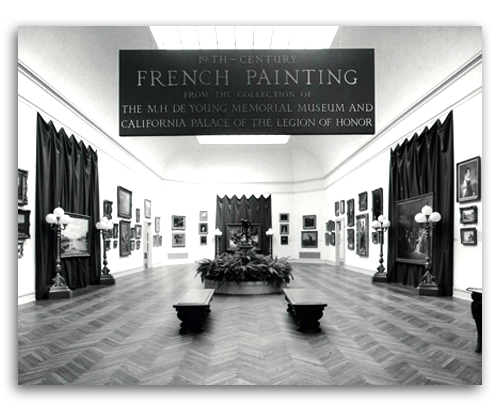
19th CENTURY FRENCH PAINTING,
Legion of Honor Museum, San Francisco, 1972. Design by FLG and Roy Basich
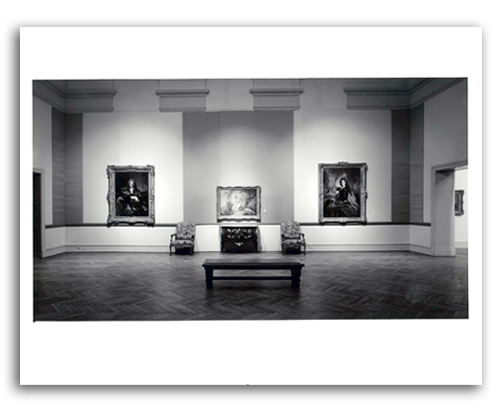
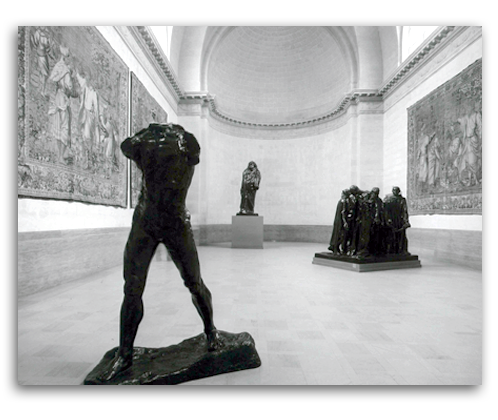
THREE CENTURIES OF FRENCH ART FROM THE NORTON SIMON COLLECTIONS,
Legion of Honor Museum, San Francisco, 1973. Design by FLG
1) 17th &18th century Gallery. 2) Rodin Gallery.
Vol.12 FRENCH ART, 1973
Part 1. 19th CENTURY FRENCH PAINTINGS, 1972
NOTE: This exhibition of 19th century paintings from the combined collections of the de Young & Legion of Honor museums was hung in a 19th century style. It was one of a series of exhibitions that combined the collections of the two museums. Others were American, Flemish, and British. These were “political” exhibitions designed to show the trustees and the general public some of the advantages of merging the two Old Master museums into one museum. A city-wide ballot eventually ratified the merger of the two museums that previously had competed into a single museum called The Fine Arts Museums of San Francisco.
~ GKS
Part 2. THREE CENTURIES OF FRENCH ART FROM THE NORTON SIMON COLLECTIONS, 1973
NOTE: Norton Simon had one of the finest French collections in private hands. This was the first public presentation of his French masterpieces as a group. FLG negotiated the loans, selected the works, designed the exhibition, and wrote the text of the catalogue. Each of the three galleries was designed in the spirit of the centuries being represented: 17th, 18th, 19th, & 20th centuries. The show was well received in California and Paris.
~ GKS
Vol.13 SPECTRAL SYMBOLISM, Part 1
1974 The Spectral Symbolism of the Tower of Babel
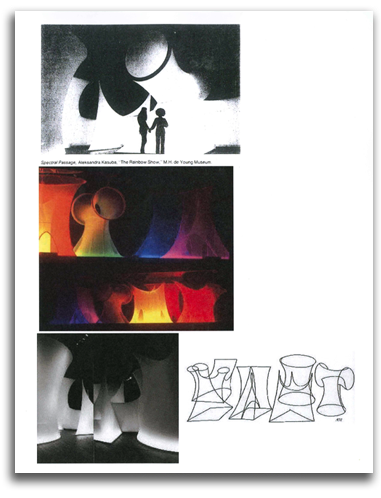
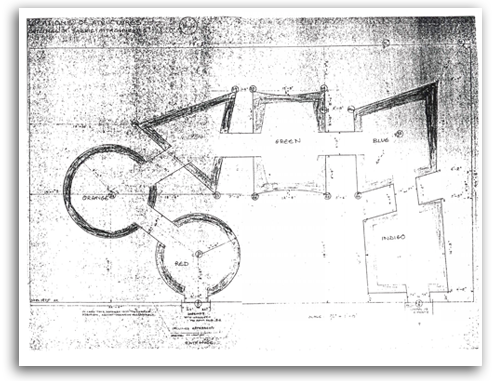
THE SPECTRAL PASSAGE by Aleksandra Kasuba, 1975.
NOTE: In 1970 when FLG became Chief Curator of the combined de Young & Legion of Honor Museums, these “Old Master” museums had decided it was not appropriate to continue to exhibit contemporary art. The Board had been made uncomfortable by a number of contemporary shows curated under the previous administration. The feeling was that such exhibitions would better be done by other museums such as in Berkeley and Oakland. FLG did not think this was a good policy, because the Bay Area was filled with such a large amount of dynamic art – art that deserved to be seen. He worked to slowly change this policy by mounting a series of small contemporary shows of very high quality. By 1974 the Board was willing to change the policy. FLG organized an exhibition called “THE RAINBOW SHOW” that would announce this dramatic policy change and celebrate the extraordinary creativity of the Bay Area. The plan was for all the art museums in the Bay Area to be part of the show, along with science museums, and whatever galleries wanted to participate from downtown galleries to community-based galleries. At the heart of the experience in the de Young Museum was “The Spectral Passage,” an architectural sculpture commissioned from Aleksandra Kasuba. People walked through 7 richly shaped and highly colored spaces in a spectral sequence, while hearing music that had been composed using sounds with frequencies harmonic with the frequencies of those colors. The show opened on the Spring Equinox 1975. The music for The Spectral Passage was arranged by Mark Burstein. He invited a number a Bay Area composers to improvise on the theme of the parallel frequencies between notes and colors which he wrote about in THE RAINBOW BOOK. An early visit to the studio of composer-painter Paul Kalbach confirmed that one could pick out which colors he was working with. Then Burstein selected similar feeling-tones from other composers who associated keys and modes with colors. Finally, he orchestrated elements from all these sources into the tapes that were heard inside each spatial module of The Spectral Passage.
The Spectral Passage itself was a huge success, but The Rainbow Show as a whole was controversial. Graham did not relish controversy, but he knew that sometimes it must be dealt with if art museums were to be part of the Social Revolution that gathered force during the early ‘60s under the inspiration of Martin Luther King. Graham marched with King in the 1963 March on Washington D.C., and was committed to social change. He was troubled by the fact that art museums in the United States for the most part had been closed self-serving clubs for the white upper class establishment ever since they were founded in the 19th century. They spoke of “education” but usually educated only a very small minority of society. What would it take to crack those assumptions and start serving the general public as a whole?
Every socially conscious curator of the time was facing this question and wondering what to do to help catalyze change. They were not in the business of being heroes, but they wanted to be part of the solution. One could be sure that every change would bring at least some controversy. It was controversial when Graham stood with Lucy Lippard and the Art Workers Coalition in the garden of the Museum of Modern Art in the late ‘60s and argued for greater openness to people of color in the exhibition schedule and in the management of all museums.
The “War & Peace” exhibition he organized in 1970 was more controversial. It was at the height of the Vietnam War, and the nation was bitterly divided. Many thought art museums should say nothing about it. Art museums were widely regarded as “above” such things. Graham disagreed. He argued that art museums are places where people reflect on the highest hopes and deepest values of humanity. He felt museums should also be engaged in discussing how such core values are operating in the contemporary world and not just the past. The position he took in presenting the “War & Peace” exhibition was not for or against. Instead, he advocated serious “reflection” on what was going on. What he created was a special space for meditating on the questions involved. In a city as liberal as San Francisco, Graham’s exhibition was better received than it would have been in other cities.
The Rainbow Show of 1975 was controversial for other reasons. Graham knew he was going against established museum practice when he invited not only well-known artists but also community-based artists to participate. But he felt it was essential for a public museum to serve the public as a whole and not just the traditional elite. Community-based artists had not been welcome in most major museums at this time. The wider community was not visiting art museums precisely because there was little they felt they could relate to. It was a white, upper middle-class world. Graham wanted to extend a wider invitation. He knew such thinking would be regarded as radical but he did not anticipate how strong the reaction would be from conservative factions. Graham also wanted to provide visitors with a broad context for rainbow art. So he incorporated the perspectives of not just artists but also scientists, philosophers, and spiritual teachers. Looking back, some who like the “Whole Earth” perspective, told Graham they recalled the Rainbow Show as the “Last Great Manifestation of the New Age.” Others think the “New Age” should never have set foot in an art museum.
On the one hand, the show was very popular with the general public. It set a record for attendance, and brought in many segments of the community who had never visited before. That is a large part of what Graham wanted. The television and radio reporters loved it, as did the art critic of the SAN FRANCISCO EXAMINER, Alexander Fried. THE RAINBOW BOOK that Graham edited to encapsulate the exhibition was wildly successful. It sold over 100,000 copies. However, the very influential art critic of the SAN FRANCISCO CHRONICLE, Alfred Frankenstein, hated the exhibition. The fact that community artists were represented at all he said was a betrayal of “museum values.” The fact that the physics of science and the metaphysics of philosophy were discussed along side art he considered “ridiculous” and “irrelevant.” The Board of Trustees were shocked. They had never had to face such vehement criticism.
Graham had been planning to leave the museum in order to head a cultural planning think tank the following year, after the Rockefeller exhibition. He had been recruited by the National Endowment for the Humanities and the Norton Simon Museum for this position. However, he now faced new circumstances: how disappointed the Board was in their highly regarded and previously spotless Chief Curator, and how such public criticism might be slowing down the “Great Dream of America’s First Museum Merger,” and how this negative aura might even turn away Mr. Rockefeller who was about to donate to San Francisco his extraordinary collection – a collection for which Graham and his Director had been secretly negotiating for five years. The Director and the Board were torn. Graham had generated serious criticism, but he also has played a major role in developing these regional institutions to national standing. What to do? Graham decided to remove the dark cloud hanging over the museum. He resigned earlier than planned, much to the relief of the museum administration.
I only knew about THE RAINBOW SHOW second hand. Because it was one of the most dramatic exhibition/publication events in his museum career, I wanted to know more. How was all that being remembered now, four decades later? THE RAINBOW SHOW, for all its drama, was only a small part of what Graham did for that museum. What was his FAMSF legacy as whole? So I went through Graham’s archive of letters and arranged for the question to be put to a number of individuals who were major players in the San Francisco art world of that time. Here is the general picture.
In 1980, that angry critic from the CHRONICLE, Alfred Frankenstein, apologized to Graham, saying he had not understood his larger social purpose, and never would have said those nasty things if he had understood. Years later, members of the museum Board also apologized to Graham for not understanding what he was trying to do. A number thanked him for opening their eyes to a broader social commitment, as well as for bringing the city’s Old Master museum into the contemporary world by inaugurating a vigorous new program of contemporary exhibitions.
Here is a representative letter about 1975 from a highly respected member of the museum’s Old Guard from the 1970s, Robert Bransten, who still sits on the museum’s Acquisitions Committee.
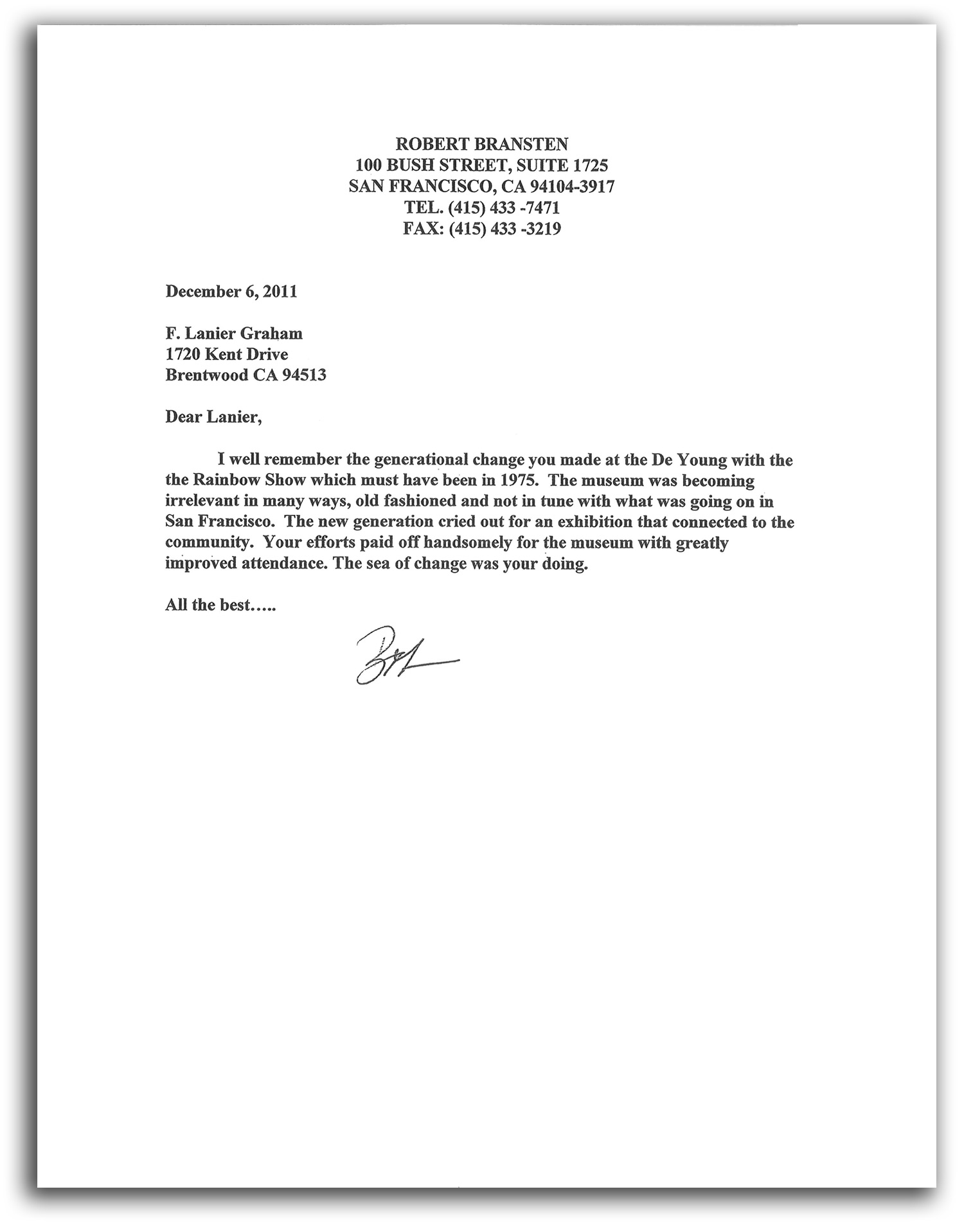
Click on image to enlarge, or, to view the Bransten Letter in PDF format, (Click here)
Here is a 1982 letter from John May. As head of the San Francisco Foundation, May granted a great deal of money to Graham’s FAMSF projects during the 1970s.
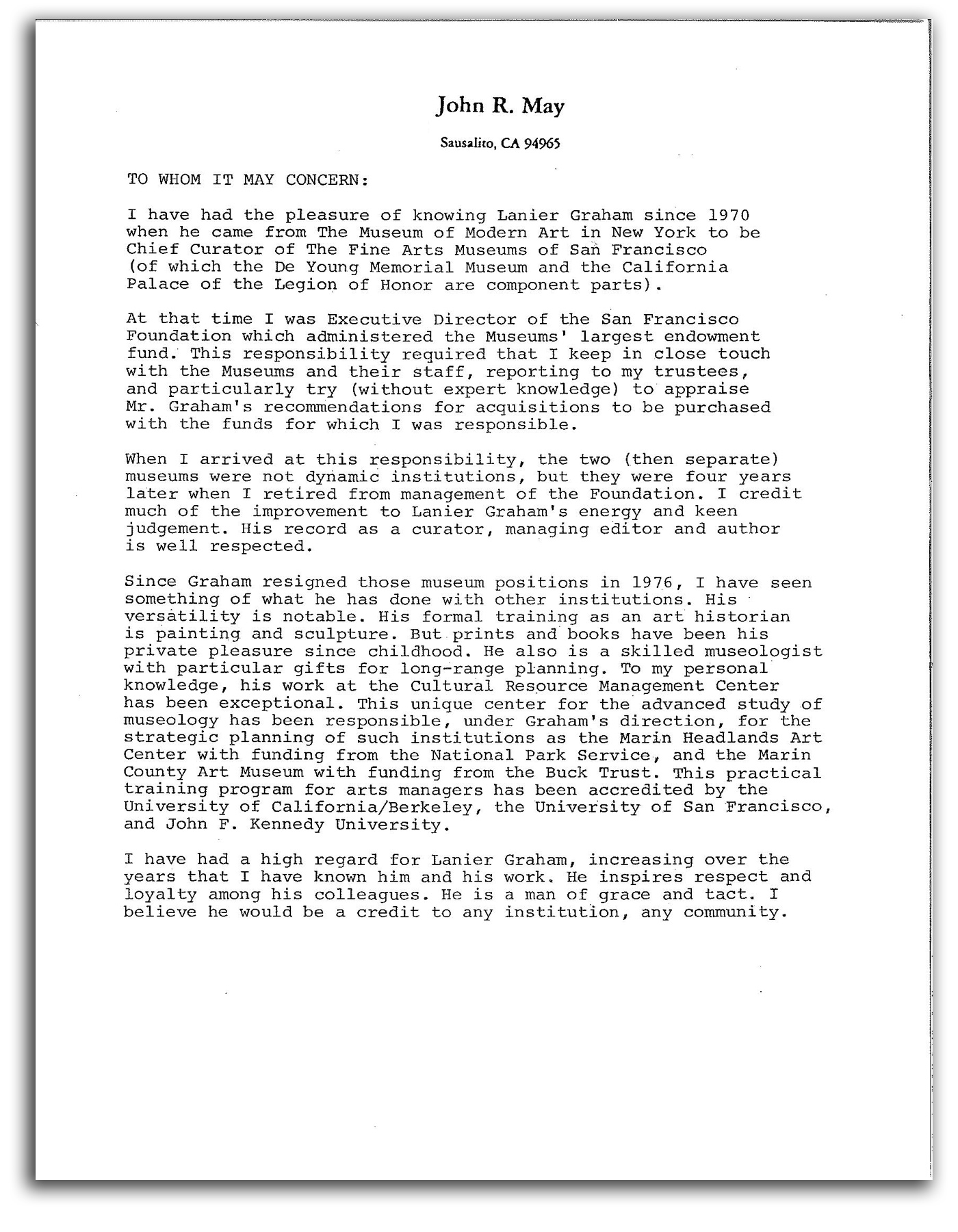
Click on image to enlarge, or, to view the May Letter in PDF format, (Click here)
Here is a 2012 email from Walter Newman. As President of FAMSF during the 1970s, he knew Graham’s work well.
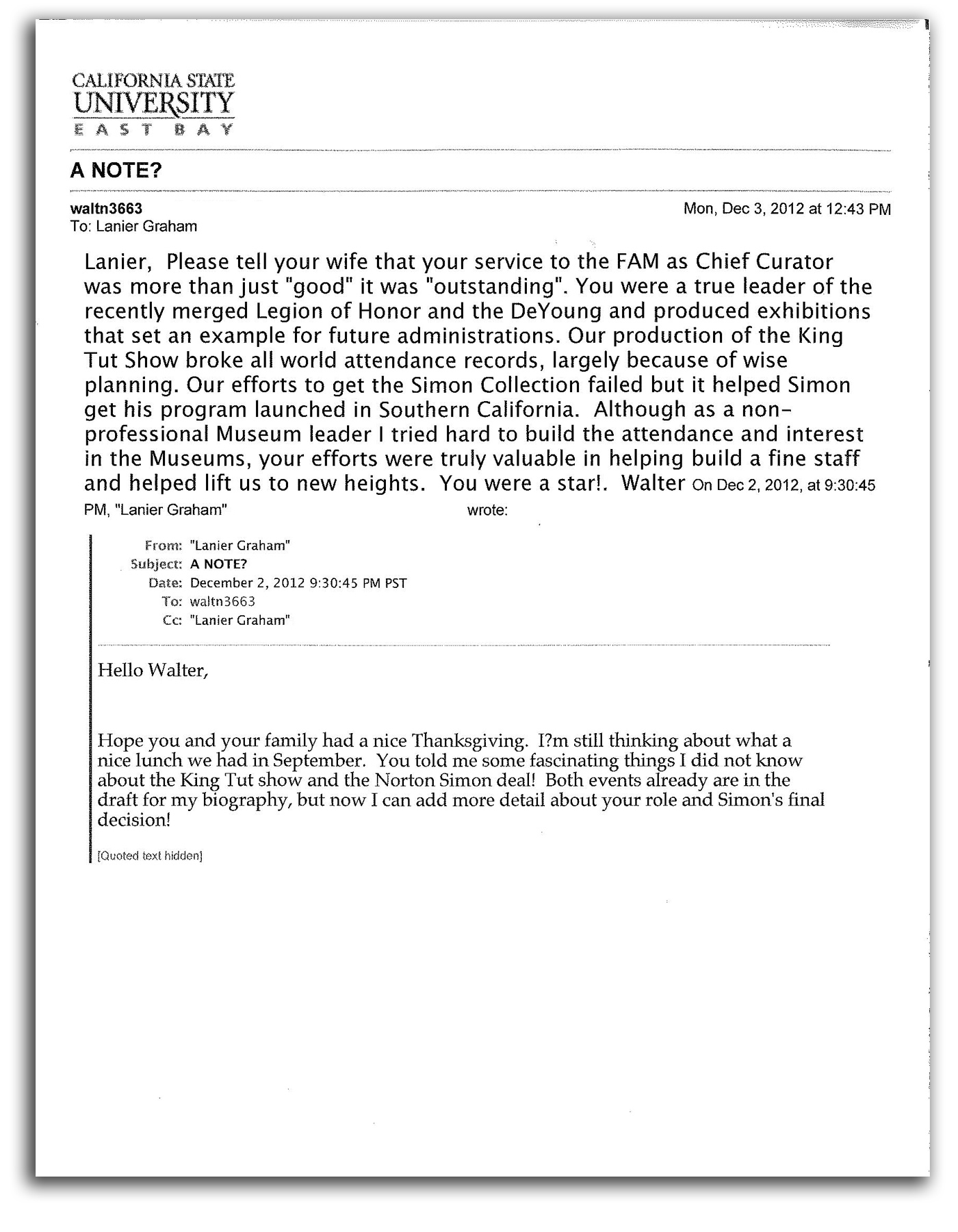
Click on image to enlarge, or, to view the Newman Letter in PDF format, (Click here)
~ GKS
Vol.14 SPECTRAL SYMBOLISM, Part 2
1975 Spectral Spaces: The Architectonical Sculpture of Aleksandra Kasuba in The Rainbow Show
Vol.15 HISTORY OF SACRED ARCHITECTURE: A Library of Study Guides from Sacred Visions: An Introduction to the Sacred Art of World Religions, aka A Survey of World Art & Architecture Part 1 [university reader]
1976a Tribalism
1976b Hinduism
1976c Buddhism
Vol.16 HISTORY OF SACRED ARCHITECTURE: A Library of Study Guides from Sacred Visions: An Introduction to the Sacred Art of World Religions, aka A Survey of World Art & Architecture Part 2 [university reader]
1977a Islam
1977b Christianity
Vol.17 THE RENAISSANCE IN EUROPE, Part 1 Essays in THE AMERICAN ACADEMIC ENCYCLOPEDIA
1978a Alberti
1978b The Art & Architecture of the Renaissance in Europe
1978c Biographical Sketches [add artist’s names/coming later]
Vol.18 THE RENAISSANCE IN EUROPE, Part 2
1979 The Symbolism of the Double-Serpent in the Art & Architecture of the Renaissance in Europe
Vol.19 ARTISTS-IN-RESIDENCE PROGRAMS IN THE U.S.
1980 A Planning Study for the GGNRA, National Park Service
Vol.20 THE ARCHITECTURE OF THE MARIN HEADLANDS ART CENTER
1981 Golden Gate National Recreation Center, National Park Service
Vol.21 ARTISTS-IN-NATURE
1982 Masterplan for the Marin Headlands Art Center, GGNRA
Vol.22 SEASONAL MARKINGS
1983 Season-Marking Earth Art from the Stone Age to the Present, Part 1
Vol.23 SEASONAL MARKINGS
1984 Season-Marking Earth Art from the Stone Age to the Present, Part 2
Vol.24 ARCHITECTURE & PHOTOGRAPHY, Part 1
1985 Constructivism
Vol.25 ARCHITECTURE & PHOTOGRAPHY, Part 2
1986 Sheeler
Vol.26 ARCHITECTURE & PHOTOGRAPHY, Part 3
1987 Shahn
Vol.27 ARCHITECTURE & PHOTOGRAPHY, Part 4
1988 Flowering Earth: Photographs of The Huntington Gardens
Vol.28 ARCHITECTURE & PHOTOGRAPHY, Part 5
1989 Lotus Ponds: Photographs of The Huntington Gardens
Vol.29 ARCHITECTURE & PHOTOGRAPHY, Part 6
1990 Silent Cities: Atget & the Modern Urban Landscape [NSM exhibition]
Vol.30 SACRED VISIONS: A Survey of World Art & Spiritual Symbolism
1991 Vol.1 Shamanism, Taoism, Hinduism, & Buddhism [university reader]
Vol.31 SACRED VISIONS: A Survey of World Art & Spiritual Symbolism
1992 Vol.2 Judaism, Islam, & Christianity [university reader]
Vol.32 HECTOR GUIMARD BIBLIOGRAPHY
1993 Additions since the MOMA Exhibition of 1970
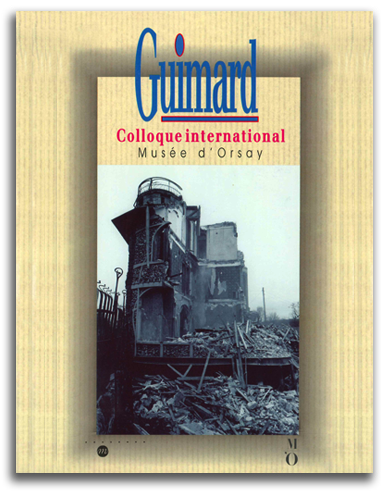
GUIMARD: COLLOQUE INTERNATIONAL,
Musée d’Orsay, 1992
Vol.33 HECTOR GUIMARD ENCORE [Symposium Papers in Paris]
1994a Etudes sur Guimard: Passe et Avenir
1994b Guimard, Viollet-le-Duc, et Modernisme
NOTE: FLG was asked to present the first papers at this international conference because he had published the first book on Guimard. His two papers were published in French.
~ GKS
Vol.34 SOLIDITY & INFINITY
1995 The Symbolism of the Circle & Square in World Architecture
(Click here to view Part One of this title in PDF format)
(Click here to view Part Two of this title in PDF format)
Vol.35 SOLIDITY & INFINITY
1995 The Symbolism of the Circle & Square in Modern Architecture
Vol.36 A LINEAGE OF LIGHT:
PAINTER-ARCHITECTS OF THE RENAISSANCE
1996 Alberti, Piero, Leonardo, Bramante, Raphael, & Romano
Vol.37 CHRISTOPHER WREN & THE FOUR ELEMENTS:
1996 Traditional Symbolism in Protestant Church Steeples
Vol.38 ARCHITECTURAL PROPORTIONS
1997 A Study Guide
Vol.39 THE GOLDEN PROPORTION
1998 A Study Guide
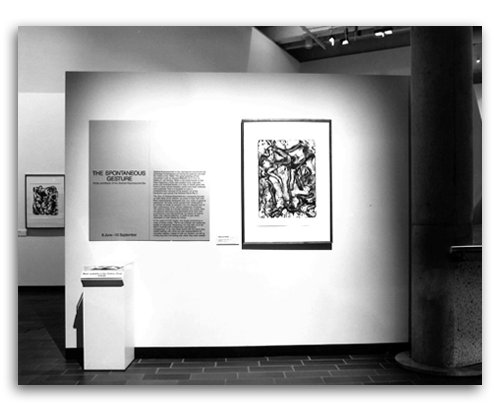
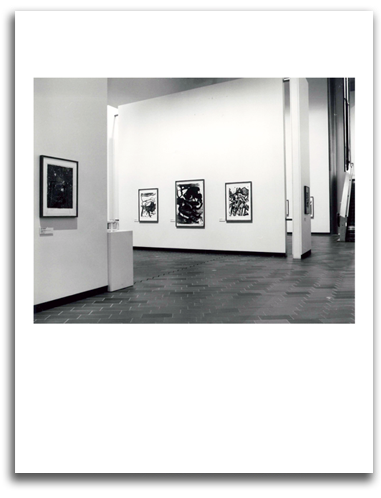
THE SPONTANEOUS GESTURE:
PRINTS & BOOKS OF THE ABSTRACT EXPRESSIONIST ERA,
National Gallery of Australia, Canberra, 1987
Design by FLG. 1) Title Wall. 2) De Kooning Wall
NOTE: THE SPONTANEOUS GESTURE was the first comprehensive exhibition of this subject. Graham’s book of the same title remains a standard reference. IMPOSSIBLE REALITIES connected Duchamp, formally and philosophically, with a large number of his associates in the Surrealist Circle. By popular demand the Simon Museum extended the show for a year. That was FLG’s last project at the Simon Museum.
~ GKS
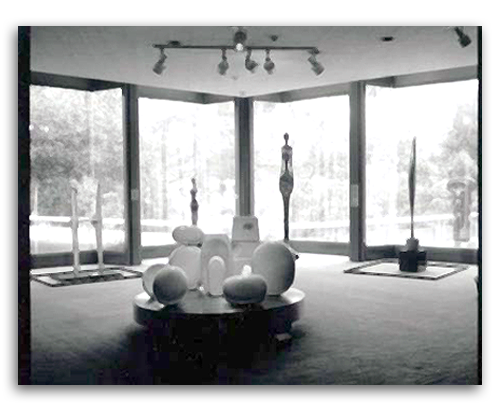
IMPOSSIBLE REALITIES: MARCEL DUCHAMP & THE SURREALIST TRADITION,
Norton Simon Museum, Pasadena, 1991. Design by FLG
1) Sculpture Gallery
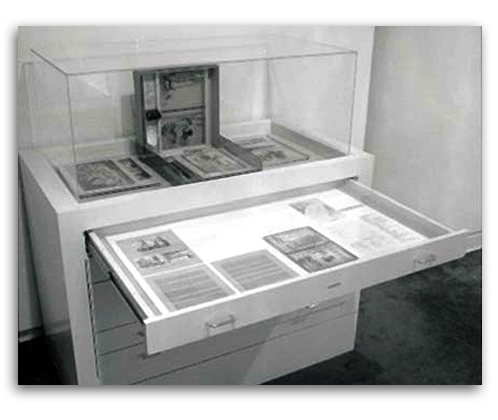
IMPOSSIBLE REALITIES: MARCEL DUCHAMP & THE SURREALIST TRADITION, Norton Simon Museum, Pasadena, 1991. Design by FLG.
2) Duchamp Drawers
Vol.40 MUSEUM EXHIBITIONS
in Canberra, Australia & Pasadena, California
2000 A Portfolio of Photographs
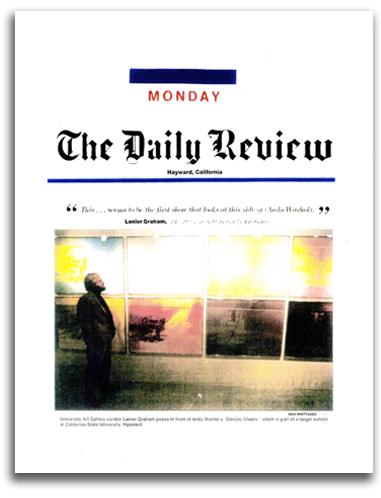
Warhol Wall of Electric Chairs,
University Art Gallery CSUEB, 2000. Design by FLG
Vol.41 ANDY WARHOL & SOCIAL CONSCIOUSNESS:
ANOTHER SIDE OF POP ART, 2000
NOTE: This was the first exhibition to focus on this aspect of Warhol’s work. Because FLG knew Warhol, he could articulate the lesser known side of a person who secretly fed the poor often and went to church regularly. The publicity was extensive, including two articles on front pages of the OAKLAND TRIBUNE.
~ GKS
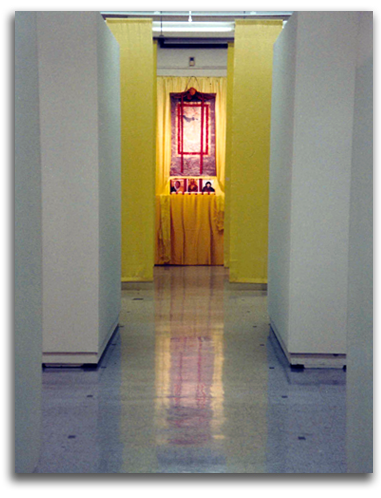
The Lion’s Roar: Tibetan Thangkas,
University Art Gallery CSUEB, 2001
Design by FLG in collaboration with Mark Levy and Master YeYoung
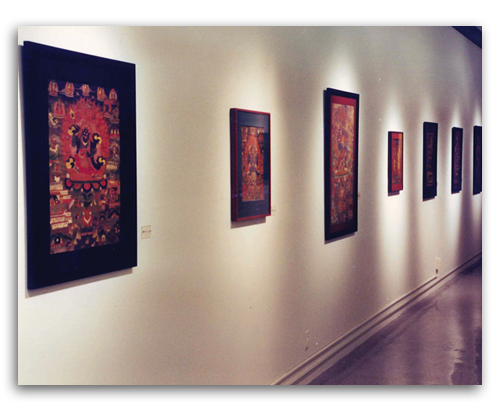
The Lion’s Roar: Tibetan Thangkas,
University Art Gallery CSUEB, 2001
Design by FLG in collaboration with Mark Levy and Master YeYoung
Vol.42 THE LION’S ROAR: TIBETAN THANGKAS FROM THE SAKYAS, 2000
NOTE: While there had been numerous shows of Tibetan thangkas in the United States, this was the first to present the Sakya tradition. The show later traveled to the Cantor Art Center at Stanford University.
~ GKS
NOTE:In this installation, the so-called “positive energy” thangkas were on one wall and the so-called “negative energy” thangkas were on the opposite wall. In between was an architectural corridor of empty space leading to an altar, an altar designed by Master YeYoung of the Sakya Order. This empty corridor (“between opposites”) was designed to suggest the experience of the sushumna. In the esoteric Tantric traditions of both Buddhism and Hinduism, the sushumna is the vertical channel of subtle energy that parallels the spinal chord. It serves as a connection between the lower chakras (energy centers, or levels of consciousness) and the higher chakras (energy centers, or levels of consciousness). When properly activated, the Kundalini energyascends up the sushumna (between the positive Solar polarity and the negative Lunar polarity) activating all the energy centers. This makes possible a superior level of awareness, and ultimately the full potential of an individual’s humanity. Such information was kept quite secret for centuries until the “New Age” of the 1960s & ’70s when many silly books on the subject began to appear. In spite of what popular books may say, it is not useful (and is potentially dangerous) to undertake Kundalini meditations without the guidance of an advanced meditation master.
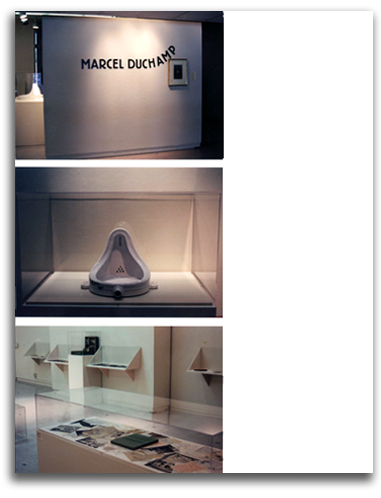
MARCEL DUCHAMP: ARTIST-HUMORIST-PHILOSOPHER
University Art Gallery CSUEB, 2001. Design by FLG
Vol.43 MARCEL DUCHAMP: ARTIST-HUMORIST-PHILOSOPHER, 2001
NOTE: The first Duchamp retrospective took place in Pasadena California in 1963. FLG’s first Duchamp exhibition also took place in Pasadena in 1991 using much of the same material. FLG’s Duchamp show of 2001 in Hayward was the first to focus on the theme of Androgyny as central to the artist’s work. FLG’s book, DUCHAMP & ANDROGYNY: ART, GENDER, AND METAPHYSICS remains the standard reference.
~ GKS
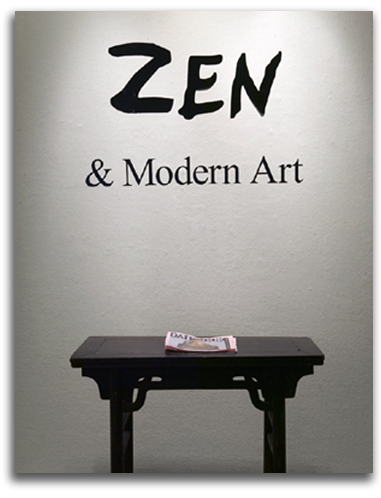
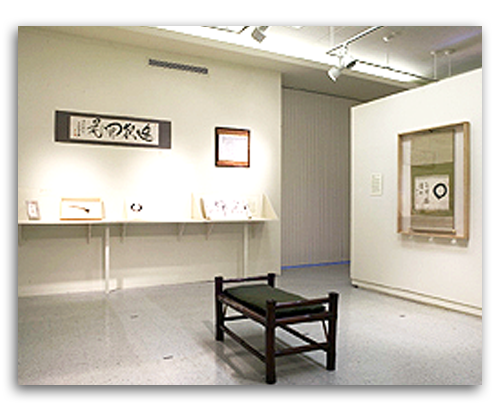
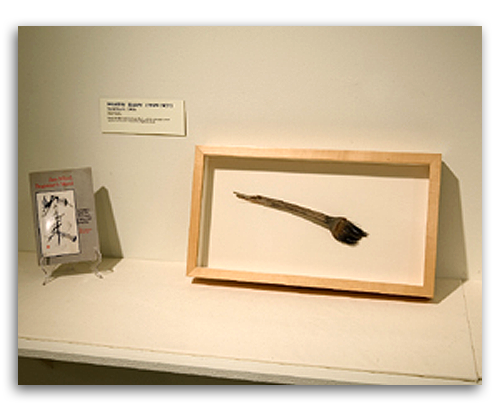
NOTE for this image: This is the brush used by Susuki Roshi to make the world’s most famous enso in 1966. It was lent to the exhibition by Yvonne Rand who witnessed the brushing at Zen Center’s Tassajara Springs retreat near San Francisco. That enso is reproduced at the top of the ASIAN STUDIES section of this index.
~ GKS
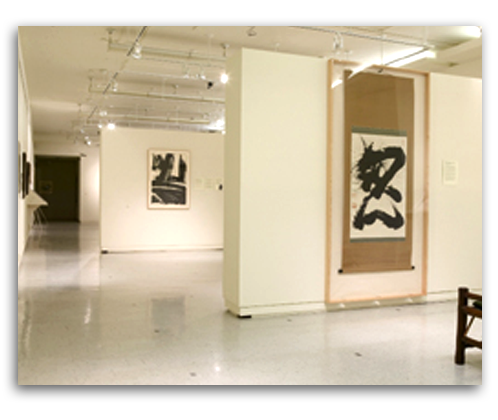
ZEN & MODERN ART:
ECHOES OF BUDDHISM IN PAINTINGS & PRINTS,
Introductory Gallery. University Art Gallery CSUEB, 2002
Design by FLG
Vol.44a 2003 ZEN & MODERN ART: ECHOES OF BUDDHISM IN PAINTINGS & PRINTS
NOTE: This was the first exhibition to focus on this aspect of Buddhism & modern art. There was a great deal of publicity locally and nationally. FLG’s book on the subject is in progress.
~ GKS
For a video of Tanahashi painting a giant enso at the opening of the exhibition, CLICK [http://class.csueastbay.edu/artgallery/zen%5Fpublic/]
Vol.44b 2003 THE PANTHEON OF ROME: A Study Guide
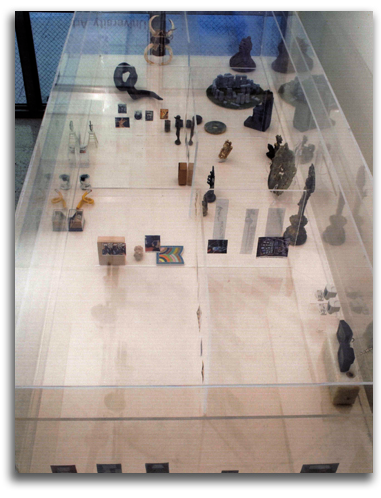
Miniature Museum of World Art, with plexiglass walls (detail)
University Art Gallery, CSUEB, 2004-2010
Design by FLG as a concept model for the World History Learning Center
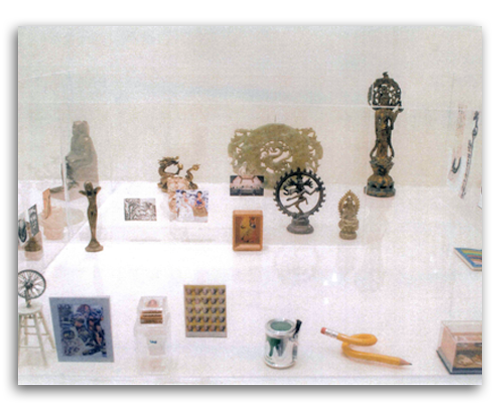
Miniature Museum of World Art, with plexiglass walls (detail)
University Art Gallery, CSUEB, 2004-2010
Design by FLG as a concept model for the World History Learning Center
Vol.45 2004 A MINIATURE MUSEUM OF WORLD ART in the University Art Gallery
Vol.46 2005 WORLD HISTORY LEARNING CENTER, Plan #1, A Classroom in the Art & Education Building
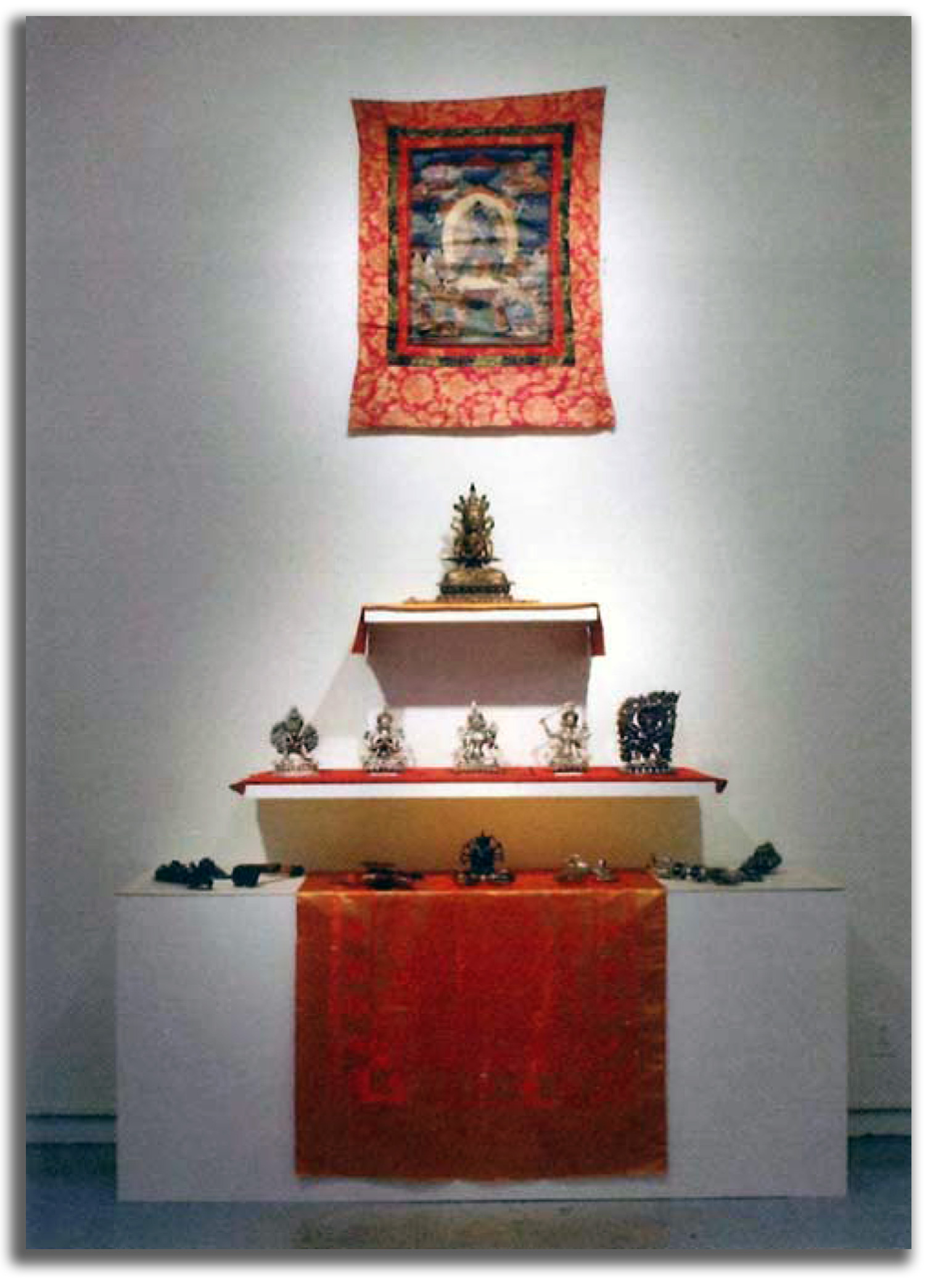
TIBETAN WALL in Global Vision, Part 1, 2006
Design by FLG with Philip & Jill Ringler
Click here or on above image for enlarged view of Tibetan Shrine
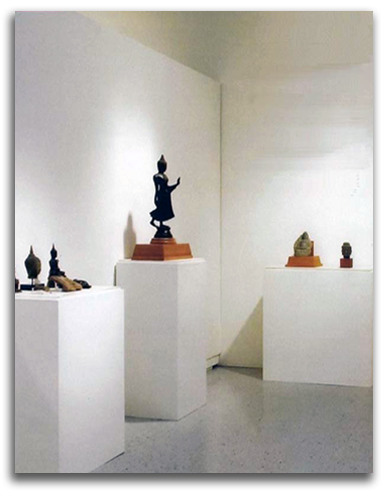
THAI WALL in Global Vision, Part 1, 2006
Design by FLG with Philip & Jill Ringler
Vol.47 2006 GLOBAL VISION: A Survey of World Art, Part 1
Vol.48a 2007 WORLD HISTORY LEARNING CENTER, Plan #2, Mezzanine Wing of the Library
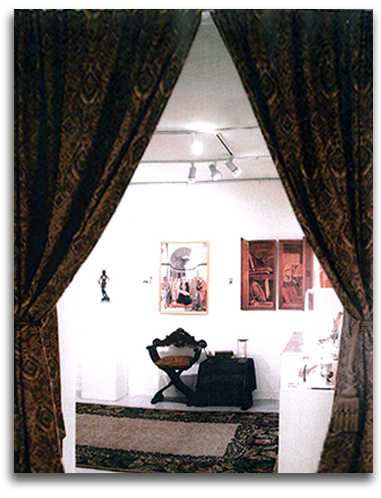
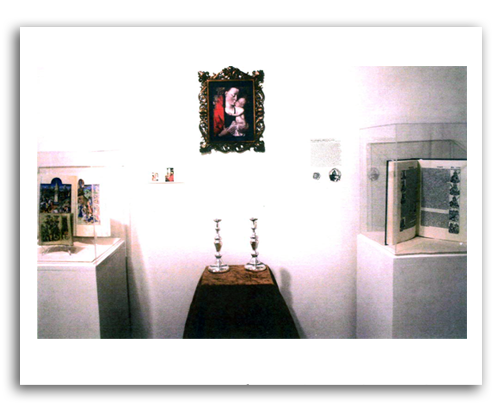
Vol.48b 2007 THE SPIRIT OF THE RENAISSANCE,
University Art Gallery CSUEB, 2007
Design by FLG as a full-scale model for a “period room”
in the World History Learning Center
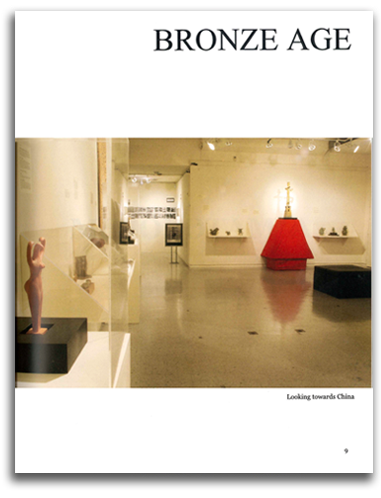
CHINA WALL in Global Vision, Part 2, 2008
Design by FLG with Philip & Jill Ringler
Vol.49 2008 GLOBAL VISION: A Survey of World Art, Part 2
Vol.50 2009 SPIRITUAL VESSELS
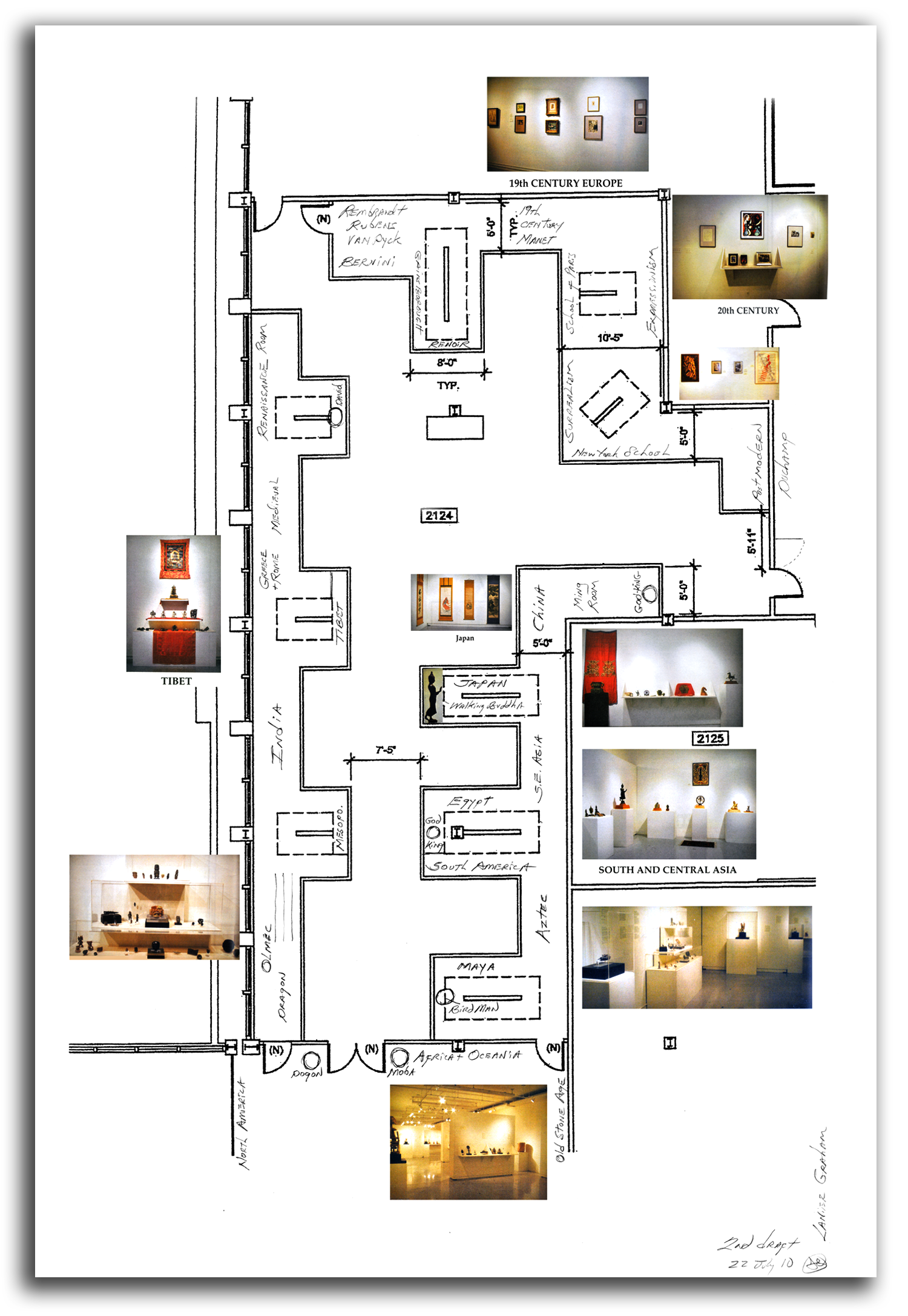
Preliminary Plan, Humanities Wing, 2011
Featuring Art Donated by IAD
click here or on above image for closer view of the WHLC floorplan
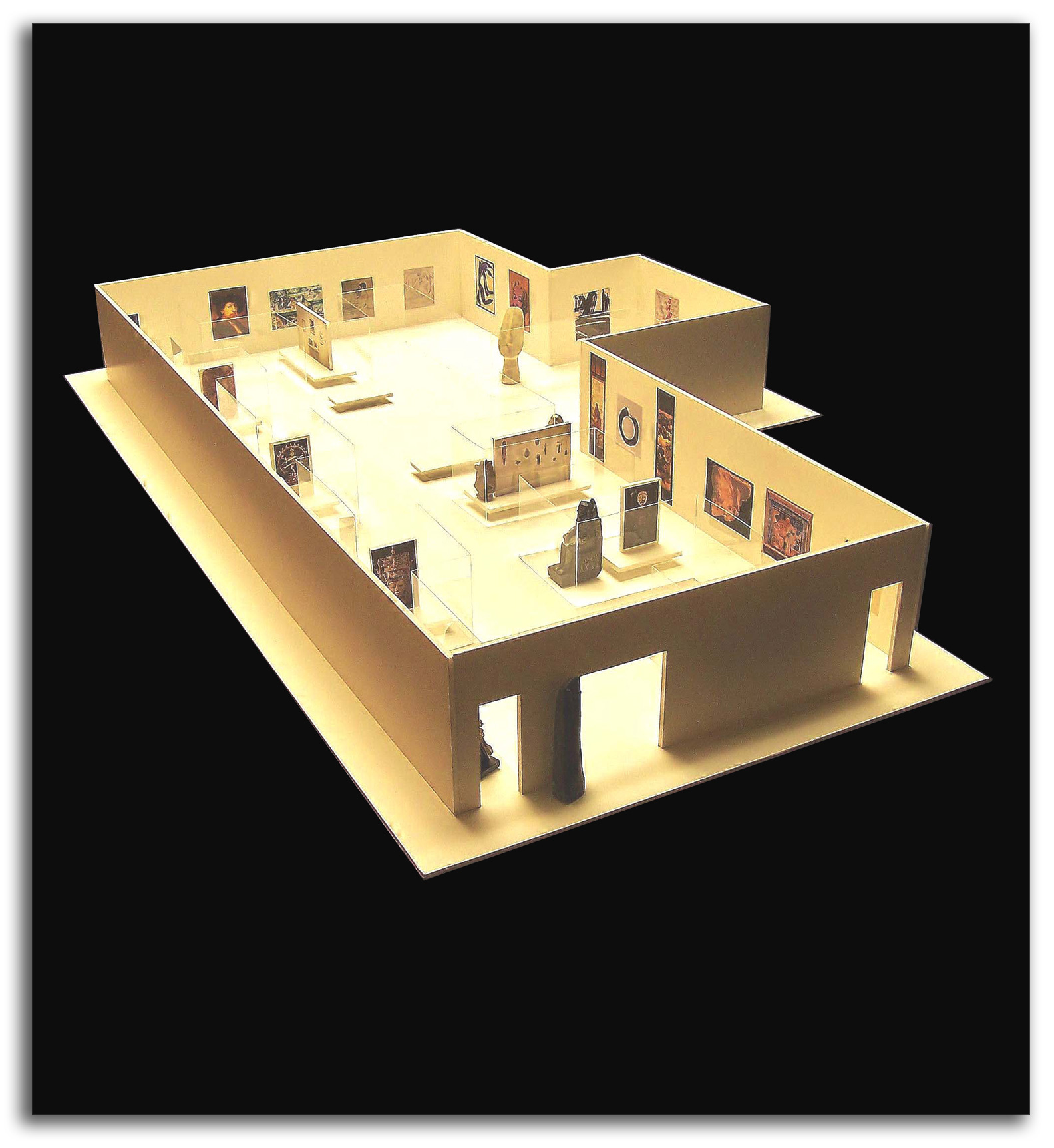
Preliminary Plan, Humanities Wing, 2011
Featuring Art Donated by IAD
click here or on above image to view a large version of above model
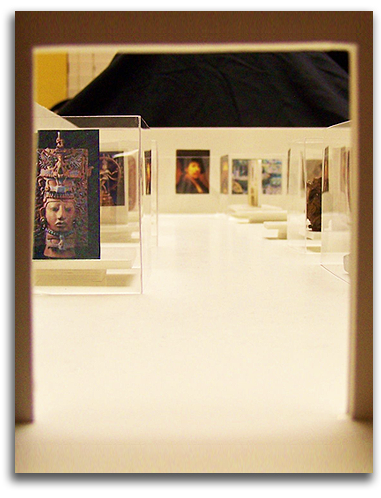
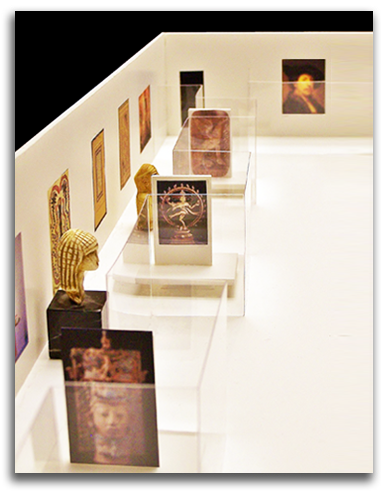
WORLD HISTORY LEARNING CENTER
Model #3 by Daniel Charm,
Museum Studies intern at CSUEB, 2010
Photograph by Daniel Charm
Vol.51 2010 WORLD HISTORY LEARNING CENTER, Plan #3,
Reference Wing of the Library with a Scale Model of the Center
Featuring Art Donated by IAD
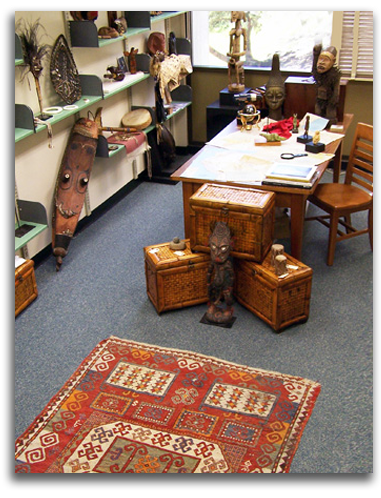
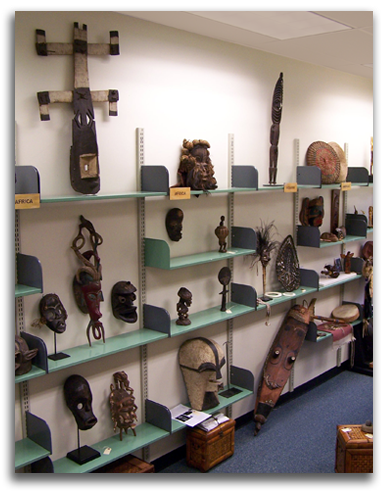
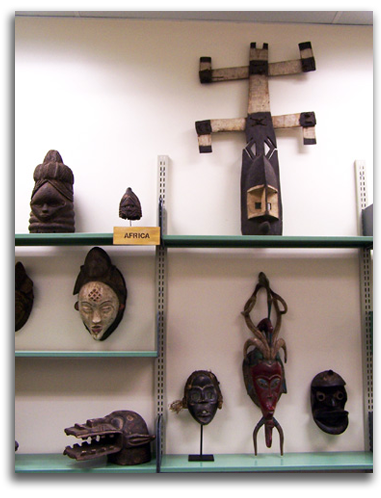
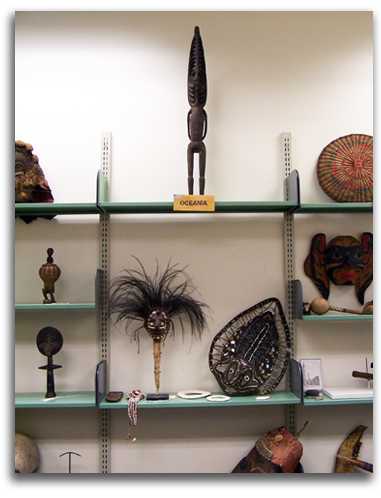
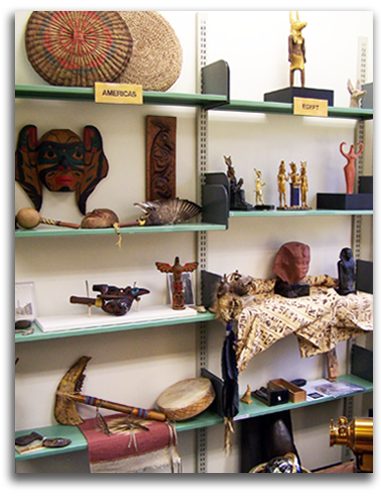
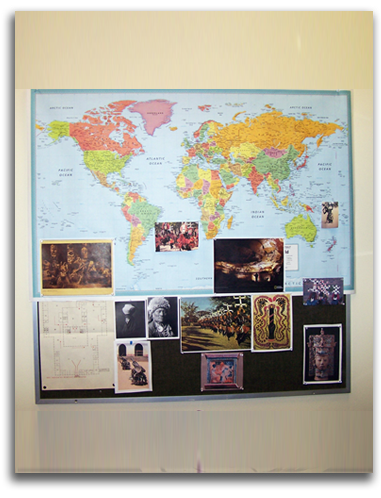
Vol.52 2011 TRIBAL WORLD CLASSROOM-GALLERY
Featuring Art Donated by IAD
Design by Daniel Charm & FLG. Photos by Daniel Charm
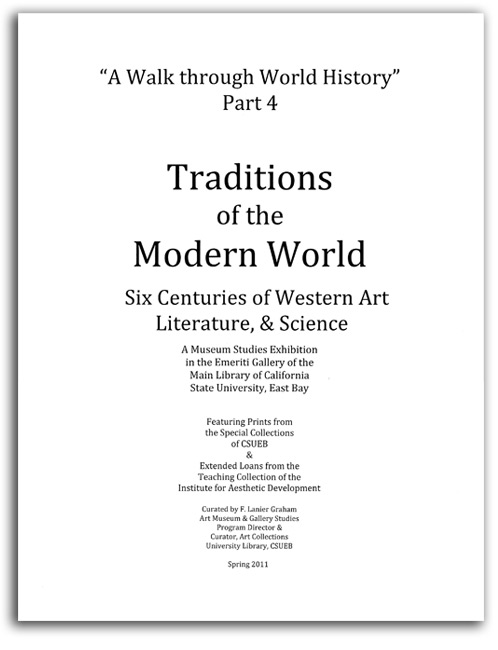
Click here for entire “Traditions of the Modern World” brochure in PDF format
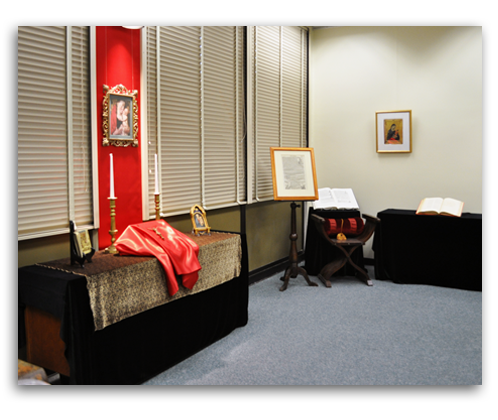
Early Renaissance Walls with books illustrated by Durer and Botticelli
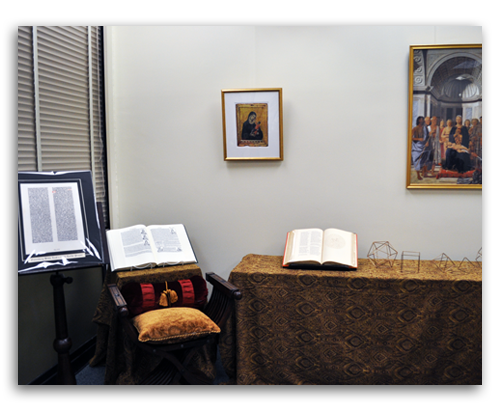
Early Renaissance Walls with books illustrated by Durer and Botticelli
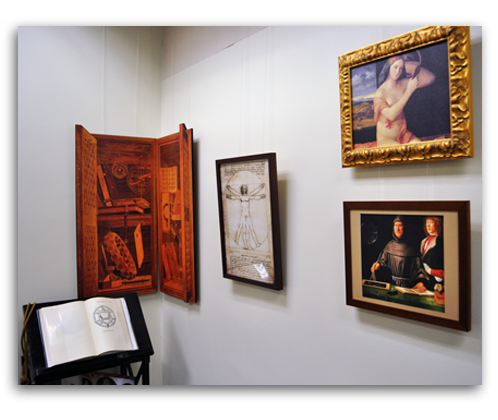
The Leonardo Corner, showing him as Artist and Scientist, and Book Illustrator
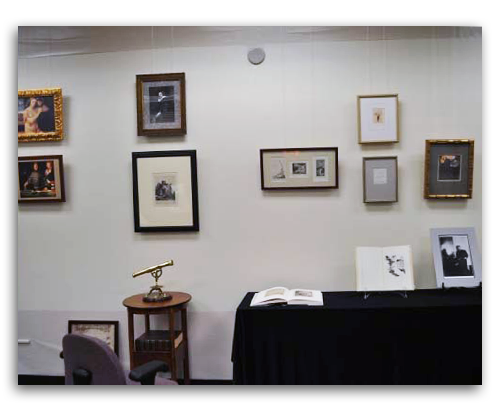
Baroque & 19th Century Wall with books by Blake and Manet
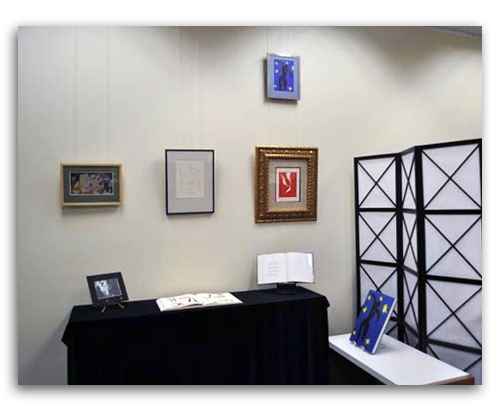
Early 20th Century Wall with books by Matisse and Miro
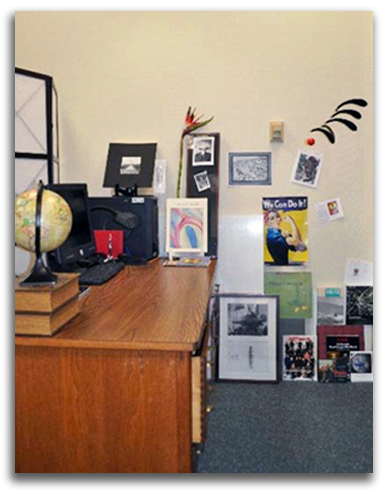
Late 20th Century Wall, an Interactive Corner,
where students arrange their own picture of history
Vol.53 2011 MODERN WORLD CLASSROOM-GALLERY
Featuring Art Donated by IAD
Design by FLG & Daniel Charm. Photos by Richard Apple
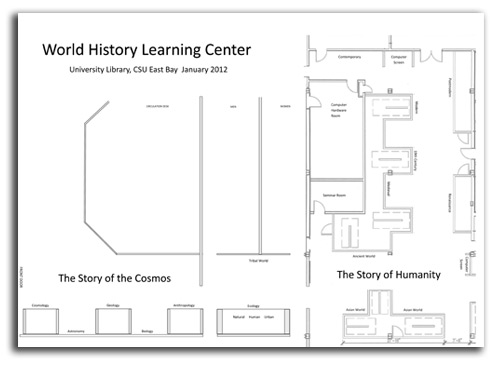
Click here for a closer view of floorplan as a PDF file
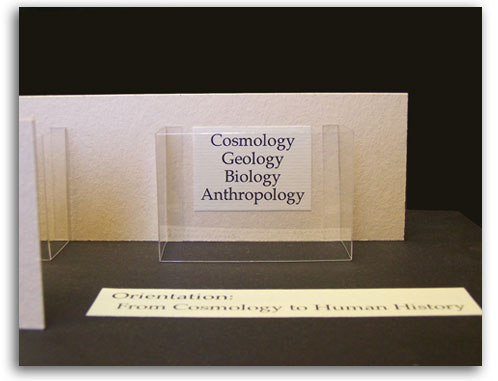
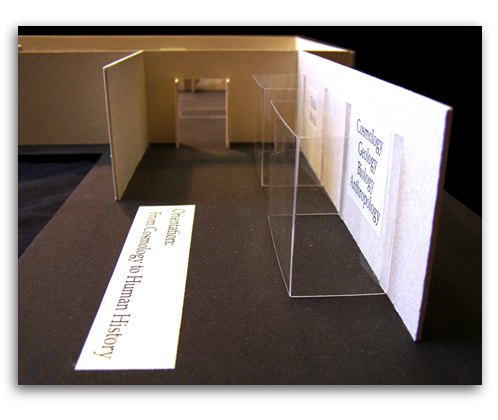
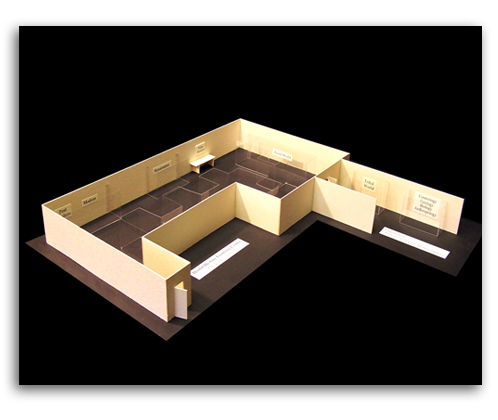
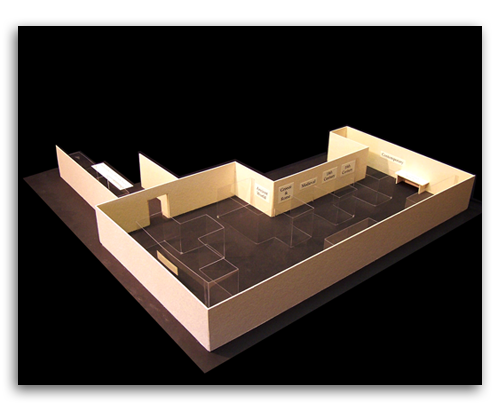
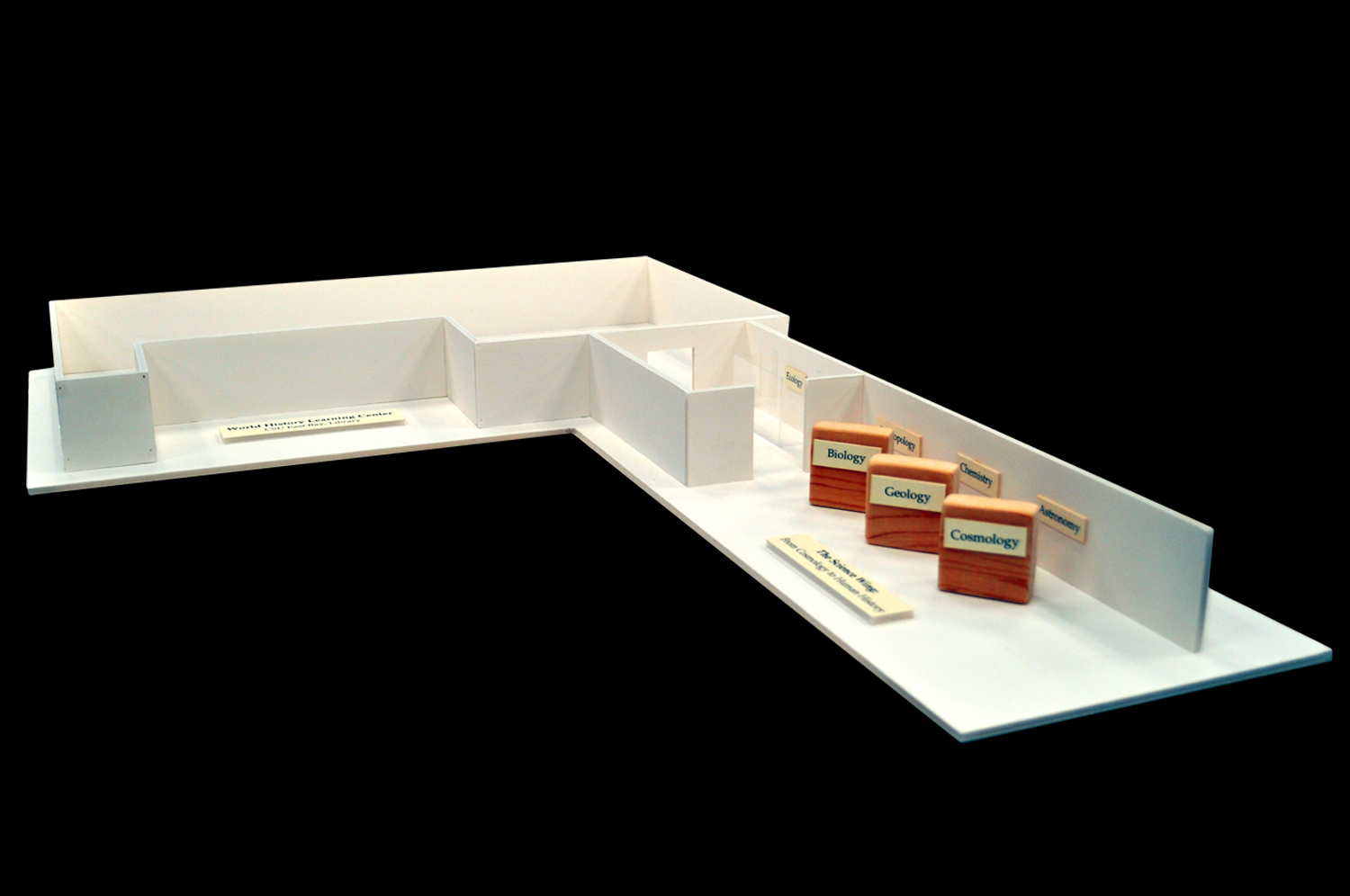
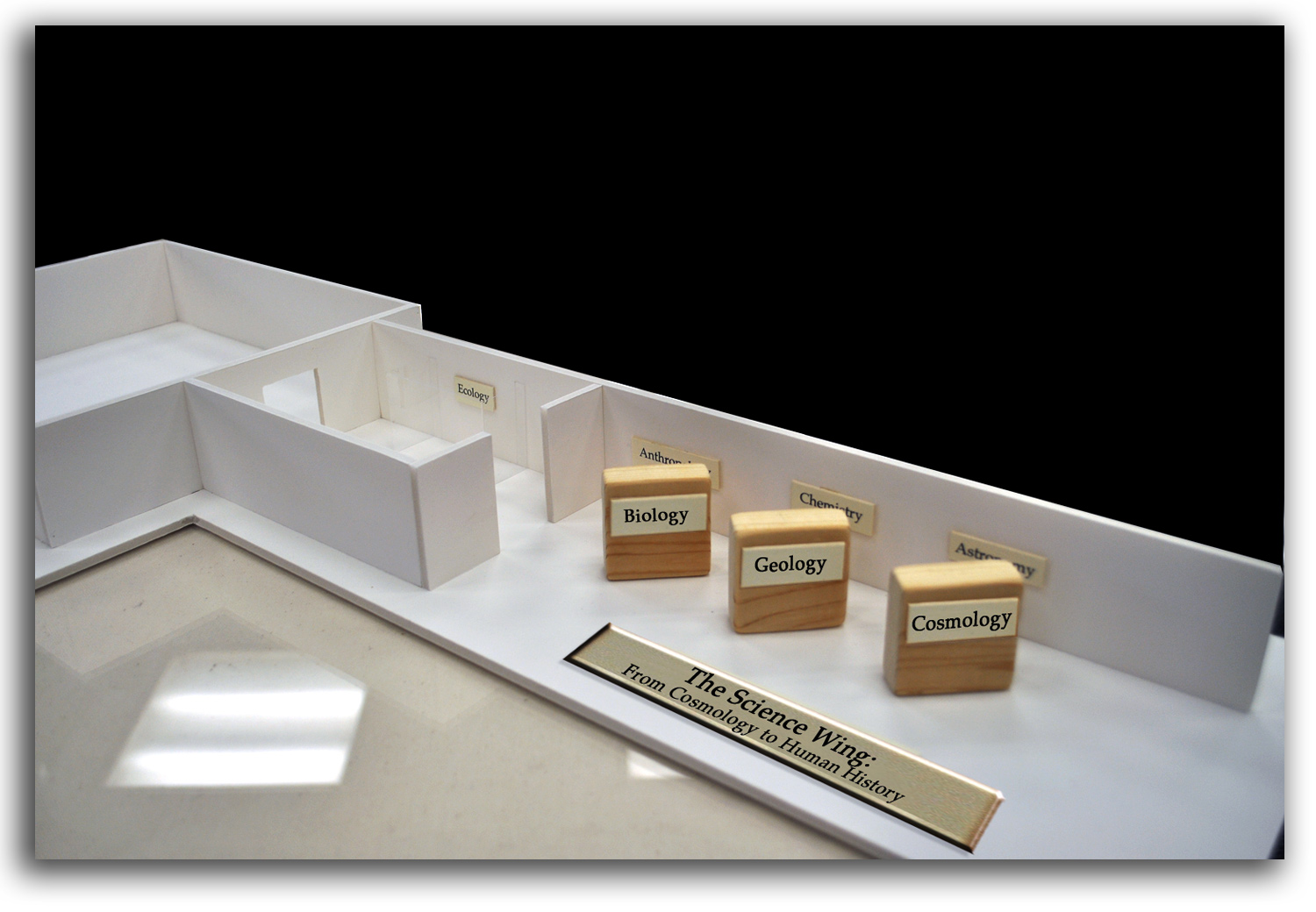
Vol.54 2011 WORLD HISTORY LEARNING CENTER, Plan #4,
Biella Wing of the Library with a Scale Model of the Center
Featuring Art Donated by IAD
Click here for full Prospectus for the World History Learning Center