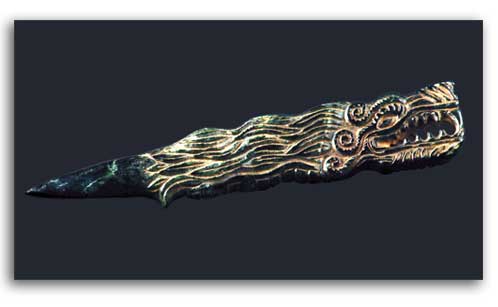
Feathered Serpent/Dragon #1. Olmec
Stone bloodletter. Collection: FLG on loan to IAD
Published in GLOBAL VISION: A SURVEY OF WORLD ART, Part 2, 2008
To view full-length, enlarged image, click here
NOTE: The earliest known visualization of Feathered Serpent in Mesoamerica is at La Venta. This pointed perforator, which is thought to be of Olmec design, appears to be another very early example. A perforator is a ritual object used to puncture human skin in order to draw blood, blood used for ceremonial purposes. How it was used in the Olmec world is uncertain. What is known is that various perforators were used by divine Maya kings and queens to draw their sacred blood during the ritual of The Sacred Marriage. The carving of this Feathered Serpent with its tooth-filled mouth and flowing feathers, as if flying through the windy sky, is a remarkable work of art. A similar vision of Feathered Serpent with a powerful jaw and mystic spirals behind the eyes appears at Teotihuacan.
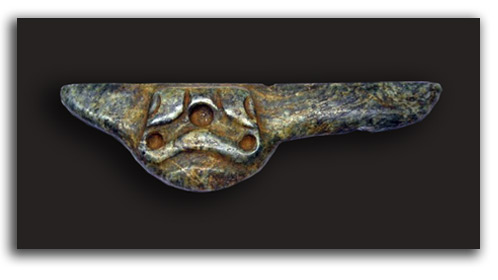
“Blood Spoon,” Olmec
Stone. Collection: FLG on loan to IAD, 2011
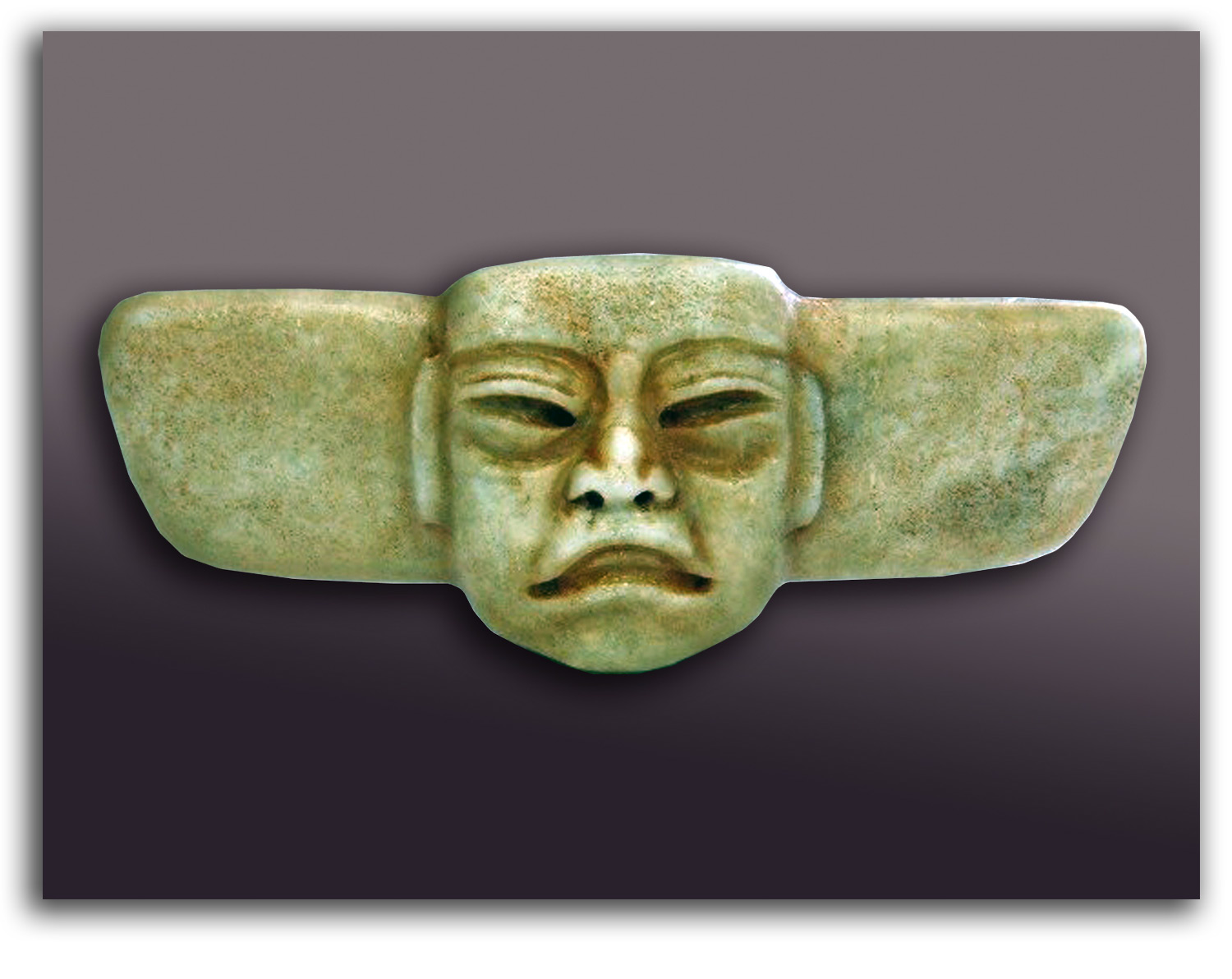
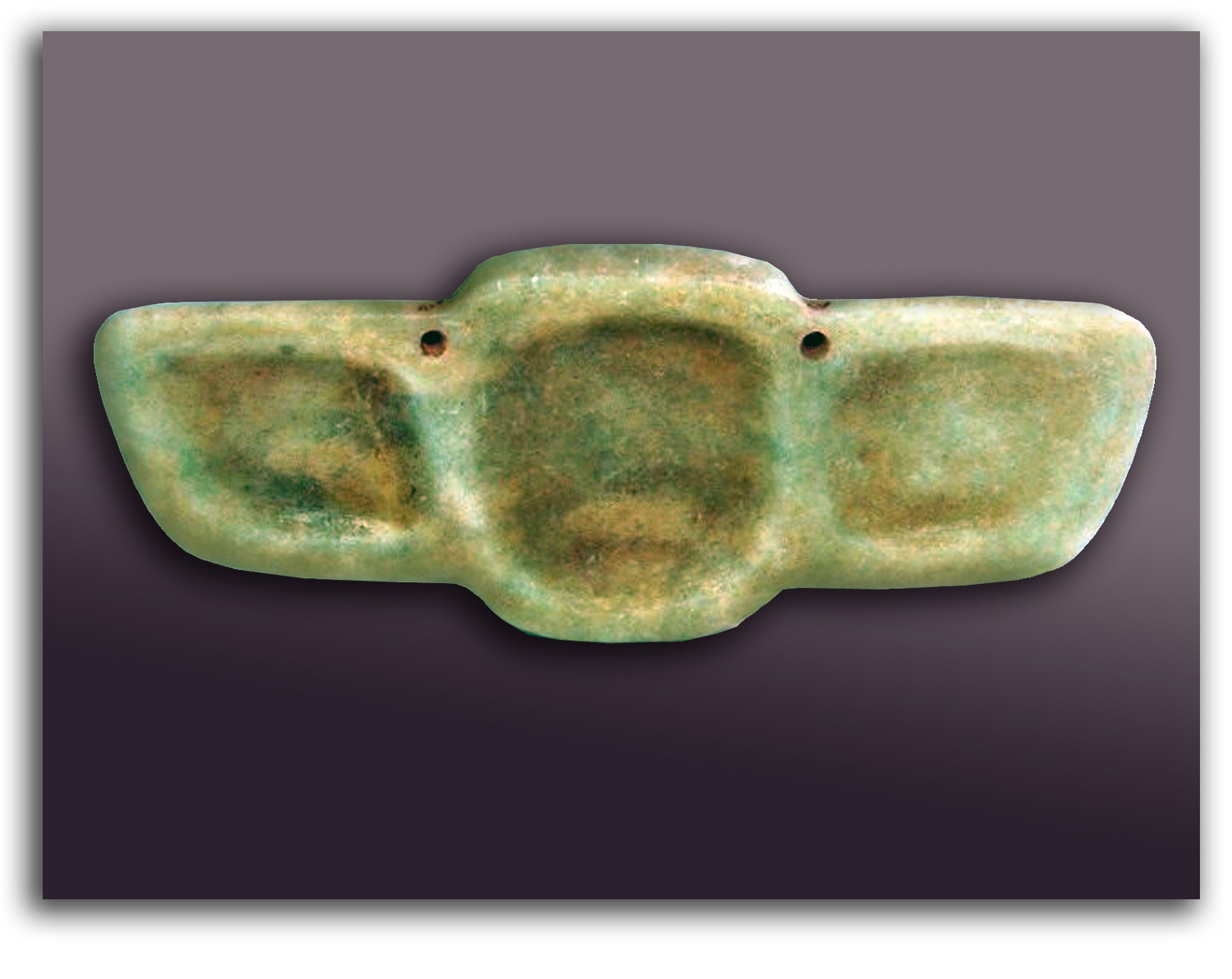
NOTE: Blood-letting was a common ritual of self-sacrifice in Mesoamerica. It seems to have started with the Olmec and was continued by the Maya. The blood taken from one’s body in a sacred ceremony, by means of a “blood-letter” or “perforator,” was offered to the gods as food. The belief was that the gods needed human blood to survive. This so-called “spoon” has carved into it the abstract face of a jaguar, a totem of the Olmec people. This type of object is thought to have been the container that held the blood until it could be poured on paper and then burned so the smoke could ascend to heaven.
PRE-COLUMBIAN
Astroarcheology in Mesoamerica: Heavenly Alignments in Temple Architecture
Feathered Serpents & Double Serpents in North American Art and their relationship with Mesoamerican Mythology
OLMEC
NOTE: No jade sculpture in Mesoamerica is carved more beautifully than that of the Olmec. Its famous standing figures and masks usually portray ecstatic trance. This is widely understood as a shamanic trance in which a person is changing from ordinary consciousness to jaguar conciousness. In short, one is ìbecomingî a jaguar. Jaguars were at the top of the food chain and at the top of their mythology. Olmec leaders, political and spiritual, clearly were shamans. Tribal leaders for the rest of Mesoamerican history often had jaguar as one of their names. One of the standing figures exhibited here has markings on his legs. These markings seem to be part of the first writing system in Mesoamerica, a system which has not yet been deciphered. Three of the most dramatic of the shamanic objects in this group, a ring and two pendants, picture life & death beside each other. In the modern world, life & death are regarded as having little to do with each other. In the traditional world of Mesoamerica and elsewhere, life & death are natural aspects of each other. Said in philosophical terms, the two are not two. These Olmec carvings represent the profound face of nonduality. The Child and “baby face” images seem to symbolize an aspect of the Olmec fertility deity. The small black ìbaby faceî pendant in this group was collected by ADR Lanier who was born in Jalapa. He returned to Jalapa frequently during the second half of the 19th centuty. He collected this pendant and the tallest standing figure (3.6 inches) before 1904. Gift of Mrs. ADR Lanier 1955. The rest of this Olmec group was acquired with the Martha Lanier Graham Purchase Fund.
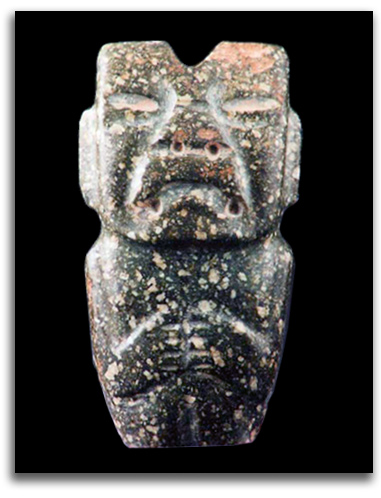
Celt. Olmec
Stone. Collection: FLG on loan to IAD
Published in GLOBAL VISION: A SURVEY OF WORLD ART, Part 2, 2008
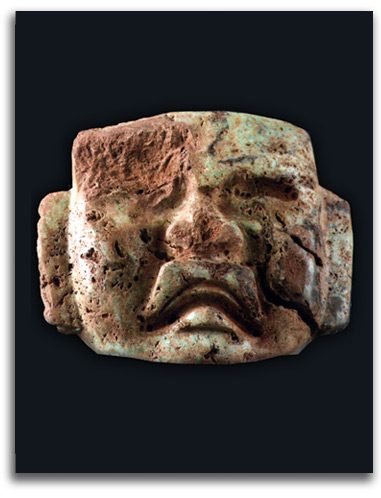
Mask. Olmec
Stone (quite deteriorated). Collection: FLG on loan to IAD
Published in GLOBAL VISION: A SURVEY OF WORLD ART, Part 2, 2008
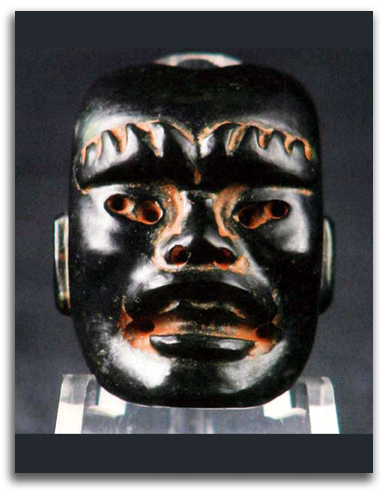
Masquette with Flame Eyebrows. Olmec
Stone. Collection: FLG on loan to IAD
Published in GLOBAL VISION: A SURVEY OF WORLD ART, Part 2, 2008
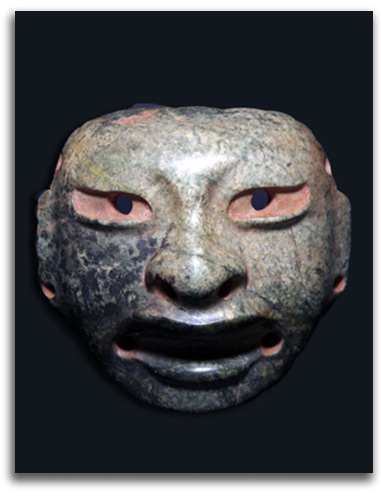
Masquette. Olmec Stone. Collection: FLG on loan to IAD, 2011
1 The Olmec: A Basic Bibliography
2 The Olmec & The Shang: A Bibliography of Diffusion Theories
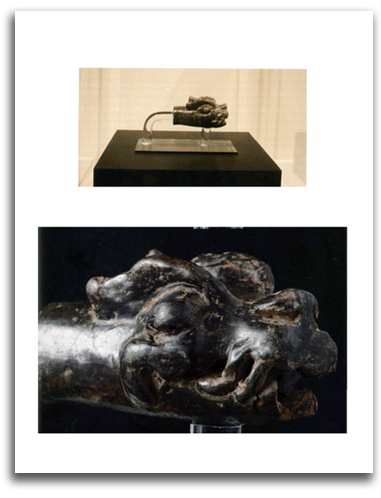
Head of Feathered Serpent/Dragon (2 views). Olmec
Terracotta. Collection: FLG on loan to IAD
Published in GLOBAL VISION: A SURVEY OF WORLD ART, Part 2, 2008
3 Divine Dragons: Feathered Serpents of the Olmec
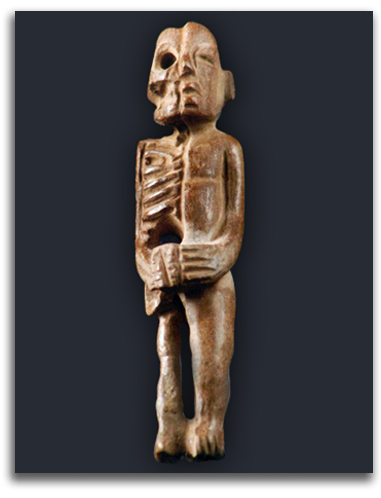
Life/Death Nonduality Man. Olmec
Stone. Collection: FLG on loan to IAD
Published in GLOBAL VISION: A SURVEY OF WORLD ART, Part 2, 2008
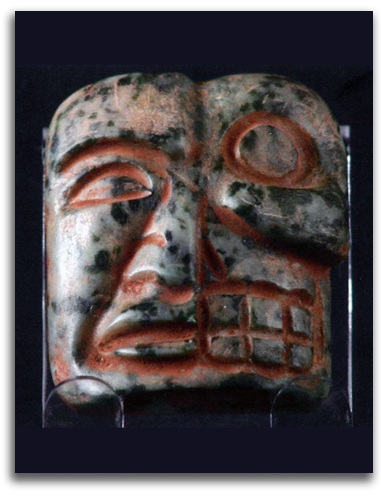
Masquette. Olmec Life/Death Nonduality Man. Olmec
Stone. Collection: FLG on loan to IAD
Published in GLOBAL VISION: A SURVEY OF WORLD ART, Part 2, 2008
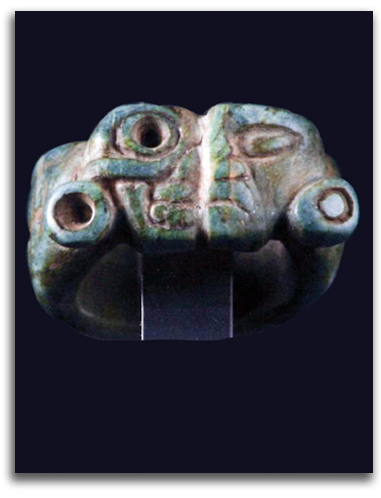
Life/Death Nonduality Ring. Olmec
Stone. Collection: FLG on loan to IAD
Published in GLOBAL VISION: A SURVEY OF WORLD ART, Part 2, 2008
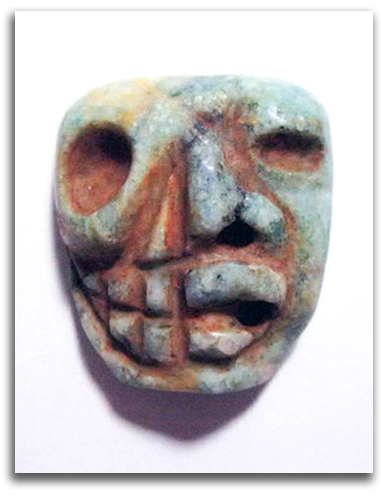
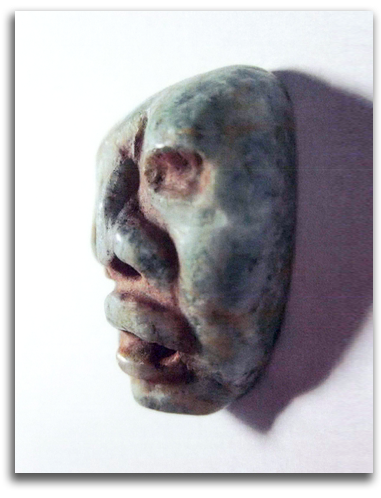
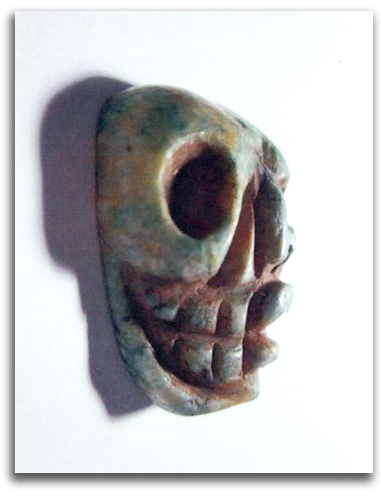
Life/Death Nonduality Face #2. Olmec
Stone. Collection: FLG on loan to IAD, 2011
4 Life, Death, and Nonduality in Miniature Olmec Sculpture
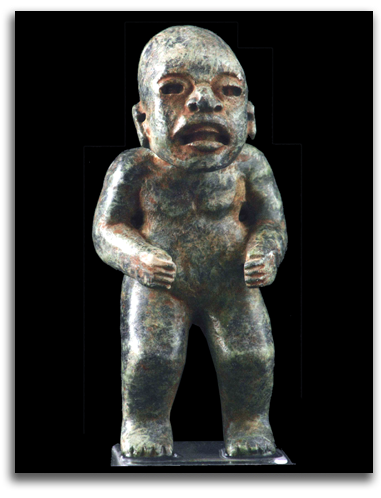
Shaman undergoing Transformation #1. Olmec
Stone. Collection: FLG on loan to IAD
Ex. Collection: Mr. & Mrs. S.C. Lanier, Jalapa;
and then Mr. & Mrs. ADR Lanier, Chattanooga
Published in GLOBAL VISION: A SURVEY OF WORLD ART, Part 2, 2008
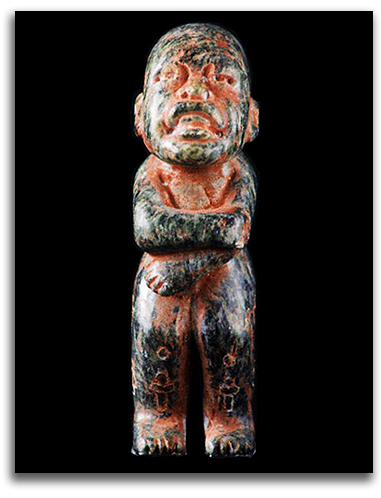
To view enlarged image with details of tatoos, click here
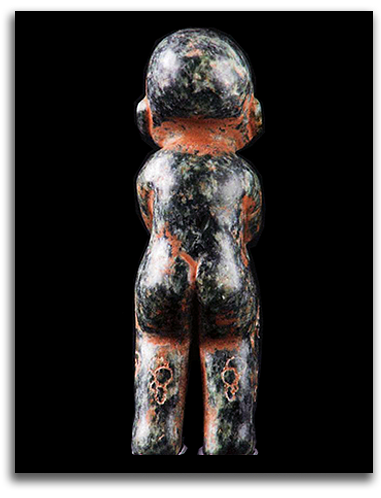
To view enlarged image with details of tatoos, click here
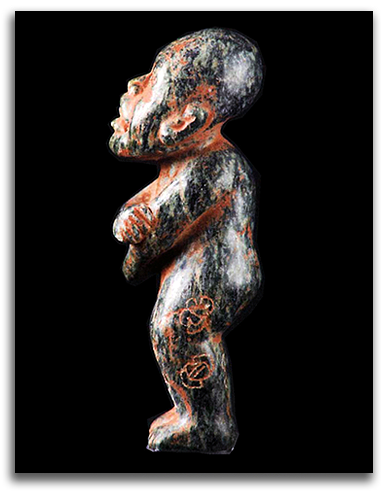
To view enlarged image with details of tatoos, click here
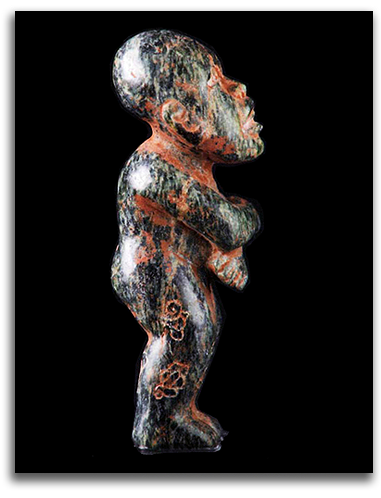
To view enlarged image with details of tatoos, click here
Four views of Shaman undergoing Transformation #2 (with tattoos). Olmec
Replica. Stone. Collection: FLG on loan to IAD
Published in GLOBAL VISION: A SURVEY OF WORLD ART, Part 2, 2008
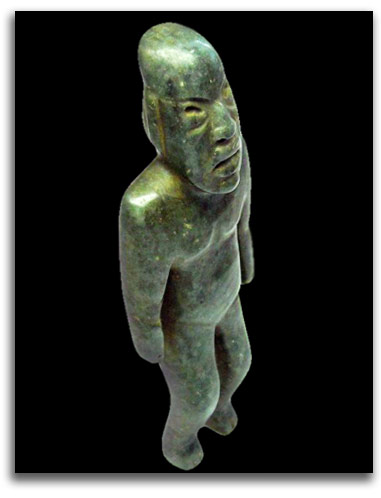
Shaman undergoing Transformation #3. Olmec
Stone: Collection: FLG on loan to IAD, 2011
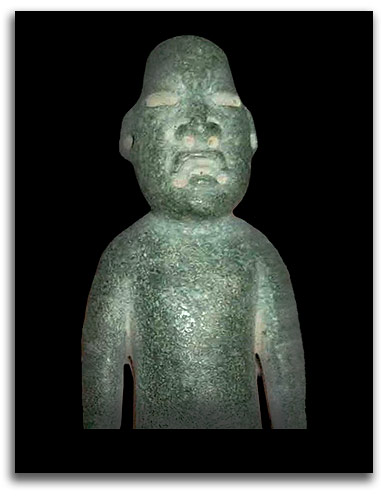
Shaman undergoing Transformation #4 (detail). Olmec
Stone: Collection: FLG on loan to IAD, 2011
5 Olmec Figures in Shamanic States of Transformation
6 The Sacred Marriage in Mesoamerica:
The Cyclical Uniting of Heaven & Earth among the Olmec & the Maya
MAYA
1 The Burial Mask of Lord Pacal: A Survey of Modern Replications
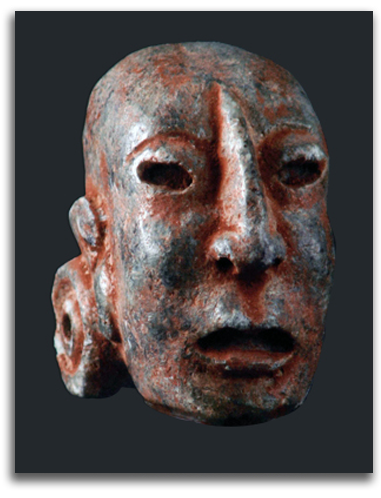
Head of a Man with a wide Open Mouth, Ear Loops & a Nose Extension
Maya. Stone. Collection: FLG on loan to IAD
Published in GLOBAL VISION: A SURVEY OF WORD ART, Part 2, 2008
Click here to view enlarged image
NOTE: The Maya culture seems to have developed under the influence of the Olmec and Teotihuacan. Its jade sculpture is of exceptional quality. The famous masks of Teotihuacan do not appear to be portraits of individuals. Portraiture as such was developed in Mesoamerica by the Maya. Like the carved faces of the Olmec and Teothihuacan, many Maya faces seem to be faces of ecstasy, faces in a trance state. The style of two of the remarkable stone faces shown here in the middle of this shelf are close in style to the era of Lord Pacal, 7th century CE. One has a nose extension far up into the forehead, which is typical of that family. The larger of these two is very similar to one in Harvardís Peabody Museum. It was seen in the T.V. documentrary ìCracking the Maya Code.î Both ìPacalî pieces were acquired with the Martha Lanier Graham Purchase Fund. The Maya earspool was collected in the middle of the 19th century by Gideon Wells, Secretary of the Navy under President Lincoln. His son, Edgar T. Wells, president of the International Company of Mexico, donated the family collection of a New England Museum which recently sold the collection. Partial gift of Dr. Rod Rogers, 2007.
2 Maya Face Masks in Shamanic States of Transformation
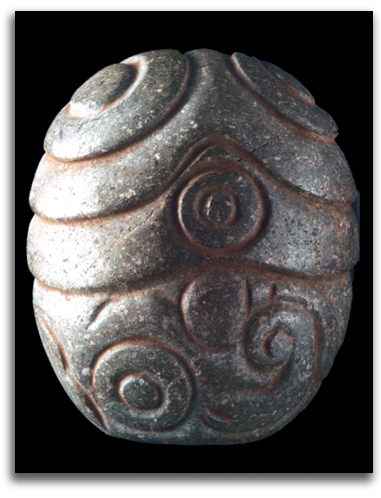
Sacred Heart with Swirling Volutes, c.600-800. Maya
Stone with traces of cinnabar. Collection: FLG on loan to IAD
Published in GLOBAL VISION: A SURVEY OF WORLD ART, Part 2, 2008
Click here to view enlarged image
NOTE: The Aztec are famous for extracting human hearts and feeding them to the gods because they thought the gods needed them to live. The Maya engaged in such rituals only rarely, as Karl Taube has pointed out. This stone appears to represent the sacred heart. A similar stone, less elegantly carved, was found near the main Aztec temple, Templo Mayor, and is now in the National Museum, Mexico City. That stone is called the ìStone of Copil.î The stone heart in this exhibition is thought to be Maya because of the style of its carving. More research is needed to determine if it could be a prototype for the Aztec stone. The volutes that swirl on this remarkable stone probably are symbolic of the life-force. Various forms of blood-letting as a type of self-sacrifice were common in Mesoamerica, as was human sacrifice. The most common way to kill a sacrificial victim seems to have been decapitation, but sometimes the ritual was cutting out the still-beating heart and offering it to the heavens. This ritual in the literature of anthropology is called ìheart extraction.î There are indications that five men performed the ritual. Four priests associated with the rain god held the victim. A fifth cut open the chest, pulled out the palpitating heart, and raised skyward this miraculous thing which seems to have a life of its own. Beside the priests stood a shaman singing thankful words of offering to the beings above as the energy went up from earth to the heavens and then voicing the gratitude of the gods as the heavenly energy came down to earth. This beautifully carved heart would have been used in very special rituals. The cinnabar still visible in the lines was commonly painted on stone and jade objects. Red symbolized blood and was associated with death and rebirth. The spirals and volutes are a common symbol in Maya art. Taube points out that the spiraling volutes symbolize ìspirit breath,î the breath of the spirit, the life force. The concept seems quite similar to ìchiî in East Asian metaphysics, and ìpranaî in Hindu metaphysics. In other words, this lovingly carved object, to the Maya, was not a cold dead stone but rather a vibrant pulsating sphere of cosmic energy.
NOTE: This dramatic stone is carved with volutes that probably represent “spirit breath” or “breath of the spirit,” in other words, the life-force or universal energy. It is similar to the later Aztec “Stone of Copil” in the National Museum of Mexico. Symbolized is the beating heart that was taken from ritual victims and offered to the Gods in sacred ceremonies. It was believed that the very survival of the Gods depended on drinking human blood.
3 Pulsing Life: A Ceremonial Maya Heart of Stone
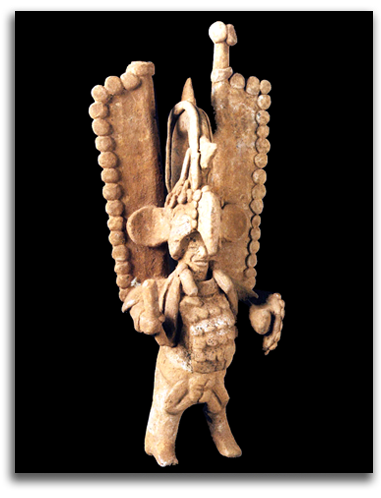
Shaman Warrior as the Sun Bird (Kinich Kakmo). Maya
Terracotta. Collection: FLG on loan to IAD
Published in GLOBAL VISION: A SURVEY OF WORLD ART, Part 2, 2008
Click here to view enlarged image
NOTE: Kinich Kakmo was one of the oldest forms of the Sun God. He was widely worshipped in the Maya world as a special form of the “Golden Bird,” a macaw. This beautiful bird was also known as the Sun Bird, the Golden Bird, and the Fire Bird who controlled drought and disease. (Kak means fire; mo means bird.) The myth was that every day at noon, the god-bird would descend to earth to receive offerings, offerings that would ensure that the sun would continue to rise and generate well-being. This figure is a powerful expression of a shaman as Kinich Kakmo. That which is the spirit of the heavenly bird and that which is the material reality of the earthly man are almost equal in height, suggesting a kind of equality. But the majestic wings of the Golden Bird make up the primary presence. Remarkable and rare detailing unites the above and the below. One may need to look twice to find the man who has become the bird in his shamanic trance. The huge head of the spiritual bird envelops the physical head of the shaman. But the man has not been overwhelmed by this mystic unification of the heavenly and the earthly. With strong eyes, he stands tall and firm holding a shield and a war club. From the front, we see the bottom of the beak of the great bird comes down to look like it is touching the nose of the bird-man — another indication of their unity. At night Kinich Kakmo became a jaguar and descended to rule in the underworld of the dead. The fact that Kinich Kakmo has animal forms indicates this type of conceptualization predates expressions of the Sun god that has exclusively human form. In the tribal world, totemic manifestations of animal spirits almost always are older than human forms. In a very early myth from the Popol Vuh, there was a seven-feathered macaw who wanted to be both sun & moon, but did not have what it takes. Kinich Kakmo assimilated the esoteric symbol of seven-feathers. In the most famous of the many closely associated solar myths, Kinich Ahau (the sun) has a son named Itzamna, ìKing of the gods.î He was both Lord of the Rain and a typical Culture Hero who created civilization by giving the Maya the arts of farming, writing, calendars, and medicine. His legend may well have started with the life of a shamanic earthly priest-king. His partner was Ixchel, Lady of the Moon, responsible for childbirth and health. Her name is commonly translated as “Rainbow Lady.” This sculpture comes from the well-known collection of William Freeman, an active Arizona artist and collector during the 1950s and 1960s.
4 Kinich Kakmo: A Maya Shaman Dressed as the Sun Bird
AZTEC
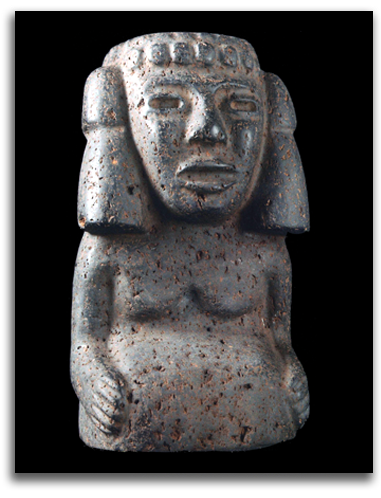
WATER GODDESS (Chalchiuhtlicue). Aztec
Stone. Collection: FLG on loan to IAD
Published in GLOBAL VISION: A SURVEY OF WORLD ART, Part 2, 2008
Click here to view enlarged image
NOTE: There were many gods and goddesses in the Aztec pantheon, one for virtually every aspect of life. They were all children of Coatlicue. None was more important than the Rain goddess. The name of her Rain god partner, Chac (or Tlaloc to the Aztecs), is better known. But male deities in this world usually do not function alone. They have female partners, or mates, or aspects. Each deity is a united duality. The Aztec water goddess was the goddess of all kinds of water: lakes, rivers, streams, and even the watery womb. She protected women in childbirth and children at baptism. In the codices she usually is portrayed with a jade skirt. Indeed her name means ìShe of the Jade Skirt.î Children are pictured in the codices emerging from her floating in a fluid stream. She usually was sculpted by the Aztecs as a very simple form. Aztec artists could be quite naturalistic when they wanted to be and quite abstract when they wanted to be. When rendering the Water Goddess, the Aztec artists went back to the minimal shapes formulated at Teotihuacan, where her mate, the Rain God, often has the prominent fangs of the jaguar in a continuation of Olmec influence. Most of the surviving versions of the Aztec Water Goddess have a similar iconic composition. The original example in this exhibition is typical. She kneels with her hands on her knees. The very large gatherings of hair on each side of her face hang in a thick weighty way, possibly suggestive of heavy rain and/or flowing water. This detail is given more emphasis on more realistic versions. While much of her body is quite abstract, her open mouth is curiously naturalistic. It almost seems to move, as in the sculpted faces of the Olmec and at Teotihuacan. The half-open ovaloid eyes also continue the Teotihuacan tradition. The upper and lower portions of her body have been given equal weight, perhaps suggestive of an equality between the heavenly spirit that gives water and the earthly spirit that receives water.
1 Chalchiuhtlicue: The Aztec Goddess of Rain, Water, & Fertility
2 Quetzelcoatl: The Double Serpent of Mystic Unity in Aztec Art
3 The Jaguar-Warrior & the Eagle-Warrior as Bi-singularities:
The Iconography of the Totemic Double in Maya & Aztec Art
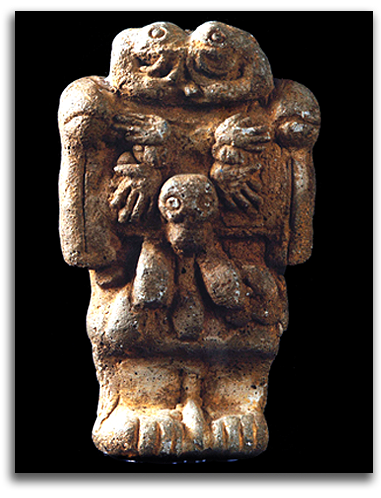
Great Goddess (Coatlicue). Aztec
Stone. Collection: FLG on loan to IAD
Published in GLOBAL VISION: A SURVEY OF WORLD ART, Part 2, 2008
Ex. Collection: Mr. & Mrs. S.C. Lanier, Jalapa;
and then Mr. & Mrs. ADR Lanier, Chattanooga
Click here to view enlarged image
NOTE: Coatlicue was the Great Goddess of the Aztec world – Mother Goddess, Earth Goddess, and much more. In her aspect as all-nourishing Mother she gives birth to all that is – all plants, all humans, the sun and moon and stars. In her opposite aspect she is the Devourer, swallowing up all that is at the end of its appointed time. She was sculpted in different ways. Most famous is the monumental version 9 feet tall that stood in the central plaza of the capital. Her presence is so powerful that when she was excavated it was decided she should be buried again. Her body is that of the Double Serpent, with the two heads of the rattlesnakes facing each other. Her necklace is made of human skulls and hearts and hands. Her skirt is made of serpents interweaving. Her name in Nahuatl means ìLady of the Serpent Skirt.î She also was called Cihuacoatl which means ìSerpent Lady,î and Toci which means ìour Grandmother.î Among her many epithets is ìGoddess of Life, Death, and Rebirth.î Many modern scholars often speak of her only in connection with life and death. This is a dualistic way of thinking which overlooks the fact that continuous rebirth is what traditional metaphysics is all about. Serpent Lady also is the mother of Feathered Serpent, who is pictured from time to time as Double Serpent. It is difficult for modern minds to comprehend, but this mother and son were seen as aspects of each other, not as totally separate. In the typical mythology of the prehistoric world, the first supreme being is the Great Goddess. She is dominant in the Old Stone Age. She creates all. In the New Stone Age she gives birth to the Great God who becomes her partner as co-creator of the universe. In other words, as we find this pair in the Aztec world, the great Female and the great Male together constitute the great Double Serpent. At the highest level of understanding there is no duality. There is only one supreme reality which can be perceived from different perspectives. This is a small stone version of the famous 9 foot tall configuration of Coatlicue in the National Museum of Mexico. It is small enough to be held in the hand. The wear pattern shows it was held by devotees of the Great Goddess for many years. The date of the tall original is about 1500. The date of this small version is unknown. It was collected in Mexico by ADR Lanier before 1904.
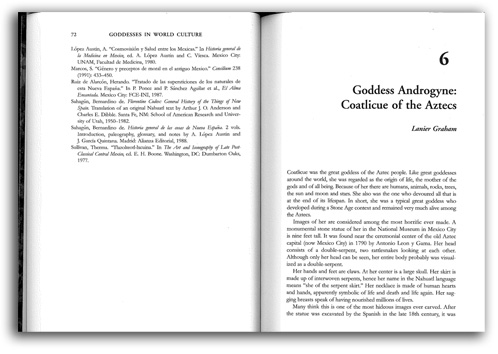
Click here for entire article in PDF format
4 “Goddess Androgyne, Coatlicue of the Aztecs” in Monaghan, ed.,GODDESSES IN WORLD CULTURE, 2011
MOCHE
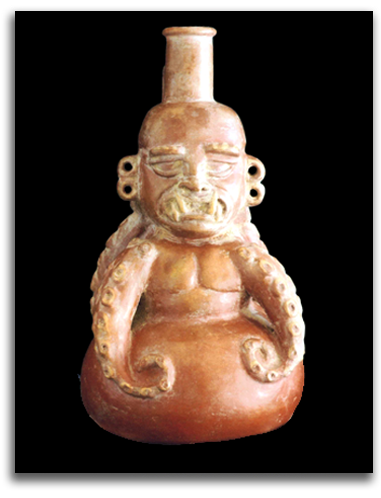
Octopus Vessel (replica?). Moche
Ceramic. Collection: FLG on loan to IAD
Published in GLOBAL VISION: A SURVEY OF WORLD ART, Part 2, 2008
NOTE: When the extraordinary headdress of the Octopus God was excavated two decades ago, scholars were unsure how to interpret it. It was clearly important. It appeared on the head of an elite figure. Was it really an octopus, or a version of the old Sun God with serpents for hair? It seemed like a positive being but how positive? The matter received little scholarly attention for some time. The piece was stolen soon after being unearthed and was not recovered until quite recently. In 2007 another version of the Octopus God appeared. This is a ceramic sculpture which expands the symbolism of the flat jewelry into a robust three dimensions. This time the body of the deity has not just eight rays that curl at the tips but the highly realistic arms of an actual octopus. We also see that this face is an equally realistic picturing of the traditional fanged feline who is generally accepted as the ìSupreme Beingî of the Moche. This confirms the identity of the more abstract face of the ìSupreme Deityî on the Octopus headdress. Even the quadruple earloops are basically the same. The logical conclusion is that the Octopus God was considered an aspect of the Highest Good, and perhaps another aspect of the Spider God (the so-called ìDecapitatorî). The provenance of this vessel is uncertain. More research needs to be done. If it proves to be authentic, this dramatic image will take its place in the Moche pantheon, as a vibrant vision of the life-force in the sea.
1 An Unrecorded Moche Octopus Vessel

Figure holding Two Sacred Tumis Ear Spool (one of a pair). Moche
mosaic mounted in silver. Collection: FLG on loan to IAD
Published in GLOBAL VISION: A SURVEY OF WORLD ART, Part 2, 2008
NOTE: We are just beginning to comprehend how important hearing was in traditional America. Earspools of various sizes and shapes were common. The possibility is strong that earspools were much more than decorations and status symbols but rather devices for hearing spiritual sounds. This particular pair is similar to the most famous of Moche earspools which were excavated with the Lord of Sipan. In this pair a warrior-king is holding two tumi.
2 An Unrecorded Pair of Moche Mosaic Earloops
edited 2007