Vol. 1 ANCIENT CHINESE JADES (Spring 2010)
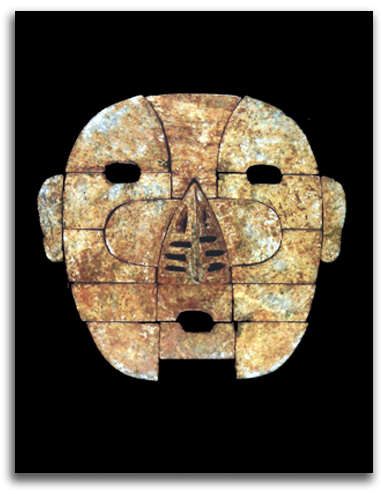
Burial Mask, Han Dynasty, c. 2nd/3rd century
Jade. Collection: FLG on loan to IAD
Published in GLOBAL VISION: A SURVEY OF WORLD ART, Part 1, 2006
The Bronze Age ended when the Iron Age began. The new development of iron weapons helped the army of the ‘First Emperor’ to unify a divided society into one nation during the Chin Dynasty (221-206 BCE). From Chin came the word China. Next came the Han Dynasty (206 BCE – 220 CE) which flourished about the same time as ancient Rome. Among the best known objects of this Dynasty are the jade suits in which some very prosperous nobility were buried. Lesser nobility were buried with jade masks such as the one on display here. What is interesting is that high status individuals in Mesoamerica also were buried wearing jade masks during this same period. Could there have been a relationship between these cultures? There are many theories. Another famous object from the Han Dynasty is the so-called ‘Flying Horse’ shown here in an excellent modern replica. It may be difficult for modern urban people to appreciate how highly revered fine horses were to the warrior elite of the ancient world. How much they loved their horses can be felt in sculpture such as this bronze and in this red terracotta head of a horse from the Tang Dynasty (618-906 CE). Research on the exact dates for all of the Early Chinese pieces in this exhibition are an ongoing curatorial process. ©Lanier Graham
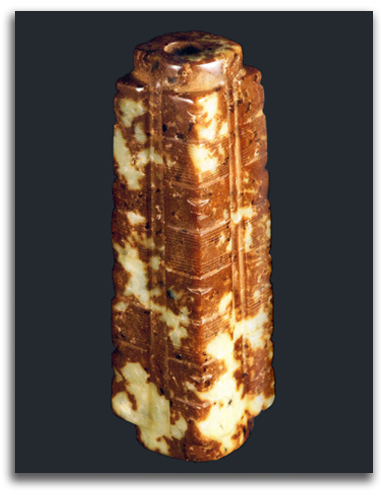
Cong. Liangzhu culture. Neolithic
Jade. Collection: FLG on loan to IAD
Published in GLOBAL VISION: A SURVEY OF WORLD ART, Part 1, 2006
NOTE: Seen from above, the form is a circle-in-a-square
A EARLY CHINESE JADE MANDALAS, 1962
B CONVERSATIONS WITH MASTER CHI, 1962-1963
C CONVERSATIONS WITH CHINESE SCHOLARS
D GLOBAL VISION: A SURVEY OF WORLD ART, Part 1, Oct. 2006 (Catalogue entries for Neolithic & Bronze Age Chinese jade
E STONES & BONES THAT SPEAK: Inscribed Chinese Art, Ancient to Modern (CSUEB Library Exhibition, Oct. 2008 to Feb. 2009)
F The CONG, the BI, & ETERNITY in ANCIENT CHINA, 2005
G TASTING CLOUDS: An Introduction to the Zisha Tradition, 2009
H Chinese translation of TASTING CLOUDS by Master Bing Fan YeYoung, 2009
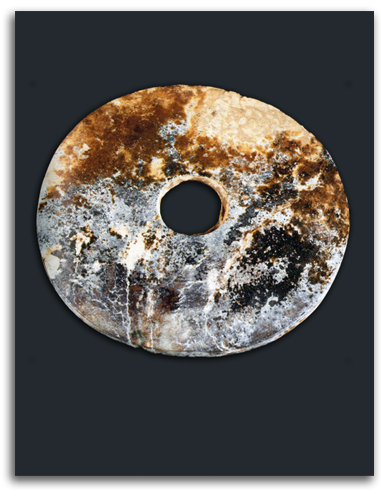
Bi Disk. Liangzhu culture. Neolithic
Unpolished Jade. Collection: FLG on loan to IAD
Published in GLOBAL VISION: A SURVEY OF WORLD ART, Part 1, 2006
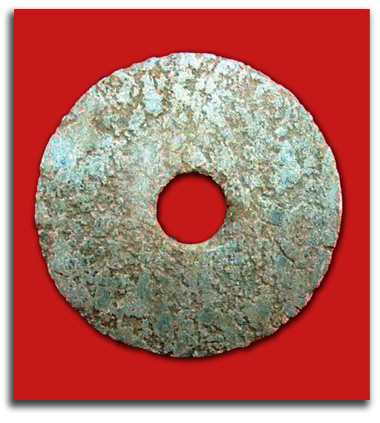
Bi Disk, Liangzhu Culture. Neolithic
Unpolished Jade. Collection: IAD, 2011
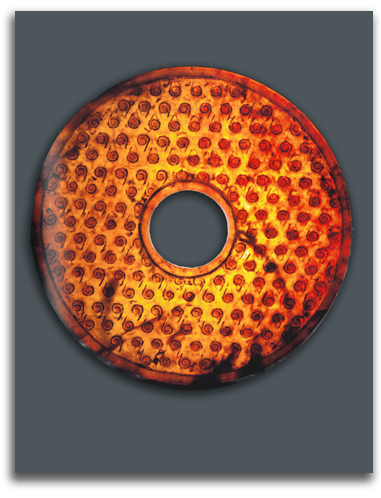
Bi Disk with Rice Grain Pattern, Shang Dynasty, c1600-1000 BCE
Polished Jade. Collection: FLG on loan to IAD
Published in GLOBAL VISION: A SURVEY OF WORLD ART, Part 1, 2006
College courses on Chinese Art usually begin with the Shang and Chou Dynasties of the Bronze Age which started about 3500 years ago. But the roots of those bronze forms and symbols are in the jade sculpture of the kind on display here. Most of them are from two neolithic cultures. The figurative pieces are from the Hongshan society in the north near the boarder of what is now Mongolia. Their chronology is still being established but they seem to have flourished from about 3500 BCE to about 2000 BCE. There are no documents to explain what these shapes mean. They lived long before writing but the shapes themselves say a great deal. Most if not all these pieces have shamanic associations. In the tribal world of Stone Age people it is common to depict combinatory beings who dwell in many dimensions not just one. For example we have here a “cat-man” who part man and part cat. The geometric pieces are from the Liangzhu society west of what is now Shanghai. They seem to have flourished between about 5000 BCE and 2500 BCE. The two most important of these sacred geometric shapes were designed to be buried with the bodies of the departed. This burial ritual continued through the Bronze Age. The flat circular discs called “bi” (formerly “pi”) were placed under and on top of the bodies. At first they were undecorated. Then they became richly decorated with various symbols including the mysterious “taotie” monster mask. The “cong” (formerly “t’sung”) is a rectangular shape in the center of which is a smooth circular tube. Seen from above or below the form is that of the mandala the circle-in-a-square which became a core symbol in Taoism- Hinduism and Buddhism. The square represents the material world and the circle represents the spiritual world or “nothingness.” The cong is a vessel that holds nothing or perhaps more accurately it contains “nothingness.” They were placed around the body. At first these ritual objects also were undecorated but became richly decorated with symbolic shapes and faces. Modern scholars are unsure of the meaning of these objects. However the surviving esoteric Taoist tradition explains that the “nothingness” at the center of the bi and the cong is the path that spirit takes from the earthly world to the heavenly world. The cong were made in many sizes apparently depending on the wealth of the deceased. Those on display here represent the known range of sizes from the tiny to the monumental. They are all made of sacred jade. Research on the exact dates for all of the Early Chinese pieces in this exhibition are an ongoing curatorial process. ©Lanier Graham
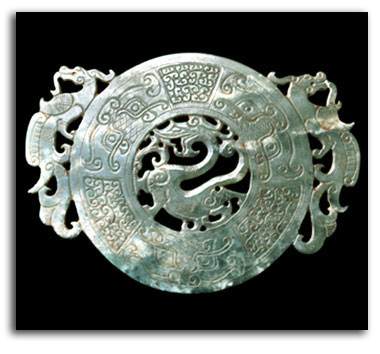
Bi Disk. Chinese. Han Dynasty, c200 BCE-200 CE
Jade. Collection: FLG on loan to IAD
I THE CIRCLE OF HEAVEN: An Exhibition of Ancient Chinese BIs, 2010
J SONGS OF THE BI: a Book of Visualized Poems, 2010
K PROPORTION IN ANCIENT CHINESE BIs, 2010
L HONGSHAN JADE BIBLIOGRAPHY, 2010
M. LIANGZHU JADE BIBLIOGRAPHY, 2010
N ANCIENT CHINESE JADES in the collection of F. Lanier Graham 2010
Vol. 2 COLLECTION CATALOGUES (Summer 2010)
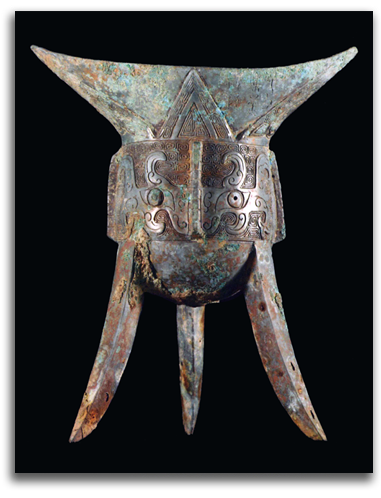
Ritual Vessel (“Jue”), Shang Dynasty, c1600-1000 BCE
Bronze (replica). Collection: FLG on loan to IAD
Published in GLOBAL VISION: A SURVEY OF WORLD ART, Part 1, 2006
NOTE: The bronze vessels of ancient China are widely considered the finest bronze objects ever made. They were extremely important in Bronze Age China. It was through the offerings made inside them that the shamans communicated with the ancestors and the deities. On the side of this one is the abstract face of the legendary Taotie. This exact meaning of this mythological creature is much debated. However, it probably was the most powerful totemic being in their pantheon.
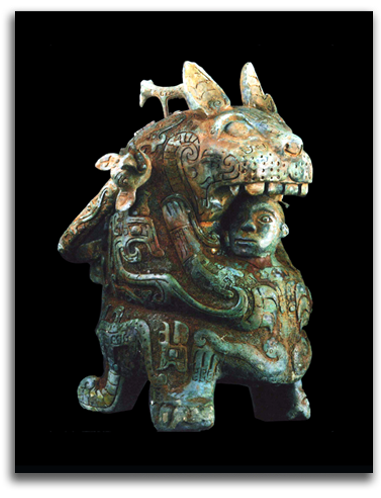
Ritual Vessel (“Yu”), Shang Dynasty, c1600-1000 BCE
Bronze (replica). Collection: FLG on loan to IAD
Published in GLOBAL VISION: A SURVEY OF WORLD ART, Part 1, 2006
NOTE: The young man is being protected by his totemic tiger (not devoured). To this day Chinese children celebrate this totemic relationship. They wear “Tiger Hats” to protect them from evil spirits.
~ GKS
A Ancient Chinese Bronzes in the collection of F. Lanier Graham
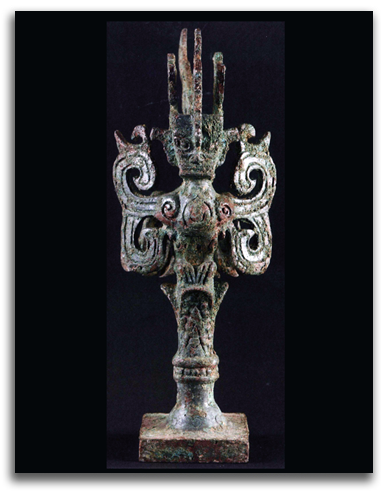
Flying Shaman, Shang Dynasty (Sanxingdui culture), 12th/11th century BCE
Bronze (replica). Collection: FLG on loan to IAD
Published in GLOBAL VISION: A SURVEY OF WORLD ART, Part 1, 2006
B Sanxingdui Sculpture of the Chinese Bronze Age in the collection of F. Lanier Graham
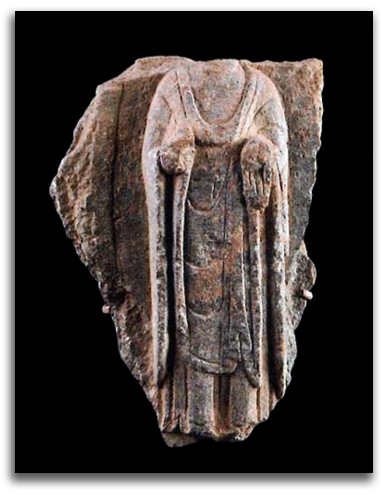
Standing Buddha Blessing, Sui Dynasty, 6th/7th century
Stone. Collection: FLG on loan to IAD
C Chinese Buddhist Sculpture in the collection of F. Lanier Graham
D Chinese Porcelain in the collection of F. Lanier Graham
Click here for closer view of this work in its current condition
[a digitally-restored version appears below]
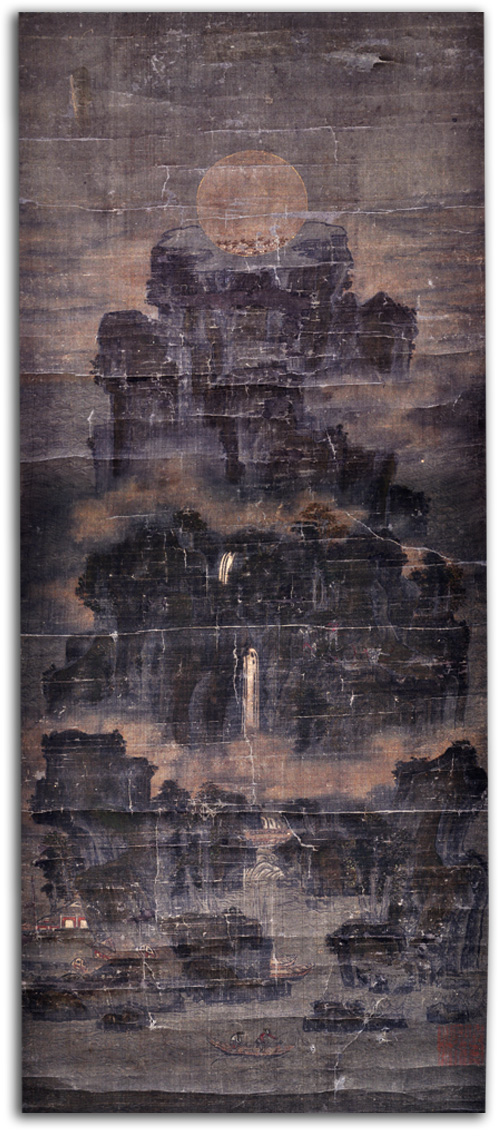
Landscape Scroll (“Mountain of the Flowering Moon”) possibly Sung Dynasty, c.10th/13th century
Inscribed on the back with an attribution to Mu Ch’i
Color on silk. Collection: FLG
Ex. Collection: Rudi Rudrananda, New York
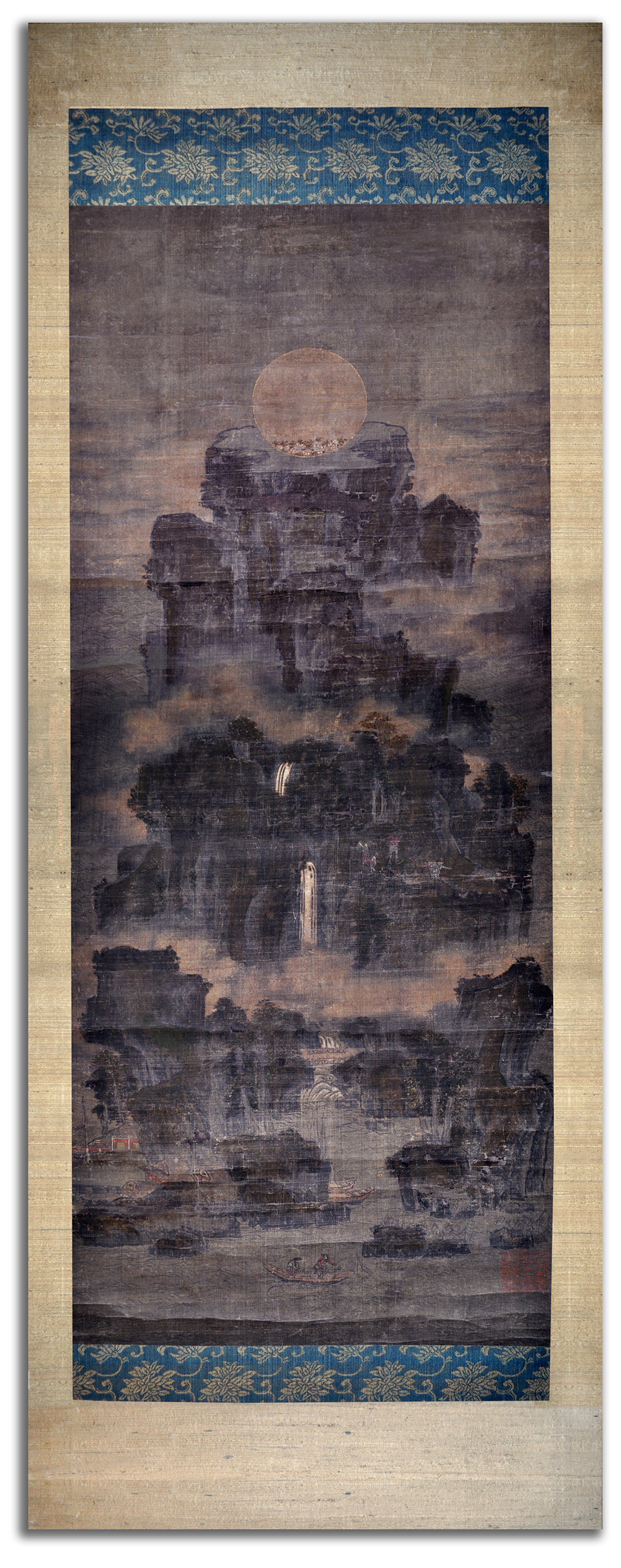
Click here for a closer view of this work, digitally-restored
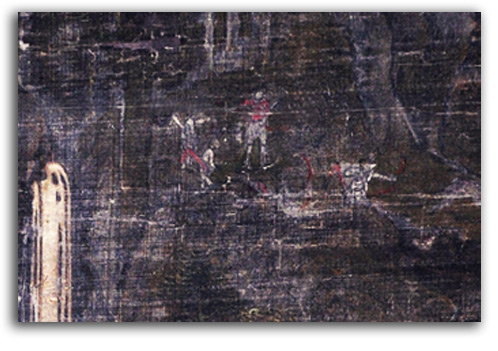
Detail of Hunters from the above scroll
NOTE: Inscribed on the back in an old hand is the name of Mu Ch’i. The remarkable quality of this unique scroll has been admired by a number of notable authorities on Chinese art, including Sherman Lee of the Cleveland Museum of Art, Jay Xu of the Asian Art Museum, James Cahill of the University of California/Berkeley, and Michael Sullivan of Stanford University.
The Asian specialists who examined this scroll also were struck by the symbolism of the flowers inside the moon. None of them had seen this symbolism before. This symbol is so striking that I call this scroll “Mountain of the Flowering Moon.” I suspect this image is a visual metaphor. “Reaching for the moon” is a traditional Buddhist metaphor for the Enlightenment quest. The meaning of this lunar garden could well be that one’s spirit ‘flowers’ when one finally reaches the “moon.”
Especially striking in the composition of this painting as a whole is the relationship between the hard mountain and the soft mist. Many Chinese and Japanese landscape scrolls over the last thousand years have attempted such harmonies of formed and formless, solid and void, yang and yin, and many are very good. The Chinese have long regarded landscape painting as the highest form of painting. Their distinctive landscape tradition, a dynamic dance of form and emptiness (mainly emptiness), is one of the greatest contributions of Asia to the art of the world. However, only a few landscape paintings have attained the aesthetic quality of “Mountain of the Flowering Moon” – an exquisite equilibrium of hardness and softness, together with a subtlety that hovers on the outside edge of perceptual possibility. Many of the painter-monks who developed this dramatic visual symbolism during the Sung Dynasty (aka Song Dynasty) were Chan Buddhists. They were not just painting pretty pictures. They were members of a new spiritual tradition, an early form of Zen that emerged from a synthesis of Taoism and Buddhism. Their paintings were (and are) teachings.
A landscape painting such as this one is a meditation on the unity of the non-material reality of the Tao together with material reality. The misty clouds that symbolize the Tao envelop every layer of this earthly world, from the upper layer of the luminous moon to the lower level of the water. No mountain could be more tactile or heavier. The sharpened stones of these jagged crags bite into the fingers of the mind. The weight of the mountain is a billion tons of earth. No clouds could be lighter. Visually, these soft clouds occupy much of the composition, yet they are barely present. The power of their presence is implied. The cloudy ring around the level of the moon is almost not there. And yet this moist mist seems to have the capacity to melt the heavy black rock into a softer grey stone all the way down the mountain. The lower cloud levels become slightly more solid (closer to being made of matter), until we reach the level of the water, water which seems to echo the form and fluid feeling of the lowest cloud.
Here is a picture of the absolute Emptiness that pervades every ounce of material reality together with the material reality which this Emptiness pervades and surrounds. In this painted scroll a profound musicality continues to sound through centuries of cracks on the surface of the scroll. Only after the impact of this Yin-Yang symphony begins to subside does the eye move on to the luminous moon, and then wander slowly down to the very white, ever-flowing waterfalls that bifurcate the picture (and soften the thickness of the black mountain), past the tiny people on the side of the mountain, down to the fisher folk at the bottom of the scene.
Many Chinese painters also were poets. Indeed, the Chinese invented the convention of writing poems on paintings. One wonders what this artist might have written while composing this painting. Surely it would have involved the Great Dragon (traditional symbol of universal energy) and a tale of transformation. Clearly, the mystical clouds of the Tao coil around the mountain like the body of the Great Dragon. Ch’i propels the Dragon everywhere in the cosmos. Ch’i literally means breathe or air. But the metaphysical reference of the term is to the active principle of the universe, the formative force. The misty moisture of this painting can be seen as the breathe of the Dragon. There is a mysterious plasticity to these clouds. Semi-solid at the center, they are thinner at the sides, almost transparent – as if the Dragon is shedding scales as he rubs against the earth, seeding matter to grow from darkness into light.
Regarding authorship, no name is certain. The name of Mu Ch’i is brushed on the back of the scroll. However, that is the case with many scrolls done ‘in the spirit’ of the famous Sung Dynasty painter, Mu Ch’i, (a Chan Buddhist monk) in the centuries after his death. Therefore, this attribution to Mu Ch’i should not be regarded as definitive.
Regarding the date, I think it probably is Sung Dynasty, or at the latest a copy of a Sung scroll done in the Ming Dynasty (1368-1644). Would that mean Northern Sung (960-1127) or Southern Sung (1127-1279)? The density of the composition, the dominant central peak, and the general tonality seem much more like Northern Sung than Southern Sung. And this is also the considered opinion of two of the world’s leading authorities of Chinese Art: Sherman Lee and James Cahill. In the unlikely event that this scroll actually was painted by Mu Ch’i, it would have been by a young Mu Ch’i who was learning landscape painting by following the spirit of Old Masters of the Northern Sung (such as Fan K’uan, Li Ch’eng, and Yen Wen-kuei), before studying with the artist of is said to have been his master, Liang Kai (c1140-c1210) – an artist who introduced a new level of spontaneity to painting.
E “Mountain of the Flowering Moon;”
An unrecorded Landscape Scroll inscribed with the name of Mu Ch’i
in the collection of F. Lanier Graham
F Chinese Scrolls in the collection of F. Lanier Graham
G Scholar Rocks (Viewing Stones) in the collection of F. Lanier Graham
H Chinese Furniture & Furnishings in the collection of F. Lanier Graham
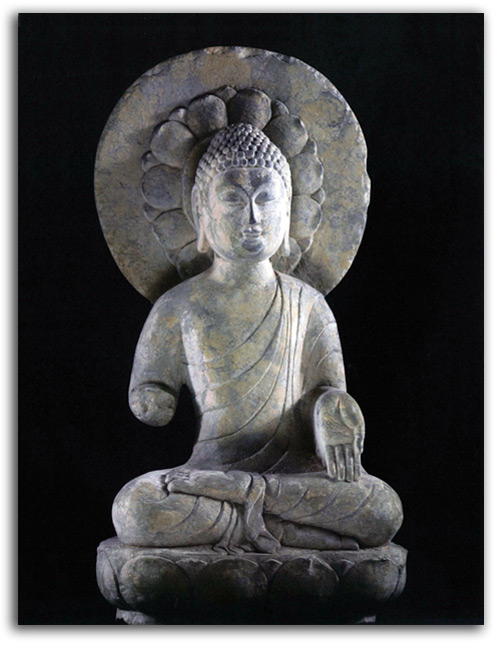
Buddha Blessing, probably Tang Dynasty, c.7th/10th century
Stone. Collection: FLG on loan to IAD
Published in GLOBAL VISION: A SURVEY OF WORLD ART, Part 1, 2006
Ex. Collection: Rudi Rudrananda, New York
Click here for an enlarged view of this Buddha
NOTE: There were (and are) many forms of Buddhism including both religious Buddhism and philosophical Buddhism. Most of the best-known Buddhist sculptures were worshipped in religious rituals. In contemplative or esoteric Buddhism there is no worshipping of idols or scriptures. All that really matters is meditation. This form of Buddhism is thought to have been brought to China by Bodhidharma (Da Mo in Chinese) in the 5th century. It became known as Chan Buddhism in China and eventually Zen Buddhism in Japan. The quality of steadfast resolution for which Bodhidharma is famous is often found in the best statues of highly evolved Buddhist masters who followed the teachings of Bodhidharma. In India such individuals are known as Arhats in China Lohans. They also can be called Bodhisattvas who have attained a certain level of Enlightenment and could leave the karmic cycle of reincarnation but have chosen to remain involved with humanity incarnation after incarnation to help everyone towards liberation. ©Lanier Graham
I An Unrecorded Buddha of the Tang Dynasty
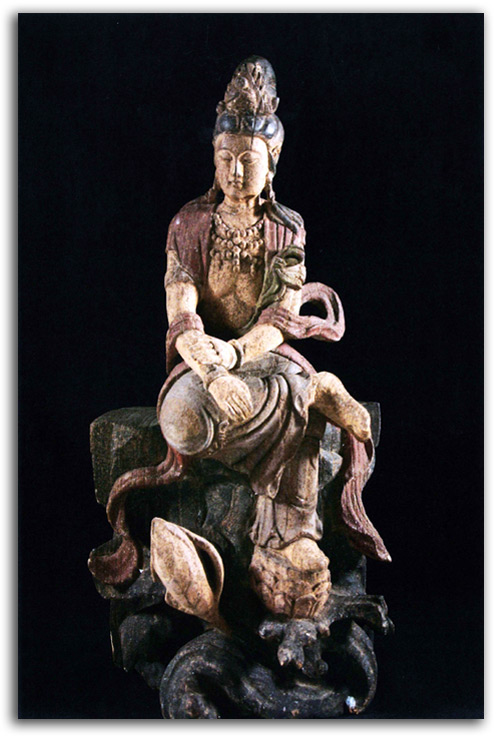
Kuan-Yin seated in a Relaxed Pose, probably Sung Dynasty, c.10th/13th century
Colored wood. Collection: FLG on loan to IAD
Published in GLOBAL VISION: A SURVEY OF WORLD ART, Part 1, 2006
Ex. Collection: Rudi Rudrananda, New York
Click here for an enlarged view of this Kuan-Yin
J An Unrecorded Kwan-Yin of the Sung Dynasty
NOTE: There were (and are) many forms of Buddhism including both religious Buddhism and philosophical Buddhism. Most of the best-known Buddhist sculptures were worshipped in religious rituals. In contemplative or esoteric Buddhism there is no worshipping of idols or scriptures. All that really matters is meditation. This form of Buddhism is thought to have been brought to China by Bodhidharma (Da Mo in Chinese) in the 5th century. It became known as Chan Buddhism in China and eventually Zen Buddhism in Japan. The quality of steadfast resolution for which Bodhidharma is famous is often found in the best statues of highly evolved Buddhist masters who followed the teachings of Bodhidharma. In India such individuals are known as Arhats in China Lohans. They also can be called Bodhisattvas who have attained a certain level of Enlightenment and could leave the karmic cycle of reincarnation but have chosen to remain involved with humanity incarnation after incarnation to help everyone towards liberation. ©Lanier Graham
Vol. 3 The Taotie, Lao Tzu, & Broken Buddhas (Fall 2010)
A The Taotie Mystery :
Reflections on Interpretations
B Lao Tzu:
A Translation of Poem #1
C The Image of Lao Tzu through the Ages:
The Changing Face of Wisdom
D BROKEN BUDDHAS:
Poems by F. Lanier Graham
Photographs by Philip Ringler (in progress)
Vol. 4 NONDUALITY (Winter 2010)
A The Pearl of Wisdom: Reflections on Nonduality
B The Yin-Yang: Reflections on Nonduality
C The Mandala: Reflections on Nonduality
[edited 2010]