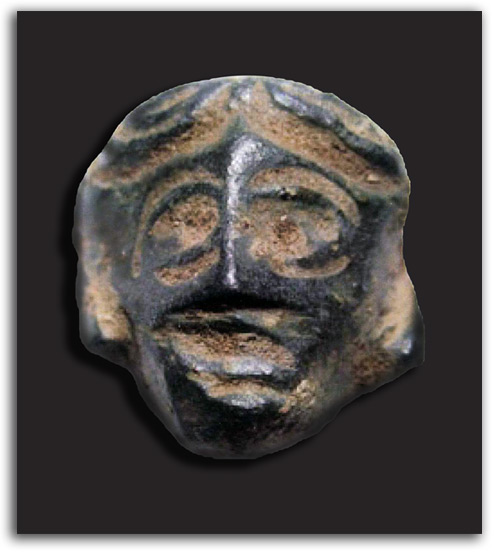
FACE. c.3rd/2nd century BCE
Bronze mount, perhaps from a sword or ritual vessel Collection: FLG
THE CELTIC WORLD: An Introduction
The Celtic tribes occupied a great deal of Europe, spreading from their homeland in central Europe, for perhaps a thousand years. Having developed their characteristic cultural patterns by about 1000 BCE, their tribes spread as far east as Turkey (Galatia) and as far west as Iberia. There is some reason to believe they originally came into Europe from the Russian steppes some 5,000 years ago. Eventually they migrated to what is now Great Britain starting at least as early as 500 BCE. Some say that date of migration was much earlier. Indeed some scholars, with DNA evidence, argue that the earliest Celtic people in England were there by 3,000 BCE and probably built Stonehenge.
The Celts were a loose association of Indo-European tribes connected by language and custom. They did not urbanize. They were tall and fair-haired. Society was headed by kings, a warrior aristocracy, and a priesthood of semi-shamanic druids. Kingship was not hereditary. It could be attained by vote or in battle. Confirmation of kingship took place in sacred rituals. That could be a communal feast where all were served a mystical drink from the hand of the Goddess (by means of her priestess), or a Sacred Marriage where the king united sexually with the Goddess (by means of her priestess). A survey of Celtic graveyards shows about 25% of the men were buried with their swords. Most people farmed and raised animals. Some also skillfully traded salt (to preserve food) and tin (for making bronze) with Greeks, Etruscans, and Romans. Metalsmiths fabricated objects with extraordinary skill.
Very little of their art has survived from the time before influence from the civilizations of Greece and Rome (major trading partners). The art that does survive has a robust vitality. There is little interest in the calm realism of the classical traditions of Greece and Rome. The dynamism of their highly abstract objects is unique. Their forms are often explosive and the aesthetic balance of many multiple parts is amazing. Their intense love of energetic curves generated coins with extraordinary compositions starting in the 3rd century BCE. Many feel these astonishing forms were not matched in variety and imagination until the modern art of Picasso.
This rich imagination continued into the later Christian era in the form of High Crosses of Ireland – the finest sculpture of the time – and richly illuminated manuscripts with even more fantastic layers of interlacing patterns. Painted books such as the BOOK OF KELLS are the most important visual books in all of Europe at the end of the first millennium CE.
Celtic spirituality was nature-centered and polytheistic. The names of some 300 deities survive. The Celts preferred to worship outdoors among trees (especially Oak trees) rather than inside temples. The famous Gundestrup Cauldren provides a lively picture of a Celtic pantheon. The Celts believed the dead go to an Otherworld – a joyful place of constant feasting where many gods and goddesses reside. It was not a “heaven” in the sense that it was a reward for living well. All Celts went there when they passed over. It appears they also believed in reincarnation, and other philosophical and spiritual traditions that Roman commentators described as Pythagorean. They also, it is said, had a special interest in astronomy.
The Celts loved their farms and animals, their sacred rituals (of earth, sky, water, and fire), lavish feasts, beautiful ornaments, lively dancing, music, poetry, story telling, and war. Their legendary warriors were fierce. Their ferocious battle cries and wildly painted bodies were known to scare opponents from the field before a battle could begin. Some were naked and wore only torcs. Celtic warriors held their own against the Romans for a long time. After they lost their wars for independence, the Romans often hired them as mercenaries. Families were patriarchal, but Celtic women had high status and many rights. The army of one Celtic queen, Queen Boudica, actually defeated a Roman army in England.
The Celtic language primarily was an oral tradition. The absence of a written tradition has left us with very little knowledge of the details of their culture. There are some short Roman descriptions, and some longer recollections written in Ireland during the medieval Christian era. However, much that is written by historians today necessarily is often speculation.
Some things are widely accepted. Their bards were singing poets who educated the people with songs. It is said that the druids, trained in the music of poetry, did not want something as sacred as knowledge to be defiled by the vulgarity of mere writing. Julius Caesar reported that the priestly druids might study for 20 years in order to prepare for their complex role as teachers, healers, and judges. It is thought that this training probably included a good deal of meditation, probably in caves rather than in monasteries. Druids respected minds that think in the present moment without being carried elsewhere by the abstract act of writing. However, it would be a mistake to call the Celts illiterate. They did have an elementary “alphabet” called Ogam (in which marks symbolize letters) to consecrate sacred stones, and they were quite able to express their language in standard European forms of writing such as Greek and Latin whenever they so desired.
Today, a number of Celtic languages continue in some western parts of the United Kingdom and in Brittany. Clan tartans are relatively modern inventions and are often merely decorative clothing for people in many families. However, in traditional Celtic regions such as Scotland and Ireland blood ties among families of ancient clans with the same last name remain strong, as does the traditional title of clan chief. Most of the Celtic work in this collection is ancient. Only a few pieces are modern replicas. The most widely collected of Celtic artifacts today are coins because so many have survived. The coins in this collection constitute a representative selection of one of the most remarkable of Celtic art forms.
Part One – THE CELTIC WORLD
1 HISTORY: Geography, Culture, Language, Writing
2 LEGENDS: Dragons, Druids, Arthur, Merlin, The Holy Grail
3 THEOLOGY: Gods+Goddesses, Mythology, Symbols
4 ARTS: Painting, Sculpture, Architecture, Design
Part Two – STUDIES IN CELTIC ICONOGRAPHY
1 EPONA, THE HORSE GODDESS
2 EPONA’S SUN & MOON
3 SUN & MOON TAKE TURNS GOVERNING THE UNIVERSE?
4 OPPOSING LUNAR CRESCENTS
5 LOTUS SYMBOLISM
Part Three – CELTIC COINS
1 HISTORY
2 ILLUSTRATED CATALOGUE OF CELTIC COINS IN THE COLLECTION OF F. LANIER GRAHAM
3 PROTO-MONEY RING
Part Four – CELTIC SCULPTURE
FACES & FIGURES
1 FACE. c.3rd/2nd century BCE
Bronze mount, perhaps from a sword or ritual vessel
Collection: FLG
NOTE: The head was a very important feature in Celtic iconography. Of the few pieces of stone or bronze sculpture that survive heads form a large proportion. Some classic commentators state the Celts were “head hunters.” It is not clear if that was true or only Roman propaganda to make the Celts seem “barbarian.” The same kind of questioning applies to the accusation of human sacrifice. It does seem to be true that to the Celts the head was the “seat of the soul.” This dynamic face seems to be an early work, before the naturalistic influence of Greek and Roman realism.
 DOUBLE-FACE, probably Lug (Lugus)
c.3rd/2nd century BCE
stone
Collection: IAD, 2011
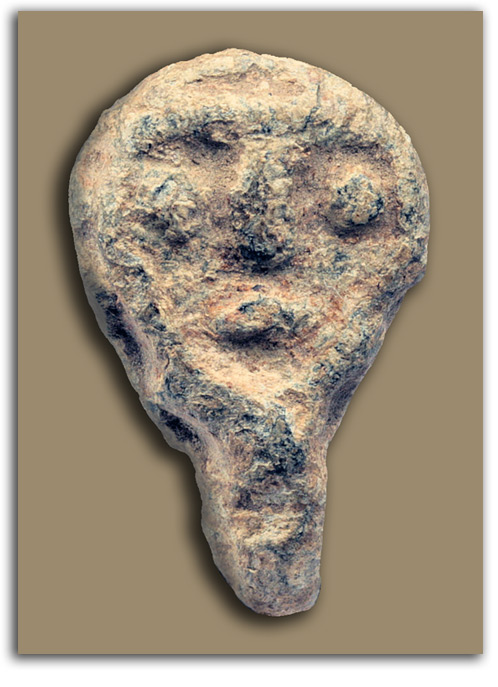
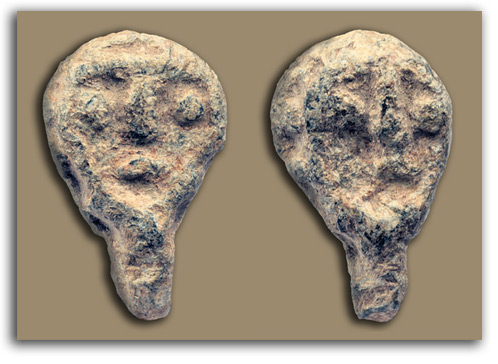
2 DOUBLE-FACE, probably Lug (Lugus). c.3rd/2nd century BCE
Stone. Collection: IAD, 2011
NOTE: This is one of a number of Celtic sculptures that has two faces. This head could well be a representation of the deity known on the continent as Lug or Lugus (Irish: Lugh; Welsh: Llue). His name has been translated as “Shining One” or “Bringer of Light.” He probably was the son of the supreme male deity and the supreme mother goddess, and certainly was one of the most widely worshipped of Celtic deities. The Romans compared him with Mercury (Greek: Hermes). Among other things, it was he who gifted humankind with all the artful skills, protected trade, and guided souls to the afterworld. Like the caduceus of Mercury, this Celtic deity is frequently associated in sculpture with the Double-Serpent.
Even though this piece of sculpture is quite worn, an interesting feature is still visible on both faces. The proper right eye is shallower and less well carved than the proper left eye. This seems to be deliberate since the same contrasting eyes appear on other Celtic stone heads, e.g., The Caerwent Head. As with the symbolism of the double-head and the double serpent, this eye symbolism seems to be a representation of some form of what usually is called duality, perhaps darkness/light, or death/life. However, the metaphysical symbolism probably is nonduality not duality. As in most traditional mythologies, a key feature of the Lugus mythology is his ability to bring success by the reconciliation of opposites. The unification of opposites is a regular theme in Celtic art.
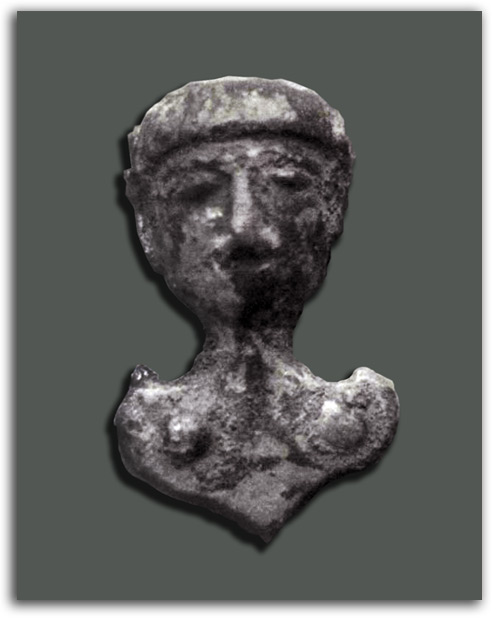
3 BUST. c.1st/2nd century CE
Bronze mount, perhaps from a sword or ritual vessel
Collection: IAD, 2011. Gift
NOTE: This seems to be a late work, done under the influence of Roman realism.
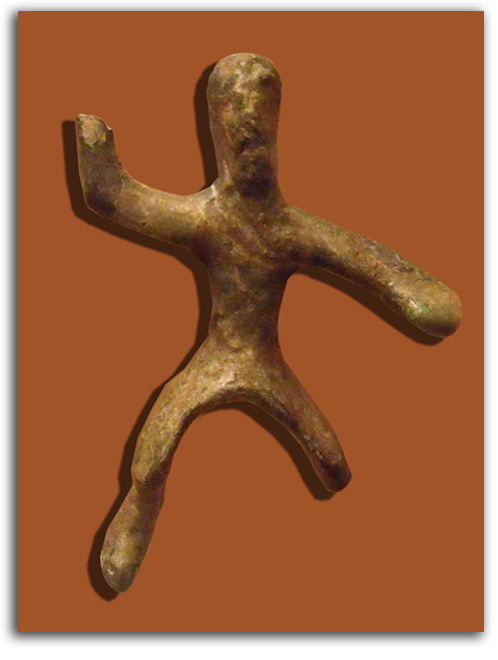 RIDER
RIDER
c.4th/3rd century BCE
bronze
Collection: IAD, 2011
4 RIDER. c.4th/3rd century BCE
NOTE: Horses were extremely important to the Celts. Indeed, these Indo-Europeans may have been among the first to know how to ride horses. Their much beloved horse goddess was Epona. She was the only Celtic deity adopted by the Romans. [See above: COINS] This dynamic, highly abstract figure of a rider on his horse seems to have been executed early in Celtic history, before the naturalistic influence of Greek and Roman realism. The Celtic artist was not so much concerned with that urban “classical tradition” which delineates the appearance of the surfaces of faces, figures, and things. Rather, the Celtic artist uses pictorial form as an expression of the internal energies of the world. Form is a force.
JEWELRY
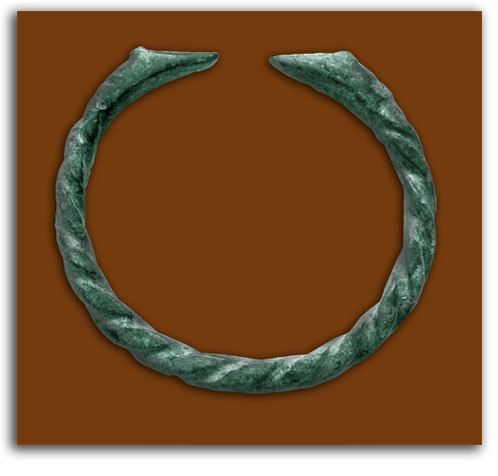
DOUBLE-SERPENT BRACELET
c.100 BCE – 100 CE
bronze
Collection: FLG on loan to IAD, 2011
1 DOUBLE-SERPENT BRACELET
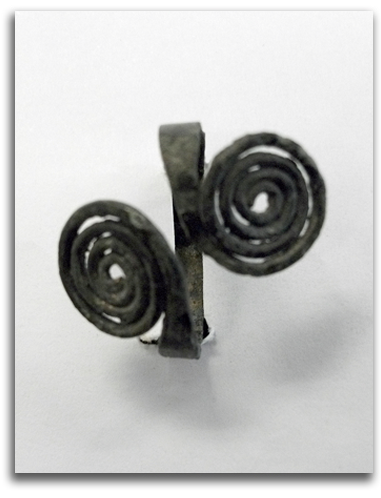
DOUBLE-SPIRAL RING
c.3rd/2nd century BCE
silver
Collection: IAD, 2011
2 DOUBLE-SPIRAL RING
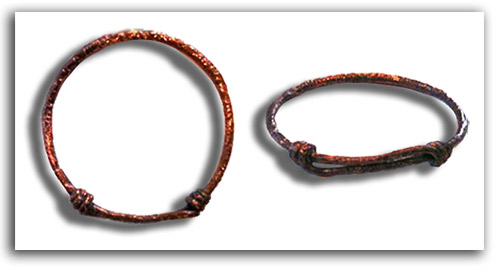 BRACLET
c.3rd/2nd century BCE
bronze
Collection: IAD, 2011
3 BRONZE BRACELET
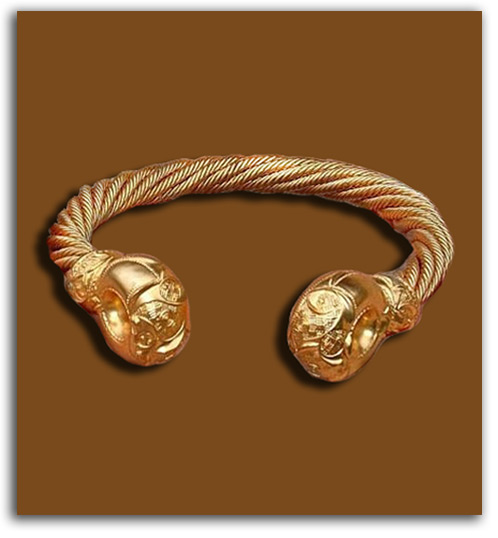 TORC
TORC
c.3rd/2nd century BCE
“gold”
Collection: FLG, 2011
4 TORC (REPLICA)
NOTE: A torc usually is defined as open-ended neck ring, but smaller ones were designed for arms and wrists. Torcs were worn by Celtic men and women. High status individuals worn heavy rings of twisted metal, often of gold. People of lesser status wore more simple neck rings and bracelets, often of bronze. Some torcs are so large and heavy they could not have been worn. They probably were offerings to deities, deities who were pictured in contemporary art wearing torcs.
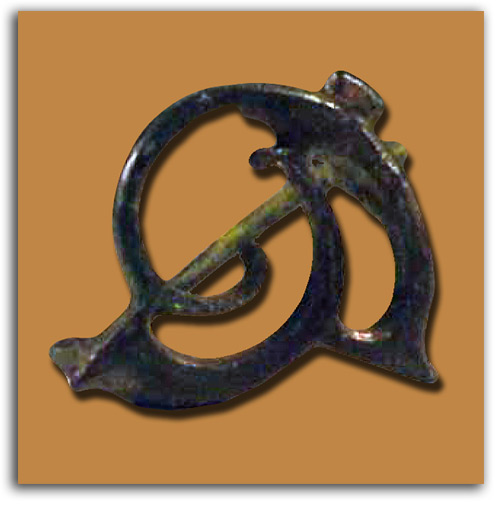
TRUMPET BROOCH
c.100 BCE – 100 CE.
bronze
Collection: IAD, 2011
5 TRUMPET BROOCH
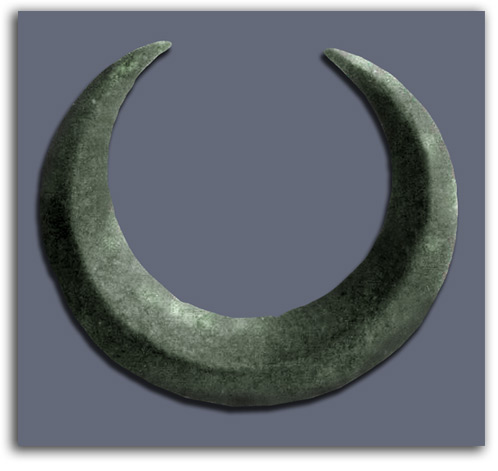
CRESCENT BROOCH
c.100 BCE – 100 CE.
bronze
Collection: FLG on loan to IAD, 2011
6 CRESCENT BROOCH, black bronze
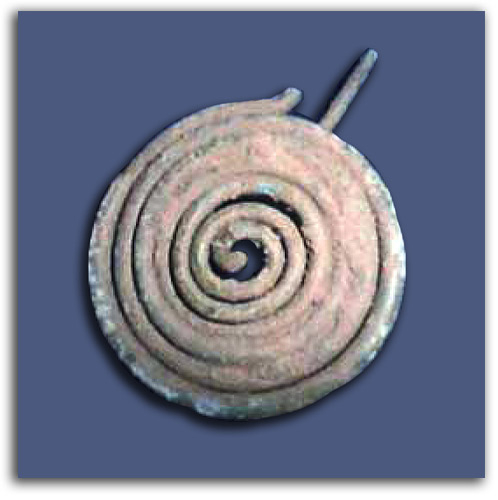
SPIRAL BROOCH
c.100 BCE – 100 CE.
bronze
Collection: IAD, 2011
7 SPIRAL BROOCH/FIBULA
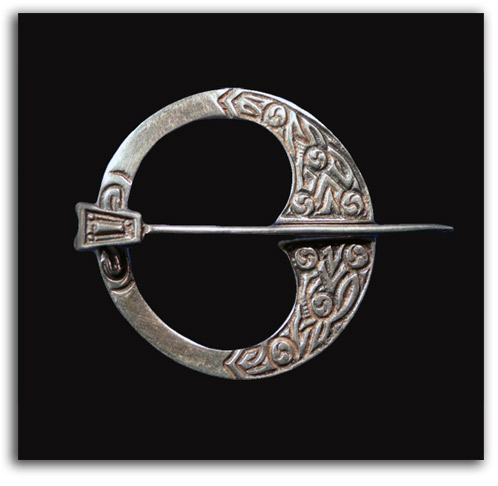
PENANNULAR BROOCH (FIBULA)
c.1st century BCE (replica) bronze
Collection: IAD, 2011
8 PENANNULAR BROOCH/FIBULA
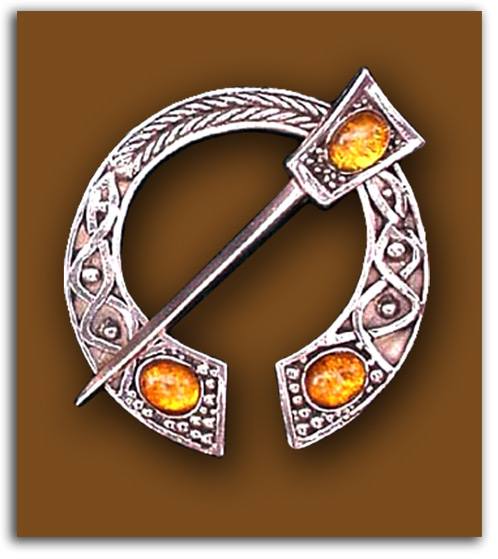
“TARA” PENANNULAR BROOCH (FIBULA)
c.1st century BCE (replica)
mixed media with three yellow stones
Collection: IAD, 2011
9 “TARA” PENANNULAR BROOCH/FIBULA
OBJECTS
SUN WHEEL
c.100 BCE – 100 CE.
bronze
Collection: IAD, 2011
NOTE: Probably a mount for a harness or a ritual vessel. Chariot wheels of this design were often symbolic of the sun.
1 “SUN” WHEEL/MOUNT
DRAGON MOUNT
c.1st century BCE
bronze?
Collection: IAD, 2011
NOTE: Probably mounted on a ritual vessel
2 DRAGON/MOUNT
DAGGER
c.1st century BCE
iron?
Collection: FLG on loan to IAD, 2011
Gift of Mary Rhoda Montegue
Ex. Collection: Stuart Piggott
3 DAGGER, gift of Mary Rhoda
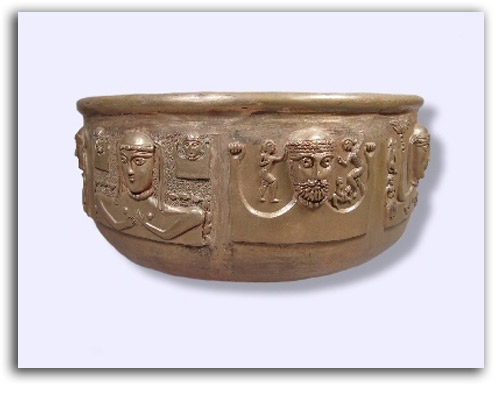
GUNDESTRUP CAULDREN
c.100 BCE – 100 CE (reproduction)
“silver”
Collection: IAD, 2011
4. GUNDESTRUP CAULDREN
Date of original: c.100 BCE-100 CE (reproduction)
Original material: silver Collection IAD, 2011
NOTE: This huge ritual vessel probably dates from between 100 BCE and 100 CE. Measuring 27 inches in diameter and 15.6 inches high (69 x 42 cm), it is the largest surviving silver object of the Celtic era. It was found in Denmark but could have been made in any number of Celtic regions. The original is in the National Gallery of Denmark. A pantheon of male and female deities are pictured. We do not know who is whom, but at least one head seems to be that of a goddess. The most famous image on the cauldren is a seated shamanic figure with horns (wearing a torc) who is holding a torc and a snake. He is surrounded by animals. His horns are those of a reindeer. The large animal next to him is a reindeer with identical horns. The snake he holds has the head of a ram. This animal-man is thought by many to be Cernunnos, forest-dwelling spirit of fertility. One carving inscribed with the name of Cernunnos shows him with the horns of a stag. Another carved figure that probably is Cernunnos shows him wearing a torc, wearing another torc on his chest, and being encircled at the waist by a pair of ram-headed snakes. Many different interpretations of this vessel have been proposed. The most widely accepted interpretation is based on the evidence from Irish legends that Celts associated cauldrens with fertility, death, and rebirth – rebirth not only for crops but for people. In one scene on this cauldren a tall figure is shown dipping a smaller figure into a very large vessel. That vessel could have been a representation of this vessel. This cauldren certainly is large enough to hold the submerged head of a person, perhaps involved with something like a Christian Baptism. It may well have been used for a watery ritual by means of which a dead person was projected into a life after death.
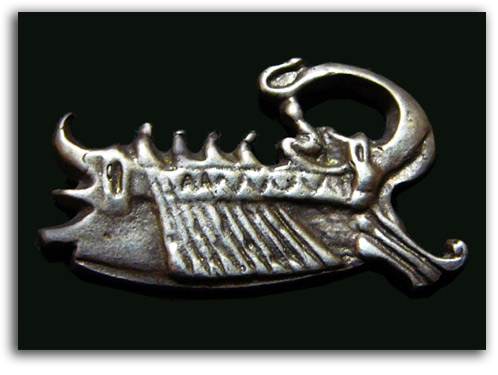
SHIP BROOCH
c.1st/2nd century CE (replica)
“silver”
Collection: IAD, 2011
NOTE: The Celts in Brittany and Devonshire were fine ship builders. Their work was better than the work of the Roman who asked the Celts to make ships for them. Curiously, those two regions of France and England are places where ships are still built. This piece of sculpted jewelry shows a galley with four men at the oars and a pointed bow for ramming other ships. Only centuries later did sea going vessels use only sails.
5 SHIP (replica) 2011
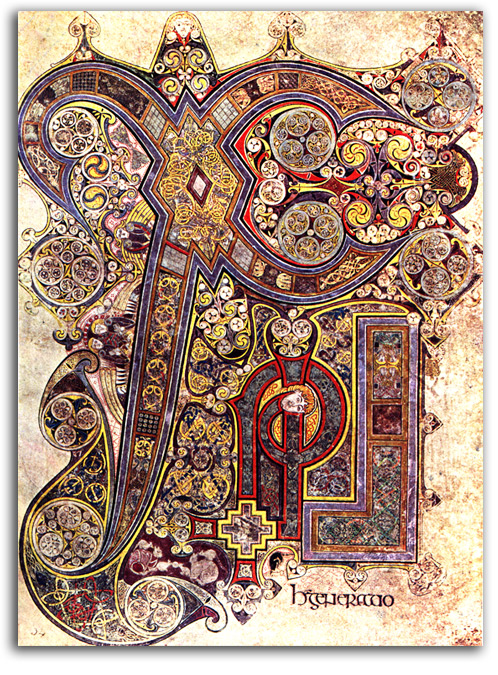
BOOK OF KELLS. c.800 CE (partial replica)
A painted page with the initials CHI RHO (a P and an X) which is an Early Christian symbol taken from the Greek word for Christ
Published by Thames & Hudson, 1988
Collection: CSUEB. Gift of IAD
NOTE: This is widely regarded as the most beautiful European book of the Early Middle Ages. The original is in Trinity College, Dublin.
6 BOOK OF KELLS (replica) CSUEB, gift of IAD
edited 2010