A. Public Poems
(Poems published Publically or published privately but now in Public Collections)
B. Private Poems
(Poems published Privately)
NOTE: My first collection of poems, STAR SONGS, was published in 1954. Writing poems has been a major part of my life ever since. Knowing my family included poets on both sides encouraged me to write from the heart. The fluid rhythms and musical sounds of Sidney Lanier, the famous poet of the Old South (my grandfather’s first cousin and dear friend), were a particular inspiration in my early years. Indeed, my friends claim I grew up as a “Late Victorian.” It is true that I did not discover Mallarmé and Modernism until college.
Most of my poems have been collected in private press editions that I gave to family and friends. Some poems have appeared in commercial books and periodicals. In this checklist, if the edition was for sale the title has been underlined.
By the 1970s, Zen-inspired haiku had become my preferred verse form. My favorite single moment as a poet may have been when one of my haiku was published in Japan (1979). East & West united in that moment. Or was that favorite moment when I published Jennifer’s book of LITTLE POEMS (1979)?
As a boy, I enjoyed being published by the HIGH SCHOOL POETRY ASSOCIATION. As an adult, I enjoyed becoming a member of the INTERNATIONAL SOCIETY OF POETS. In high school, I resolved to try to fuse poetry & prose by making each of my essays a prose poem. From the point of view of purpose, that unity has remained a regular objective ever since. Using line-breaks in prose that are like line-breaks in poetry keeps the visual experience parallel to the verbal experience. Materialism need not control the length of type. Each idea can have its own complete shape.
What is a poem, anyway? A rhyme is only the most elementary kind of poem. A good poem happens when words become musical. If I have succeeded in writing prose-poems consistently, perhaps my editor should have cross-indexed all my essays under “poetry.” However, even if an essay is poetic, a poem usually is different from an essay. As a rule, a poem is more intense than a piece of prose. In prose, there are spaces between intensities. The spaces stretch out. Very long poems like those of Dante or Milton or Blake or Longfellow start sounding rather prose-like after a while. Intensity is difficult to maintain. Modern poems usually are a good deal shorter than pre-modern poems, and often have a certain intensity all the way through.
Primary Poetry Collections
NATURE POEMS, 1958
POP POEMS, 1966
THE SIN OF 100 DEBTS, 1967
RAINBOW HAIKU, 1976
HEAVY LIGHT, 1978
ELECTRO-MAGNETISM, 1981
FRAGMENTS OF FEELING, 1994
UNDULATIONS OF ETERNITY, 1994
NOTHING IS NOT, 1995
THE KISS OF KENOSIS, 2002
BROKEN BUDDHAS, 2006
BREAKING OUT, 2011
Part A. PUBLIC POEMS
“Utopia – The Perfect Peace,” 1956
“Satisfaction” published in Anthology of High School Poetry, 1956
“Stars” published in Anthology of High School Poetry, 1957
“Satisfaction” in The Oakwood High School OAKLEAF, 1957
“Stars” in The Oakwood High School OAKLEAF, 1957
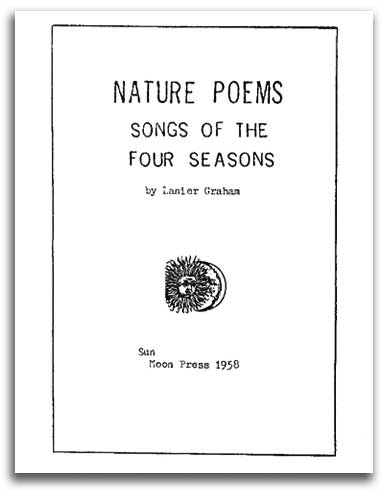
NATURE POEMS:
Songs of the Four Seasons
Dayton: Sun-Moon Press, 1958. 1st Edition
{Reviewed privately by Carl Sandburg, Flat Rock, N. C., 1960]
NATURE POEMS:
Songs of the Four Seasons
Washington, D.C.: Sun Moon Press, 1963. 2nd Edition
ENLIGHTENING INSIGHTS: A Portfolio of Prints & Poems
New York: Handmade Press, 1963
{Reviewed by Master Chi, Washington, D.C., 1963
POP POEMS
New York: Handmade Press, 1966
{Reviewed privately by Frank O’Hara, New York City, 1966)
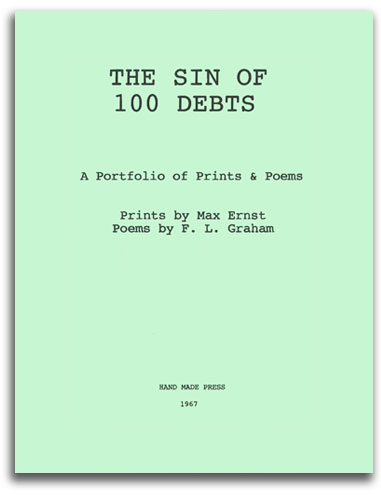
THE SIN OF 100 DEBTS
New York: Handmade Press, 1967.
{Reviewed privately by Max Ernst & Marcel Duchamp, New York City, 1967
Click here to view entire ‘Sin of 100 Debts’
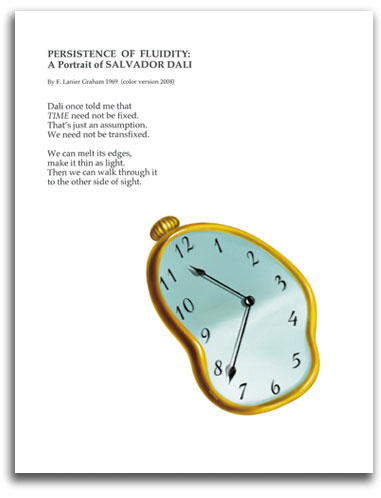
THE PERSISTENCE OF FLUIDITY: A Portrait of Salvador Dali
New York: Hand Made Press, 1969 (color edition 2011) Broadside #2
Click here for closer view of Dali broadside
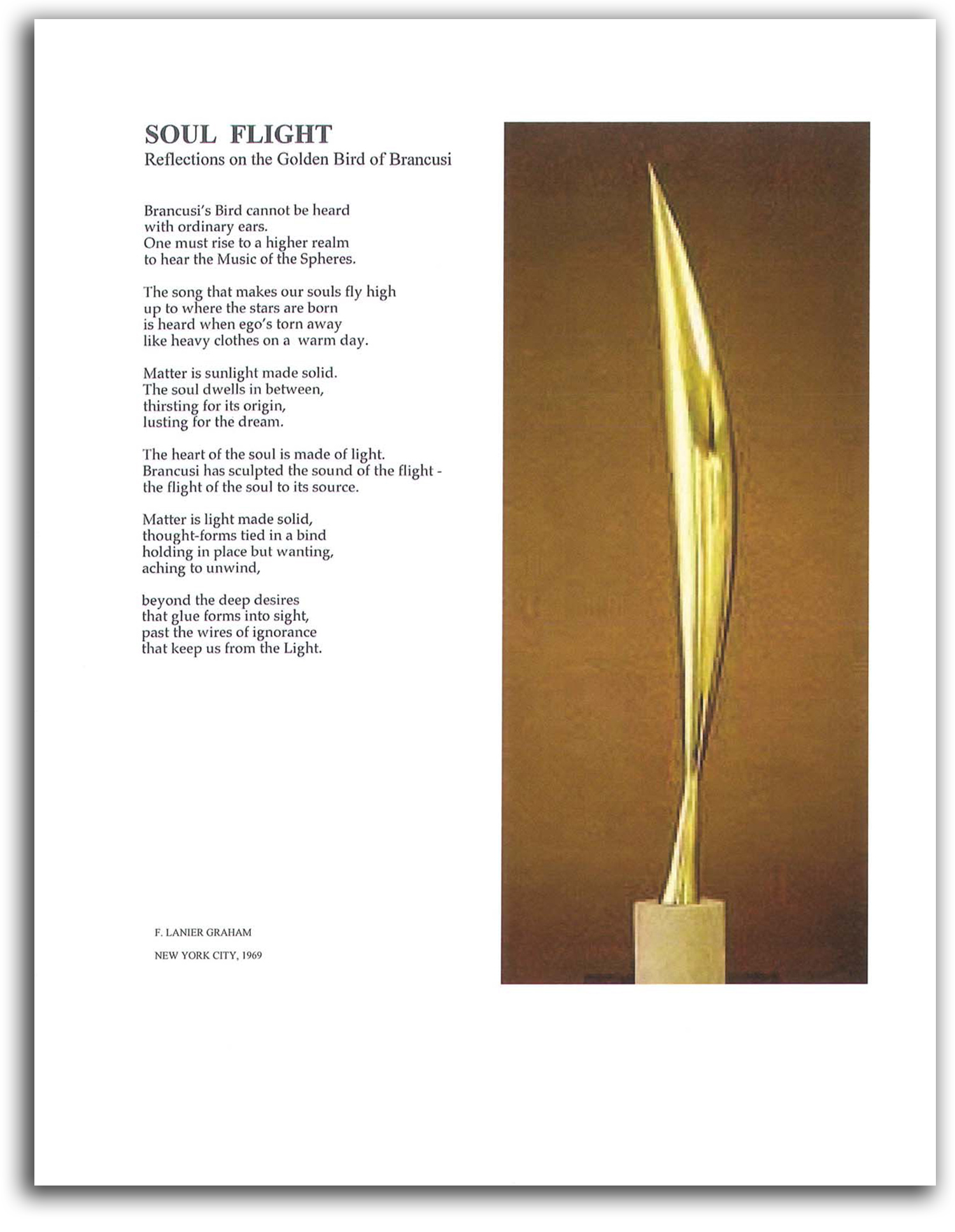
SOUL-FLIGHT: The Golden Bird of Constantin Brancusi
New York: Hand Made Press, 1969 (color edition 1976) Broadside #3
Click here for larger image of this broadside
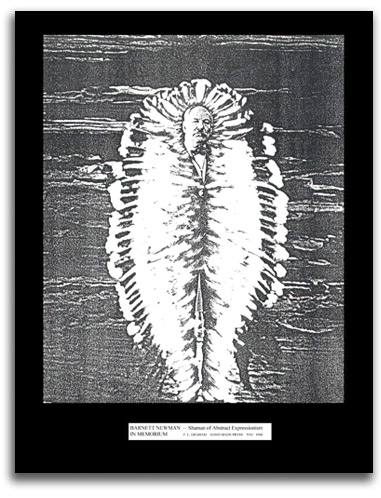
BARNETT NEWMAN: Shaman of Abstract Expressionism IN MEMORIUM. Broadside #4
New York & San Francisco: Hand Made Press, 1970
RAINBOW HAIKU, 1974. 1st Edition
“Rainbow Haiku” in THE RAINBOW BOOK,
Boulder: Shambhala, 1975. 2nd Edition {Reviewed privately by Allen Ginsberg, Naropa, 1976]
Click here to view contents of “Rainbow Haiku”
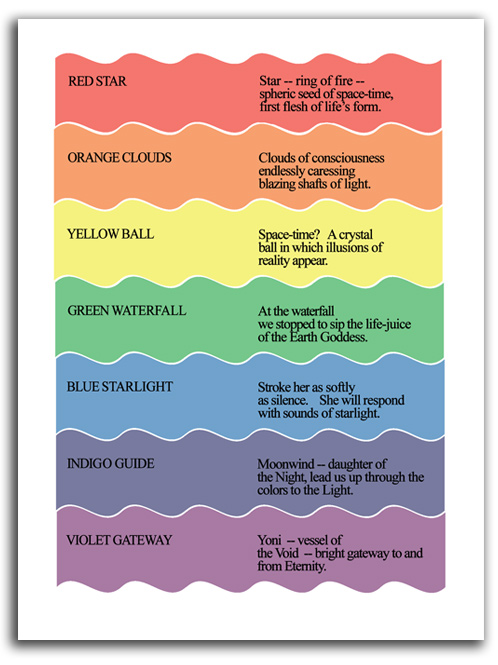
RAINBOW HAIKU, 1975. 3rd Edition
Broadside #6
Click here for closer view of “Rainbow Haiku” Broadside #6
HEAVY LIGHT:
Haiku on the theme of Modern Physics & Ancient Wisdom
San Francisco: World-Image Press, 1978. 1st Edition
{Reviewed privately by Frank Oppemheimer, San Francisco, 1978, &
by Fred Wolf, San Francisco, 1978, & by Itsuo Sakane, Tokyo, 1979
INTRODUCTION: One of the most interesting developments of our time is the growing dialogue between modern physics and ancient wisdom. Over the past two centuries a dramatic split has divided the realm of science and the realm of spirit. Until very recently there was very little communication between people involved with physical science and people involved with traditional philosophy – by that I mean what Aldous Huxley and others have called Perennial Philosophy, the world view that is at the core of Shamanism, Taoism, Hinduism, Buddhism, Judaism, Christianity, and Islam. The “Quantum Revolution” in modern physics has given to science a new perspective on spiritual traditions, and visa versa. Much to the surprise of both sides, a certain amount of common ground has been uncovered. Non-scientists have been introduced to this common ground in such books asTHE TAO OF PHYSICS by Fritjof Capra, and TAKING THE QUANTUM LEAP by Fred Wolf. Both groups are looking at a kind of “nothingness” from which something emerges. And both think what usually is called reality is formed, at least in part, by the act of perception. But this way of thinking is difficult to wrap words around. In Capra’s book I read: “ ‘Quantum koans’ led to the formulation of quantum theory.” In January of 1978, at the 3rd Annual Conference on Physics & Consciousness at Esalen, my host Mike Murphy reminded me of what Bronowski had written in THE ASCENT OF MAN: “Niels Bohr once said to Heisenberg ‘When it comes to atoms, language can be used only as in poetry.’ “ In light of this, I suggested to the members of the Physics/Consciousness Research Group, who had gathered for this conference, that it would be fruitful for all of them to try their hand at poetry. That kind of experimenting might generate new ways to communicate. Many different verse forms might be useful. e. g., the sonnets of Shakespeare, or the sayings of Lao Tzu. To start them off, I offered to compose a series of “Quantum Haiku.” A month later I sent themHEAVY LIGHT: HAIKU ON THE THEME OF MODERN PHYSICS & ANCIENT WISDOM. I was delighted to receive a very positive response from all of them. My thanks for that go to Jack, Fred, Saul-Paul, Barbara, Nick, Betsy, Will, and Diane. I look forward to reading their poems. This 2nd edition is for my students at the California Institute of Asian Studies in San Francisco.
~ FLG
Parnassus Heights, San Francisco, November 1979
HEAVY LIGHT:
Haiku on the theme of Modern Physics & Ancient Wisdom
San Francisco: Word-Image Press, 1979. 2nd Edition
{Reviewed privately by David Bohm, Ojai, 1979}
Click here for entire contents “Heavy Light”
“Form is what happens to consciousness” (from HEAVY LIGHT)
published in an article on FLG by Itsuo Sakane, ASAHI SHINBUN, 1979.
1st Edition (the Tokyo newspaper)
“Rainbow Light” in THE RAINBOW CALENDER
Berkeley: Golden Turtle Press & The Literary Guild, 1981
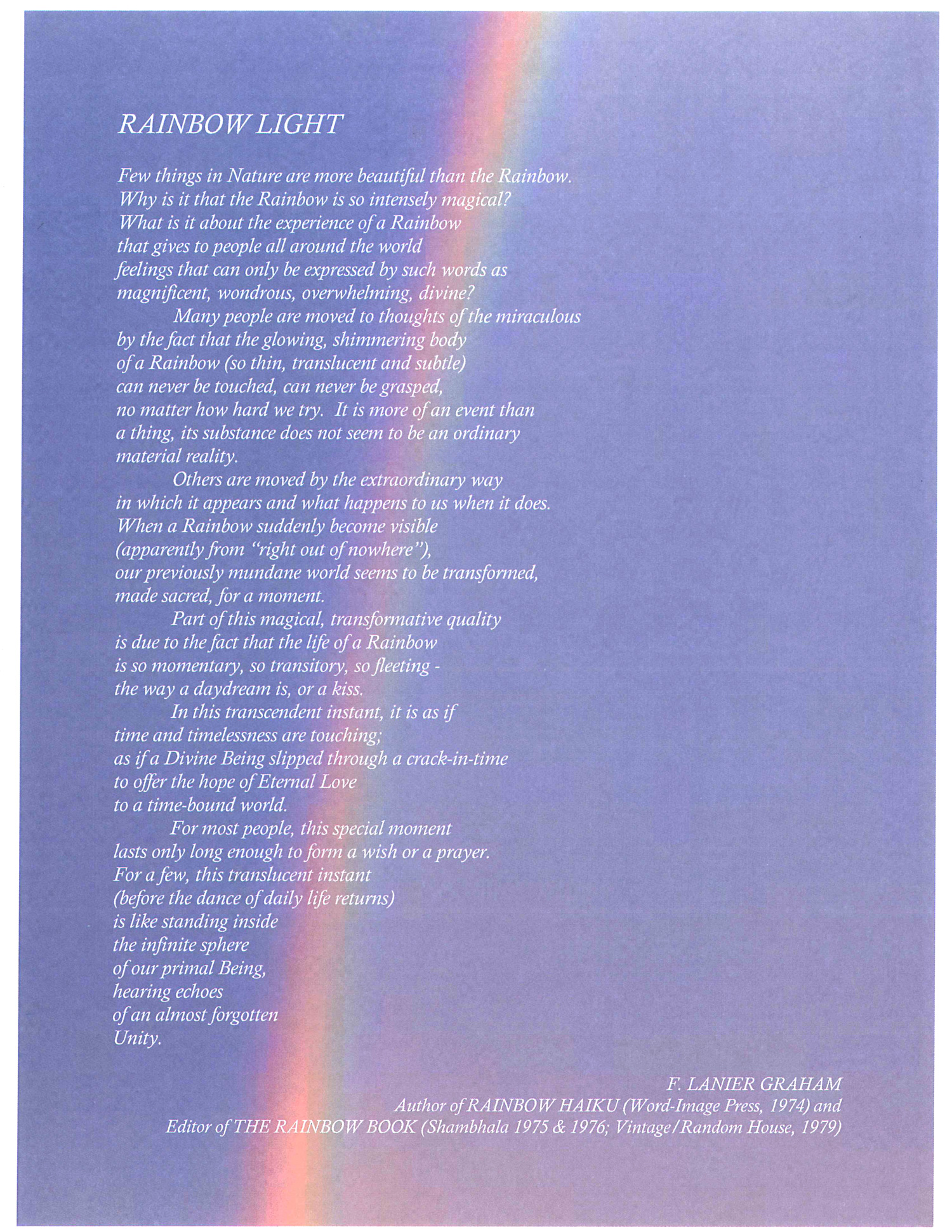
RAINBOW LIGHT
San Francisco: Word-Image Press, 1981
Broadside #7
Click here or on above image for large view of “Rainbow Light” broadside
ELECTRO-MAGNETISM:
A Collection of Philosophical Poems on the subject of Complementarity
San Francisco: Word-Image Press, 1981 {reviewed privately by Frank Oppenheimer, San Francisco, 1981, & Itsuo Sakane, Tokyo, 1994}
Click here to view entire contents of “Electro-Magnetism”
“Form is what happens to consciousness” (from HEAVY LIGHT) published in Itsuo Sakane, KYOKAISEN NO TABI [TRAVELING ON THE BORDERLINE: Art, Science, & Consciousness]
Tokyo: Asahi Shinbunsha. 1984. 2nd Edition
FRAGMENTS OF FEELING:
Selected Short Poems by F. Lanier Graham
Arcata: Soluna Press, 1994
{reviewed privately by Hayden Carruth, Munnsville, NY, 1994}
UNDULATIONS OF ETERNITY:
The Collected Poems of F. Lanier Graham
Arcata: Soluna Press, 1994
“Summer Sea” and “In Dreamland” from UNDULATIONS OF ETERNITYwere published in Caroline Sullivan, ed., THE GARDEN OF LIFE,
National Library of Poetry, 1995
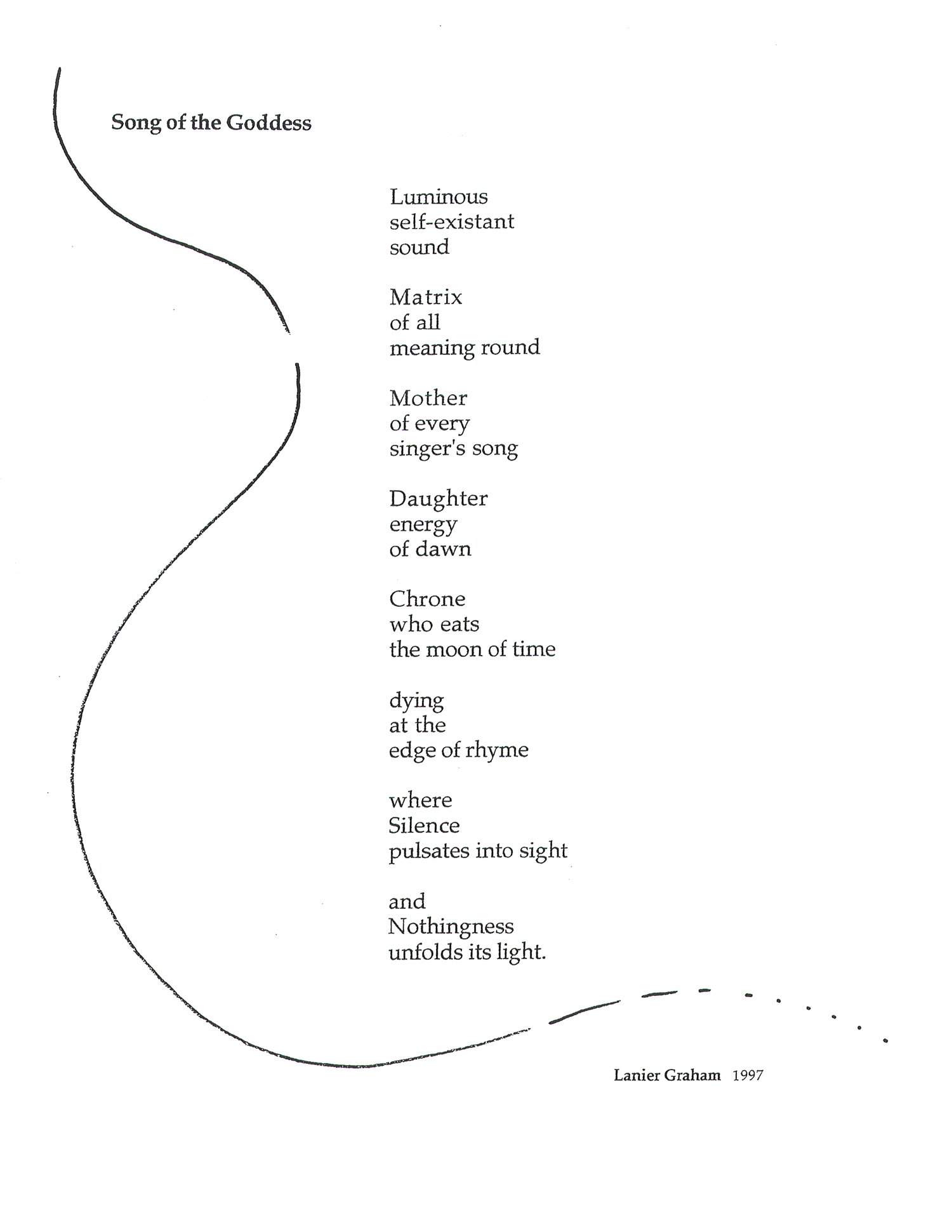
SONG OF THE GODDESS
Brentwood: Soluna Press, 1997 (color edition 1999)
Broadside #8
Click here for large view of “Song of the Goddess” broadside
“Moon Eye”
published in ART IN THE UNITED STATES, Colonial to Modern
Brentwood: World Art Press for CSUEB, 1999 (revised 2009)
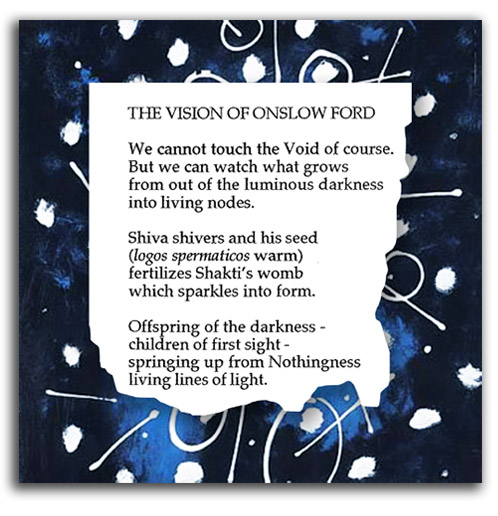
“The Vision of Onslow Ford”
published in ZEN & MODERN ART:
Echoes of Buddhism in Paintings & Prints
World Art Press for the University Art Gallery CSUEB, 2003
NOTE: I wrote this poem for Gordon in 2003 and gave it to him when the two of us were having lunch one day with Fariba at his mountain-top home in Inverness. They both liked the poem very much, and were happy I wanted to publish it in my book on ZEN & MODERN ART. I then asked Gordon for some postcards of his paintings because I wanted to make a collage out of one of his compositions and my poem and give that to him as a second present. Doing the Zen exhibition (including a Zen scroll from Gordon’s collection) and other things got in the way. By the time I finally completed that “lines-of-light” collage project, Gordon had passed away. This version of that collage project uses one of his untitled paintings of 1991. It speaks very clearly of the “lines-of-light” I wrote about in the poem as a celebration of his paintings.
“Measuring Ibram Lassaw”
published in IBRAM LASSAW: A BOUQUET OF MEMORIES
East Hampton: Guild Hall Museum, 2004
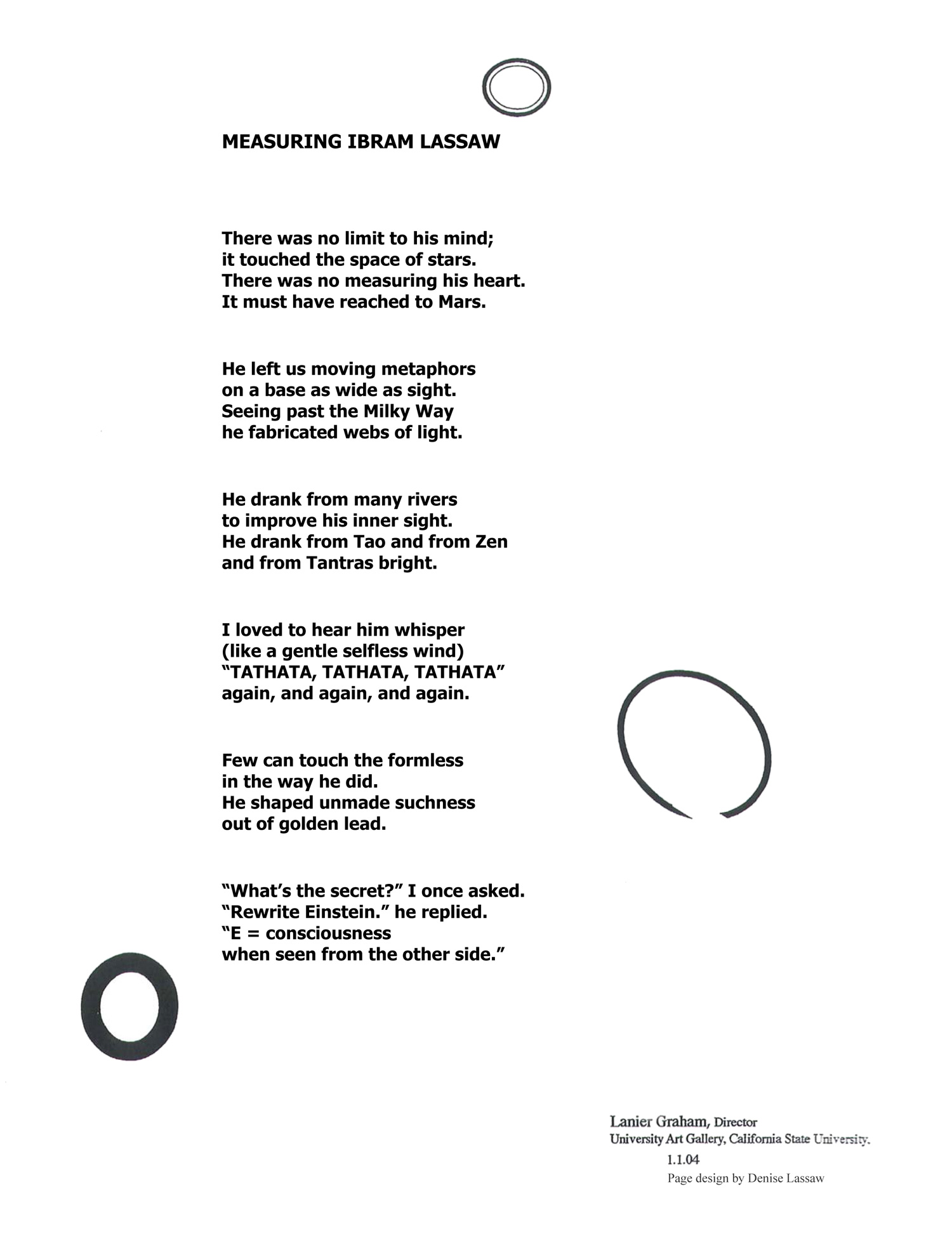
“Measuring Ibram Lassaw” Broadside #11
Click here or on above image for large view of “Measuring Ibram Lassaw” broadside
NOTE: Part of this poem came directly from Lassaw. In a conversation with me, Lassaw repeated in a whisper “Tathata, Tathata, Tathata” many times. This Sanskrit term in Hinduism and Buddhism means “suchness,” or “existence as it is” (or “There is no duality”). This refers to perceiving ultimate reality. However, the phrase “E = consciousness” is not his. It came to me during a conversation about Einstein with Chogyam Trungpa Rinpoche in 1976. We were talking about the many meanings of E=mc². The conversation went like this:
FLG: Einstein says that if matter speeds up to the speed of light it becomes pure energy. So the reverse must be true also. Would you say that matter is compressed light?
CTR: Yes.
FLG: Would you say that light is pure energy?
CTR: Yes, or more precisely, light is how energy appears.
FLG: Light is the clothing energy wears?
CTR: Yes, you could say that.
FLG: If energy is that out of which everything is made, then E = Consciousness.
CTR: Exactly.
I put that E = C phrase into this poem, and Lassaw’s daughter, Denise (a Buddhist), liked it. She also designed the page on which this poem appears in her book. Her page decorations are enso variations.
SURREALIST PORTRAITS: A Collection of Philosophical Objects with Portrait-Poems (exhibited in the Annual Art Faculty Show, CSUEB, 2008)
1 “The Day Eternity Dawned: a Portrait of Joseph Cornell”
2 “Lobster Lunch: a Portrai of Salvador Dali”
3 “Fried Eggs: a Portait of Salvador Dali”
4 “Persistence of Fluidity: a Portrait of Salvador Dali”
5 “Fur-Covered Teacup: a Portrait of Méret Oppenheim”
6 “Bubble of Being: a Portrait of Agnes Pelton”
7 “Bicycle Bull: a Portrait of Pablo Picasso”
8 “Iron Object: a Portrait of Man Ray”
9 “Paracelsus the Alchemist: a Portrait of Frederick Sommer”
Part B. PRIVATE POEMS
NOTE: Most of these poems were composed in groups and published by one of his five private presses as limited editions, often with original prints. Most private press editions range from 2 to 20 copies. Larger commercial editions range from 2,500 (“Rainbow Haiku”) to 10,000 (“Rainbow Light”). Included here are all the private press editions, as well as citations for selections from those editions which were later reprinted in other books such as those printed by the American Poetry Society and the National Poetry Association in the 1950s & 1960s and the National Library of Poetry in the 1990s. His Undulations of Eternity: Collected Poems may be found in the libraries of UCLA and California State University, East Bay, both of which collected the books of FLG extensively.
~ GKS
SUN-MOON PRESS
Dayton, Paris, & Washington, D.C.
1 STAR SONGS 1954 1st ed.
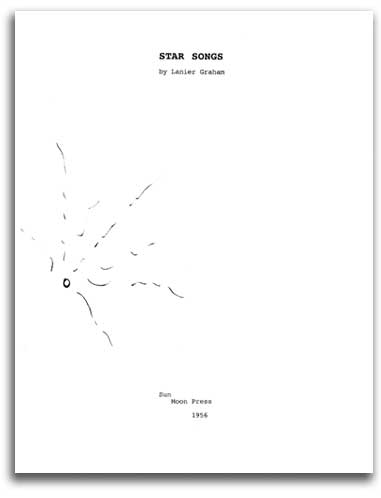
2 STAR SONGS 1956 2nd ed.
Selections (“Stars” & “Satisfaction”) reprinted in three national anthologies:
YOUNG AMERICA SINGS, 1956; SONGS OF YOUTH, 1958; and YOUNG AMERICA SINGS, 1960.
Published by the American Poetry Society & the National Poetry Association.
Click here for a selection: “Star People”
3 PUBLIC POEMS (including “Utopia”) 1957
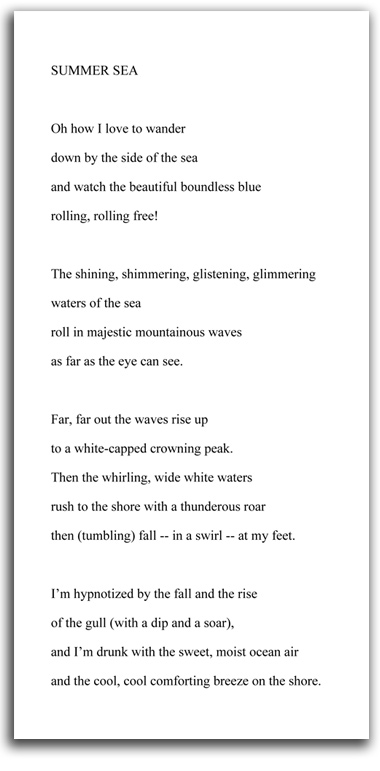
Click here for a closer view of “Summer Sea”
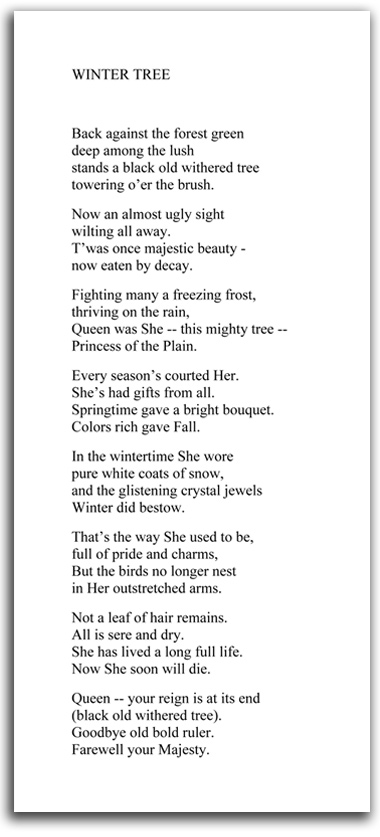
Click here for a closer view of “Winter Tree”
4 NATURE POEMS
Songs of the Four Seasons
Dayton: Sun Moon Press, 1958 1st Edition
5 PRIVATE POEMS 1958 & 1963
6 THE SAGA OF WORLD HISTORY 1960
7 NATURE POEMS
Songs of the Four Seasons 1963 2nd ed.
“Summer Sea” from NATURE POEMS was reprinted in
THE GARDEN OF LIFE , 1995, National Library of Poetry.
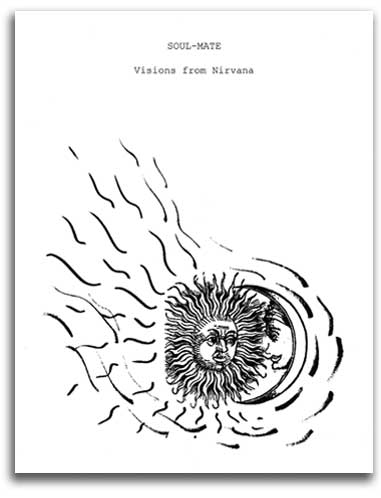
7 SOUL-MATE Visions from Nirvana 1960
“In Dreamland” from SOUL-MATE was reprinted in
THE GARDEN OF LIFE, 1995, National Library of Poetry.
8 SEA LOVE A Portfolio on the Theme of Liquefaction 1962 1st ed.
9 SEA LOVE A Portfolio on the Theme of Liquefaction 1972 2nd ed.
HANDMADE PRESS
New York City
10 ENLIGHTENING INSIGHTS:
A Portfolio of Prints & Poems, 1963
(for Master Ch’i)
11 CALLIGRAPHIC CONCEPTS:
A Portfolio of Prints & Poems, 1964
(for Matisse, Miró, Motherwell, & all Zen poets)
12 MAGIC CHALICE An Illustrated Poem 1964 (for Rosemary)
13 ALCHEMICAL DREAM An Illustrated Poem 1965 (for Rosemary)
14 POP POEMS 1966 1st ed. (for Rosemary)
15 THE SIN OF 100 DEBTS:
A PORTFOLIO OF PRINTS & POEMS
Prints by Max Ernst. Poems by F. L. Graham
New York: Hand Made Press, 1967
Click here to view entire ‘Sin of 100 Debts’
16 POP POEMS 1968 2nd ed.
(For Allen Ginsberg, Lawrence Ferlinghetti, & Frank O’Hara)
17 MUSIC MIND A Book of Poems 1969 (for David & Elena)
18 BARNETT NEWMAN Shaman of Abstract Expressionism 1970
WORD IMAGE PRESS
San Francisco, California
19 THE VOID A Book of Painted Poems 1972
20 WE WE A Book of Painted Poems 1972
21 PAINTED PAGES: A Book of Poems 1972 (for Larry & Carol)
22 FLOWER MIND: For Gloriana from whose forehead Flowers Grow 1972 (for Gloria)
23 SIMPLE THOUGHTS A Collection of Poems 1973 with Illustrations by Jennifer Robin Graham (for the Searam Clan)
24 FAMILY HAIKU:
A Book of Poems 1974 (for the French-Graham Clan)
25 RAINBOW HAIKU: A Book of Poems, 1974
1st ed. (for Jennifer aka Mary Heart Rainbow Color)
26a RAINBOW HAIKU: A Book of Poems, 1981 2nd ed. in THE RAINBOW BOOK published by Shambhala & FAMSF; in 1st ed. only
Click here to view “Rainbow Haiku” color Broadside #6
26b RAINBOW HAIKU [BROADSIDE #1]
27 LIGHT AND/OR LOVE A Pictured Poem 1976 (for Robert & Rosemary Caples)
28 ELENA or the Secret Doctrine 1976 (for Elena)
29 SACRED SYMBOLS A Portfolio of Poems & Prints on the theme of Single Nature’s Double Name 1976 (for Chogyam Trungpa Rinpoche)
30 FRAGMENTS OF FEELING:
Selected Short Poems by F. Lanier Graham, 1976 1st ed. (for Jennifer)
31 MAYA & ME An Illustrated Poem 1977 (for Sharon)
32 MS. MAYA MINERVA An Illustrated Poem 1977 (for Sharon)
33 THE SHAMANIC CHANT OF MINERVA An Ode to the Owl of Wisdom 1977 (for Sharon)
34 SEEDS TO/FROM ETERNITY 1978 (for Alexander Lanier French)
35 HEAVY LIGHT:
Haiku on the theme of Modern Physics & Ancient Wisdom
1978 1st ed. (for the Physics/Consciousness Research Group)
INTRODUCTION: One of the most interesting developments of our time is the growing dialogue between modern physics and ancient wisdom. Over the past two centuries a dramatic split has divided the realm of science and the realm of spirit. Until very recently there was very little communication between people involved with physical science and people involved with traditional philosophy – by that I mean what Aldous Huxley and others have called Perennial Philosophy, the world view that is at the core of Shamanism, Taoism, Hinduism, Buddhism, Judaism, Christianity, and Islam. The “Quantum Revolution” in modern physics has given to science a new perspective on spiritual traditions, and visa versa. Much to the surprise of both sides, a certain amount of common ground has been uncovered. Non-scientists have been introduced to this common ground in such books asTHE TAO OF PHYSICS by Fritjof Capra, and TAKING THE QUANTUM LEAP by Fred Wolf. Both groups are looking at a kind of “nothingness” from which something emerges. And both think what usually is called reality is formed, at least in part, by the act of perception. But this way of thinking is difficult to wrap words around. In Capra’s book I read: “ ‘Quantum koans’ led to the formulation of quantum theory.” In January of 1978, at the 3rd Annual Conference on Physics & Consciousness at Esalen, my host Mike Murphy reminded me of what Bronowski had written in THE ASCENT OF MAN: “Niels Bohr once said to Heisenberg ‘When it comes to atoms, language can be used only as in poetry.’ “ In light of this, I suggested to the members of the Physics/Consciousness Research Group, who had gathered for this conference, that it would be fruitful for all of them to try their hand at poetry. That kind of experimenting might generate new ways to communicate. Many different verse forms might be useful. e. g., the sonnets of Shakespeare, or the sayings of Lao Tzu. To start them off, I offered to compose a series of “Quantum Haiku.” A month later I sent themHEAVY LIGHT: HAIKU ON THE THEME OF MODERN PHYSICS & ANCIENT WISDOM. I was delighted to receive a very positive response from all of them. My thanks for that go to Jack, Fred, Saul-Paul, Barbara, Nick, Betsy, Will, and Diane. I look forward to reading their poems. This 2nd edition is for my students at the California Institute of Asian Studies in San Francisco.
~ FLG
Parnassus Heights, San Francisco, November 1979
36 HEAVY LIGHT:
Haiku on the theme of Modern Physics & Ancient Wisdom
1979 2nd ed. (for students at the California Institute of Asian Studies)
Click here to view entire contents of “Heavy Light”
STRAWBERRY PRESS
Mill Valley, California
37 LITTLE POEMS 1979 1st ed. by Jennifer Robin Graham
38 EGO IMAGES 1980 (for CLR)
39 RAINBOW LIGHT 1980 1st ed. (for Jennifer)
40a RAINBOW LIGHT 1981 2nd ed.
[Introduction to THE RAINBOW CALENDAR
Published by Golden Turtle Press & The Literary Guild]
Combined Ed. of 10,000
40b RAINBOW LIGHT Published on the World Wide Web, Fall 2000 www.parkenet.org/jp/fractals/tz2/rainbowbraid.html without the poet’s knowledge } 2000
40cRAINBOW LIGHT Broadside #7
41 HEAVY LIGHT:
Haiku on the theme of Modern Physics & Ancient Wisdom
1981 3rd ed. (for the Art & Consciousness students at JFK University)
Click here to view entire contents of “Heavy Light”
42 EYE LIGHT A Collection of Poems on the subject of Sight 1981 (for His Holiness, the Karmapa)
43 ENERGY NOTES A Collection of Poems on the theme of Energy Forms 1981 (for David & Elena)
44 BALANCED MIND 1981 (for Lama Govinda & Li Gotami Govinda)
45 ELECTRO-MAGNETISM: A Collection of Poems on the Subject of Complementarity 1981 (for Frank Oppenheimer) 1st ed.
46 FRAGMENTS OF FEELING:
Selected Short Poems by F. Lanier Graham, 1982 2nd ed. (for Jennifer)
47 THE MARRIAGE OF THE SUN & MOON 1983 (for Mom & Dad on their 50th Wedding Anniversary)
SOLUNA PRESS
Arcata & Brentwood
48 UNDULATIONS OF ETERNITY:
Collected Poems of F. Lanier Graham [draft] 1985 draft (for Jennifer)
49 FRAGMENTS OF FEELING:
Selected Short Poems by F. Lanier Graham, 1994 3rd ed. (for Jennifer)
50 UNDULATIONS OF ETERNITY:
Collected Poems of F. Lanier Graham, Volume 1 1994 (for Gloria)
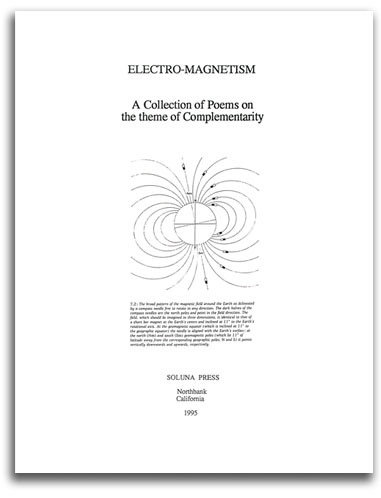
51 ELECTRO-MAGNETISM:
A Collection of Poems on the theme of Complementarity 1995 2nd ed. (for Frank Oppenheimer)
Click here to view entire contents of this edition of “Electro-Magnetism”
52 ELECTRO-MAGNETISM:
A Collection of Poems on the theme of Complementarity 1995 3rd ed. (for Frank Oppenheimer)
INTRODUCTION: Not being a scientist, I turned to my friend Frank Oppenheimer to guide me into an understanding of various principles of science while I was editing THE RAINBOW BOOK in 1974-1975. He kindly acted as my editorial advisor on the entire physics section in that interdisciplinary survey of the art, physics, and metaphysics of color. He also offered to contribute a short statement on the physical nature of light. His statement of luminous concision reads like a poem. With his permission, I have used it again as the prologue to this collection of my poems. In fact, it was Frank’s prose-poem that inspired this collection.
At other times during the 12 years I served on the Advisory Board of the Exploratorium, Frank and I spent many hours talking about the concept of Complementarity. He told me it was the subject that he and his brother (J. Robert Oppenheimer) talked about more than any other subject. Frank was very fond of my 1978 collection HEAVY LIGHT: HAIKU ON THE THEME OF MODERN PHYSICS & ANCIENT WISDOM. From time to time, Frank and I would design small conversation groups, using “think tank” methodology. During one of these “conversation groups” designed to involve “Artists, Scientists, & Humanists,” Frank challenged me to write something about Complementarity. My response to Frank’s challenge was ELECTRO-MAGNETISM: A COLLECTION OF POEMS ON THE THEME OF COMPLEMENTARITY. The first edition was printed in 1981. The first public reading, at the invitation of Jack Weller, was at the 1983 “Quality Conference” at John F. Kennedy University where I had joined the graduate faculty of the Art+Consciousness MFA program. More often than not, when I write “philosophical poems” such as these, they are intended for my students. However, I was delighted with a Japanese editor wanted to published some of the haiku from HEAVY LIGHT in Tokyo in 1979, and when the same editor wanted to publish some of ELECTRO-MAGNETISM in LEONARDO: ARTS, SCIENCES AND TECHNOLOGY in 1994.
Most of the haiku written in English follow the standard model of three unrhymed lines made up of 5, 7, and 5 syllables. I love that verse form and have used it often. I started to use it for this collection, then changed my mind. I developed a new form. I wanted these word-images to be as simple as a sentence but also to carry some of the weight of being an aphorism. I also changed the viewpoint. In HEAVY LIGHT, I stayed close to the facts or accepted theories of contemporary physics. In ELECTRO-MAGNETISM, I moved from the literal to the metaphorical. By making parallel the sun/moon image and the electric/magnetic image I tried to evoke the essential nature of the bimodal value clusters that operate at the core of cultures.
Many cultural historians have taken over the right-brain/left brain model from psychophysiology and are finding it a useful tool in the analysis of psycho-social systems. I have found these little poems useful when I teach World Art and World Religions. They provide my students with a taste of how the structure of values (or what I call the “architecture of awareness”) changes over time. This edition of E-M (as some of my students call it) is dedicated to all the students in my classes on World Art, World Religions and World Mythology at California State University, Hayward, and at Humboldt State University, Arcata.
~ FLG
Northbank, January 1995
53 SMALL POEMS 1995 (for Gloria)
54 TEXT – IN – CONTEXT Metalinguistic Aphorisms 1995 (for Gregory Bateson)
55 NOTHING IS NOT:
Reflections on Nothingness 1995 (for Master Rajinder & Mother Love)
56 ECO – HAIKU, Volume 1 1995
57 ECO – HAIKU, Volume 2:
A Review of Dharma-Gaia in the form of Poems about the Earth & Us 1995 (for Gloria)
58 NAVAJO HAIKU: A Review of Navajo & Tibetan Wisdom in the form of Poems about Ancient Knowledge 1995 (for Denise Dalton, aka Spider Lady, our Spirit Sister)
59 ETERNITY POEMS 1996 (for Gloria)
60a GODDESS POEMS 1997 Homage to Mallarmé illustrated. (for Gloria)
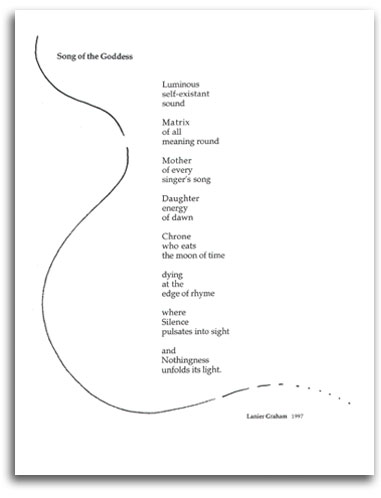
60b “Song of the Goddess” 1997
Exhibited: University Art Gallery, CSUEB 1999
Broadside #8
Click here or on above image for large view of “Song of the Goddess” broadside
61 THE DOUBLE-SERPENT OF OUR WEDDING DAY 1998 (for Gloria)
Broadside #9
62 EINSTEIN POEMS 1998 (for Alexander Lanier French)
63 SUN/MOON SOUP 1998 (for Chelsea, my God-Daughter)
64a TANTRA 2000 The Thread of Connectedness (for Gloria)
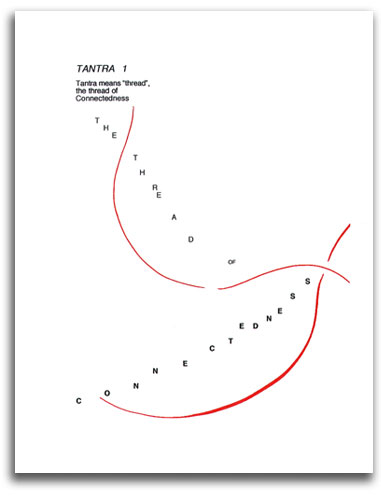
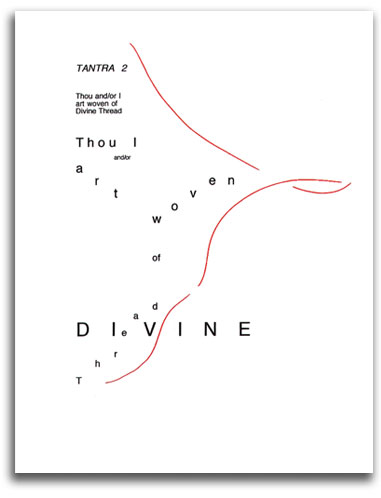
64b Broadside #10
65 APHORISMS FOR YOUNG PEOPLE 2000 (for my Grandson Kai)
66 CELESTIAL POEMS 2002
67a THE KISS OF KNOSIS :
10 Poems on the Buddhist/Christian Dialogue 2002 (for Elena)
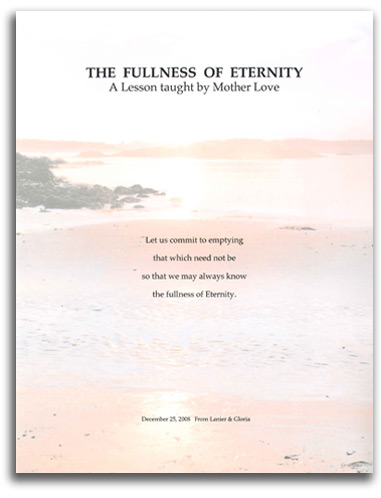
Click here for a closer view of this broadside
67b “The Fullness of Eternity” from THE KISS OF KNOSIS
Broadside #12
68 BROKEN BUDDHAS:
A Portfolio of Prints & Poems
Poems by F. Lanier Graham
Photographs by Philip Ringler 2006
69 SURREALIST PORTRAITS
with Poems for Every Portrait, 2008.
Exhibited: University Art Gallery, CSUEB 2008
70a SONGS FOR MY MOTHER 2009
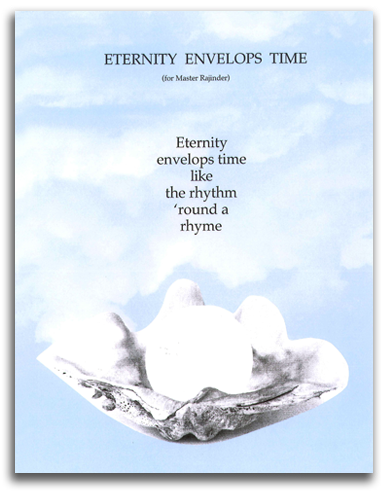
70b ETERNITY ENVELOPS TIME 2009 Broadside #13
71 SONGS OF THE BI 2009
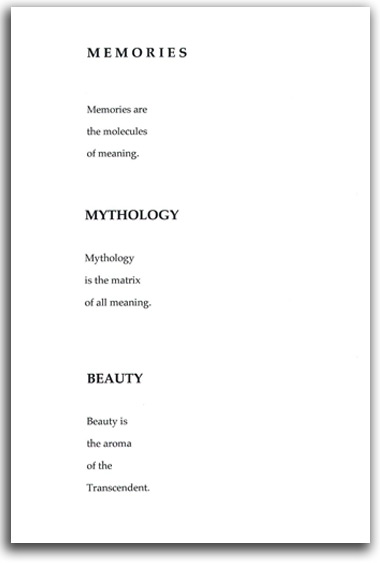
72 KISS-ABLE PHRASES 2010 (For Tom & Charlotte)
Click here for closer view of “Kiss-able” Phrases

73 “Floral Nude: A Portrait of Arp,” 2010
Broadside #14
74 HOLDING THE INVISIBLE Poems of an Art Collector 2010
75 BREAKING OUT: Songs for & from Brother David 2011
76 ”Flower-of-Light,” 2011
Broadside #15
77 ”Duality Boxed,” 2011
Broadside #16
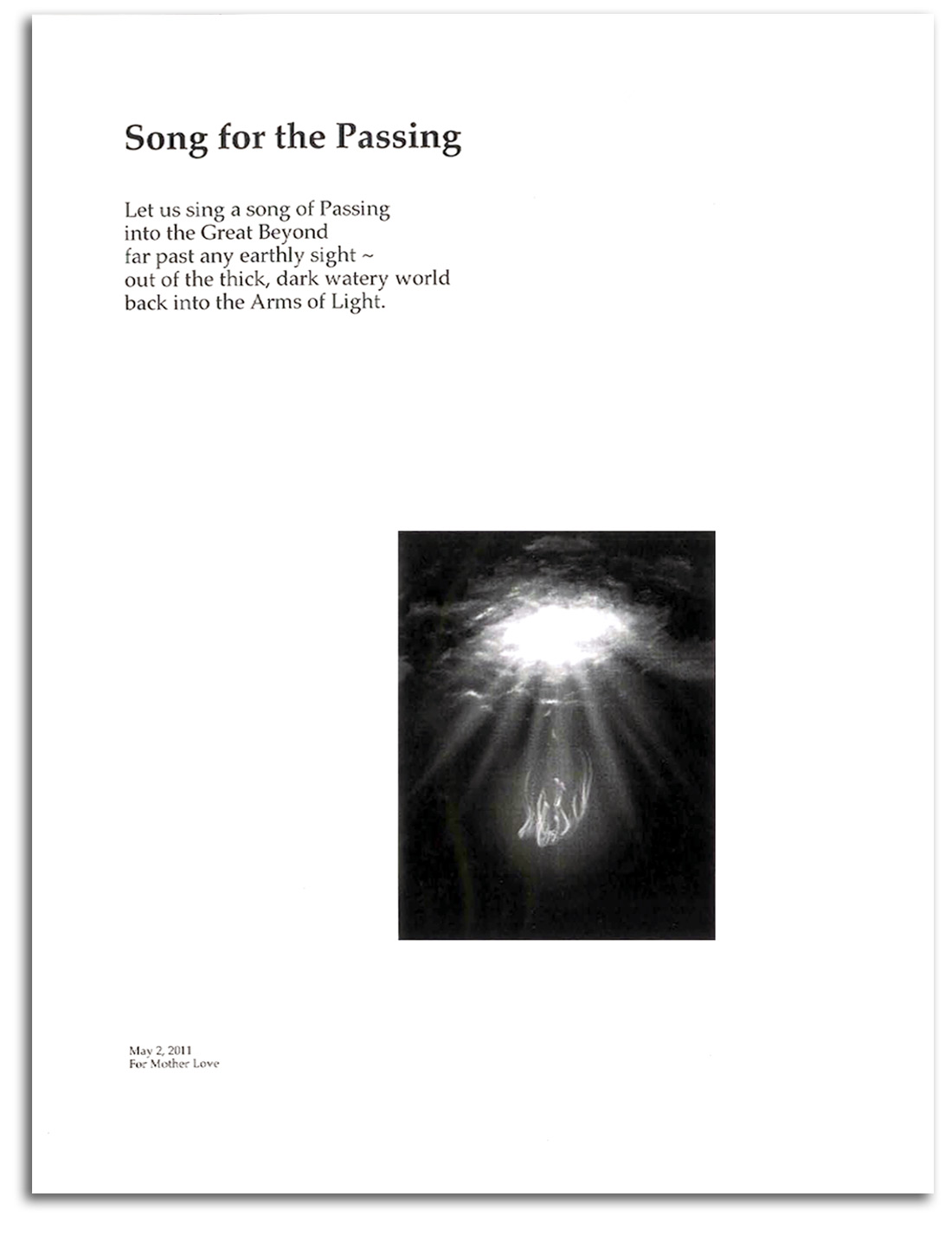
Click here or on above image for large view of “Song for the Passing” broadside
78 ”Song for the Passing,” 2011
Broadside #17
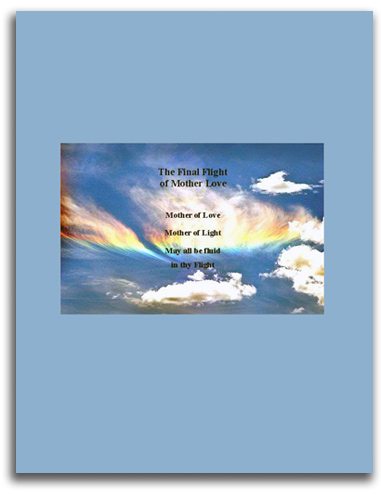
Click here for larger view of this broadside
79 “The Final Flight of Mother Love,” 2011
Broadside #18