THE SPIRIT OF THE RENAISSANCE
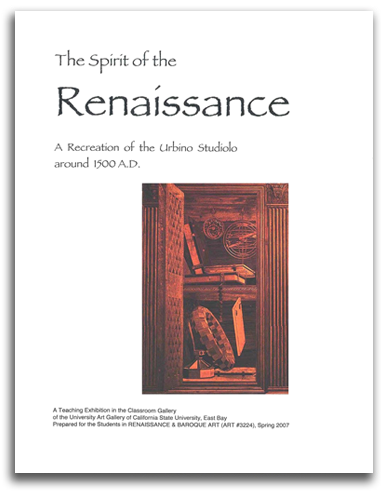
 A.1 The Spirit of the Renaissance: A Recreation of the Studiolo of Urbino around 1500 [catalog & study guide, 15,000 words]
INTRODUCTION
When most art historians use the word “modern” their reference is to a period between the middle of the 19th century and the middle of the 20th century. However, when social historians and cultural historians use the word “modern” they have a much larger frame of reference. They usually mean from the Renaissance to the 20th century, in other words, from the time when the ideals of the Middle Ages were replaced by those that most of modern people still live by artistically, socially, economically, and spiritually. When did the Renaissance begin? Literary historians usually say in the 14th century. Art historians usually say in the 15th century.
Italy is the 15th century was a patchwork of independent city-states. Among the most highly developed cultural centers in northern Italy were Florence, Sienna, Venice, Milan, Mantua, and Urbino. Urbino is the city that remains most like it was five centuries ago. The rulers of these centers had to deal with many problems: economic. military, etc. But most of them also were humanists. Inspired by the Greeks and Romans, they wanted the artists they patronized to harmonize Christian ideals with the ideals of the ancients. When the Dukes & Duchesses of these little nations wanted to get away from it all and read quietly or meditate on Platonic harmonies, they often did so in a small chamber called a studiolo. Here were housed their libraries and the finest of their paintings, sculptures, and other objects of vertu – objects of exceptional character, which stimulated them to be persons of exceptional character.
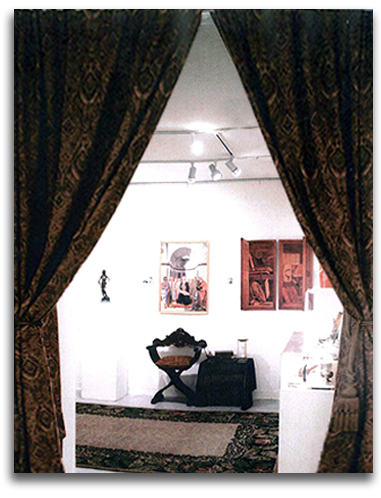
Frederico da Montefeltro, Duke of Urbino (1422-82), was an exceptional character. In between fighting the wars that kept his people safe, his legendary patronage extended to some of the greatest painters, architects, and philosophers of the age, figures such as Piero, Alberti, and Pacioli. Thanks to a book by Castiglione about life there, the court of Urbino was known throughout Europe as a place that understood the true meaning of artistic, social, and spiritual vertu. From this world came the profoundly beautiful art and architecture of Raphael and Bramante. We know more about the Urbino studiolo than we do about any other. That special space is our point-of-departure for this exhibition in which we suspend disbelief and pretend we are visiting the Duke’s little treasure chest of art, ideas, and values. This gallery is about the same size as the Urbino studiolo.
This exhibition is the first in a new series of small teaching exhibitions designed as interactive adjuncts to courses. The Satellite Gallery this time is a “display case” inside of which our students can see not slides but original objects and facsimiles of objects created in Italy and northern Europe between the 14th & early 16th centuries. Most of these works were owned or could have been owned by the Duke and his son.
Future exhibitions will be devoted to such themes as Shamanic Objects, Asian Sculpture, the Civil Rights Movement, and Postmodernism.
We are grateful to the Institute for Aesthetic Development in Brentwood, California, for the loan of these objects from its Teaching Collection of World Art, and for providing to our students with this illustrated study guide which reproduces the entire exhibition.
A.2 The Spirit of the Renaissance: Student Evaluations of the Class
THE STUDIOLO IN THE EARLY ITALIAN RENAISSANCE
FIORENTINO
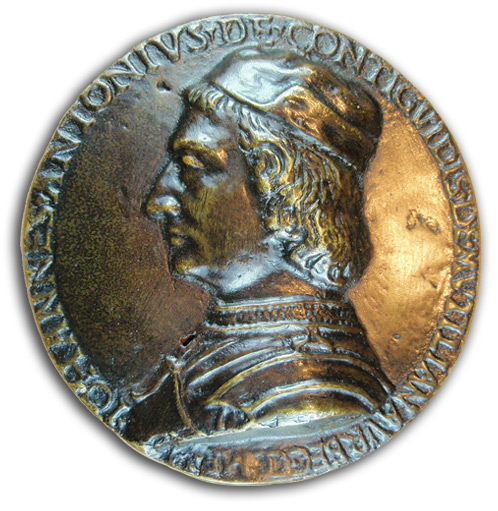
PORTRAIT OF GIOVANNI ANTONIO GUIDO,
COUNT OF URBECCHE AND MODIGLIANA
Conceptualization of this medal & its first casting: Florence, c.1490
Realization of this casting: Italy, c.16th century
bronze
Collection: IAD 2012
Ex. Collection: Neil A. Goodman, Chicago
NOTE: Niccolo Fiorentino (1430-1514) was one of the most gifted medalists of the 15th century. He lived and died in Florence where he was a friend of Leonardo da Vinci. He also worked for the highly sophisticated Dukes of Burgundy. He worked in a style invented by Pisanello at mid-century, a style that his contemporaries compared with the sculptural qualities of such Greek masters as Phidias and Praxiteles. Fiorentino’s work was in such high demand that 148 medals are now attributed to him. This particular medal is one of his finest works. The modern idea of the portrait as the rendering of the likeness of a person (together with some indication of that person’s nature) began in the middle of the 15th century with the rapid growth of Individualism. The earliest portrait paintings and sculptures were profiles, because the Humanistic artists and their patrons during the Early Renaissance were following the profile custom of Roman coins. For many centuries the classical art of Greece and Rome was of little interest in medieval Europe. If such a statue were found in a farmer’s field, it most likely would have been crushed into powder for fertilizer. It was not until the 14th century & early 15th century that ancient coins and statuary suddenly became “beautiful.” Among these early modern individuals the classical art of Greece and Rome was stimulating a newly developed feeling for their own humanity. Classical art, literature, and philosophy fueled the explosive creativity of the European Renaissance. Those ancient values were mirrors in which Humanistic Europeans saw themselves reflected. Later in the 15th century, the ¾ view of the Flemish portrait painters was adopted by the Italian portraitists, along with the Flemish inventions of oil paint and atmospheric perspective. It was not until the High Renaissance (c1490-1520) that the front-view portrait was developed in the hands of such artists as Leonardo, Raphael, and Titian. For most people today, these unsurpassed masters of form and penetrators of psychology created the standards of quality by which portraits are still judged.
MANTUAN SCHOOL
Rendered in the manner of Antico (c.1460-1528)
PORTRAIT OF GIULIA ASTALLIA
Conceptualization & first casting: Mantua, c.1480-85
Realization of this casting: Italy, c.16th/17th century
bronze
Collection: IAD 2012
Ex. Collection: Neil A. Goodman, Chicago
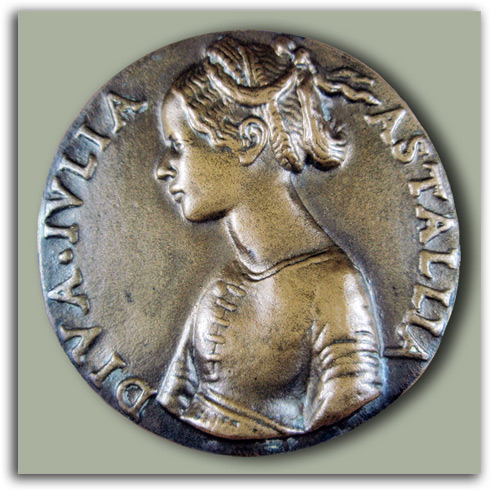
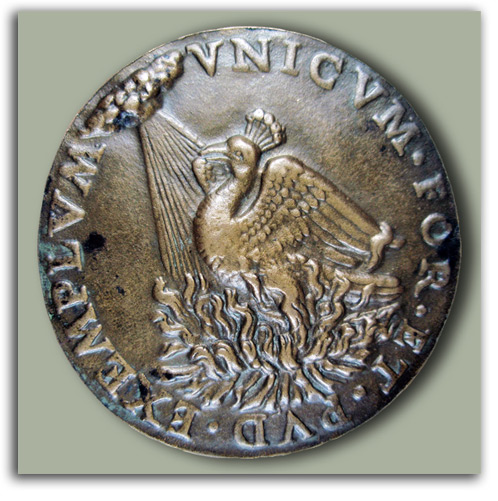
NOTE: On the obverse is her lovely portrait and her name preceded by the term Diva. On the reverse is an emblematic Phoenix on a flaming pyre looking at the sun, and the inscription: “Example of Chastity and Courage.” There is reason to think this is not a portrait of an actual young lady but rather a fictional character from a novel by Matteo Bandello. This Giulia was violated by a servant of the Bishop of Mantua and drowns herself.
Collecting antique statuary was a fashion that swept the royal and noble courts of Europe in the late 15h & early 16th centuries, especially in Italy. An actual statute thought to be by Praxiteles or some other ancient was the most desirable of sculptural acquisitions, of course. However, that was very rare. Most collectors purchased or commissioned replicas. The Mantuan sculptor & goldsmith Antico earned this name because of his remarkable ability to make fine bronze miniatures of antique statuary. His best-known piece of the “Apollo Belvedere” (c.1490). However, Antico also felt the spirit of his own time. This lovely rendering of a young lady is as close to Botticelli as was ever rendered in bronze. Bronze statues and medals such as “Giulia” were not made in large numbers during the 15th century. Unique bronze masterpieces were made in the early 15th century by Ghiberti and Donatello as Florence became the capital of bronze-casting. However, it was not until the later 16th century, when Giambologna developed a virtual bronze industry in Florence, that the now famous “Renaissance bronze” became very popular for both upper class and middle class collectors. More often than not, the themes of these statuettes are Greek and Roman. They remain highly desirable to modern collectors of Renaissance art. (Bronze is an alloy of copper and tin; brass is an alloy of copper and zinc. Bronze makes possible a very sensuous surface, suggestive of human flesh.)
B.1 The Studiolo in Early Renaissance Italy: a Study Guide
B.2 The Studioli & Library of the first Duke of Urbino
B.3 The first Duke of Urbino’s Taste in Painters
B.4 The Studiolo of Isabella d’Este in Mantua
B.5 The Studiolo of Alfonso d’Este in Ferrara
B.6 Furniture & Interior Design in Renaissance Italy
THE NEW PERSPECTIVE
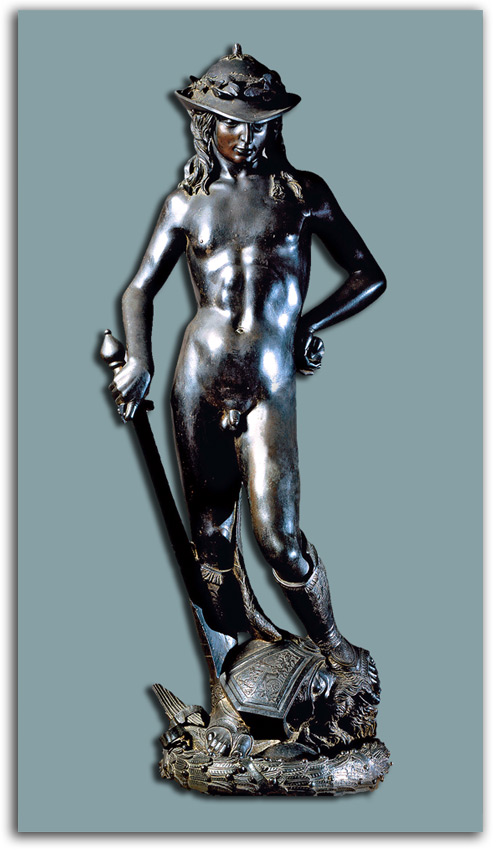
C. The New Perspective: Brunelleschi, Masaccio, Donatello, & Piero
BOTTICELLI
SANDRO BOTTICELLI
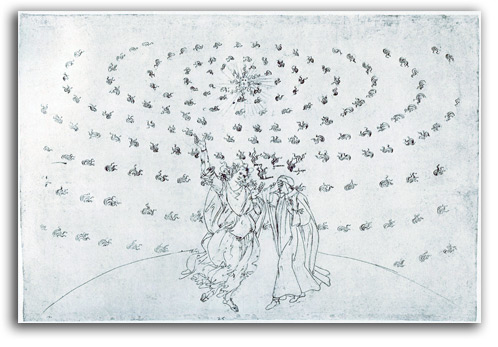
ILLUSTRATION OF DANTE & BEATRICE ASCENDING TOWARDS HIGHEST HEAVEN
in DIVINA COMMEDIA or THE DIVINE VISION OF DANTE ALIGHIERI
in ITALIAN & ENGLISH
Conceptualization of the original drawing: Italy, c1490-95
Realization of this lithographic illustration of the drawing, England, 1928
Collection: FLG
NOTE: Botticelli probably is the most famous artist of the Early Renaissance. He spent many years drawing illustrations for an edition of Dante’s Divine Comedy, which can be understood as a large “self portrait” of Dante, the story of a soul returning to its source.. He focused on this enormous project for the better part of two decades, between about 1475 and the year he is known to have stopped 1495. He planned to illustrate all 100 Cantos. Most of the drawings survive. It was said that he neglected much of his other work to do this. But not all his work, because this was the period in which he created his two most famous paintings – the “Birth of Venus” and “Primavera.” Many regard this series of silverpoint drawings as the most beautiful series of the Early Renaissance, if not the entire Renaissance. One poorly engraved partial edition appeared in 1481, but it was not until the 20th century that a complete edition of all his drawings and all of Dante’s famous poem were published together. This illustration is from that historic edition. It pictures Dante and Beatrice ascending toward the Highest Heaven as described in Canto XXXVIII. She has told him to close his eyes so he can see with his Inner Eye the ultimate Reality.
D.1 Botticelli’s Pagan Iconography: a Bibliography .
D.2 Botticelli’s “Venus:” Who? What? When? Where? Why? [lecture notes]
D.3 Botticelli’s “Mars & Venus:” An Alchemical Union? [lecture notes]
D.4 Botticelli’s “Divine Comedy:” An Annotated Bibliography
D.5 Botticelli’s “Portrait of a Goldsmith?” Reflections on an Attribution
D.6 Botticelli & the Studiolo of Urbino: An Annotated Bibliography
LEONARDO
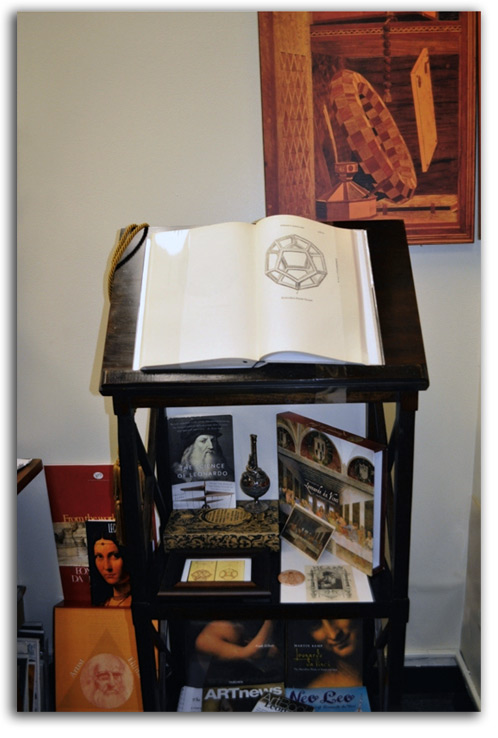
DIVINA PROPORTIONE written by Leonardo’s teacher Pacioli was published in Venice in 1509. It is the only printed book Leonardo ever illustrated. This facsimile edition of that book on an antique book stand was at the center of a Museum Studies exhibition called “Looking at Leonardo” in the Main Library of CSUEB during 2011.
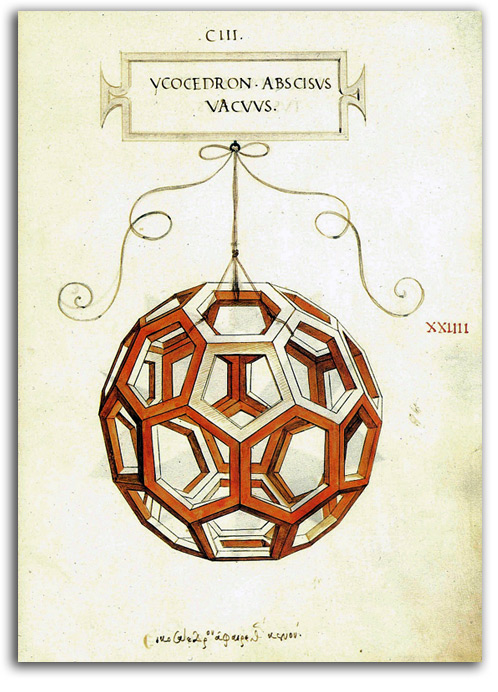
LEONARDO DA VINCI
ILLUSTRATION OF A DODECAHEDRON
in Pacioli’s DIVINA PROPORTIONE
Conceptualization & execution of the drawing: Milan, c.1496-98
Publication of the woodcut in the first edition: Venice, 1509
Publication of this lithograph from the woodcut in a facsimile edition: Italy, 1980?
Collection: FLG
NOTE: Leonardo left behind numerous manuscripts, many of them illustrated with his drawings. A number of those manuscripts he wanted to become books, but that did not happen until after he died. DIVINA PROPORTIONE, written by his teacher and friend Luca Pacioli, was the first book in which Leonardo’s name appeared. It also was the only printed book Leonardo ever illustrated. To both Leonardo and Pacioli the geometric forms illustrated in this book were beautiful both as forms and as symbols of spiritual truths. It s know that Leonardo drew the illustrations, but who carved the printed woodcuts based on the drawings is uncertain. For more on this geometric symbolism
CLICK HERE for my essay “Leonardo’s Platonic Polyhedrons” in Looking at Leonardo, cf. pages 4-5
E.1 Leonardo & his Paintings: Reflections on Attributions
E.2 Leonardo & Pacioli: A Partnership of Divine Proportions
E.3 Pacioli’s Divina Proportione: A Bibliography of Editions
E.4 Leonardo’s “Vitruvian Man:” Reflections on Symbolism
E.5 Leonardo & Bramante: An Architectural Friendship?
E.6 Leonardo’s Architectural Plans & the Golden Ratio
E.7 Leonardo’s Allegory of the Wolf & the Eagle
E.8 Leonardo & The Da Vinci Code: Facts & Fictions
E.9 Leonardo & Alchemy: an Annotated Bibliography
E.10 LEONARDO & ANDROGYNY:
SEXUALITY & ENLIGHTENMENT IN THE ITALIAN RENAISSANCE
[book manuscript, in progress]
THE GOLDEN RATIO
[TO COME: Study Guide]
F.1 The Golden Ratio: A Concise Study Guide [A.2 Appendix]
F.2 The Golden Ratio in the Renaissance: a Visual Survey
F.3 The Golden Ratio: A Bibliography
RETURN OF EROS: BELLINI, GIORGIONE, TITIAN, & ARETINO
G.1 Investigating Bellini’s “Feast of the Gods”
G.2 Bellini’s “Nude Woman with a Mirror” & the Return of Eros
G.3 The Nudes of Giorgione and Titian & the Growth of Eros
G.4 Aretino, Guilio Romano, & the Eruption of Lust
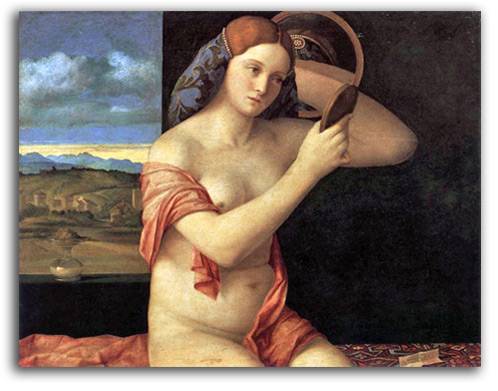
GIOVANNI BELLINI
NUDE WOMAN WITH A MIRROR, dated 1515
oil on canvas
Vienna
NOTE: Bellini (1430-1516) is the “Father of the High Renaissance” in Venice. He single-handedly developed this expansive vision, and then trained Giorgione and Titian to carry the new “modern” style into the 16th century. His earlier nudes were rather restrained in form and feeling. They were more iconic than sensual. Apparently inspired by what his young apprentices were doing, the old Bellini rendered this poetic image at the very end of his life. Is she Venus or just a beautiful young lady? It is not clear. This was the moment in history when a nude no longer had to be presented as Venus or Eve in order to “justify” being nude. Human-ness was becoming a value on its own. During the Middle Ages, almost all subjects were sacred. Secular art did not really exist as a tradition. It was artists such as Botticelli, Leonardo, Raphael, Bellini, Giorgione, and Titian who developed secular subjects to a level of true poetry. Gradually, over the centuries, secular art became as widespread as sacred art. By the 20th century, for better or worse, sacred art was rarely to be seen. The ugly elbow in this painting could not have been composed by Bellini. It must have been the result of another hand, presumably after some damage.
BOUTS & THE NORTHERN RENAISSANCE
H.1 Northern Renaissance Madonnas: The Iconography of Interaction
H.2 The San Francisco “Madonna” of Dirk Bouts: Attribution History
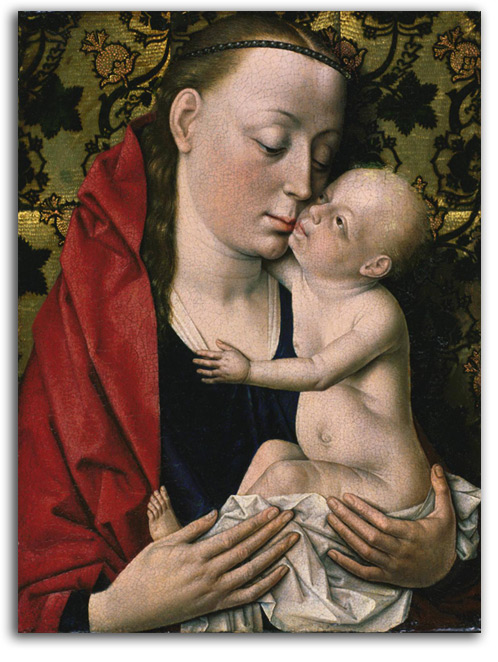
DIERIC BOUTS
VIRGIN & CHILD, c.1460
oil on wood
Roscoe & Margaret Oakes Collection???
NOTE: Bouts (1415-1475) was a member of the second generation of Flemish masters who continued the astonishing naturalistic innovations of van Eyck and van der Weyden. In the opinion of most specialists, this is the finest of three versions of this painting that were made by Bouts and his workshop. X-rays show that Bouts modified the direction of the Virgin’s eyes during the composition so that Her eyes and His eyes would meet. Coming out of a medieval tradition in which those eyes rarely if ever met each other, this was an iconographic revolution that increased the humanity of the Mother of God and the Son of God. The concept moves from being a formal and rather remote Byzantine Icon to being an intimate portrait. This beautiful painting is in exceptional condition which is extremely rare for paintings of this period. It was acquired by the Fine Arts Museums of San Francisco in 1970 at my recommendation. My goal was to round out the Renaissance collection of the city that had very little from the Early Renaissance, from the time when the modern world started to take shape, from the time when we started to be us.
DURER
I.1 Durer’s “Epiphany” in The Nuremberg Chronicle: an Attribution
I.2 Durer’s “Soluna” in The Nuremberg Chronicle: an Attribution
I.3 Renaissance North & South: Pacioli, Barbari, Durer, & Raphael
I.4 Durer’s Visits to Venice
I.5 Durer’s “Christ among the Doctors” Revised
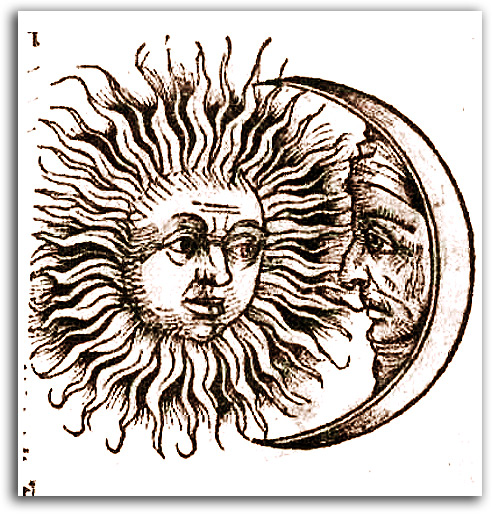
ALBRECHT DURER
ILLUSTRATION OF SUN-MOON
in the Nuremberg Chronicle
Conceptualization & execution of the woodcut: Nuremberg, 1486-89
Publication of the woodcut in the first edition: Nuremberg, 1493
Realization of this lithographic facsimile of the woodcut: San Francisco, 1977
Collection: FLG
NOTE: As a young apprentice, Durer (1471-1528) is thought to have made woodcut illustrations between 1486 & 1489 for this now-famous book, which was the most important illustrated book printed in Northern Europe during the 15th century. The book set out to be a history of the world, and did that rather well with the resources available. Scholars have long debated which of the over 600 original illustrations were designed if not also cut by Durer. Many think this particular illustration came from his head if not also from his hand. In the Fall of 1963, when I was thinking about doing my M.A. thesis on Sun-Moon symbolism in Alchemical books, Meyer Schapiro, my professor and first advisor at Columbia University, sent me to the Morgan Library to continue my research. As we were discussing the symbolism of Sun & Moon in conjunction I said it is misleading to speak of the two elements as entirely separate realties. In the universe of Alchemy, the two are conceived as two aspects of a single reality. A moment later I proposed a term that would suggest this “bi-singularity” (a term I coined in preparation for this discussion). The term was SOLUNA. Schapiro smiled and shook my hand saying: “That is a good new term. We need more terms like that.” I’ve been using that term ever since.
CLICK HERE for my discussion on another Durer illustration in this book
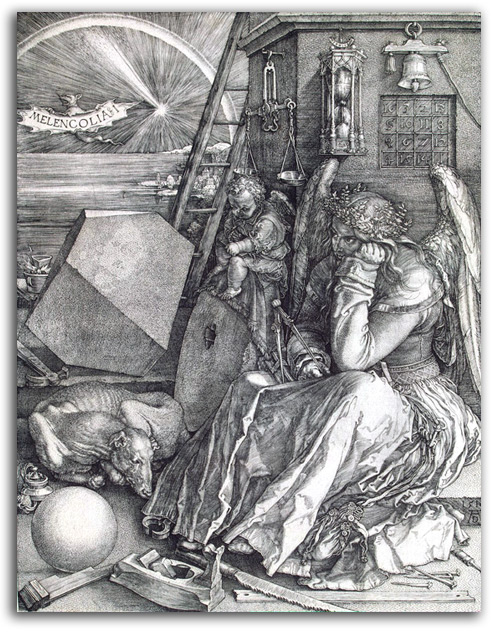
MELANCHOLIA
Conceptualization & first printing: 1514
Realization of this impression from the original plate: 19th/20th century
engraving
Collection: FLG
Ex. Collection: Metropolitan Museum of Art, New York
NOTE: Durer developed into the most important artist of the High Renaissance in Northern Europe. The depth and breadth of his achievements are so amazing that he often is called the “Leonardo of the North.” He was not only a painter who revolutionized painting and a printmaker who revolutionized printmaking, but also the author of two important books on mathematics and ideal proportions (including Platonic solids). Like Giovanni Bellini (whom Durer admired and visited in Venice), Durer almost single-handedly created a High Renaissance style. In Italy, artists had been cutting away the knotted vines of Gothic art for generations, but in the North these medieval clusters still dominated the visual arts around 1500. This makes Durer’s accomplishments even more remarkable. His starting points were quite Gothic – the crusty woodcuts of the Nuremberg Chronicle when he was a teenager during the 1480s, and then the more vibrant linearity of the engravings of Schongauer (who died while Durer was on the way to meet him in 1492).
Then came the “Light of Italy.” Durer visited Italy twice in 1494-95 and 1505-07. There he assimilated both the color of Venice, and the spatial arts of perspective and proportion not only in Venice but probably also in Mantua and Padua. Scholars continue to debate who were his Italian teachers, but the possibilities include Bramante, Barbari, and Pacioli (who also was Leonardo’s teacher.) He was gaining a high reputation throughout Europe (primarily as a brilliant printmaker but also as a portrait painter), and was in communication with Bellini, Raphael, Leonardo, as well as Erasmus and Luther. All along the way, Durer was exploring what was happening to his psychology in a series of self portraits and in a diary. He painted more self portraits than any Old Master except Rembrandt. Most of his best-known prints are religious, but also very important are his engraved portraits of leading figures.
Perhaps Durer’s most famous print is “Melancholia” (1514). Probably more has been written about it than about any other European print. This is because of its haunting complex beauty, and because of its enduring mystery. An Angel sits in shadows, unhappy, among many tools and a number of symbolic shapes, as well as an animal and a small winged being (who probably is a “genius” or guiding spirit.) Above the darkness, sunlight bursts inside a rainbow, and a bat holds up a banner reading “MELENCOLIA I.” What does it all mean? After looking at this print on my wall for 30 years, I have come to think it is a self portrait by an artist who has tasted the Light of the Transcendent and is filled with melancholy because he is thirsty for much more.
ALBERTI & BRAMANTE
J.1 Alberti & the Ancients: The Rebirth of Musical ProportionsF
J.3 Bramante in Urbino, Milan, & Rome
VERTU
K. “Virtu” — the Life of an Idea, during & after the Renaissance
POETRY & PROSE OF THE ITALIAN RENAISSANCE
L.1 Poetry of the Italian Renaissance
L.2 Prose of the Italian Renaissance
COLLECTING ITALIAN RENAISSANCE ART
M.1 Nicholas Lanier & Early Stuart England
M.2 Artemesia Gentileschi
M.3 American Museum Collections
WUNDERKAMMERS
N. Wunderkammers/Cabinets of Wonders
BIBLIOGRAPHY
O. The Italian Renaissance: a General Bibliography
1. Introductory Surveys
2. Thematic Surveys
3. Urbino Surveys
4. The Renaissance of Mythological Painting
5. Archeology & Collecting Antiquities
6. Luca Pacioli:
6a. Luca Pacioli: A General Bibliography
6b. The Barbari Portrait of Pacioli
7. Humanism
8. Neo-Platonism
9. Biographical Sketches of Eminent Individuals
P. Italian Renaissance Lectures at CSUEB
Symbols of the Transcendent, 2007
Click here to view these lectures in PDF format
PAGAN METAPHYSICS OF THE RENAISSANCE
1 The Genealogy of Botticelli’s “Venus”
2 Philosophical Venus
3 Venus, Mars, & Wisdom
4 The Metaphysical Union of Mars & Venus
CHRISTIAN METAPHYSICS OF THE RENAISSANCE
5 The Crucifixion of Christ
6 Sophia, “Holy Spirit” of Loving Wisdom
7 The Kingdom of God
8 Divine Light in Caravaggio, Rembrandt, & Bernini
Q. CHRISTIAN SCULPTURE AFTER MICHELANGELO
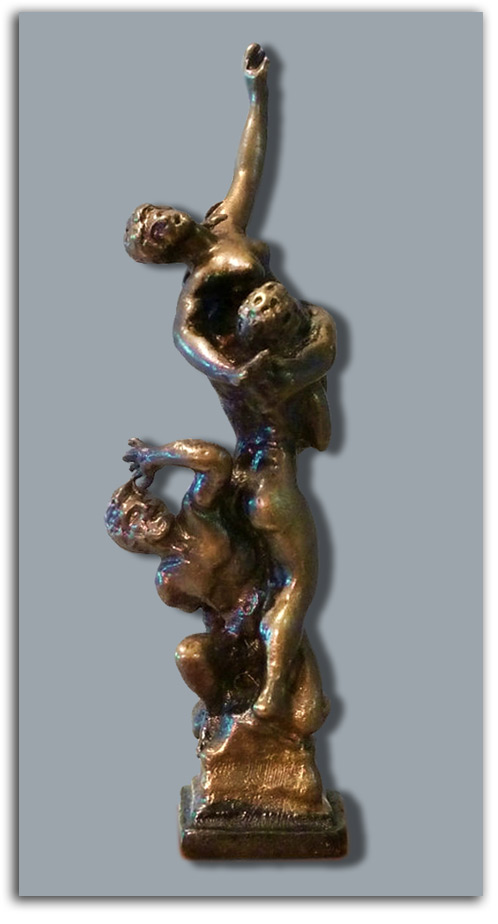
GIAMBOLOGNA (1529-1608)
(aka Jean Boulogne and Giovanni da Bologna)
ABDUCTION OF THE SABINE WOMEN
Conceptualization: Italy, 1574-82
Realization: United States, a small interpretation by Joseph Addotta
late 20th century
Collection: IAD 2012
1. “ABDUCTION OF THE SABINE WOMEN” BY GIAMBOLOGNA
NOTE: Giambologna was born in Flanders (now France), but spent most of his life in Florence under the patronage of the Medici. He was the most important sculptor in Europe working between Michelangelo and Bernini. He brought the technique of bronze-casting to a new level of refinement, and developed the art of composing full-bodied figures in twisting space to a degree not seen since Hellenistic Greece. His feeling for the dynamics of motion, and for the engagement of the space around figures, opened the way for the masterpieces of Bernini. Giambologna’s most famous work is “Mercury,” a version of which stands at the center of the National Gallery of Art in Washington, D.C., because “Mercury” remains one of the most widely admired statues of all time. His second best-known work is “Abduction of the Sabine Women.” (It also is known as “Rape of the Sabine Women” but that is misleading since no actual rape was involved.) That story is from the very early days of Rome when Romulus and his men were in need of wives. They decided to kidnap women from the nearby Sabine tribe. In an honorable gesture, the women were offered legal marriage, civil rights, and property rights. Many artists have been interested in this theme, from Poussin and Rubens, to David and Picasso. Small bronze reductions of Giambologna’s large bronzes were popular at the time, and have been treasured by collectors ever since. This particular modern interpretation is quite small (2.5 inches high), but it captures the remarkable spatial dynamics of the composition in ways that no photograph or video ever could. Why? Because tactility is the experience of the solidification of space.
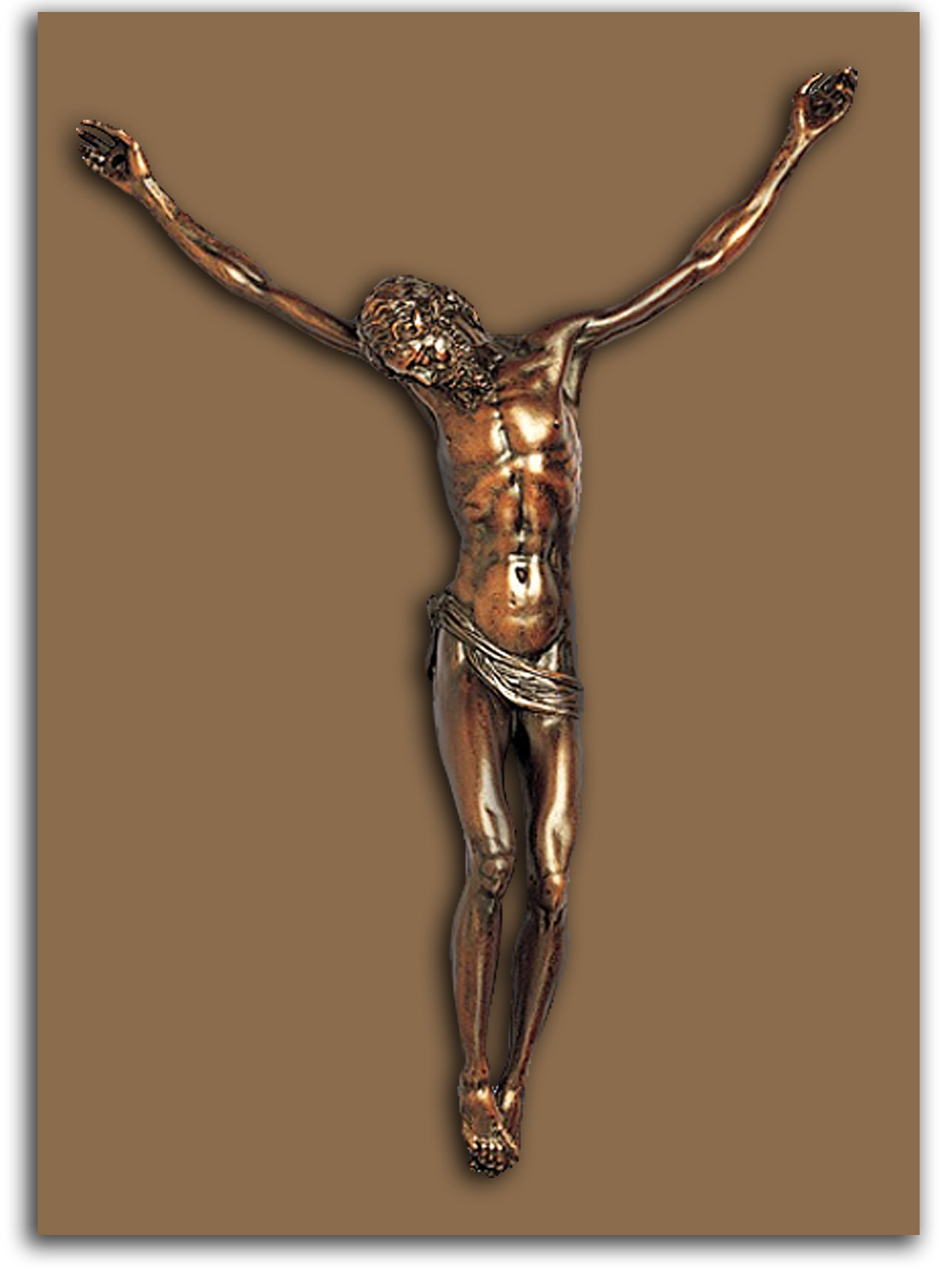
GIAMBOLOGNA
(aka Jean Boulogne and Giovanni da Bologna)
CRUCIFIX
Conceptualization: Italy, by Giambologna, late 15th century
First casting: Italy, by Giovanni Susini, c.1600
Realization of this replica: United States, late 20th century
Editioned by the Metropolitan Museum of Art, New York
bonded bronze; hand patinated
Collection: IAD 2012
2. “CRUCIFIX” BY GIAMBOLOGNA
NOTE: It was in Florence that the technique of bronze-casting reached its height during the Renaissance. There were important bronze castings during the 15th century, but the first great master of this technique as a continuing process was Giambologna. The artistic quality of this figure is excellent. He made it an industry. The patina has the kind of fine finish for which Giambologna was famous all over Europe. However, the composition has some of the weaknesses that are characteristic of the Mannerist style that dominated European art during the Late Renaissance in the second half of the 16th century. There was a profound balance of dynamic energies in the art of the High Renaissance, a well-measured harmony of form that was inspired by the art of Greece and Rome. After about 1520 (when Rome was sacked by Germans), there was a loss of confidence in Classical aesthetics. Mannerist art moved away from Classical art toward ideals that have a smooth stylistic elegance which the Italians called maniera, and the French maniere. Perhaps because it was an era of constant warfare, with little emotional stability of any kind, there is often a deliberate disbalance in the visual arts, together with oddly twisted details, and either a strange overall anxiety or almost no emotion at all. Typical also are strange, unnatural proportions such as the length of the arms on this crucifix. (They could reach below his knees!) Modern viewers are often left with an experience of superficiality. This bronze body of Christ is long on style but short on content. Do you see agony or pathos?
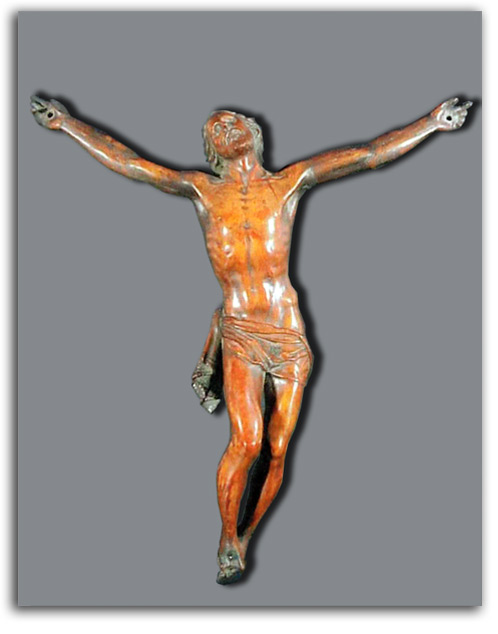
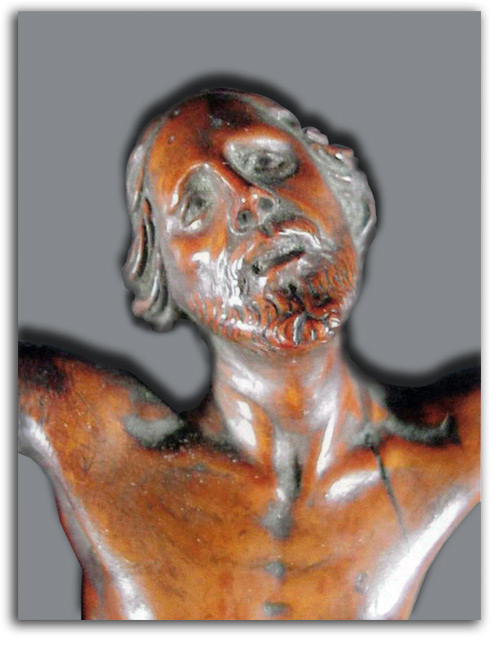
BERNINI, manner of
“CRUCIFIX” c.17th/18th century
Boxwood
Collection: FLG
3. BERNINI “CRUCIFIX”
NOTE: Giovanni Lorenzo Bernini (1598-1680) was the most important European sculptor of the 17th century, indeed the greatest European sculptor between Michelangelo and Rodin. He learned some important spatial lessons from Giambologna, but this deeply religious man took figuration to higher levels of visual expression and deeper levels of emotional reality. He rose rapidly in the estimation of the most powerful of patrons in Rome and was knighted in 1621. His mythological figures (such as Apollo & Daphne, 1621-22) have a remarkable reality of flesh and feeling inside spatial configurations of the most dramatic moment of their legendary stories. As an architectural sculptor, Bernini is best known for the remarkable colonnade that embraces Piazza San Pietro in front of St. Peter’s Basilica (symbolic of how Mother Church embraces the faithful), and for the towering baldachin inside St. Peter’s over the Main Altar and on top of the tomb of St. Peter (1623-34). As a narrative sculptor, he is best remembered for his astonishing “St. Theresa in Ecstasy” (1647-52). Never has spiritual ecstasy been rendered so fully. Rudolph Wittkower, the 20th centuries most respected authority on Bernini (and my advisor at Columbia), pointed out that this work is a great deal more than “sculpture” in the usual sense. It is a profound unity of painting, sculpture, architecture, and light. Bernini was the last great “universal genius” produced by Italy. Many crucifix figures were made under his inspiration during the 17th & 18th centuries. This is one of them. Bernini’s composition has such force that it became the prototype for millions of crucifix figures in the following centuries. The s-shape of the body quietly spirals upward to where the head lifts dramatically toward Heaven. Here is Divinity-Made-Human. The body is a beautiful as life itself. The contorted face is that of a dying God-Man who was both. His human side is experiencing the last moment of anguish before returning to the Divinity from which he came, before severing the last shred of human ego and thus merging with the endless blissful Sea of Eternity. One can hear that final cry of agony: “Why hast thou forsaken me?”
Edited 2007