ROMAN
Part 2 – EVERYDAY OBJECTS (Click)
Part 3 – COINS (Click)
Part 4 – ARCHITECTURE (Click)
A. Pantheon (Click)
B. Coliseum (Click)
ETRUSCAN
PART 1 – SCULPTURE (Click)
A. Faces (Click)
B. Figures (Click)
PART 2 – EVERYDAY OBJECTS (Click)
PART 3 – COINS (Click)
PART 4 – ARCHITECTURE (Click)
THE ROMAN WORLD: An Introduction
The Roman Empire grew from humble origins to become the most powerful empire of its time. It dominated most of Europe and all the nations around the Mediterranean Sea for centuries. It was not the earliest civilization in Italy. That honor belongs to the Etruscans in Tuscany. Their cultural patterns had become distinctive by the 9th century BCE. Under Greek influence, the art of the Etruscans was flourishing by 500 BCE with an “archaic” style featuring an “archaic smile” on the faces of funerary sculpture, a smile that seems to express some form of heavenly bliss.
Expanding north from the center of the Italian peninsula, the Romans had absorbed the Etruscans by the 2nd century CE, and assimilated even more Greek art than the Etruscans had. Rome began as a small kingdom, and by the 6th century BCE had grown into a prosperous democratic republic ruled by a senate. By the 1st century BCE, it had conquered Greece and was developing into an empire ruled by a dictatorial emperor who proudly took on the title of Caesar, in honor of the great general Julius Caesar (100-44 BCE).
The Romans were brilliant warriors, engineers, and public administrators. Some of their architecture, such as the Pantheon, is brilliant. However, in the field of sculpture they were subordinate to the achievement of the Greeks. They were so impressed by the quality of Greek monumental sculpture that they copied it, as best they could, for centuries, adding little to the tradition.
The most distinctive contribution the Romans made to the history of sculpture was in the area of portraits. This development emerged from their reverence for their ancestors, a reverence so extreme that historians have called it “ancestor worship.” During the early centuries of the Roman republic, when a family member passed away, a wax impression would be made of the face. That would be kept in a family shrine for some time, along with stone versions of other family members. As in many tribal societies, these heads would be fed in a ritual manner and paraded on feast days. It was important that every detail of a face be captured in wax and then stone. Fidelity was a sacred truth.
This reverence for reality resulted in faces quite different from the idealized faces of Greek sculpture. Roman faces tend to be extremely realistic. This hyper-realism often included “warts and all.” This custom of revering ancestors in statuary was continued during the Imperial era of Rome by the patrician class. Indeed, the law stated that only aristocratic families could continue this custom.
Bust portraits could be seen throughout the Empire. Exactness to facial features continued to be important in coins and busts. In no other ancient culture do we have such a detailed record of individual faces. Roman busts were not simply works of art. They were regarded as being alive. For example, it was the law that Romans must burn incense in front of a bust of the Emperor because he was considered a god. When the Christians in Rome refused to do this they paid for it with their lives. They were persecuted for centuries.
By the 4th century, in a remarkable turn of events, Christians were no longer being persecuted. Christianity was being favored and was rapidly permeating Roman society. This radical change began with the conversion of the Emperor Constantine the Great. This new religion eventually became THE official religion of the Empire as polytheism faded to the sidelines. The influence of Roman civilization and Christianity in general, along with the Latin language in particular, were of profound importance in the later development of Europe. It could be said that most of European history stands on two feet – Greece and Rome.
The IAD Collection includes a range of Roman work: sculpted stone, cast bronze, engraved coins, and Christian crosses, as well as ordinary, everyday objects. Some are ancient; some are replicas – not cheap reproductions but museum-quality replicas that curators often have spent years working with artisans to make sure the spirit of the original work has been maintained. The cast of characters portrayed in these Roman sculpture and coins includes ordinary citizens and high-born individuals, as well as deities. The head of fun-loving Pan (with the horns of a goat) is part human and part animal. He is typical of the spirit of many Roman festivals and orgies. From a higher level of spirituality comes a sculpture of the Divine Androgyne – the mystical ideal of many of the pagan cults of the Roman Empire.
Thanks to both objects and writings, we know more about the daily lives of ordinary Roman citizens than we do about any other society of the ancient world. The IAD Collection includes a lamp, a razor, a glass vessel, tweezers, rings, pendants, and military equipment. The IAD group of portraits and objects represents a cross-section of a society that had many strengths and many weaknesses, including a horrific love for the killing of animals and people in the Colosseum as a popular form of public recreation.
Nevertheless, the pre-Imperial ideals of the Roman Republic (democracy, justice, fairness, family values, and noble visual art) were such that they were adopted as political and aesthetic ideals by the first republic of modern times – the United States of America, a nation that also adopted the totemic eagle of Rome as its national bird, and the noble columns of its temples for buildings of special importance. The social ideals of the Roman Republic continue to be the ideals of most of the republics of the contemporary world.
ROMAN SCULPTURE
ROMAN FACES
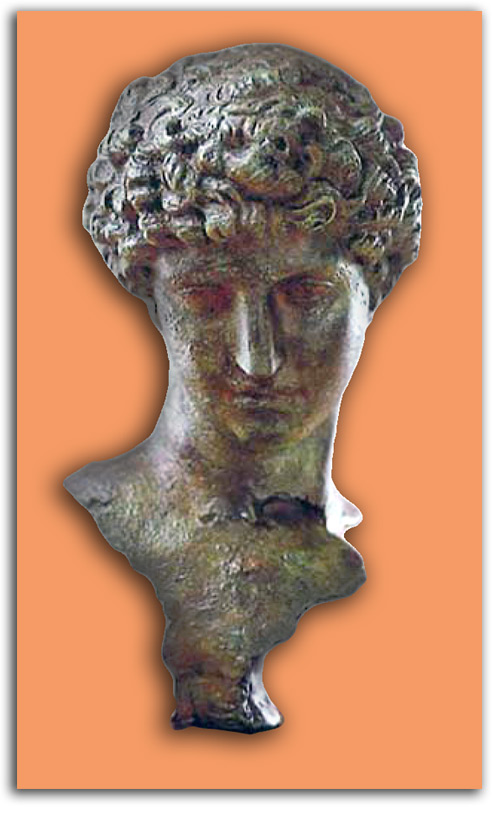
Head of Youth
Date of the original bronze: 1st century CE
after a Greek bronze of the 4th century BCE (replica)
This replica of bonded bronze was editioned by the Metropolitan Museum of Art, New York &
The Israel Museum, Jerusalem Collection: IAD, 2011
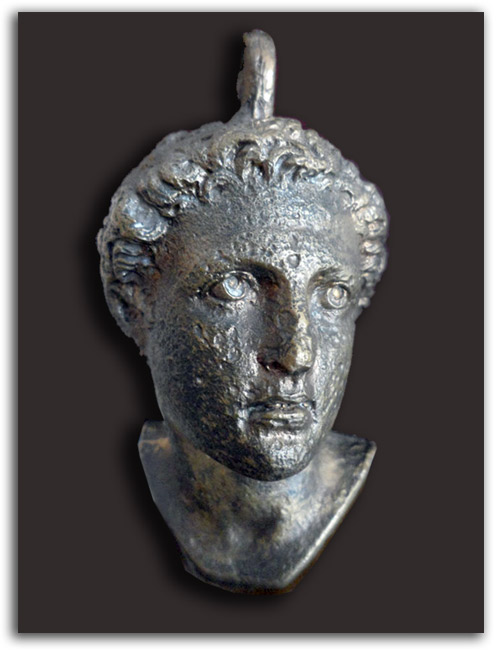
Head of a Young Man (pendant)
(Ancient Roman bronze replica of the 2nd/3rd century CE)
Date of original Greek bronze: 3rd century BCE
Collection: IAD, 2011.
NOTE: Probably worn as a pendant.
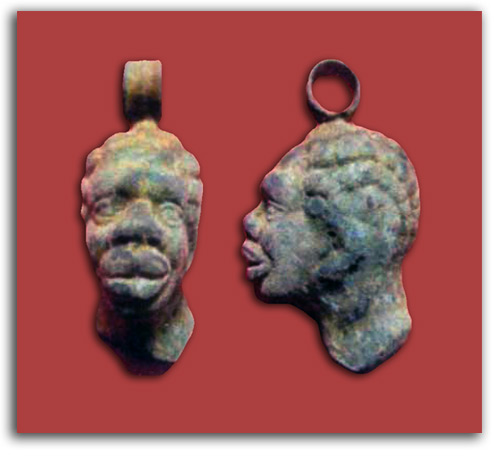
Head of an African Man (pendant)
c.2nd/3rd century CE
Bronze. Collection: IAD, 2011
NOTE: A very rare, and very early example of an African in European art. Probably worn as a pendant. Authenticated by Professor Paul Kaplan.
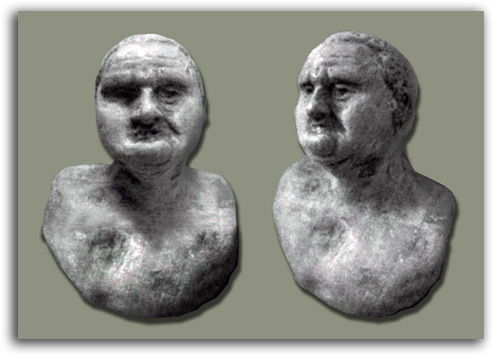
Head of Titus, Emperor of Rome (79-81 CE)
c.1st century CE.
Bronze. Collection: IAD, 2011
NOTE: Titus is remembered for putting down the Jewish Revolt and for completing the Colosseum.
Head of a Boxer c.2nd/3rd century CE
Bronze?
Collection: CSUEB. Gift of IAD
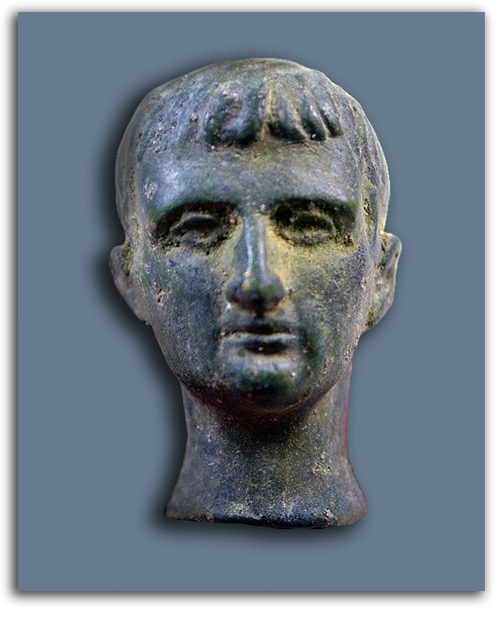
Head of a Young Man
Date of original bronze: 1st/2nd century CE (replica)
Bronze
Collection: IAD, 2011
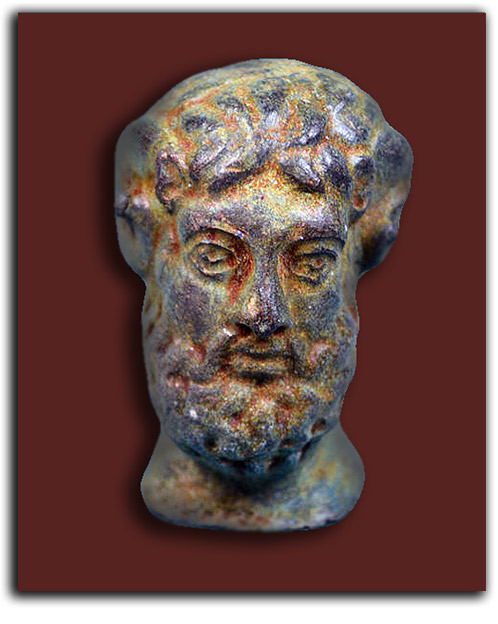
Head of Pan
Date of original bronze: 1st/2nd century CE (replica)
Bronze
Collection: IAD, 2011
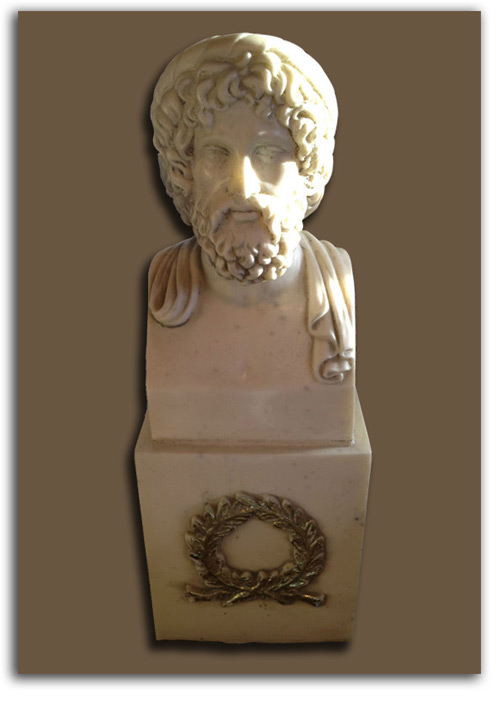
ROMAN
Bust of a Philosopher, over a Pedestal with a Laurel Wreath, c2nd/3rd century CE
“marble”
replica, 20th century
Collection: IAD, 2011
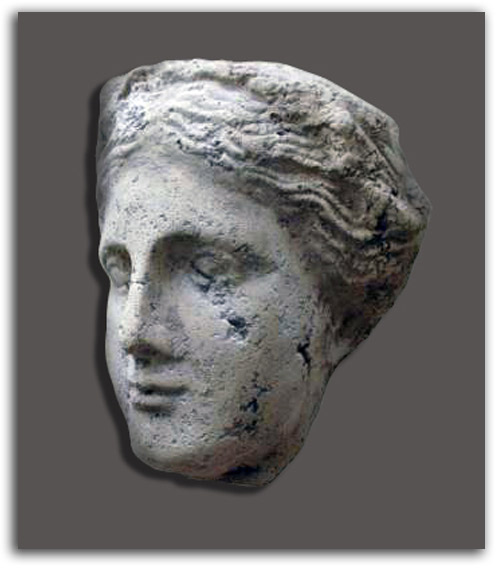
HEAD OF A GODDESS, probably Hygieia (Health)
Conceptualization: Greek, c.350 BCE. Attributed to Scopas
Realization: 20th century copy of a Roman replica, c.1st/2nd century CE
From the area of Mount Vesuvius, near Pompeii
“marble”
Collection: IAD 2011
NOTE: Hygieia or Hygiea or Hygeia (Roma: Salus) was the Greek goddess of Health and Cleanliness, and daughter of Asclepius, god of Medicine/Healing/Wholeness. From her name derives the English word “hygiene.” To the Romans, who adopted her from the Greeks, she was Salus (social welfare) and Valetudo (personal health). Her Greek name was used by the Pythagoreans as the word to identify the pentagram, the ancient 5-pointed star form composed of many Golden Proportions, which to them symbolized mathematical, geometrical, and mystical perfection. They also used her name as an esoteric greeting to one another.
ROMAN FIGURES
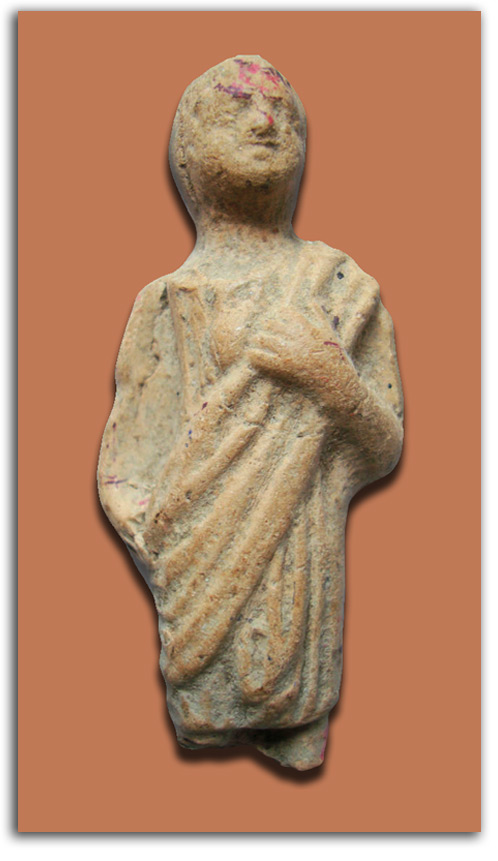
ROMAN
Statuette of a standing Citizen wearing a Toga, c2nd/3rd century CE
Terracotta
Collection: IAD, 2011
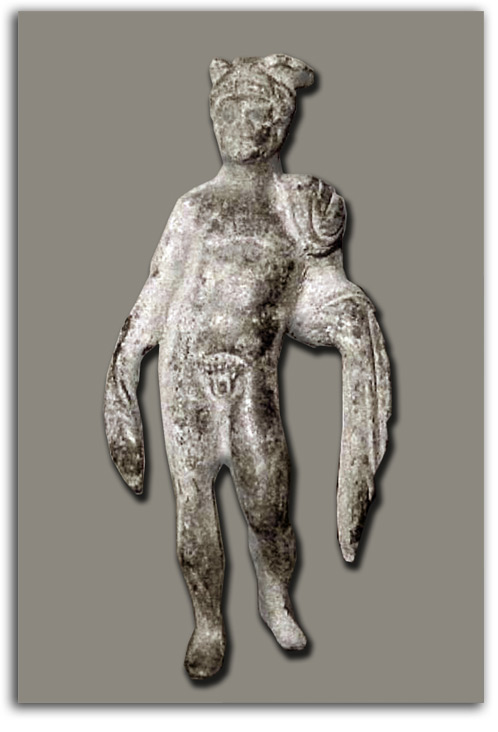
Statuette of Hermes
c.2nd/3rd century CE. bronze
Collection: IAD, 2011
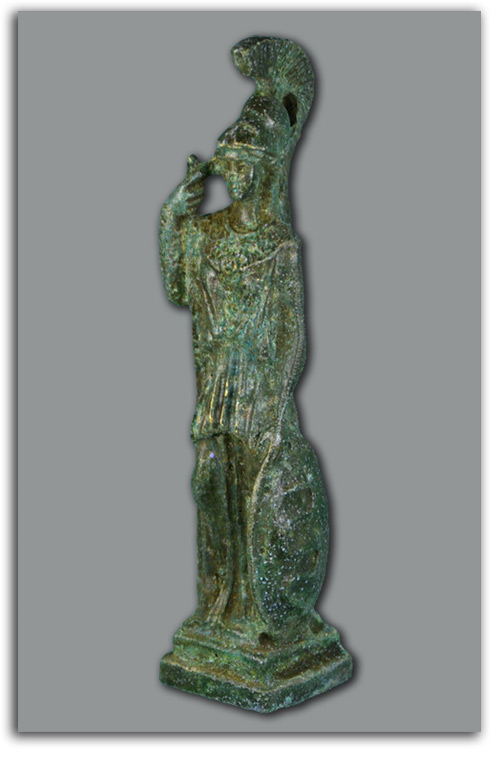
ROMAN
Statuette of Minerva/Athena, c2nd/3rd century CE
bronze
replica, 20th century
Collection: IAD, 2011
ROMAN
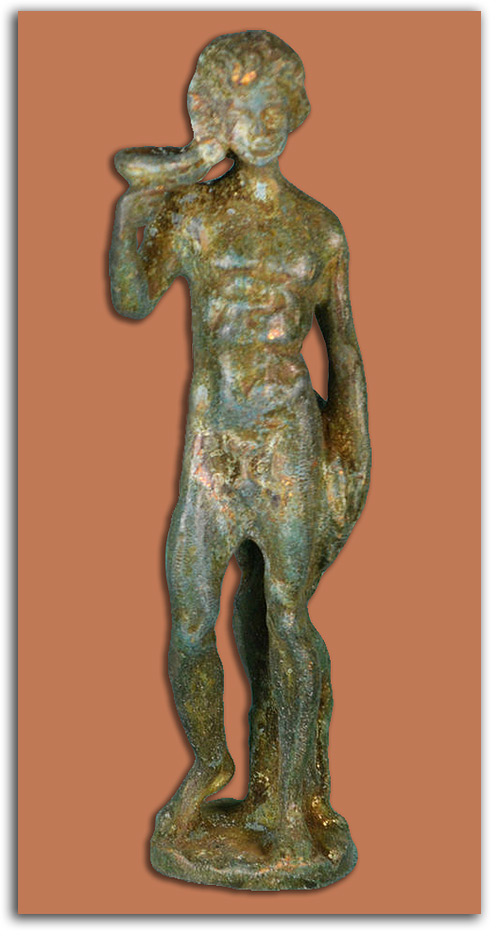
Statuette of Bacchus/Dionysus, c2nd/3rd century CE
bronze
replica, 20th century
Collection: IAD, 2011
Statuette of the goddess Victory (aka Nike) holding a Laurel Wreath
c.2nd/3rd century CE. bronze
Collection: Private Collection on loan to IAD
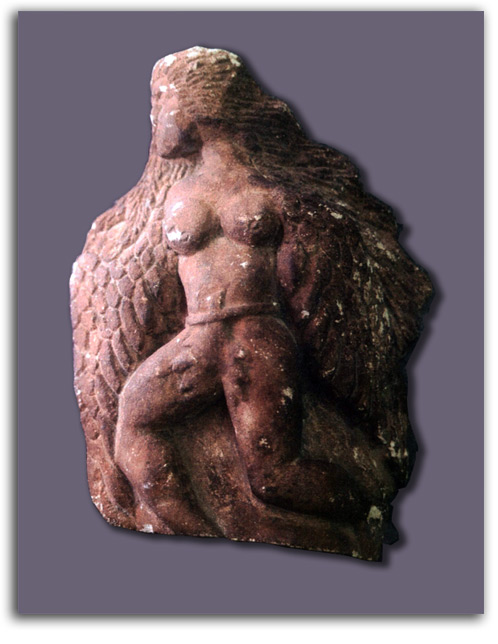
Figure of the Divine Androgyne in Flight
c.3rd/4th century CE. terracotta
Collection: Private Collection on loan to IAD
NOTE: An extremely rare work. The concept of the Divine Androgyne was common in Greek and Roman cults, but very few sculpted or painted images have survived.
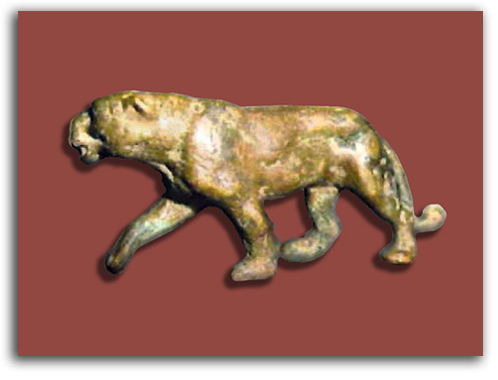
Statuette of a Puma. 2nd/3rd century CE
Bronze
Collection: Private Collection on loan to IAD
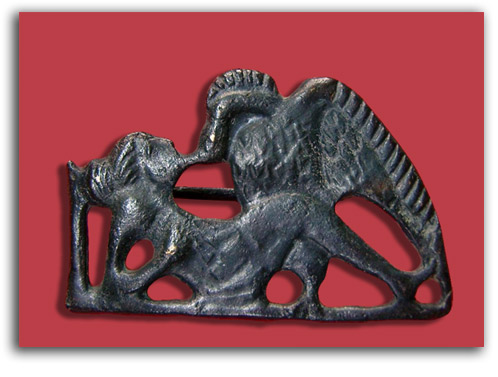
pendant with Fertility Symbolism
Date of original: c.3rd/4th century CE (replica)
Bronze
Private Collection on loan to IAD for further study, 2011 Fibula (Leda & the Swan) c.5th century CE. bronze Private Collection. On loan to IAD for further study, 2011
NOTE: Leda & the Swan was a popular image in Rome. From this mythic union came Helen of Troy over whom the Trojan War was fought. The Romans believed they were descended from a Trojan hero of that famous war. The Leda legend probably is a late version of a neolithic Sacred Marriage ritual involving a tribal queen uniting with a divine totem. The swan was one of the many totemic forms of Zeus. The theme of Leda & the Swan during the Italian Renaissance was painted by Leonardo and by Michelangelo. A fibula is a large pin made to hold parts of clothing together, especially capes and cloaks. Replaced by buttons during the Middle Ages, the ancient fibula eventually became the modern safety pin.
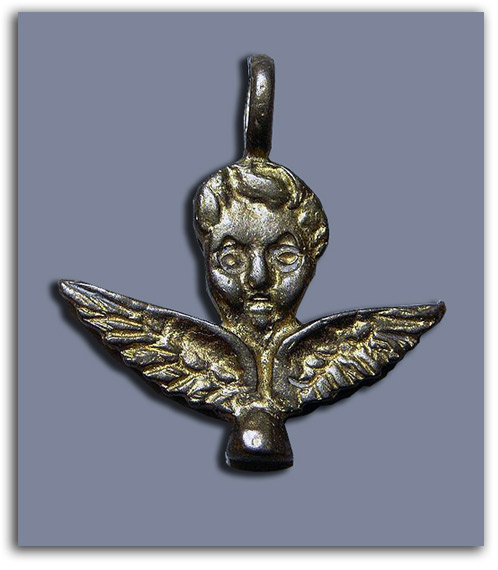
Fibula (Head of an Angel with Wings)
c.5th century CE
Bronze
Collection: IAD, 2011
NOTE: Early Christian angels were not depicted with wings until the 5th century CE. The Christian image of an angel probably derived from Greek images of Nike, Goddess of Victory. It was common for early Christians to assimilate sacred images from contemporary cults. For example, some early images of Christ look like the Greek sun god Apollo, and early images of the Virgin holding Her Son Jesus look like the Egyptian Isis holding Her Son Horus.
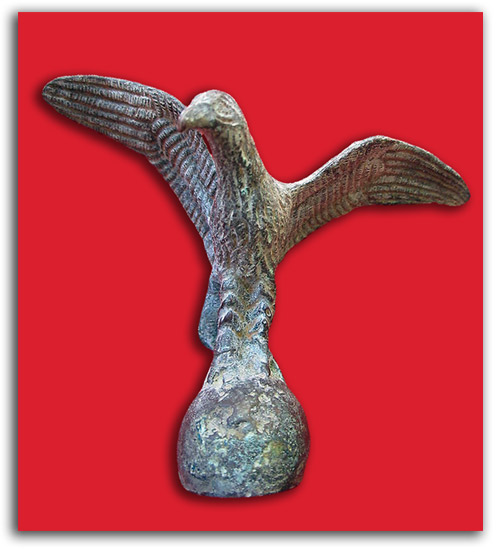
Figure of an Eagle. c.3rd/4th century CE
Stone
Collection: IAD, 2011
ROMAN OBJECTS OF EVERYDAY LIFE
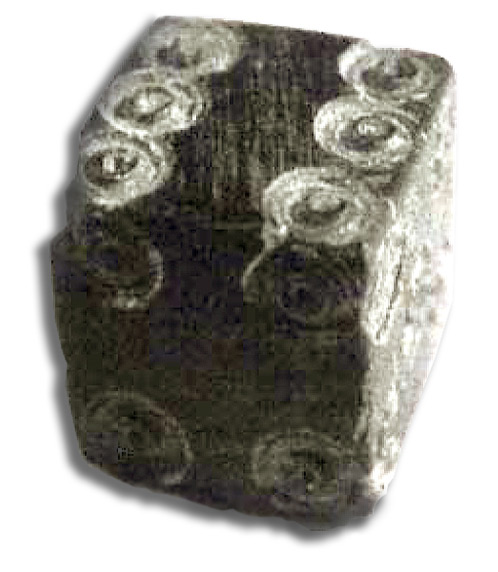
One of a pair of Dice. c.1st/2nd century CE
Black bone
Collection: IAD, 2011
NOTE: Dice were popular in Rome.
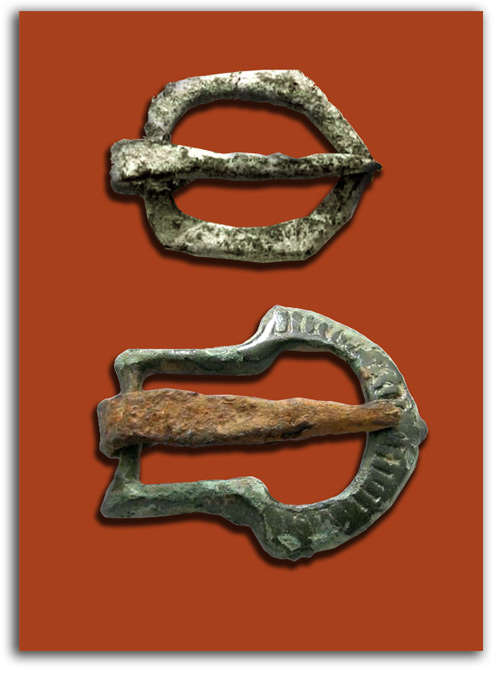
Military Buckles. c.3rd/4th century CE
Iron
Collection: IAD, 2011
NOTE: Probably to hold armor in place.
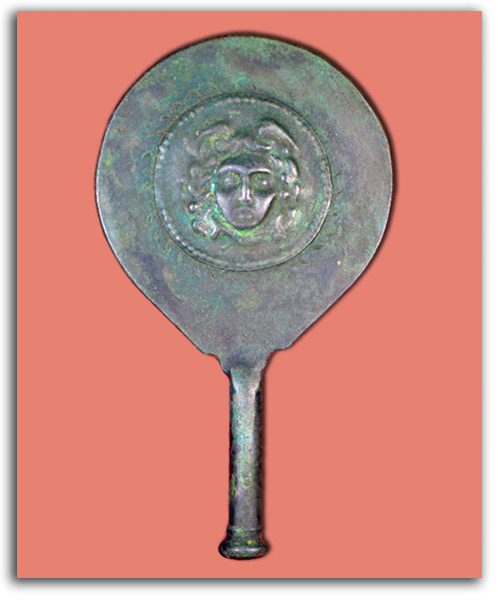
ROMAN
Hand Mirror, with the Face of Medusa, c2nd/3rd century CE
bronze
Collection: IAD, 2011
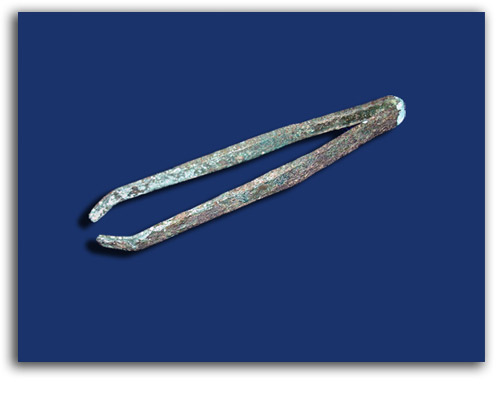 Tweezers. c.1st/3rd century CE
Bronze
Collection: IAD, 2011
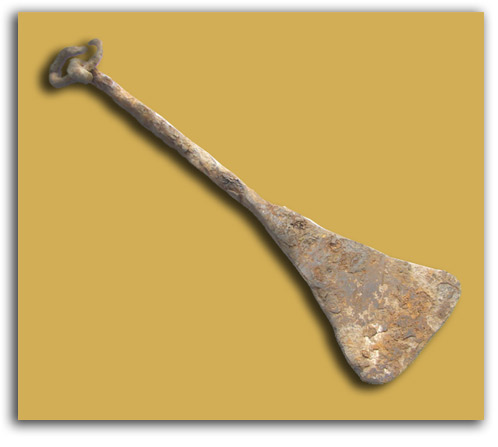
Razor. c.1st/3rd century CE
Iron
Collection: IAD, 2011
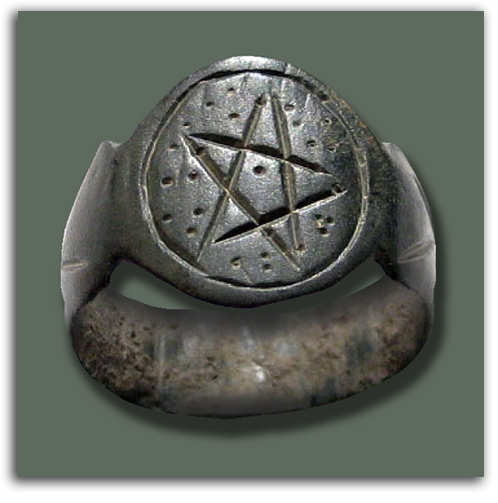
Pentagram Ring. c.1st/3rd century CE
Bronze
Collection: IAD, 2011
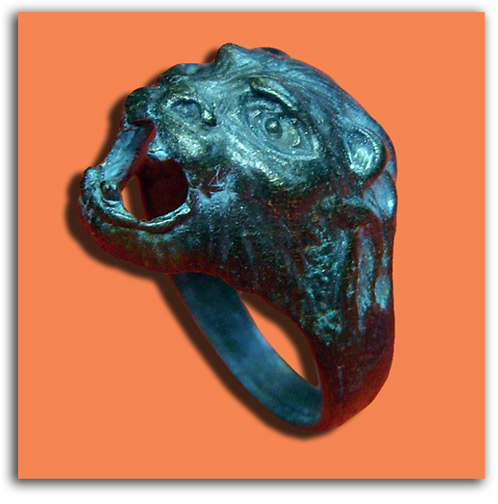
Lion Head Ring with an Open Mouth
Date of the original: c.1st/3rd century CE (replica)
Bronze
Collection: IAD, 2011
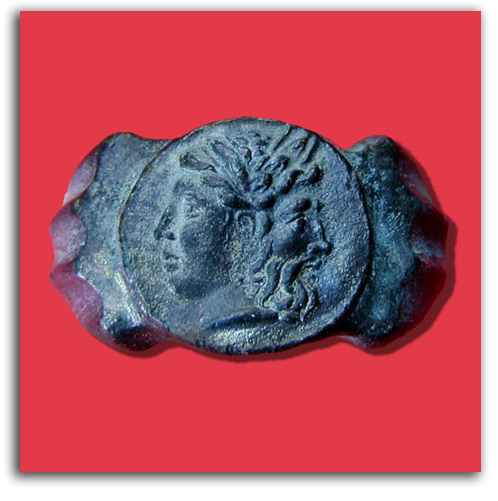
JANUS RING
Roman. c.2nd/3rd century CE
Bronze
Collection: IAD 2011
Janus to the Romans was the “Beginner” – the beginner of all things, and the “gate” though which change takes place. The history of the mythology of Janus is extremely complex and widely debated. Some elements are clear. This deity had an ancient origin, an origin older in the minds of the Romans than all the deities the Romans imported from Greece. Janus was exclusively Roman. He was Pater or Father of All. Janus was often the very first to be honored in rituals, even before Jupiter (Zeus) – King of the gods. Janus is honored at the start of each day, at the start of each New Year, at the start of every marriage, at the start of harvest time, and at the start and finish of a war. Janus also is honored as one walks through doors, gates, and marble arches. In short, Janus is time-in-transition.
Curiously, the Romans had no clearly defined Creation Myth. Even a famous Roman writer on mythology such as Ovid was uncertain of how to describe how the universe began. Janus is as close as they came to a story of Creation. In one legend, Janus is the first King of Latium. In another more esoteric myth, Saturn is Time (Time-in-general, eternal time), and Janus springs from out of Time-in-general to activate Time-in-particular. The typical image of Janus is a head with two faces that look in opposite directions. While the later images of Janus are both male (a younger male and an older male), the original image may have been a version of the Janus & Jana (Apollo & Diana) – the comic twins who were often symbolized as Sun & Moon. It could be that Sun & Moon were the cosmic parents of the Roman people in the remote mythology of the prehistoric period, before the patriarchal mythology of the historic period. In any case, classical Janus looks to the past and to the future simultaneously. He is the connector of the ends of time, and he makes sacred all the moments in between.
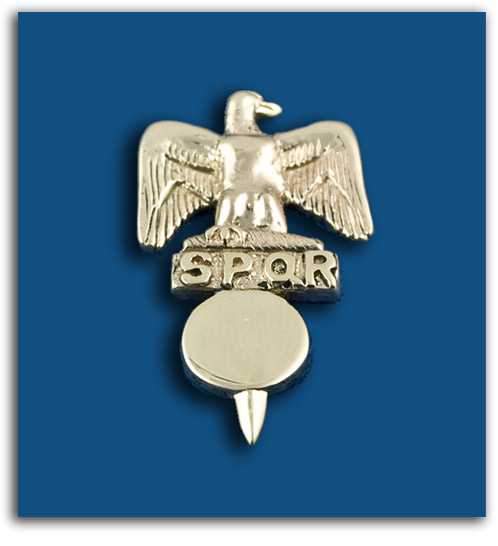
Legion Eagle Standard with SPQR
Date of original: c.1st-4th century CE (miniature replica)
Gold plated brass
Collection: IAD, 2011
NOTE: This military standard was known as the Aquila. He who carried it into battle on a staff was known as an Aquilifer. The letters SPQR stand for “The Senate and People of Rome.” Each legion of the Roman army carried a standard of this design, a standard that the soldiers would protect with their lives. The totemic eagle was an animal form of Jupiter (aka Zeus), their supreme deity. The letters SPQR are on the coat-of-arms of the modern city of Rome.
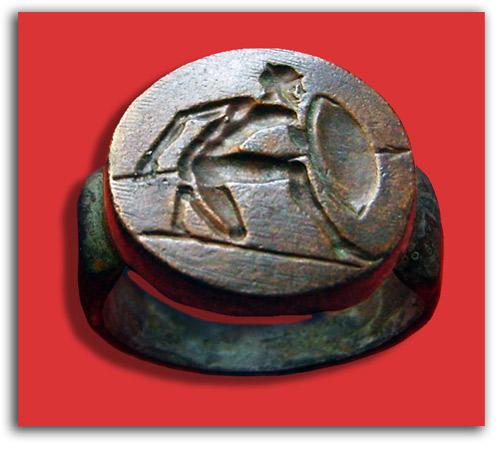
Legionaire’s Ring (Soldier kneeling with a Spear)
Date of the original: c1st/3rd century CE (replica)
Bronze
Collection: IAD, 2011
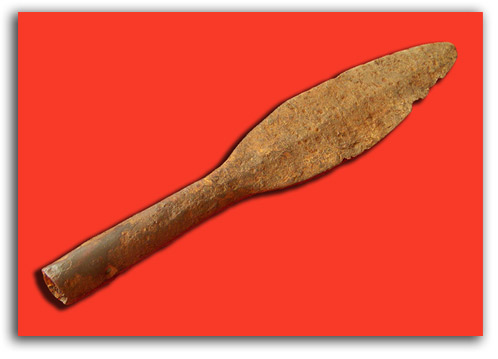
Javelin Tip. c.1st/3rd century CE
Bronze
Collection: IAD, 2011
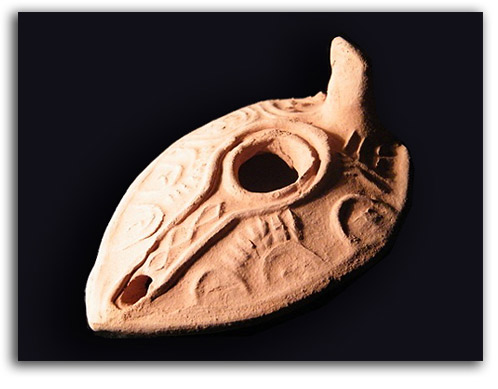
Oil Lamp (Judea). c.1st century CE
Terracotta
Collection: IAD, 2011
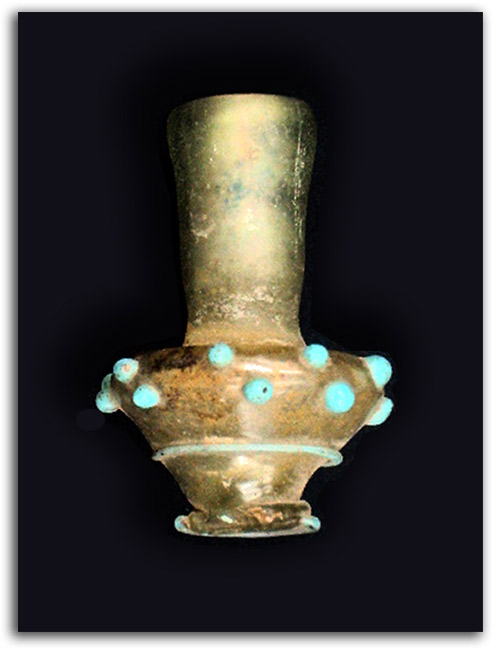
Bottle. c.1st century BCE
Glass
Collection: IAD, 2011
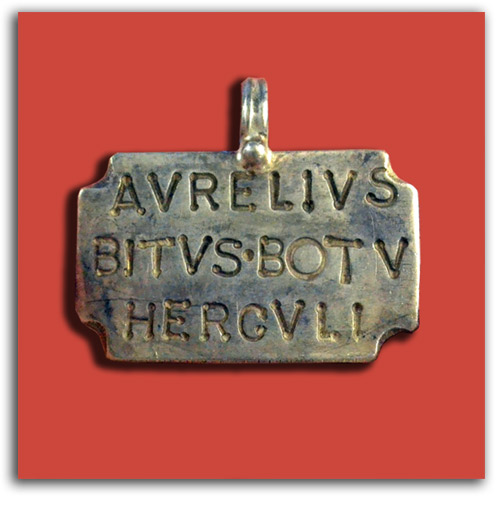
Pendant with Latin Lettering
Date of original: c.3rd/4th century CE (replica)
Bronze
Collection: IAD, 2011
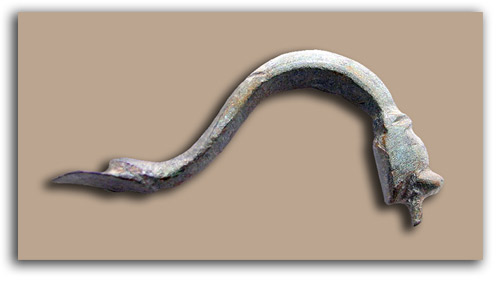
Bronze dragon handle
Date of original: c.3rd/4th century CE (replica)
Bronze
Collection: IAD, 2011
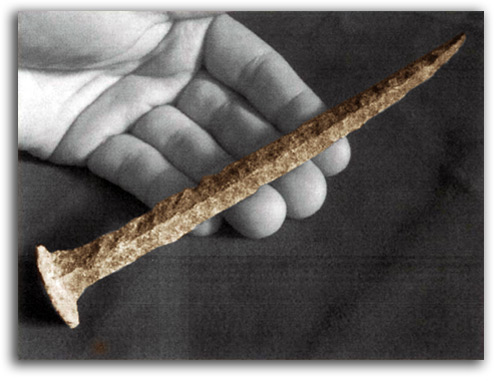
“Crucifixion Nail”
c.1st century CE. Iron (bronze?)
Collection: IAD, 2011
NOTE: Crucifixion was a common form of Roman punishment. It was nails of this standard Roman type that are thought to have been used in the crucifixion of Jesus and many others.
ROMAN COINS
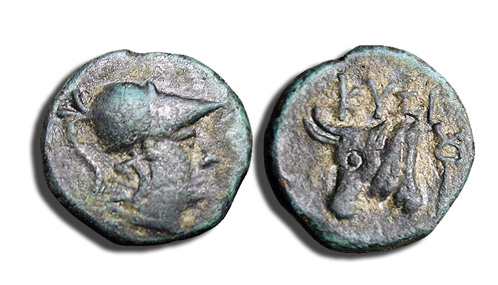
Trajan, Emperor of Rome (98-117 CE)
c100 CE. Coin minted in Rome.
Bronze
Collection: IAD, 2011
NOTE: Trajan is considered one of the so-called “Five Good Emperors” in an empire that had few good emperors. Those five are: Nerva (96-98 CE), Trajan (98-117 CE), Hadrian (117-138 CE), Antonius Pius (138-161 CE), and Marcus Aurelius (161-180 CE).
Cerberus III, Emperor of Rome (238-244 CE)
S ilver. Coin minted in Rome
Collection: IAD, 2011
Constantine the Great, Emperor of Rome (307-337 CE)
313-314. Coin minted in Rome. Bronze
Collection: IAD, 2011
NOTE: Constantine was the first Roman Emperor to embrace Christianity. He founded the city of Constantinople that remained the capital of the Eastern Roman Empire for more than a thousand years. He also is responsible for the establishment of many key Christian dogmas, including which books are part of the NEW TESTAMENT, and the Nicene Creed, a creed which continues to express the bedrock of Christian faith. His mother, Helena, identified the many of the most sacred Christian sites in Jerusalem, sites which are still visited by modern pilgrims. Constantine and Helena are saints in the Eastern Orthodox Church.
THE PANTHEON
ETRUSCAN SCULPTURE
ETRUSCAN FACES
Etruscan Head of a Goddess c.3rd/2nd century BCE.
Terracotta. Collection: IAD, 2011
NOTE: The Etruscans in Tuscany developed a civilization long before the Romans did. The Etruscans were eventually assimilated by the Romans. There is some reason to believe that the Etruscans were a Celtic tribe.
ETRUSCAN FIGURES
PART 2 – ETRUSCAN EVERYDAY OBJECTS
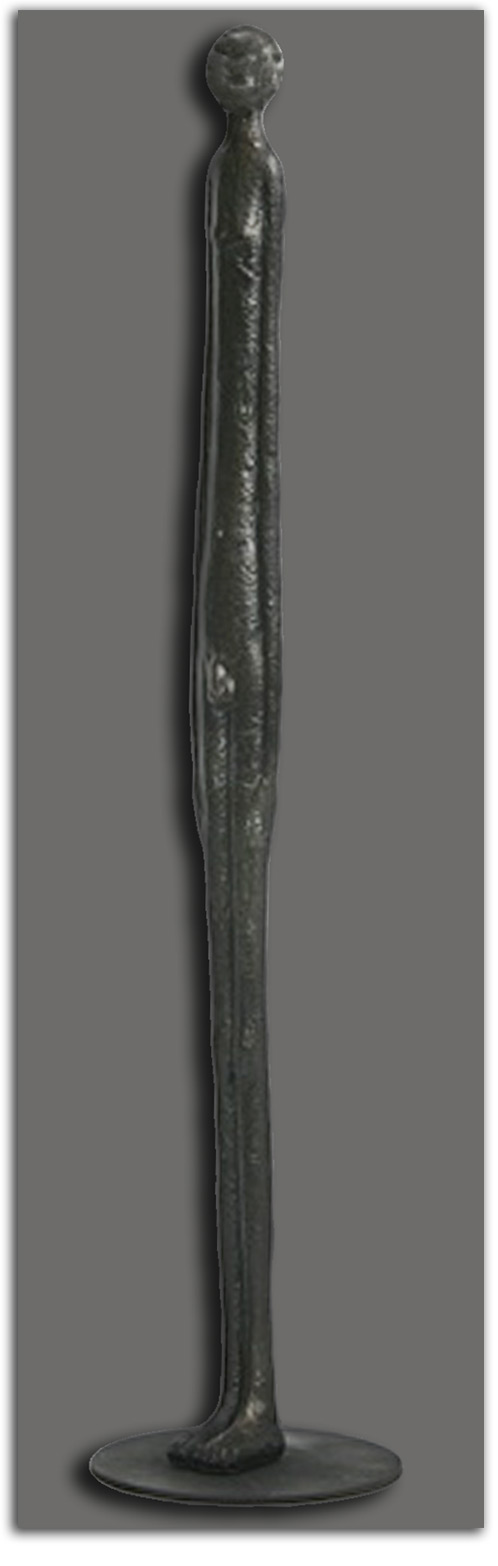
ETRUSCAN
L’Ombra della Sera [The Shadow of Night], aka “Thin Boy,” c3rd century BCE
bronze
replica, 20th century
Collection: IAD, 2011
NOTE: This type of ancient Etruscan statue inspired the Modern sculpture Giacometti [click here]
ETRUSCAN
Engraved Seal with the form of a Horse, c6th/3rd century BCE
stone from a Signet Ring
Collection: FLG
Ex. Collection: Anders Egeskov, Denmark
NOTE: This style is similar to the style of Minoan seals of the Bronze Age
ETRUSCAN
Head of a Goddess, c4th/3rd century BCE
Terracotta
Collection: IAD, 2011
ETRUSCAN
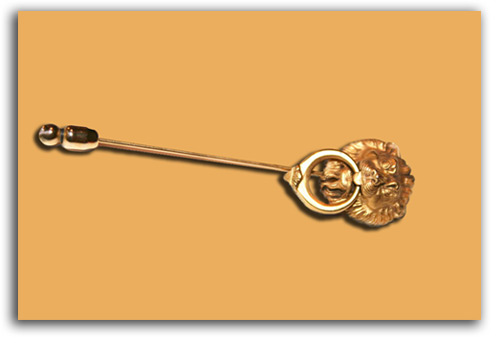
Pin with the Face of a Lion, c4th/3rd century BCE
“gold”
Edition by the Metropolitan Museum of Art, New York
Collection: IAD, 2011
PART 3 – ETRUSCAN COINS
PART 4 – ETRUSCAN ARCHITECTURE
Edited 2011