Conceptualization: Greek, 3rd century BCE
Realization: Greek, c.2nd century BCE
bronze (encrusted from being underwater for a long time)
Collection: FLG
Ex. Collection: Walter Daniels, San Francisco
Vol. 1 MINOAN SEALS
1a A Survey of Minoan Seals, Part One, 1963
1b A Survey of Minoan Seals, Part Two, 1963
1c Toward an Iconography of Minoan Seals, 1963
1d Evidence for the Birth of Perspective in a Minoan Seal, 1964
1e This Evidence for Perspective Looks Good:
A Conversation with Dr. S. Marinatos, 1973
1f Does Perspective emerge in a Pre-literate Society with the arrival of Written Language? A Conversation with Gregory Bateson, 1978
Click on above image to enlarge
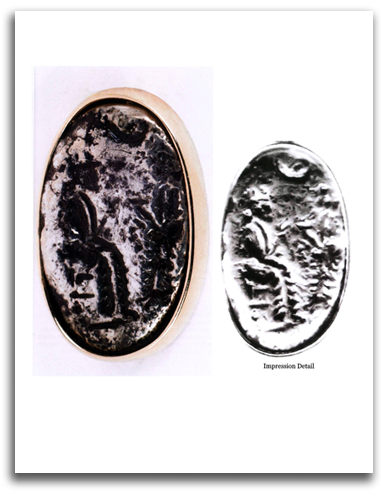
Seated Deity receiving an Offering (under a crescent Moon?) Sub-Minoan Signet Ring
(now mounted as a pendent). c.1100/1200 BCE. Electrum
Collection: FLG on loan to IAD
Published in GLOBAL VISION: A SURVEY OF WORLD ART, Part 3, 2008
Vol. 2 MINOAN SIGNET RINGS
2a A Survey of Minoan Signet Rings, 1964
2b An Unrecorded Sub-Minoan Ring, 2007
2c An Archive of Correspondence on the Attribution of an Unrecorded Sub-Minoan Ring with Sir John Boardman, 2009-10
Click Here for FLG email correspondence with Sir John Boardman
Vol. 3 MINOAN & GREEK MYTHOLOGY:
An Overview
Vol. 4 THESEUS & THE MINOTAUR:
The Transfer of an Initiation Ritual from Crete to Eleusis
Vol. 5 IONIA & THE FLOWERING OF ATHENS
Vol. 6 GREEK PHILOSOPHY: AN INTRODUCTION
Click on above image to enlarge
Click on above image to enlarge
Click on above image to enlarge
Click on above image to enlarge
Click on above image to enlarge
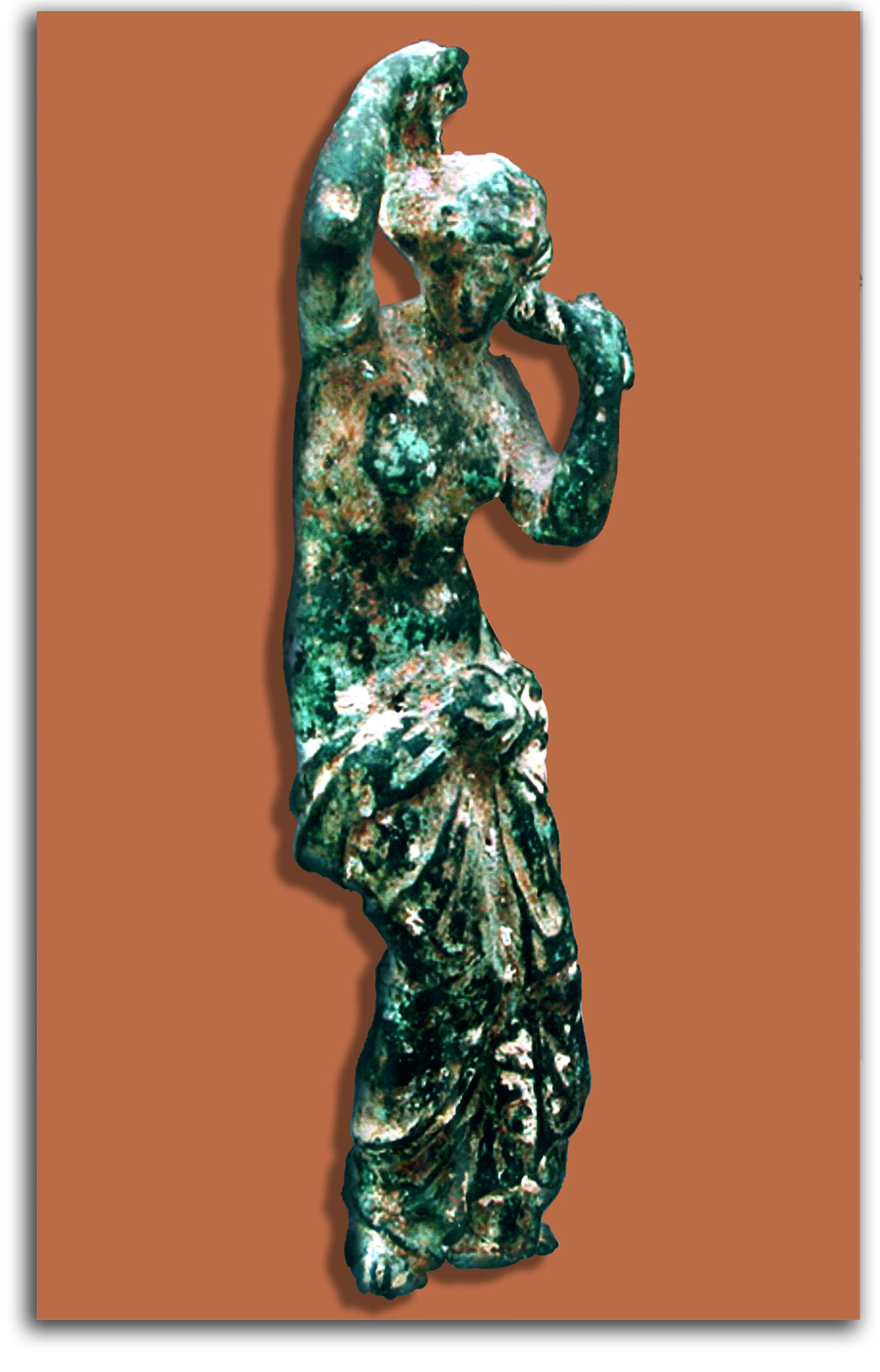
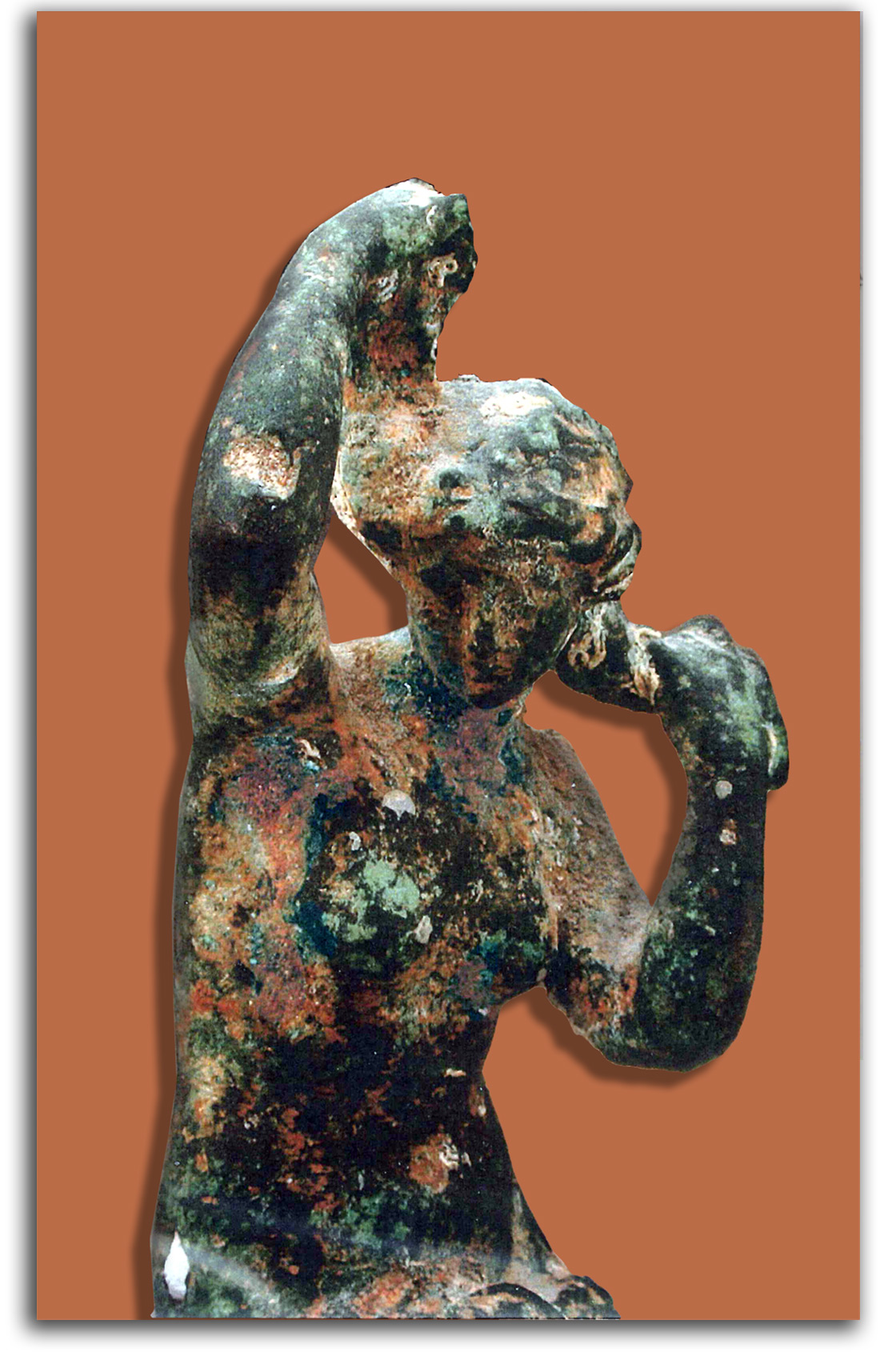
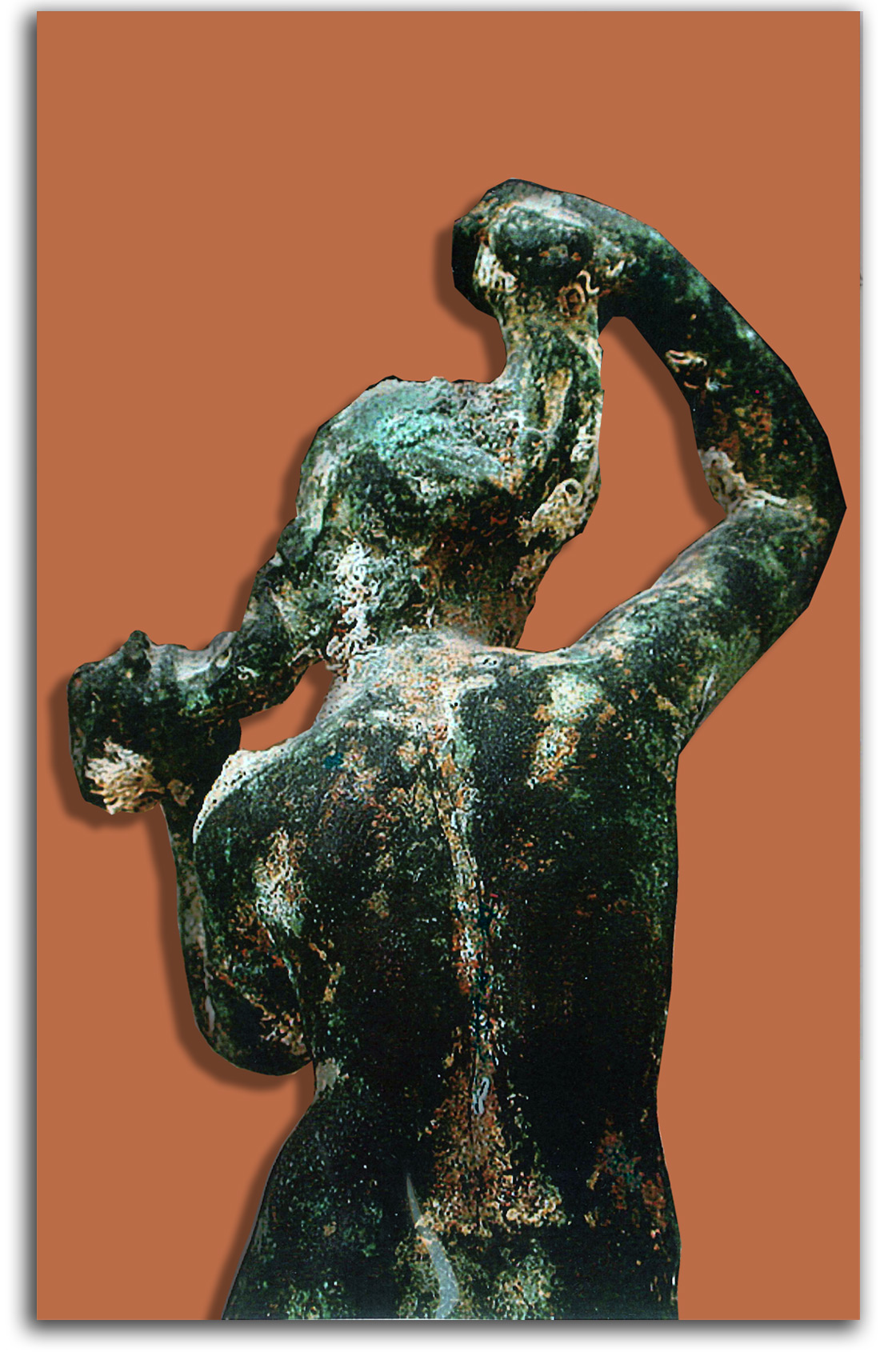
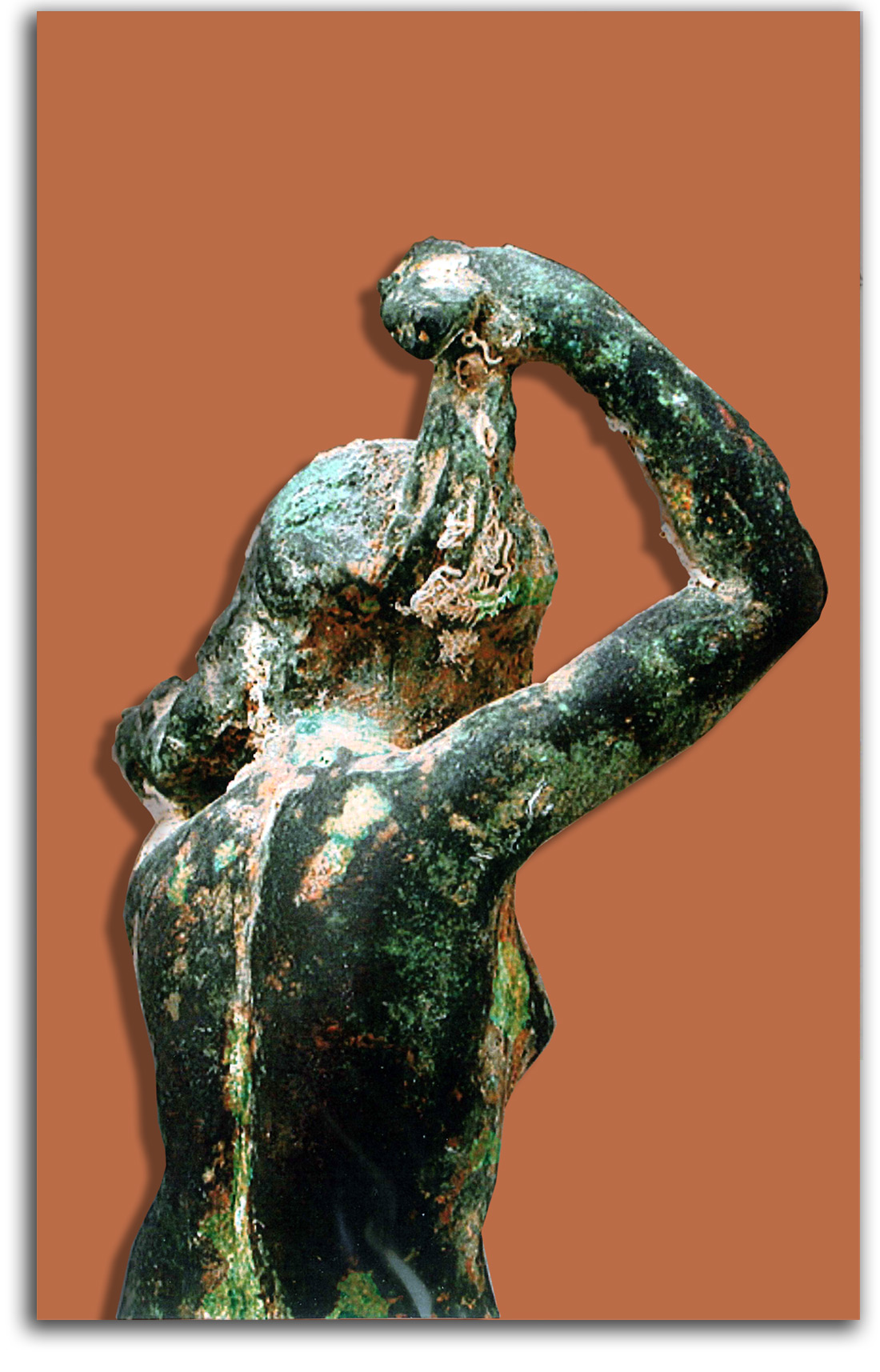
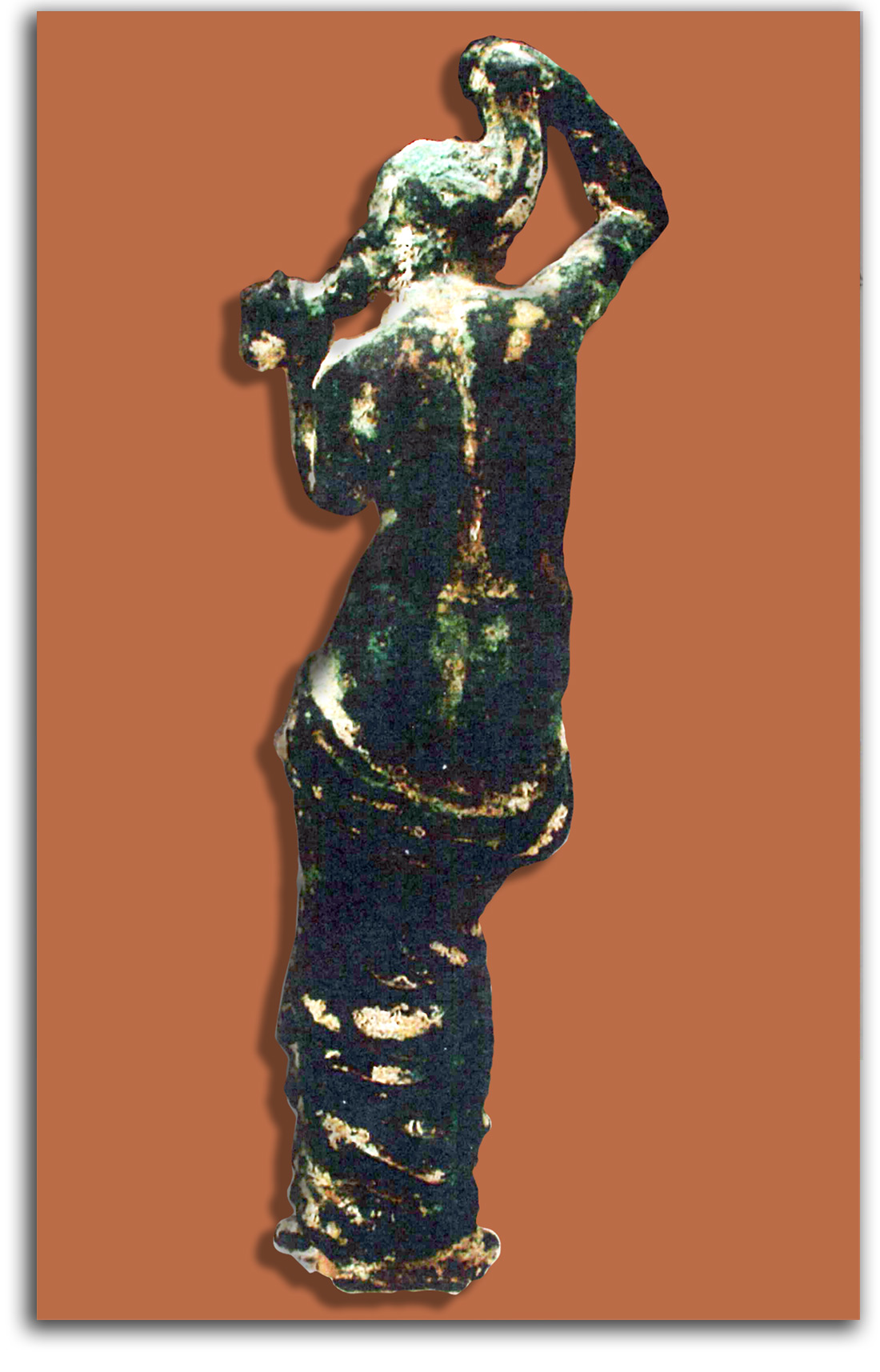
APHRODITE RISING FROM THE SEA (aka The Brentwood Aphrodite)
Conceptualization: Greek, 3rd century BCE
Realization: Greek, c.2nd century BCE
bronze (encrusted from being underwater for a long time)
Collection: FLG
Ex. Collection: Walter Daniels, San Francisco
NOTE: Aphrodite (Roman: Venus) lived at the very heart of Greek Mythology as the goddess of Beauty, Love, Sexuality, the Fertile Sea, and Vegetation. (“Where she walks flowers grow.”) Her best-known child was Eros (Roman: Cupid). One who is hit with Cupid’s “Arrow of Desire” is forced to follow that desire. Aphrodite was a late-comer to the Pantheon of Olympus, even though her myth gives her a genealogy older than that of Zeus. She probably is a transformation of the West Asia goddess Astarte who arrived in Greece, perhaps from Phoenicia, by way of Cyprus and Cytherea – the ancient centers of her cult.
The date of her arrival is still being studied, but it may have been about the time the Greeks were learning the alphabet from the Phoenicians in the 9th or 8th century BCE.
Legend has it she was born, fully grown, from the foam of the sea, foam created when the testicles of a deity fell from the sky. The Greek word for foam is aphros. She then rode to shore of a sea shell. This particular conceptualization pictures her wringing dry her hair just after emerging from the water. It is a particularly graceful image that has captured the imagination of artists and collectors for centuries.
The image seems to have originated with a statue carved in the 3rd century BCE for a temple on the island of Rhodes where a number of old replicas have been found. This design concept is one of the most enduring of classical configurations. It was copied many times by Roman artists. It also inspired many artists of the Italian Renaissance such as Botticelli and Titian, and then in the 19th century Ingres, Chassériau, and Bouguereau.
This particular version has been admired by leading authorities on Greek art, including Sir John Boardman in Oxford, Professor Andrew Stewart in Berkeley, as well as curators at the Getty Museum in Malibu, and the Metropolitan Museum of Art in New York.
Vol. 7 THE IDEALS OF GREEK SCULPTURE
a A Concise Survey of Greek Sculpture, 1998
b The Brentwood Aphrodite: An unrecorded Bronze Statuette of “Aphrodite from the Sea,” 2009
c Favorable Reports on the Attribution & Early Hellenistic Date of the Brentwood Aphrodite from Sir John Boardman, Sean Hemingway at the Metropolitan Museum of Art, Claire Lyons at the Getty Museum, & Andrew Stewart at UC/Berkeley, 2009
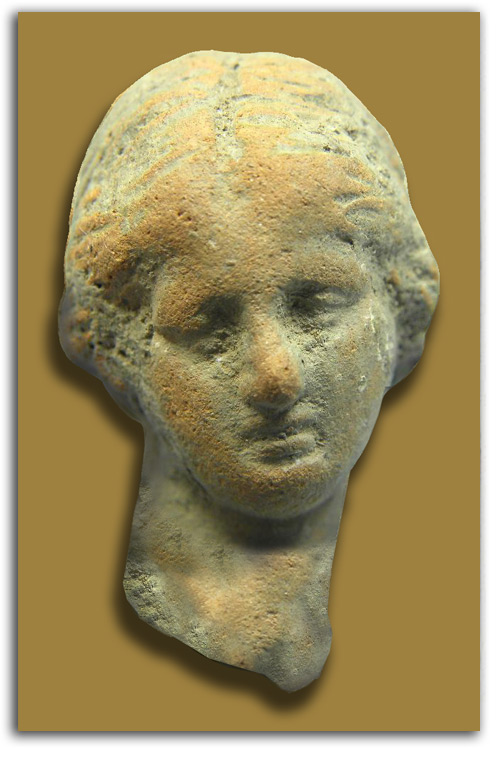
HEAD OF APHRODITE
Conceptualization: Greek, 4th century BCE
Tradition of Praxiteles
Realization: Hellenistic, ca. 300 BCE
terracotta
Collection: FLG
NOTE: This lovely head was not sculpted by Praxiteles himself, but it was made within an artistic tradition that he originated. Praxiteles (c.400-330 BCE) was the most famous Greek sculptor of the 4th century BCE. He also was one of the most influential on the subsequent history of Western sculpture. He is best known for having been the first to sculpt a life-sized figure of a female nude – probably the “Aphrodite of Knidos.” That sculpture has been lost, as have perhaps all but one of his original carvings. Nevertheless, his influence was profound. Critics celebrated him for centuries. His work was pictured on numerous Roman coins. So many full-scale Roman replicas survive that a general feeling for his remarkable style is possible. The modern world remains enchanted by his gifts of musical proportions and matchless grace. The name of no other Greek artist is more widely known. What he gave to sculpture was the gift of life. Praxiteles is a bridge between the Classical art of the Hellenic Age and Hellenistic art. The conceptual transition is from images that convey the idea of life to images that convey the actual sensation of being alive.
The primary aim of Praxiteles was reality, tactile reality. To deities who seem to have been somewhat remote in the Classical sculpture of the 5th century BCE, he humanized by means of a radical realism placed within sculpted settings of ordinary life. His figures were given a highly naturalistic pose, a sinuous S-curve and a surface as smooth as skin. His proportions are taller than the Classical canon of Polyclitus. His faces tend to be triangular, and his hair impressionistic.
Contemporary critics spoke of his surfaces as breathtakingly sensual, extremely tactile. They said it was as if these bodies could “spring to life at any moment.” Nothing like this had ever been seen before. Moreover, these marble faces and figures were polished to a level of transcendent luminosity, and his faces have a parallel serenity. This is not merely physical realism; it is metaphysical realism. His sensitivity to light was as remarkable as his sensitivity to solid structure. Each face and figure is lighted and shadowed with a sfumato that was not seen again until Leonardo.
This terracotta head of the Goddess of Love & Beauty looks back to the ideals laid down by Praxiteles. It is far from the earthly realism of Roman heads that were being sculpted at the same time. The soft realism of this Goddess is a spiritual realism. The transitions from feature to feature are as gentle as breaths. The form as a whole can almost float. It is held together by the weight of light. What we see is not merely matter but spirit-matter.
This particular head-type is illustrated in TANAGRA AND THE FIGURINES (1986, p.146) by the noted authority Reynold Higgins, Deputy Keeper of Greek & Roman Antiquities at the British Museum. Higgins observes (p.144) that: “Her oval face, with its sensuous expression, and the abundant, centrally parted hair recall the famous Knidian Aphrodite of the sculptor Praxiteles.” It is interesting that this is the only time Higgins makes a direct comparison between the great Praxiteles and the head of one of the tiny Tanagra figurines in his book. I am grateful to Professor Andrew Stewart of UC, Berkeley for his reference.
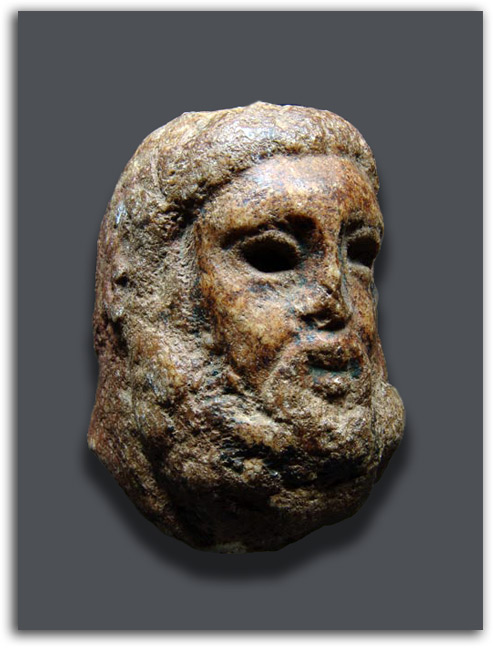
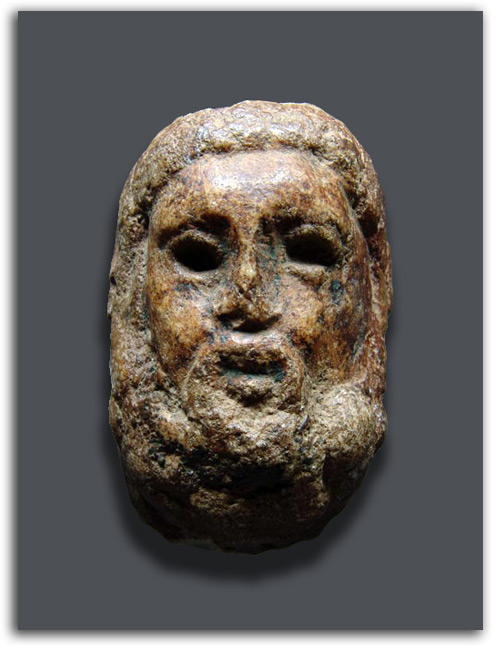
HEAD OF HERAKLES
Greek, 3rd/2nd century BCE
Tradition of Scopas
marble
Collection: FLG
NOTE: This rugged head was not carved by Scopas, but it was made within an artistic tradition that he began. Herakles (Roman: Hercules) looms large in Greek mythology. He was the only mortal man to become immortal. Scopas (c390 BCE – 350 BCE) began his work under Praxiteles. Then he moved away from that calm, gently balanced Classicism. Scopas introduced an intense emotionality to faces and figures. His characteristic style includes deeply set eyes, a slightly open mouth, and shapes that give expression to a distinctly psychological state of mind.
The Hellenistic Age, which began with the new world order generated by Alexander the Great (died 323 BCE) and the sculpture of Scopas and Lysippus in the 4th century BCE, is when the earlier tradition of generalized faces changes into individualized faces. With sculptural images of Alexander the Great, the concept of the portrait is born. Individualism becomes stronger within society as a whole. The older abstract ideal changes into personalities that hold thoughts and have feelings. Many of the greatest portraits of this period are portraits of philosophers – faces filled with thought.
A wide range of realism is practiced. For large images of deities in temples, or small images on domestic altars, the realism of form supported the realism of belief. The Greek believed their deities inhabited these sacred statues. It is no accident that most of the Greek sculpture that survives is sacred art. For the rendering of ordinary mortals, the gates were thrown open for the picturing of sadness and joy, anxiety and ecstasy, boundless energy and exhaustion – in short, for the whole spectrum of human emotion.
The heavy face and neck of this marble head speak of the legend of the strongest man on Earth, as does the very roughness of the carving. The power of this mythic person is a raw power, but a power held together by thought.
It is not surprising that this head reminds people of Michelangelo. This is the kind of ancient sculpture that actually inspired Michelangelo. From that Classical inspiration and what Michelangelo did with it came the entire history of Western sculpture from the Renaissance to Modern times.
Vol. 8 ANCIENT GREEK SCULPTURE
IN THE COLLECTION OF F. LANIER GRAHAM
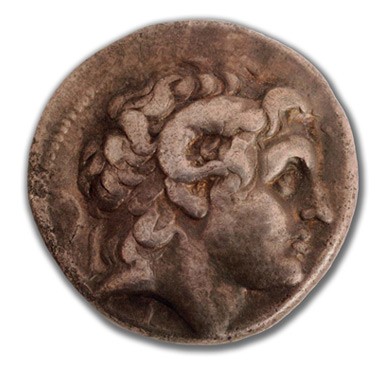
Alexander the Great, Greek. A portrait head on a coin minted by Lysimachos,
King of Macedonia & Thrace (356-323 BCE)
Silver tetradrachm. Collection: FLG & Kai Ulrich
Ex. Collection: Mr & Mrs. Sidney Cooke Lanier, Montvale Springs, TN
& Birmingham, AL; Mr & Mrs ADR Lanier, Chattanooga
Published in THE HERITAGE OF AFGHANISTAN, 2011
and in GLOBAL VISION: A SURVEY OF WORLD ART, Part 3, 2008
Vol. 9 ALEXANDER THE GREAT (356-323 BCE):
Images of Immortality
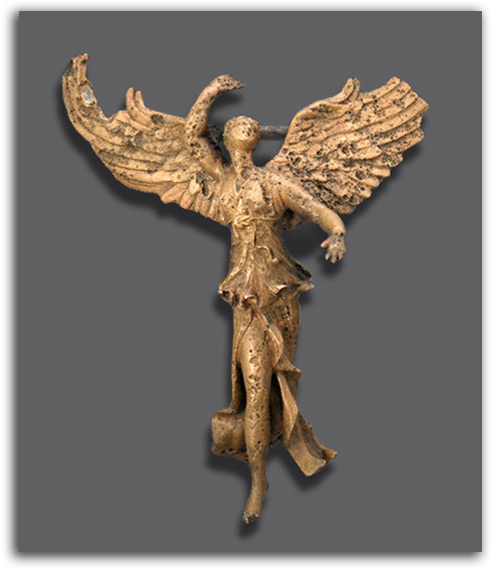
DANCING NIKE
c.1st century BCE
bronze jewelry
Collection: Unknown
Vol. 10 WINGED NIKE, Spirit of Victory
Vol. 11 MICHELANGELO & GREEK SCULPTURE
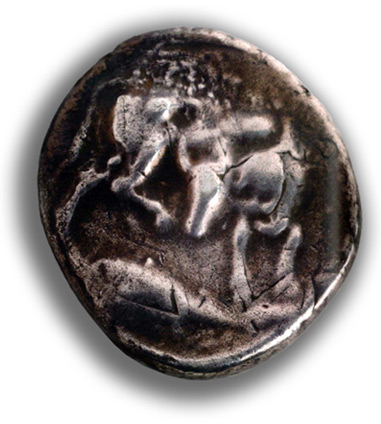
Greek silver coin from Crete. 4th century BCE
Collection: FLG on loan to IAD
Ex. Collection: Joseph Sermarini
Published in GLOBAL VISION: A SURVEY OF WORLD ART, Part 3, 2008
NOTE: Zeus is pictured here as the totemic Bull who, according to legend, united with the mortal Europa, after whom Europe was named. She (pictured on the other side of this coin) gave birth to the legendary King Minos and thus to the royal house of Minoan Crete. It was the wife of King Minos who gave birth to the famous Minotaur.
Vol. 12a ANCIENT GREEK COINS
FROM THE COLLECTION OF F. LANIER GRAHAM
1st edition, 1964
Vol. 12b ANCIENT GREEK COINS
FROM THE COLLECTION OF F. LANIER GRAHAM
2nd edition, 1999
Vol. 13 MINOAN & GREEK CHRONOLOGY:
GRAPHIC TIMELINES
Vol. 14 MINOAN & GREEK WRITING:
AN INTRODUCTION
Vol. 15 BIBLIOGRAPHY OF MINOAN & GREEK ART:
A BEGINNER’S GUIDE
Vol. 16 A SHORT HISTORY OF THE MUSEION:
THE GREEK HOUSE OF THE MUSES
APPENDIX:
NIKE: SPIRIT OF VICTORY:
An Exhibition of the Sculpted Goddess, Ancient to Modern,
from the collection of F. Lanier Graham, 2009
[What follows is a synopsis of the 2009 exhibition catalogue.
A copy is on file at the Metropolitan Museum of Art, New York.]
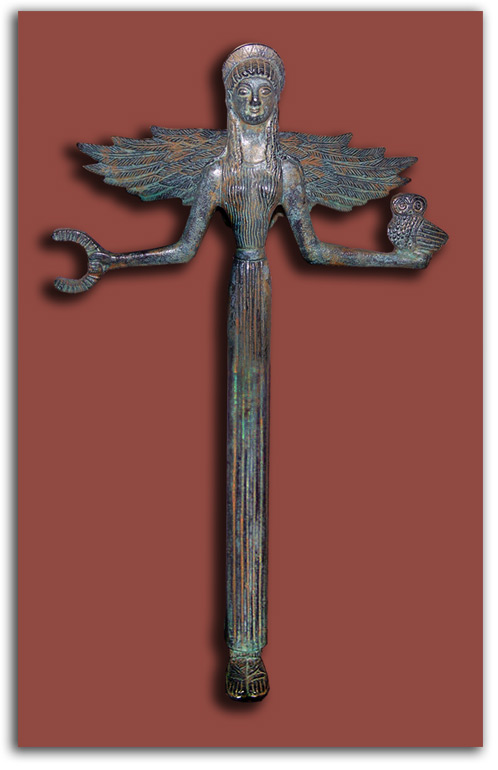
NIKE HOLDING AN OWL & A WREATH
Conceptualization: Greek, c7th/6th century BCE
Realization: Greek replica, 20th century CE
bronze
Collection: FLG
NOTE: Nike (Roman: Victoria) was a daily reality in the minds of ancient Greeks for at least a thousand years. This goddess was the spirit of victory. It was she who placed the crown-of-victory, the wreath of laurel leaves, on the heads of those who won wars and those who won Olympic games. Early legends tell of her siding with Zeus in his war against the Titians, and of driving his celestial chariot. We see her on numerous Greek and Roman coins, numerous painted vases, and as the figure in some of the most beautiful sculpture of the Hellenistic Age, from her temple on the Acropolis of Athens to the Nike of Samothrace.
All Greek deities could fly, but Nike and Hermes are pictured with wings. Their flights were special. They took messages to mortals directly from the likes of Zeus and Athena. In ancient statues of Zeus and Athena, Nike was seen standing in their hands. In more esoteric circles, Nike was regarded as the goddess who encouraged and rewarded victory in all human endeavors, up to and including victory over egotism, that ultimate psychological victory which results in wisdom. This is part of why her figure is so often seen beside that of her “big sister” Athena, goddess of war and wisdom.
Nike probably did not begin as a Greek deity. Her origins are older than Zeus. There is reason to believe she was one of a number of Minoan deities who were incorporated into the Greek pantheon from Bronze Age Crete, deities such as Poseidon – Bull god of the sea – and the Earth Goddess who lived with the Great Python of Delphi until Apollo took over that sanctuary when the Dorian Greeks conquered the Mycenaeans around the time of the Trojan War, perhaps 3,000 years ago.
Nike also has been the goddess most often pictured in the Euro-American art of the 19th & 20th centuries. She is prominent in the public statuary of most Western nations. She dominated the World War I victory medals of all the Allied Nations. No figure appears more often in the 20th century coinage of Europe and the United States. Moreover, the medals of the Olympics still celebrate her dynamic image.
This particular figure comes from the early, so-called “archaic” period of Greek sculpture, as Greek artists were just emerging from the Dark Ages when the figures pictured on vases were little more than the kind of stick-figures that children draw. After a long period of economic and artistic poverty, and the loss of literacy, it was a time when the people were just beginning to read again and to picture their deities with a renewed conviction. Compared with the famous Greek naturalism that quite suddenly emerged over the following two centuries, archaic figures such as this Nike are indeed “primitive.” Nevertheless, there is a good deal of artistic power in her compressed strength and thrusting verticality. She holds the Wreath of Victory (broken), and Owl of Wisdom.
The most famous large modern statues of Nike (all of them bathed in the color of gold) include the very early Nike driving her four-horse chariot on top of the Brandenburg Gate in Berlin (c.1788), the Queen Victoria Monument in front of Buckingham Palace in London (1911), Athena holding Nike in front of Parliament House in Vienna (1902), and the Sherman Monument in Grand Army Plaza in New York City where Nike leads the general to Victory and Peace (1903).
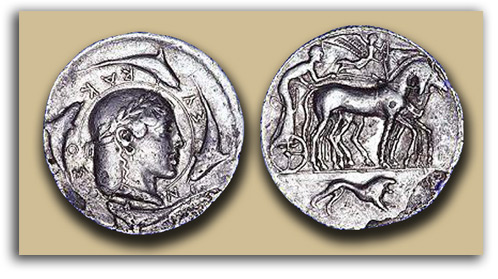
NIKE FLYING OVER A WARRIOR
Silver Decadrachm, attributed to Damareteion. c.465 BCE
Replica. Struck in Syracuse, Sicily (Greater Greece)
Collection: FLG
NOTE: This famous coin was created in the outer regions of Greater Greece about 465 BCE. This period was the height of the Classical Age when the Parthenon was being built in Athens. But the coins being struck in Athens at that time were still quite “archaic” in style. The so-called “Demareteion Master” may have been trained in Athens, but he worked in Syracuse. He carved this coin in a highly innovative style that moved Greek coinage away from its stiff “archaic” past toward a new level of dynamic realism. Within a short time, the next generation of masters in Syracuse created some of the most beautiful coins ever made anywhere. On the obverse of this coin is a bust of a female deity surrounded by dolphins which were common in this region at that time. On the reverse is Nike flying over a warrior who is driving a chariot led by four horses. The perspective and figure style is still rather primitive, but a new kind of energy is filling the field and animating the bodies. The identity of the goddess is not certain. Some think she is Nike wearing her famous Wreath of Victory that she later gave to others. Some think she is Persephone who personified Spring. The prevailing opinion at this time is that she is a water nymph called Arethusa, a chaste attendant of Artemis (Roman: Diana), who was personified as an ever-flowing spring on the Island of Sicily.
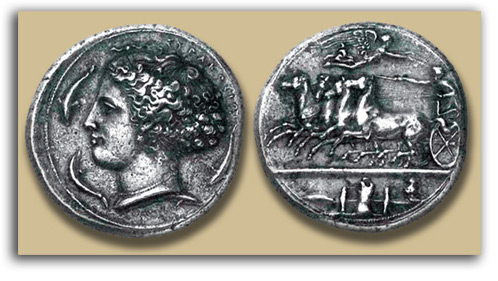
NIKE CROWNING A WARRIOR
Silver Decadrachm, signed by Kimon. 413 BCE
Replica. Struck in Syracuse, Sicily (Greater Greece)
Collection: FLG
NOTE: This magnificent carving is considered by many to be the most beautiful coin ever made in ancient Greece. It is one of the reasons coin collectors argue that some Greek coins can hold their own as artistic objects along side larger Greek sculptures of the same era. On the obverse of this coin is a bust of a female deity surrounded by dolphins. On the reverse is Nike crowning a victorious warrior who is driving a chariot led by four horses. True perspective has developed. Inside of this new kind of artistic space, the stiff animals on the Demareteion coin have sprung to life!
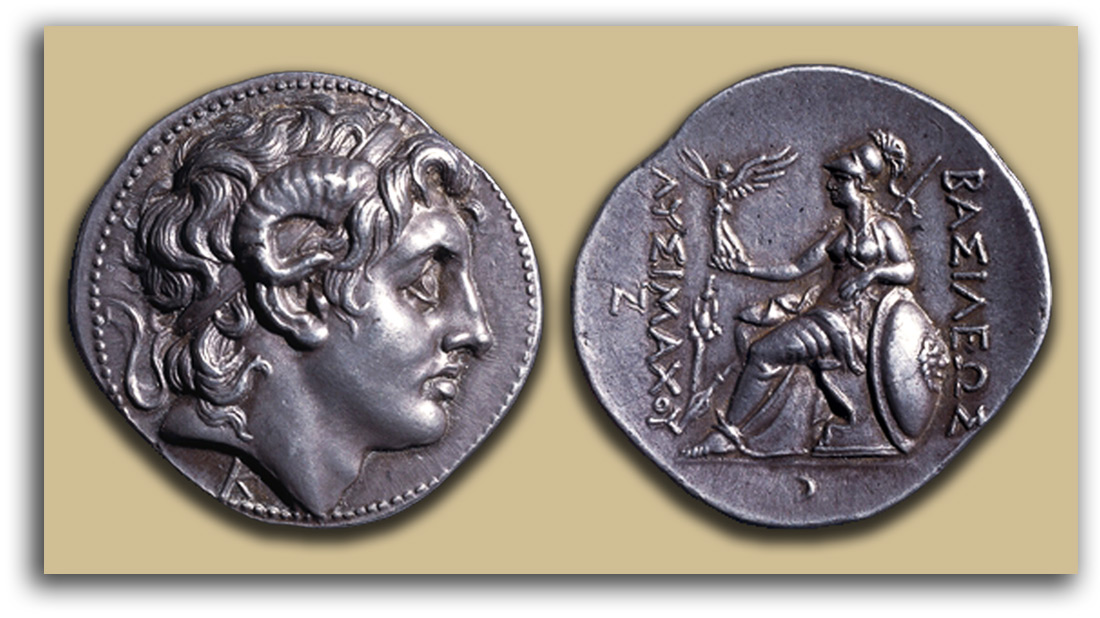
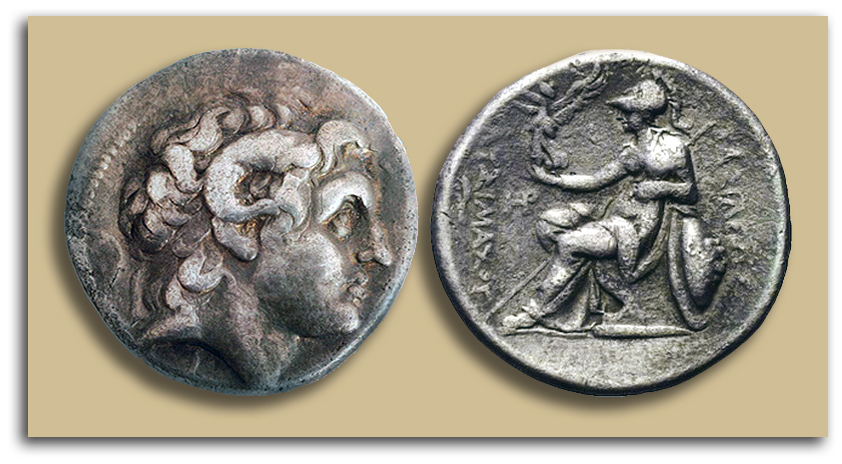
NIKE BEING HELD BY ATHENA
Silver Tetradrachem. 4th century BCE
Minted by Lysimachos, King of Macedonia & Thrace (362-282 BCE)
Collection: FLG
NOTE: The coin illustrated above (top) (from the famous collection of the British Museum) is in exceptional condition. One can see the tiny Nike in great detail. The coin illustrated below (bottom image, above) is from the Greek collection I inherited from my grandparents and great grandparents. Being much more worn, this image of Nike is less detailed. Nevertheless, the coin retains the powerful presence of authenticity. I have used it as a teaching aid in all my World Art classes since the 1990s. When it gets passed around the class, the students feel the thrill of actually touching history.
On the obverse is the head of Alexander the Great. It is thought to be a close portrait, even though the coin was struck after his death. This king knew Alexander well. He served in his army and then succeeded him on the throne of their native land. The horns on Alexander’s head symbolize that in Egypt he was officially pronounced a god, the personification of Amun Ra whose totem was the ram. On the reverse sits Athena holding Nike in her hand, just as Athena did on her gigantic statue inside the Parthenon of Athens. While the coin of Kimon is widely considered to be the most beautiful Greek coin that features a female face, this coin is widely considered the most beautiful Greek coin that features a male face.
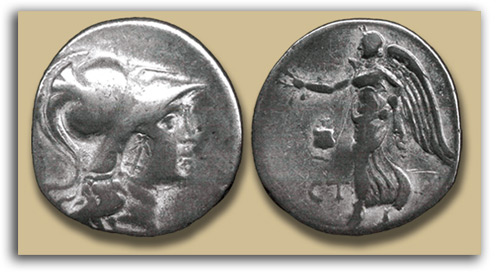
NIKE WALKING WITH A WREATH & A POMEGRANTE
Silver Tetradrachm c.300 BCE
Minted in Pamphylia (Turkey)
Collection: FLG
NOTE: On the obverse is Athena in a crested Corinthian helmet. Her face has been countermarked with an anchor. This mark was a personal symbol of the Seleukid kings of Syria. It either validated such coins for circulation in Syria, or shows it had been accepted as a religious offering. On the reverse, Nike strides forward holding a wreath, under which floats a pomegranate. The artist had made an elegant visual “echo” between the richly carved wings and the flowing of her garment caught by the air. This is one of the better Greek coin designs from this region. Later Roman copies are quite poorly cut. The large heavy wings given to Nike in coins such as this one, minted between about 400 and 300 BCE, anticipate the huge wings of the famous “Nike of Samothrace.”
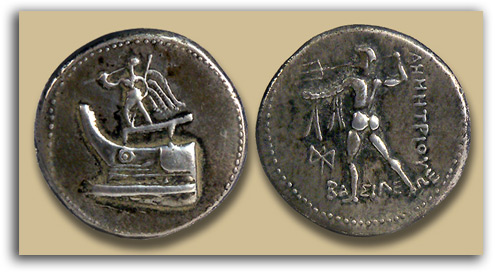
NIKE LANDING ON THE PROW OF A SHIP
Silver Tetradrachm. 294-288 BCE
Minted by Demetrios Poliorketes, King of Macedonia (306-283 BCE)
Collection: FLG
NOTE: On the obverse is Nike alighting on the prow of a ship. It was this coin that guided the curators during their installation of the “Nike of Samothrace” at the top of the grand staircase in the Louvre where she became the most widely admired of all Greek statues after the “Venus de Milo.” On the reverse is Poseidon with a trident.
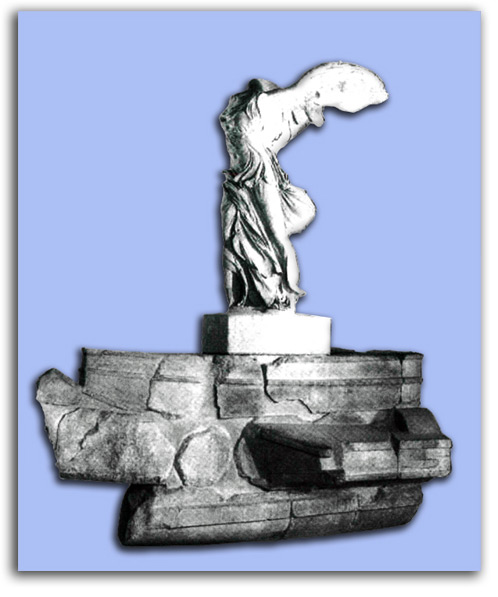
NIKE IN THE LOUVRE
NOTE: When this most famous of all Nike statues was discovered on the Greek island of Samothrace in 1863 it was not clear how it related to the architectural elements found with the statue. It was a close examination of the coin previously illustrated that provided the clue: She probably was commissioned to celebrate a sea battle (see previous image).
She stood almost 11 feet high, in a temple where she was pictured as alighting on the bow of a victorious ship. Her powerful wings, having activated the space around her, are beginning to relax and fold. Her clothing is still billowing in the wind. She appears within a divine moment, when human awareness is touched by the Transcendent. Many think there has never been a more beautiful image of spirit swirled into matter, the infinite fluidity of heavenly grace descending into earthly motion.
The date of the statue is still being debated. It could be as early as about 295 BCE (when General Poliorketes won at sea battle at Cyprus) or perhaps as late as 180 BCE. Samothrace was a Macedonian colony. This monumental presence, 328 cm (almost 11 feet high), has been on view in The Louvre since 1884. A replica stands on Samothrace.
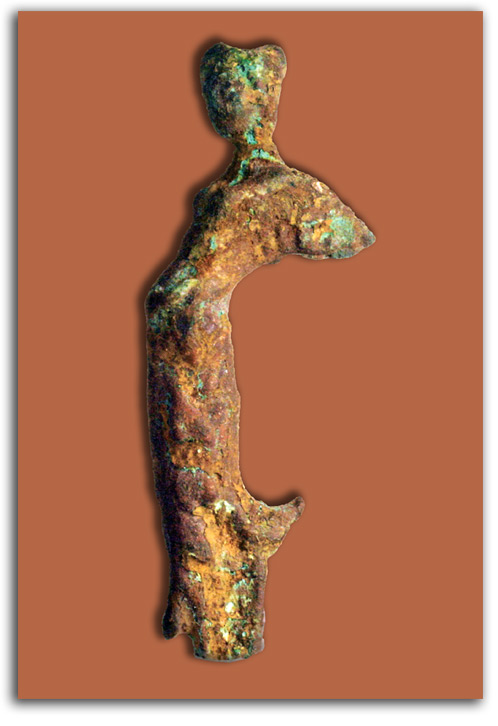
NIKE LANDING
c.2nd/1st century BCE
bronze
Collection: FLG on loan to IAD
Ex. Collection: David A. J. Liebert, New York
NOTE: The dynamic form of her torso is reminiscent of the dynamic energy of the world-famous Nike of Samothrace which was sculpted about the same time. Both appear to be landing from a celestial flight. It is remarkable how much presence has been compressed into this tiny bronze which is just over one inch high. Many think that the artistic quality of Greek coins has never been surpassed. This is also true for the small-scale sculpture of the Greek masters.
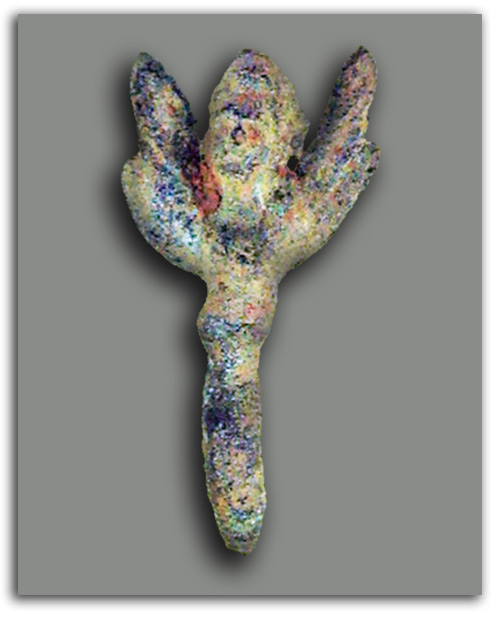
NIKE WITH UPRAISED WINGS
Greco-Roman. c.1st century BCE – 1st century CE
bronze
Collection: FLG
NOTE: Small figurines of this size (1.25 inches tall) usually were for domestic shrines. Time has melted away most of this figure. There is hardly anything left of this particular bronze, except her spirit. That would have been enough for a faithful follower to feel the presence of the goddess. The Greeks believed all their deities were immortal. Indeed, Nike did not die. She lived long enough to enter the modern world after a cultural transformation. Nike continued for centuries to be an important spiritual reality in Rome, where she was known as Victoria. When the early Christians in Rome were seeking an image to pictorialize their angels (who had not been visualized in the Bible), they adopted Winged Nike as a form that is inherently transcendent.
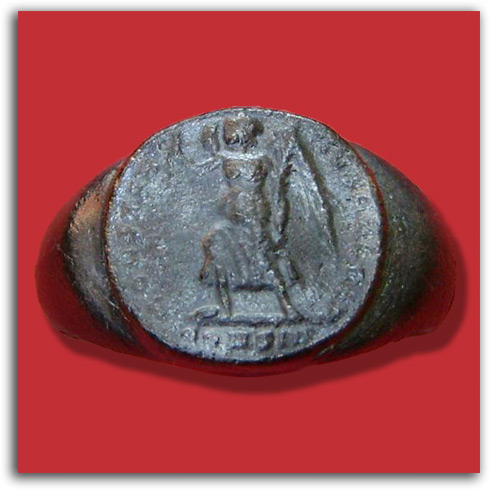
ADVANCING NIKE
Roman ring worn by soldiers
c.2nd/3rd century CE
bronze
Collection: FLG
Rome adopted Nike with such enthusiasm that she (by the name of Victoria), protected the Senate, appeared on many coins, had many temples in the Empire, and a huge body of followers among the soldiers. Nike in Greece had only awarded the wreath of Victory. In Greece, Nike did not decide the outcome of a battle, she only awarded the Wreath of Victory. The actual decision would have been made by Zeus or Athena, and then communicated to earth by Nike. In the Roman mind, Victoria actually determined who would win a battle.
It is this Imperial vision of victory that was reborn in the monumental sculpture of Imperialist Europe and the United States in the late 19th and early 20th century. These very large public statements are powerful national self-images. The most famous large modern statues of Nike (all of them bathed in the color of gold) include the very early Nike driving her four-horse chariot on top of the Brandenburg Gate in Berlin (c.1788), the Queen Victoria Monument in front of Buckingham Palace in London (1911), Athena holding Nike in front of Parliament House in Vienna (1902), and the Sherman Monument in Grand Army Plaza in New York City where Nike leads the general to Victory and Peace (1903).
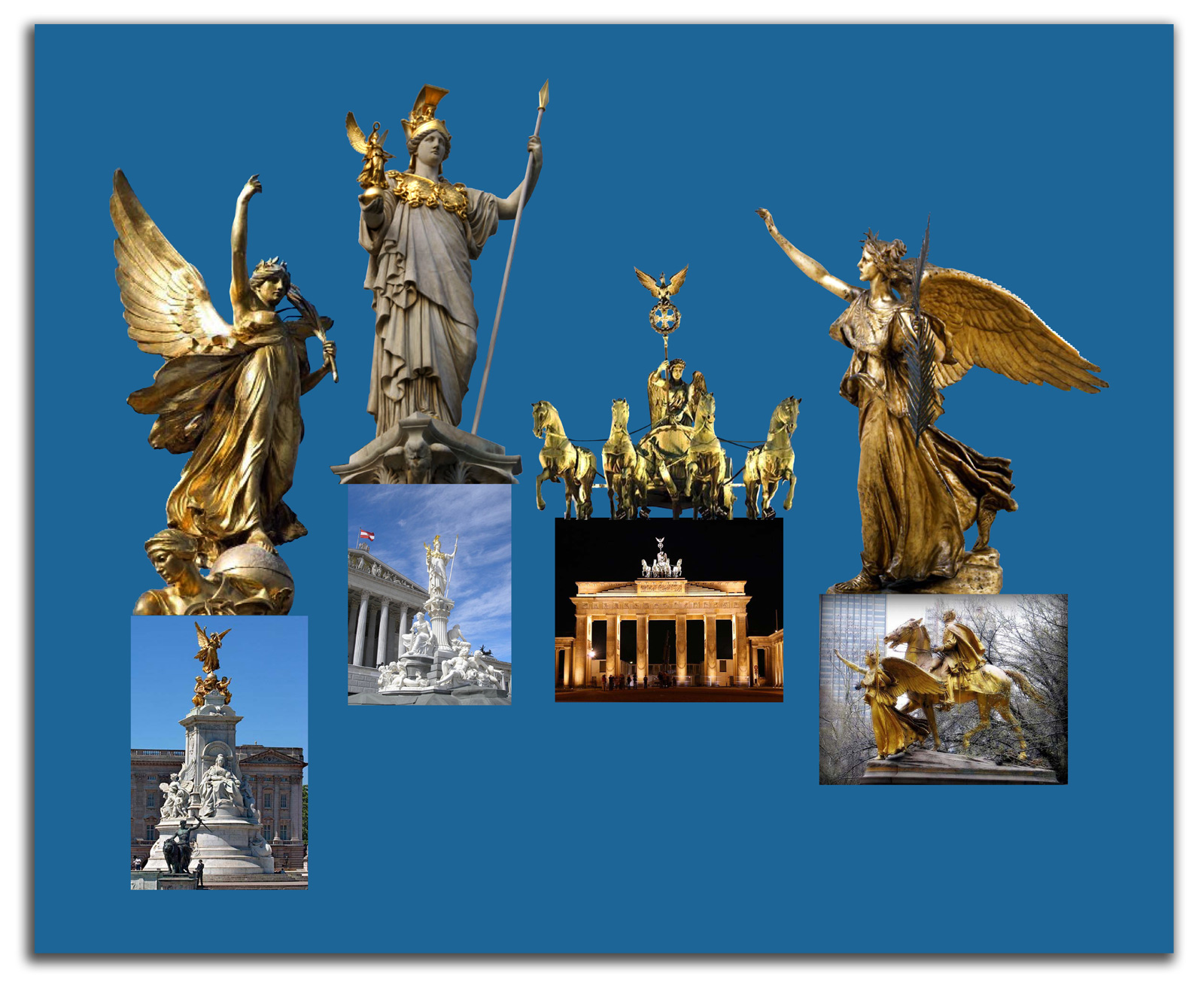
VIEW OF 4 NIKES
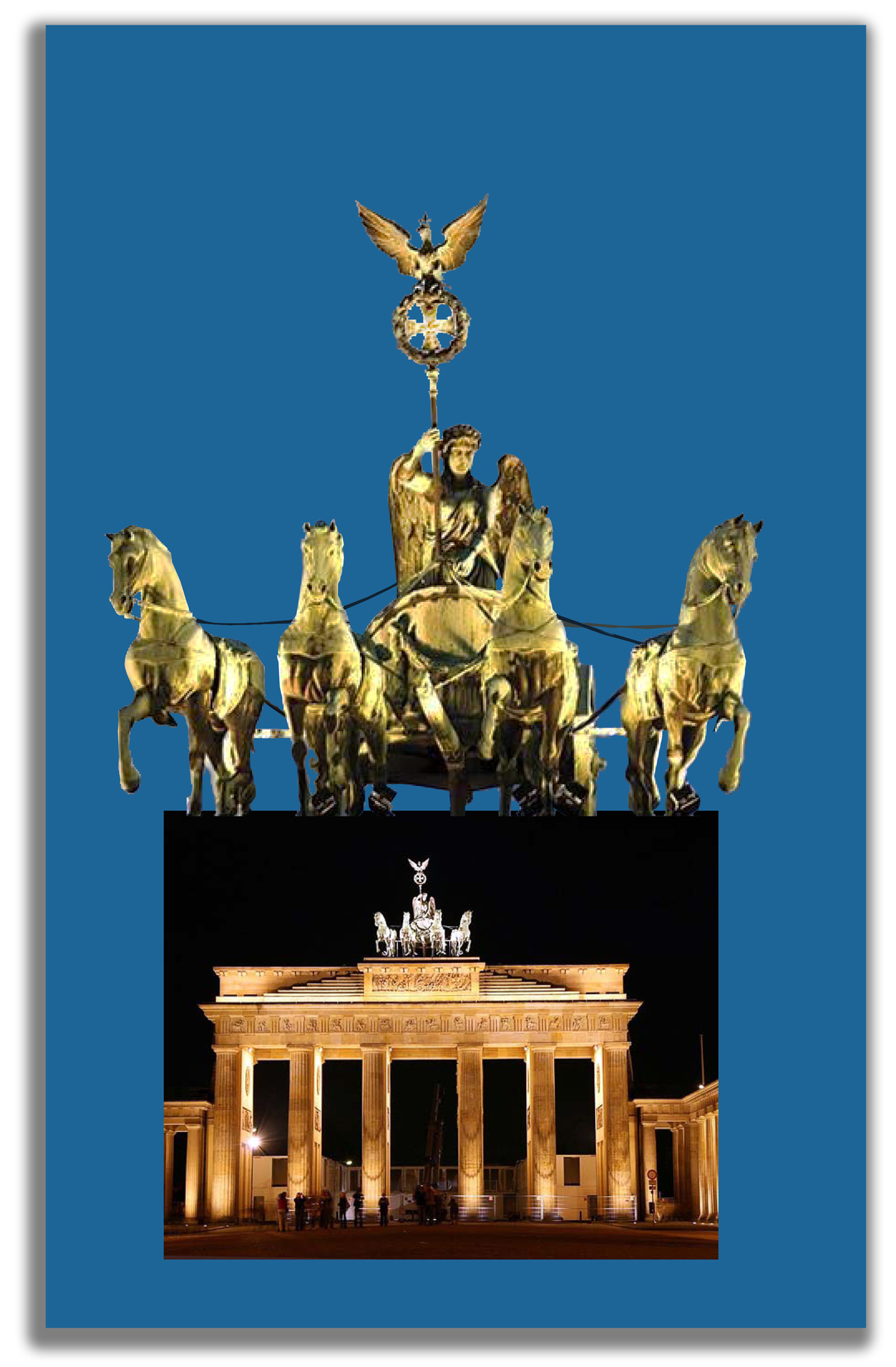
BERLIN
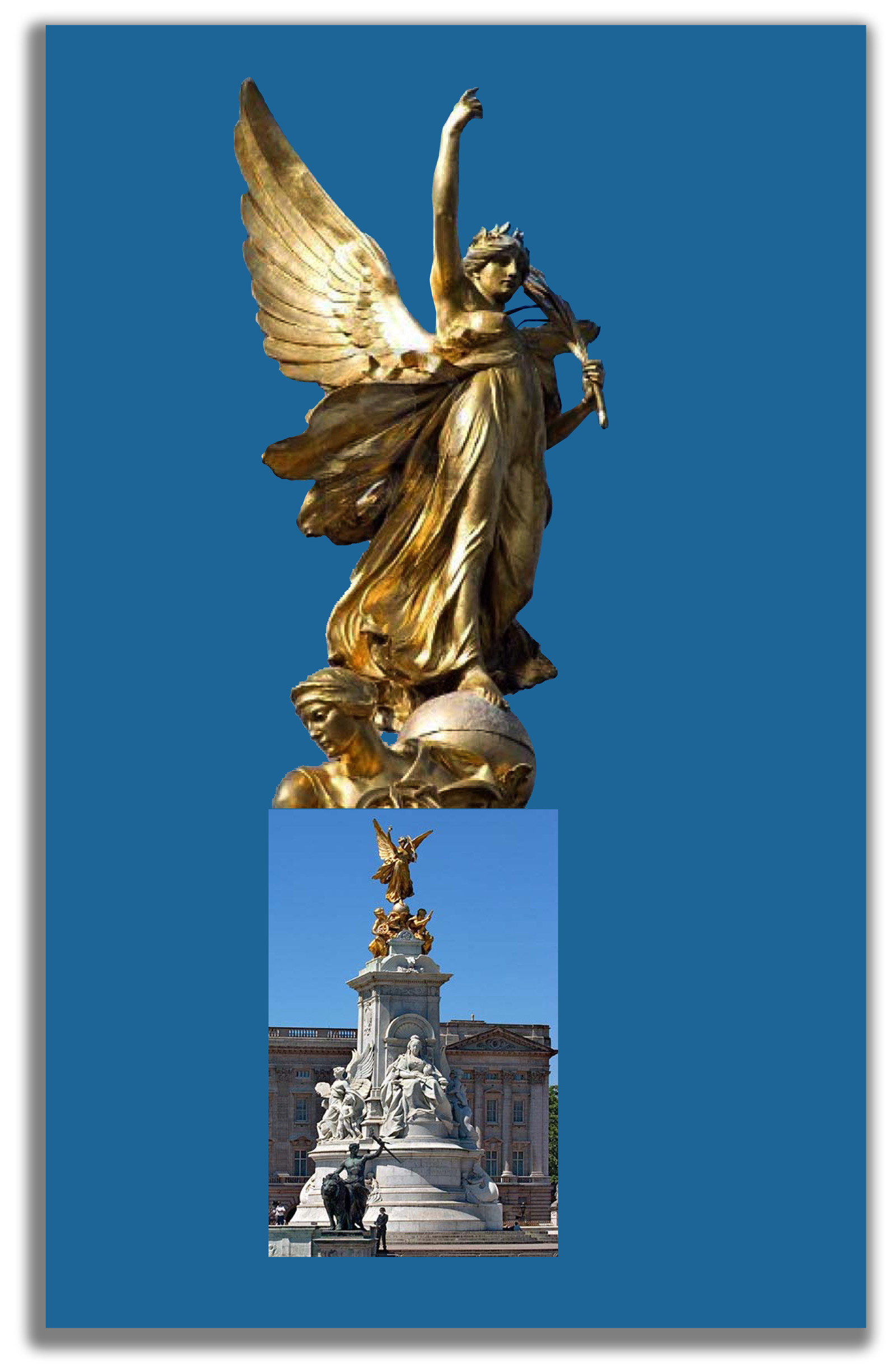
LONDON
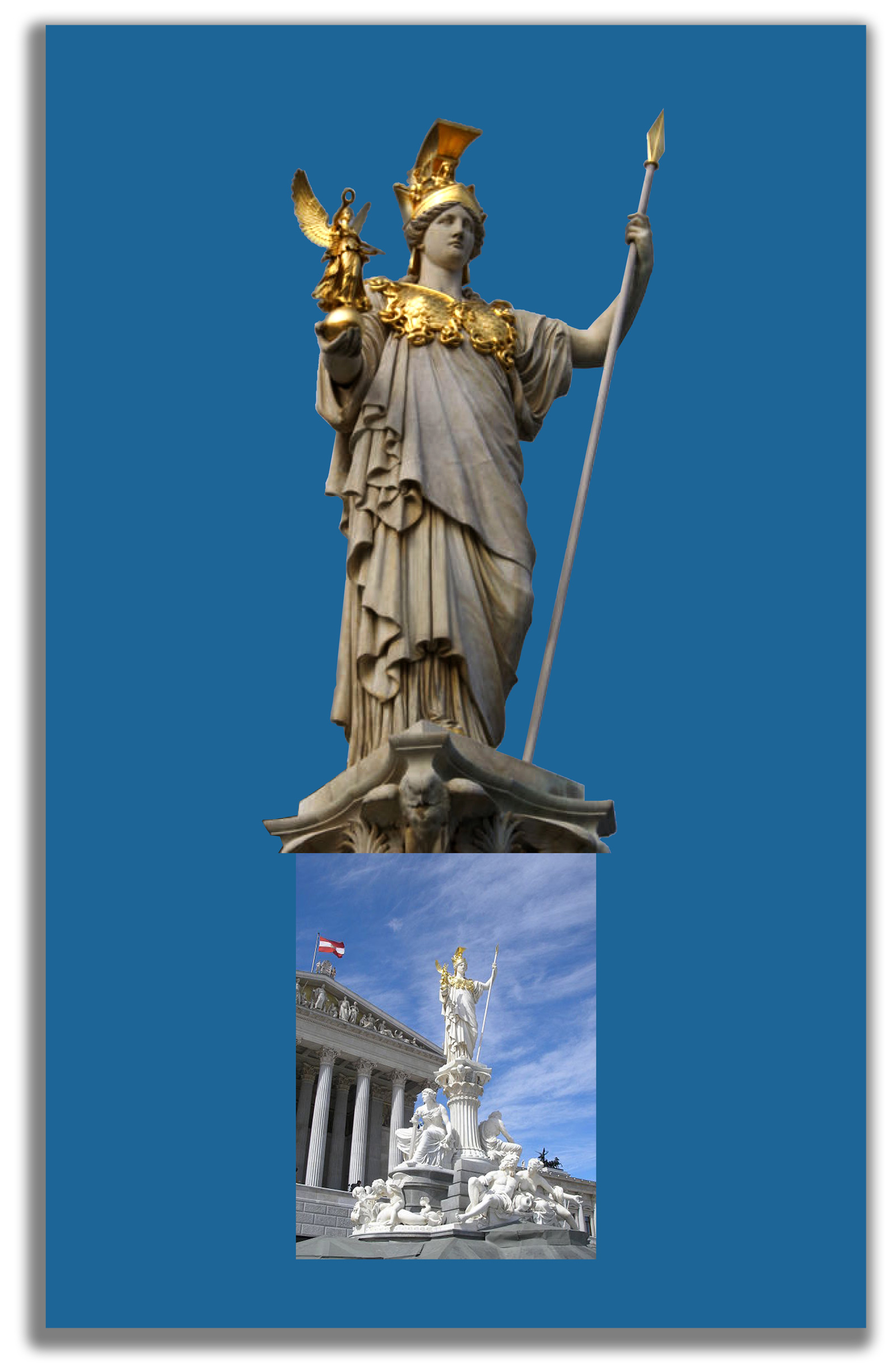
VIENNA
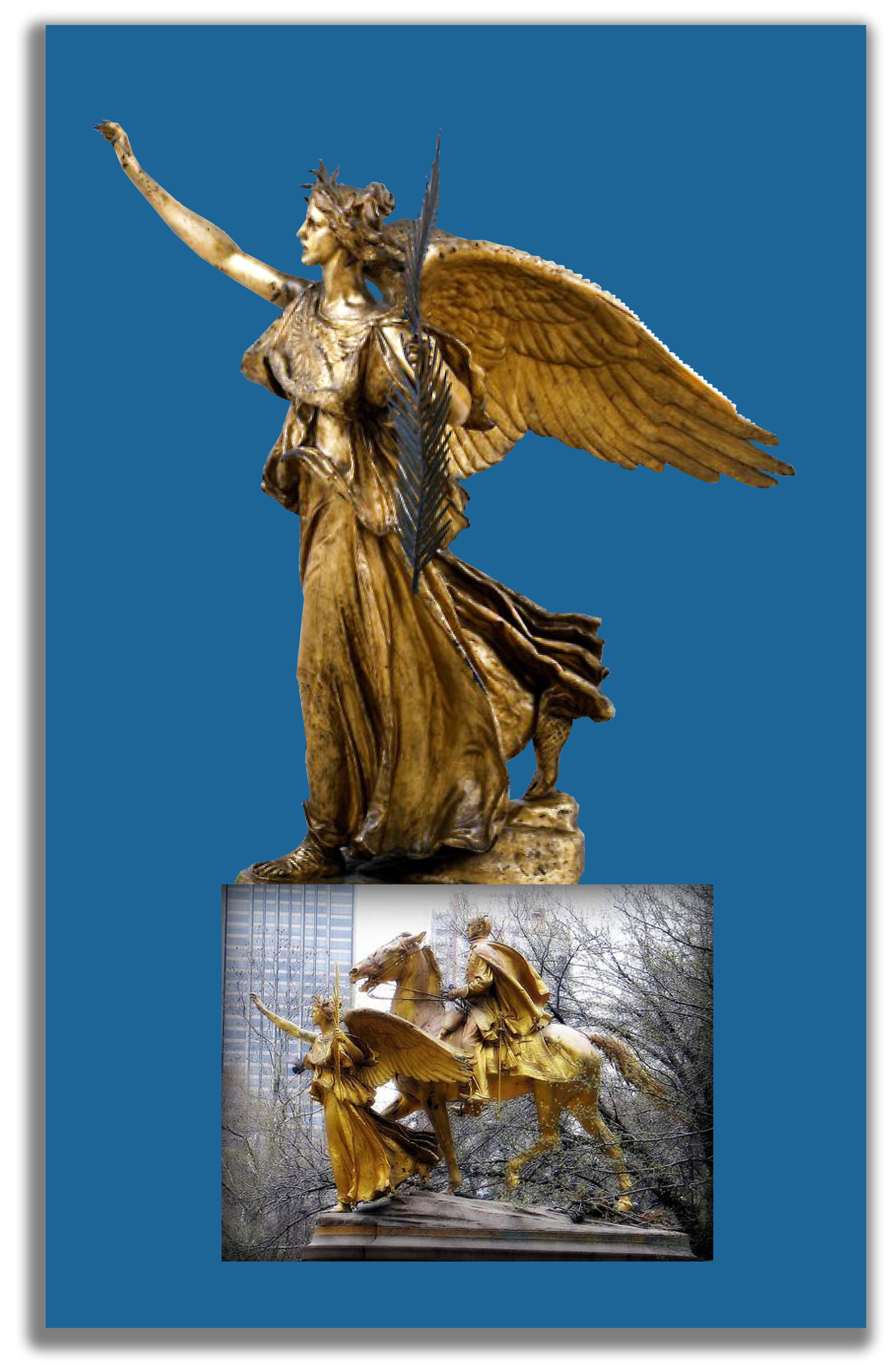
NEW YORK CITY
Nike continued to be the very vision of victory at the end of World War I and World War II. World War I Victory Medals with variations of the Nike image were produced by Great Britain [for the UK as well as Canada, Australia, New Zealand, and the Empire of India], Belgium, Czechoslovakia (Serbia), France, Greece, Italy, Portugal and Romania, as well as Brazil, Cuba, the Union of South Africa, and the United States. World War I Victory medals with Asian images rather than Nike images were produced by Japan, China, and Siam (now Thailand). In 1919, when it came time to design a medal to celebrate the allied victory at the end of World War I (1914-1918), all the Allied Nations of Europe, North America, and South America agreed to put Nike on the front of each of their national medals. In 1946, the allied victory medals of World War II (1939-1945) were made as a variation of the World War I medal. In short, millions of service men and women in Europe, North America, and Australia wore Nike medals during the 20th century.
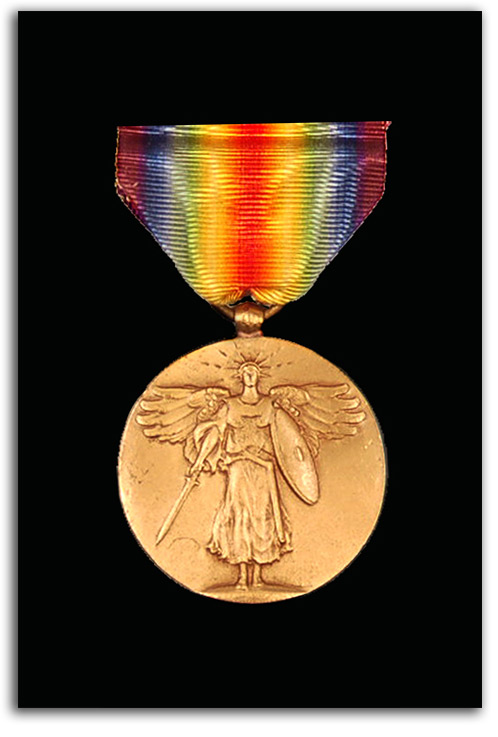
WORLD WAR I VICTORY MEDAL
United States. Design by James Earl Fraser. 1919
bronze with a Double Rainbow Ribbon
Collection: FLG
Ex. Collection: Rev. Thomas E. Graham, Oklahoma City
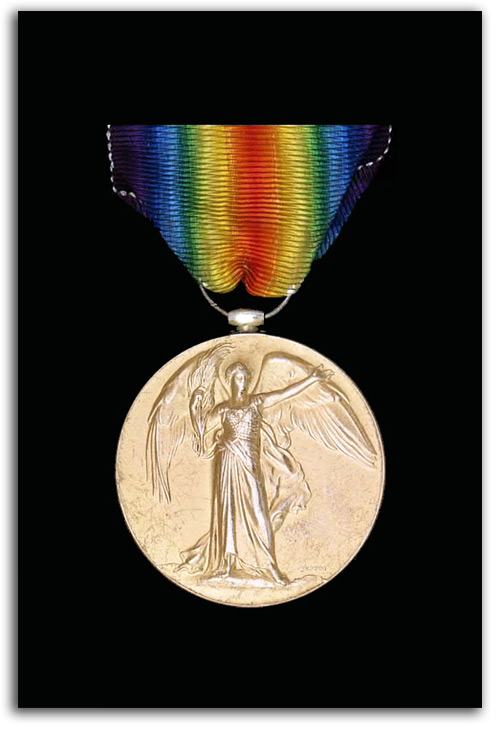
WORLD WAR I VICTORY MEDAL
Great Britain. Design by William McMillan. 1919
bronze with Double Rainbow Ribbon
Collection: FLG
Ex. Collection: Rev. Thomas E. Graham, Oklahoma City
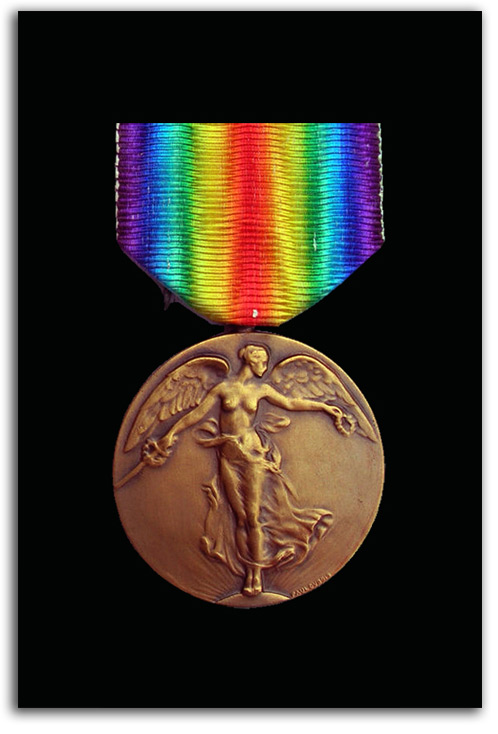
WORLD WAR I VICTORY MEDAL
Belgium. Design by Paul Du Bois. 1919
bronze with Double Rainbow Ribbon
Collection: FLG
Ex. Collection: Rev. Thomas E. Graham, Oklahoma City
In the world of Peaceful Warriors, athletic and academic winners of all ages also have proudly held images of Nike in their hands throughout the 20th century. Golden trophies of Winged Nikes have been in the homes of millions of high school heroes. Moreover, adult athletes from around the world have worn (and still wear) the summer Olympic medals that proudly feature a Greek image of the Greek goddess who has never died.
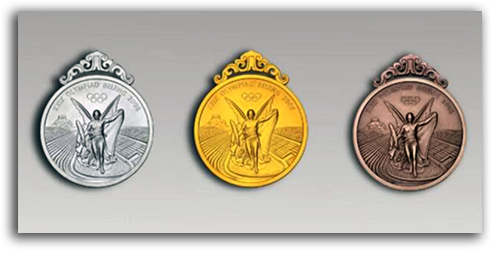
Olympic Medals from Bejing 2008 (replicas)
Chinese
silver, gold, & bronze
Collection: FLG
NOTE: The medals of the summer Olympics always feature Nike in honor of the fact that the tradition of the Olympic Games began in Greece centuries ago. Parts of the original stadium in the city of Olympia have survived from the 8th century BCE. The cities that host the winter Olympics are free to produce whatever design they like. The quality of those winter designs has varied widely.
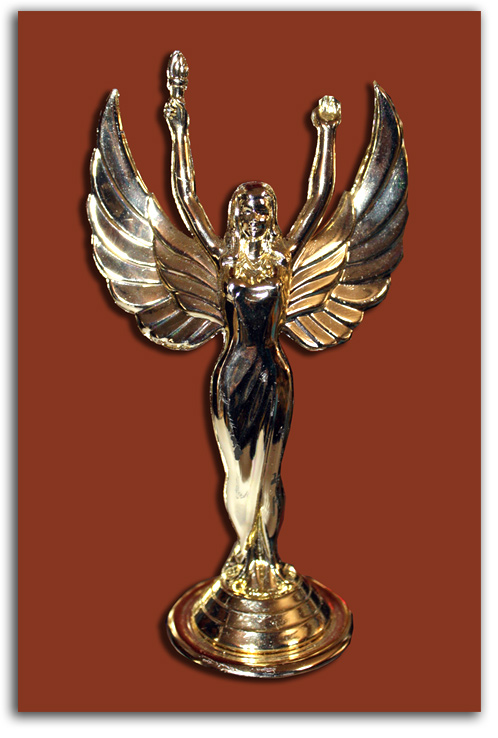
Standard commercial Victory Trophy
still often awarded in high schools.
Mid 20th century. American.
gold tone
ADDENDA: The largest Nike statues in Rome are on top of the gigantic King Vittorio Emanuelle II Monument at the Piazza Venezia that was built of pure marble to celebrate the unification of Italy. It is also known as Altar of the Motherland. It was begun in 1885, dedicated in 1911, and completed in 1935. The design of this medallion appears to be based on one of those Nike statues. Alternatively, the dynamic design of this medallion could relate to the Nike (Victory) on top of the early 19th century Marble Arch in London. Both of the large Italian and English sculptural compositions may go back to the top of the Brandenburg Gate, which in turn, derives from Greek coins.
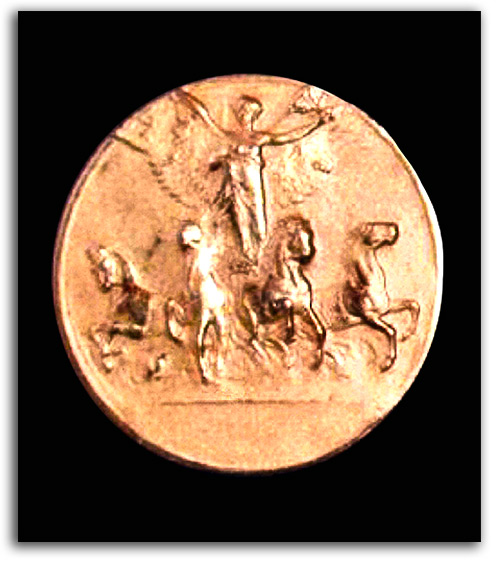
NIKE MEDALLION Italian or English?
19th/20th century. {Collected in Florence, c.1946-47}
gold
Collection: FLG
VISIONS OF VICTORY:
The Sculpted Nikes of Augustus Saint-Gaudens, 2009
[What follows is a synopsis of the 2009 exhibition catalogue.
A copy is on file at the Metropolitan Museum of Art, New York.]
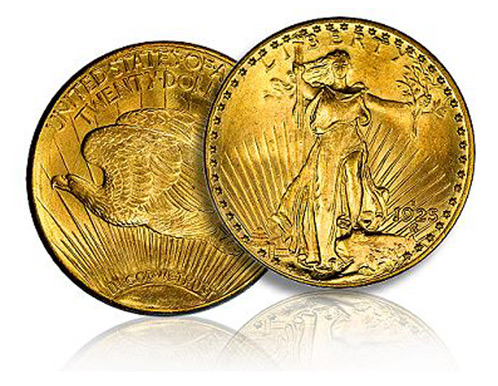
20-DOLLAR DOUBLE-EAGLE
American. Designed by Augustus Saint-Gaudens
1906 (signed with initials). Minted 1925
gold
Collection: FLG
NOTE: This gold coin is widely regarded as the most beautiful ever made in the United States. It was commissioned by Theodore Roosevelt, and minted from 1907 to 1933. The design started in the mind of the sculptor as Nike and ended as Liberty. This was the final masterpiece of Saint-Gaudens. He was dying of cancer and passed away shortly before production. The point-of-departure for this coin was the recently completed Sherman Monument. In other words, the design of the figure on this coin started as Nike and ended as Liberty. It is the supernatural energy of both figures that moves their bodies against the wind with such vitality. Nike also was the starting point for other particularly beautiful heads. The same is true for other particularly beautiful heads from the era of the Beaux-Art style, heads carved by coin artists working under the inspiration of St. Gaudens and the legendary coins of ancient Greece. Fine American examples include as the Peace Dollar (minted between 1924 and 1935), which celebrated the end of World War I, and the Winged Liberty Dime (falsely called the Mercury Dime) which was produced from 1916 to 1945. In other words, miniature bas-relief sculptures of Nike, in one form or another, were carried by millions of Americans for most of the 20th century.
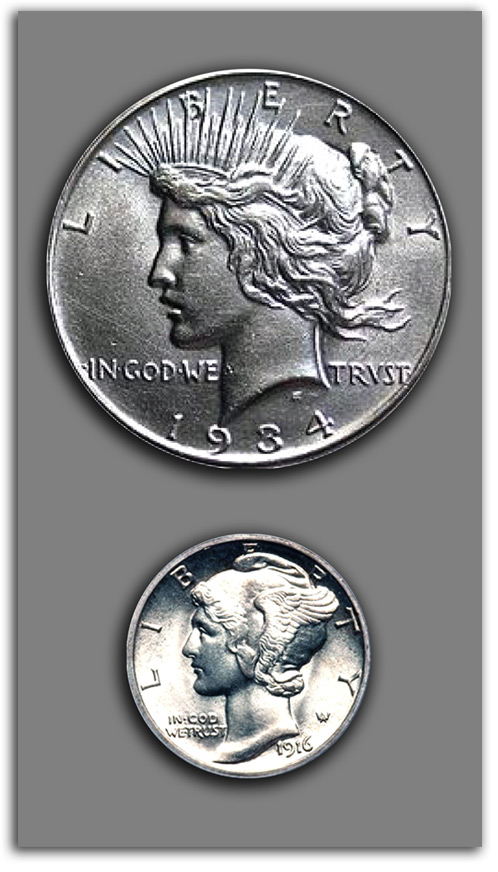
PEACE DOLLAR. American. Designed 1921
(signed with initials) silver. Minted 1934
Collection: FLG. Ex. Collection: Mrs. ADR Lanier
WINGED LIBERTY DIME. American. Designed 1916
(signed with initials) silver. Minted 1916
Collection: FLG. Ex. Collection: Mrs. ADR Lanier
Edited 2009