
THE WORLD OF THE RENAISSANCE PORTRAIT:
An Introduction
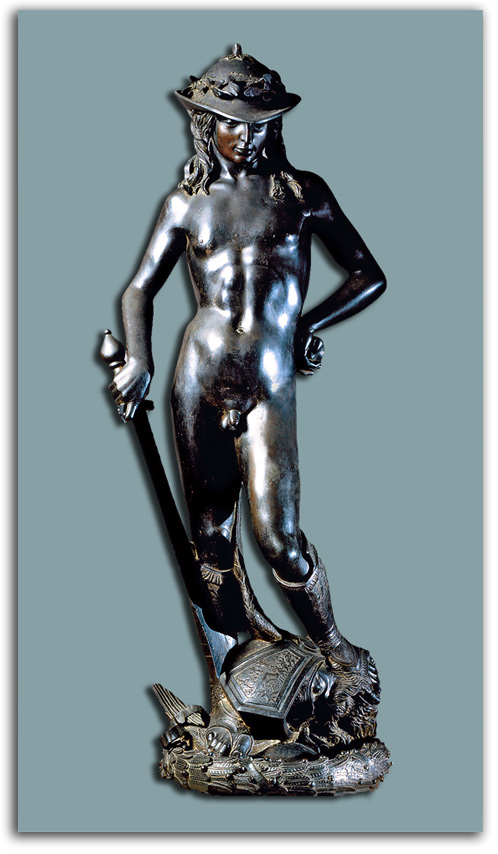
DONATELLO
DAVID
Conceptualization of this bronze & its first casting: Italy, c.1430s-1440s
Realization of this reduction: Europe, c.18th/19th century
Bronze
Collection: FLG on loan to IAD
NOTE: Donatello (c.1386-1466) was the most important European sculptor of the Early Renaissance. If the challenge were to select a single art of art to represent the birth of the Humanist spirit in the early 15th century, many would choose Donatello’s “David.” Until this moment in the history of painting and sculpture, figures (whether saints or wealthy patrons) were rendered as secondary realities within a larger context. They might be tiny figures in a painting of the Crucifixion, or small figures on a wall-sized story from the Bible, but they never stood alone. Over the centuries, these human images grew larger, as ideas of self importance grew. “David” exploded in sculptural space at the climax of this Humanistic tendency, a tendency that did not replace Christianity but rather gave to the life of human beings on earth a new respect. Medieval people tended to regard life on earth as little more than passing time in “God’s waiting room.” Their focus was on Heaven. Their visual art focused on the golden, infinitely luminous Other World. Renaissance people tended to regard life on earth as a place to experience the fullness of their humanity under the inspiration of both Christian values and Ancient values. Their visual art focused on This World. During the first half of the 15th century, this new desire for naturalism came to be structured inside a visual field called linear perspective. This way of picturing This World was a brilliant intellectual invention that made a painting or a sculpted relief function like a window through which individuals perceived This Life. Multi-point perspective expresses the group-vision of a medieval community. Single-point perspective is an individual’s way of looking at the world. This way of thinking and seeing was a revolution on consciousness. What I have termed “Institutionalized Individualism” also manifested in music as monody, in economics as capitalism, in politics as nationalism, and in religion as Protestantism. Standing over the head of Goliath, “David” is the first statue since the time of Greece and Rome to stand on its own (away from any wall, apart from any context) as a strong, proud, independent individual. No work of the period gives more vivid expression to the Individualism at the heart of the Renaissance spirit. Countless reductions of this famous statue have been made over the last 500 years, but few have been as close to the original as this remarkable bronze.
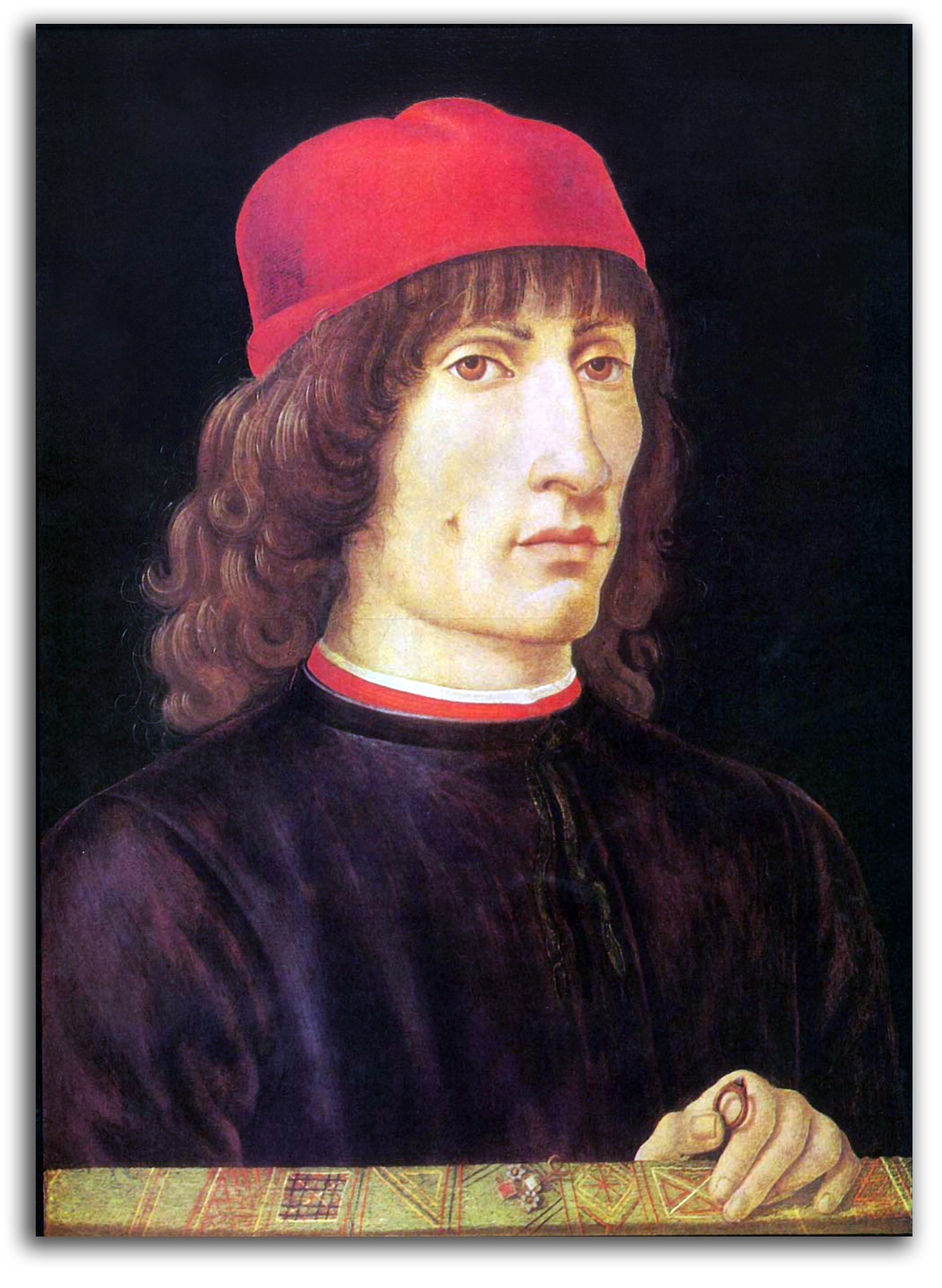
BOTTICELLI [?]
PORTRAIT OF A GOLDSMITH
Italian, later 15th century (c1480s?)
Attributed to Botticelli by Berenson. Attributed by some to Filippino Lippi
NOTE: The most important single development in the psychology of the Renaissance was the birth of Individualism. It was a cultural phenomenon that developed gradually, and was fully developed by the middle of the 15th century. The art form that symbolizes this revolution in society is the birth of the portrait as a realistic image of a person’s face and spirit.
There were very few portraits in the Middle Ages. The values being celebrated in the art of that era were collective rather than individual. When we do see the rendering of an individual, late in the Middle Ages and early in the 15th century, it usually is the rather standardized face of a donor seen to the side – properly subservient to the sacred subject being portrayed at the center of a painted or sculpted composition. Only men and women of high status were rendered. What we do not see are vibrant images of real people alive with distinctive personalities.
The first individualized portraits of the Renaissance took place in the North, in the hands of van Eyck and van de Weyden during the first half of the 15th century. The personalized portrait idea reached Italy by the middle of the 15th century. The first examples had only a side-view, based on the Humanistic adoration of the side-view in portraits on ancient coinage. The 3/4 view, which also began in the North, was common in Italy by the end of the 15th century. This view allows for a much richer depiction of a person. This trend reached a climax in Leonardo’s “Mona Lisa.”
Probably no artist of the middle of the 15th century in Italy is more widely admired (then or now) than Botticelli. Even Leonardo admired him. While he is best known for “The Birth of Venus,” he also established standards of quality for highly individualized portraits of saints, portraits of the nobility, as well as portraits of modest craftsmen. He established his own studio in the 1470s.
This “Portrait of a Goldsmith,” when I was in school, was attributed to Botticelli himself by the most respected of all Italian experts, Bernard Berenson. More recently, it has been attributed to Filippino Lippi, who was a close associate of Botticelli. Botticelli had studied under Filippino’s father. Filippino studied under Botticelli and then became his partner.
When you read about attribution debates, keep in mind that connoisseurship is not an exact science. It is a humanistic study. Moreover, Renaissance portraits are notoriously difficult to attribute. Very few are signed. Most are in very poor condition. Most of you will be surprised to know that probably less that 10% of the original work on most surviving paintings of this period remains as it was. The rest has been added during later restorations.
Therefore, attributions vary widely from art historian to art historian, and go back and forth from one name or another generation after generation. For example, when I discussed this particular portrait in 1974 with L. D. Ettlinger (America’s leading authority on Botticelli), he thought it looked very much like a genuine Botticelli – with much in common with Botticelli’s famous portraits of young men.
As Professor Ettlinger and I evaluated the attribution, here are some of the factors we considered:
- The background is one solid color (black). Most of the accepted male portraits by B have extremely simple backgrounds, often one color. Others have very simple widow frames or door frames. Very rare is any kind of landscape in one of his portraits. B seems to have enjoyed the stark rectangular framework against which to place the sensuous curves of his figure-forms.
- The modest blouse and red cap are quite like those in most of B’s better known portraits of young men. The ¾ pose is like many of B’s portraits. The figure is taut, the face calm.
- The rendering of the face, while quite naturalistic for the time, also has subtle graceful, delicately delineated, rhythmic undulations that are essentially abstract – a stylistic feature distinctive to B – so too the curling hair. This lyrical, visual “musicality” of line is, arguably, the most distinctive feature of B’s style.
- The face has the smoothly modeled texture of B’s typical skin – a thin, quietly luminous membrane. It is almost as if light were coming up from underneath the material world to fill the head as air fills a balloon.
- The eyes have heavy eyelids that seem almost carved – characteristic of B.
- The eyes have the firmly ovoid shape that is typical of B – shapes that usually are given an extra dark outline that make them stand out from the rest of the face. These eyes have two different sizes, as is common with Botticelli, and proper to the nature of perspective. (Sometimes in a manner curiously opposite to normal perspective, B reverses the two eye sizes, for some kind of expressive purpose. But that does not happen here).
- The psychology of the personality is one of deep introspection – typical of B.
- We both agreed it was theoretically possible for it to have been done by Filippini, who after all was closer to B that any other artists of the time. And B surely had apprentices who would have helped with his big murals in Rome. Moreover, no painter in Florence was more imitated at the time than B. However, the quality of this work and intensity of the expression are superior to what we know of Filippini, or anyone else in Florence, and this Goldsmith matches very well the accepted male portraits of B’s great decade between about 1475 and about 1485.
Even so, there was no room for yet another portrait to be reproduced in the small monograph that Professor Ettlinger and his wife Helen were completing for the World of Art series, a manuscript they completed shortly after our meeting in Berkeley. This Goldsmith would have to wait for a new catalogue raisonné. In short, to the best of my knowledge, this Goldsmith has not been published since the booklet on this painting published in London by Agnew’s in 1974.
How important is the question of authorship after all? It terms of market value, it matters a great deal. An accepted Botticelli could sell for tens of millions of dollars. Something by a pupil might sell for a few thousand dollars. Authorship also is worth trying to determine in order to establish a comprehensive picture of a culture as a whole.
Nevertheless, naming the artist, in the end, is an intellectual exercise. What matters to most students and museum visitors is not names but the quality of the visual experience. This portrait holds up well beside the more certain ones by Botticelli. (In fact, I would buy this painting if I could.)
I have always admired this portrait for the simple honesty of the concept and the setting (the simplicity of the composition and the extreme clarity of every precise detail) as well as straightforward directness of his gaze. This is the kind of sober, honest, tightly focused, self-activating artisan who fabricated the jewelery, picture frames, stage sets, and palaces of Renaissance. (By the way, many of the greatest painters of the period trained as goldsmiths – including Botticelli.)
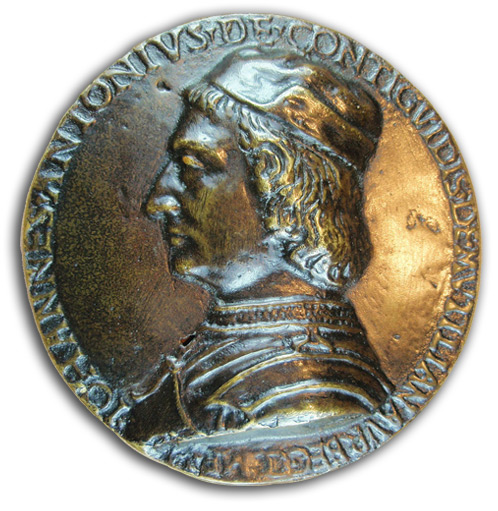
FIORENTINO
PORTRAIT OF GIOVANNI ANTONIO GUIDO,
COUNT OF URBECCHE AND
MODIGLIANA
Conceptualization of this medal & its first casting: Florence, c.1490
Realization of this casting: Italy, c.16th century
Bronze
Collection: IAD 2012
Ex. Collection: Neil A. Goodman, Chicago
NOTE: Niccolo Fiorentino (1430-1514) was one of the most gifted medalists of the 15th century. He lived and died in Florence where he was a friend of Leonardo da Vinci. He also worked for the highly sophisticated Dukes of Burgundy. He worked in a style invented by Pisanello at mid-century, a style that his contemporaries compared with the sculptural qualities of such Greek masters as Phidias and Praxiteles. Fiorentino’s work was in such high demand that 148 medals are now attributed to him. This particular medal is one of his finest works. The modern idea of the portrait as the rendering of the likeness of a person (together with some indication of that person’s nature) began in the middle of the 15th century with the rapid growth of Individualism. The earliest portrait paintings and sculptures were profiles, because the Humanistic artists and their patrons during the Early Renaissance were following the profile custom of Roman coins. For many centuries the classical art of Greece and Rome was of little interest in medieval Europe. If such a statue were found in a farmer’s field, it most likely would have been crushed into powder for fertilizer. It was not until the 14th century & early 15th century that ancient coins and statuary suddenly became “beautiful.” Among these early modern individuals the classical art of Greece and Rome was stimulating a newly developed feeling for their own humanity. Classical art, literature, and philosophy fueled the explosive creativity of the European Renaissance. Those ancient values were mirrors in which Humanistic Europeans saw themselves reflected. Later in the 15th century, the ¾ view of the Flemish portrait painters was adopted by the Italian portraitists, along with the Flemish inventions of oil paint and atmospheric perspective. It was not until the High Renaissance (c.1490s-1520s) that the front-view portrait was developed in the hands of such artists as Leonardo, Raphael, and Titian. For most people today, these unsurpassed masters of form and penetrators of psychology created the standards of quality by which portraits are still judged.
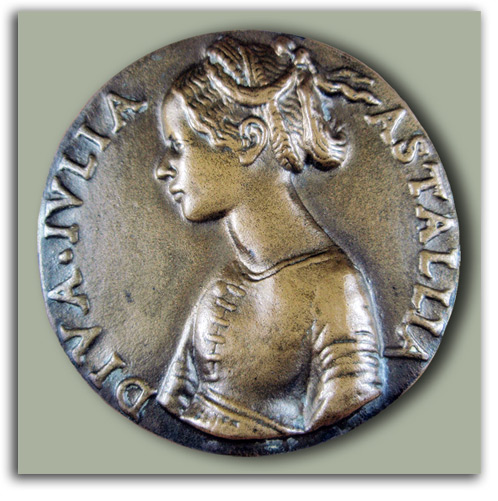
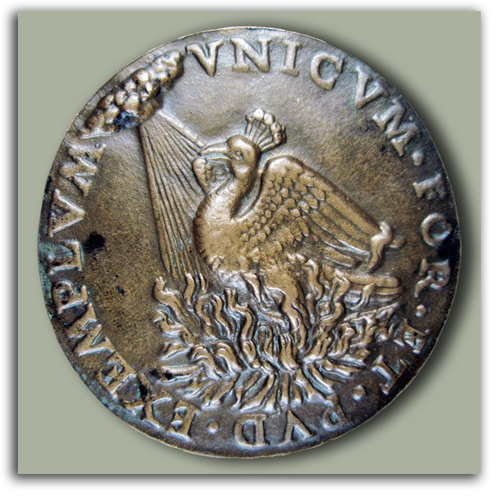
MANTUAN SCHOOL
Rendered in the manner of Antico (c.1460-1528)
PORTRAIT OF GIULIA ASTALLIA
Conceptualization & first casting: Mantua, c.1480-85
Realization of this casting: Italy, c.16th/17th century
bronze
Collection: IAD 2012
Ex. Collection: Neil A. Goodman, Chicago
NOTE: On the obverse is her lovely portrait and her name preceded by the term Diva. On the reverse is an emblematic Phoenix on a flaming pyre looking at the sun, and the inscription: “Example of Chastity and Courage.” There is reason to think this is not a portrait of an actual young lady but rather a fictional character from a novel by Matteo Bandello. This Giulia was violated by a servant of the Bishop of Mantua and drowns herself.
Collecting antique statuary was a fashion that swept the royal and noble courts of Europe in the late 15h & early 16th centuries, especially in Italy. An actual statute thought to be by Praxiteles or some other ancient was the most desirable of sculptural acquisitions, of course. However, that was very rare. Most collectors purchased or commissioned replicas. The Mantuan sculptor & goldsmith Antico earned this name because of his remarkable ability to make fine bronze miniatures of antique statuary. His best-known piece is the “Apollo Belvedere” (c.1490). However, Antico also felt the spirit of his own time. This lovely rendering of a young lady is as close to Botticelli as was ever rendered in bronze.
Bronze statues and medals such as “Giulia” were not made in large numbers during the 15th century. Unique bronze masterpieces were made in the early 15th century by Ghiberti and Donatello as Florence became the capital of bronze-casting. However, it was not until the later 16th century, when Giambologna developed a virtual bronze industry in Florence, that the now famous “Renaissance bronze” became very popular for both upper class and middle class collectors. More often than not, the themes are these statuettes are Greek and Roman. They remain highly desirable to modern collectors of Renaissance art. (Bronze is an alloy of copper and tin; brass is an alloy of copper and zinc. Bronze makes possible a very sensuous surface, suggestive of human flesh.)
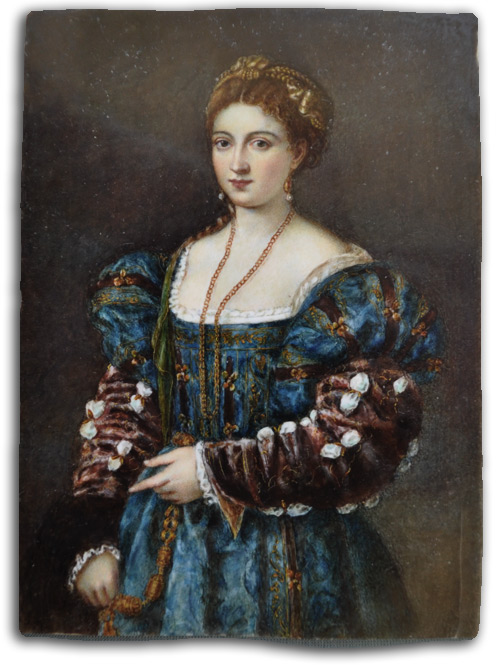
TITIAN (after)
PORTRAIT OF “LA BELLA”
Conceptualization & execution by Titian: c.1534-36
Realization of this miniature replica: c.17th/18th century
watercolor
Collection: FLG
NOTE: Titian (c.1488-1577) is widely regarded as the greatest portrait painter of the 16th century. “La Bella” is one of his most famous portraits. During the Renaissance, many artists made replicas of paintings they admired either for their patrons or for themselves. Few were copied more often than Titian. This tradition of making large and small copies the Old Master paintings as souvenirs of the experience of masterpieces continued for centuries, until the birth of photography in the middle of the 19th century reduced the market for hand-painted copies. Miniature paintings of this type have become a special category for collectors, largely because the skill of some of the copyists can be exceptional. This superb miniature seems to have painted in the 18th or early 19th century.
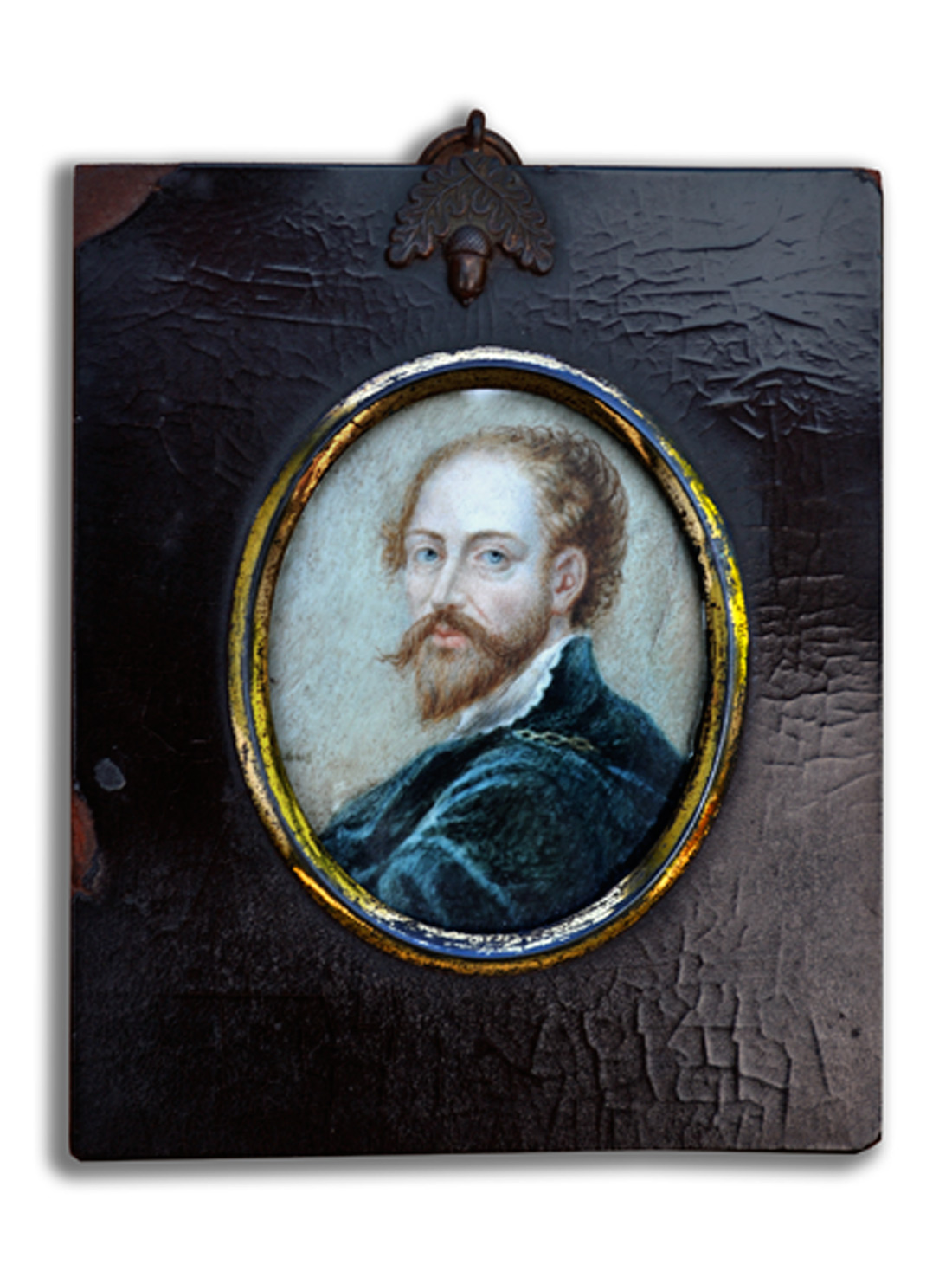
RUBENS (after)
SELF PORTRAIT
Conceptualization & realization by Rubens: 1604
Realization of this miniature replica: c17th/18th century
watercolor
Collection: FLG
Click here or on self-portrait (above) for more detailed image
NOTE: The date of the original is inscribed on the back of this miniature: 1604. This is a period in which Rubens was copying Renaissance paintings in Italy and cultivating an image of himself as the successor of Titian.
Rubens (1577-1640) was a Flemish master who became the most widely celebrated painter of the Baroque era in Northern Europe. He was raised Catholic and had a Humanist education, then worked as a younger painter in Italy where he was deeply influenced by the Venetians especially Titian, as well as by the expressive forms of Hellenistic sculpture particularly the famous “Laocoon and his Sons.” His mature work is a dynamic fusion of intensely energetic forms, rivers of vibrant color, and rich sensuality. Few artists had a greater influence during the 18th & 19th centuries, up to the time of Delacroix and van Gogh. Rubens also was a diplomat, a scholar, and a collector of note. He employed a large workshop to execute major commissions from numerous royal and noble individuals. He also directed a studio full of engravers to promote his work. His most famous student was van Dyck. Rubens received knighthoods from the King of Spain and the King of England. The history of artists being regarded as “artists” rather than mere artisans began with Leonardo, Raphael, and Leonardo during the High Renaissance. However, it was not until the early 17th century that painters such as Rubens and Valasquez were honored with knighthoods. This miniature replica of a self portrait is dated on the back 1604. In it we see the young Rubens during his apprenticeship in Italy where he decided to model himself on Titian. It was meaningful to Rubens that he was born shortly after Titian died. This handsome miniature seems to date from the late 17th or early 18th century.
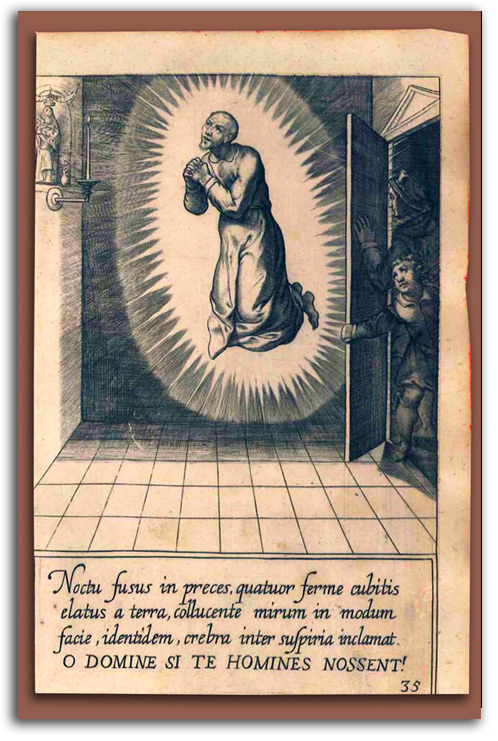
RUBENS Studio (Cornelius Galle)
ST. IGNATIUS LOYOLA IN PRAYER
1609. Engraving
Collection: FLG
Ex. Collection: Mrs. ADR Lanier
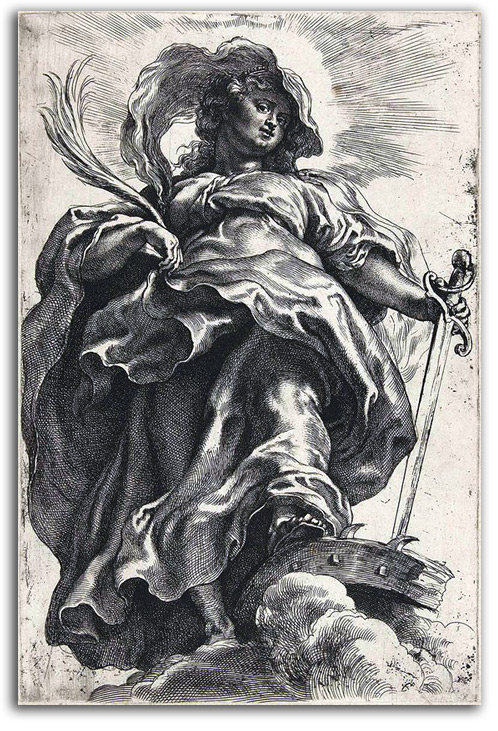
NOTE: Within the extremely diverse work of Rubens one finds the wide range of artistic quality characteristic of prominent studios during the Renaissance and Baroque eras when many artists used any number of assistants. Consider his portraits of Saints. Rubens, who was a devout Catholic, took a special interest in St. Ignatius Loyola (1491-1556), a Spanish knight from a Basque family who founded the Jesuit Order. His painted portrait by Rubens is now in the Norton Simon Museum. In 1609, the year Loyola was beatified, Rubens produced a sumptuous book called Vita Beati. P. Ignatii Loiolalie [Life of the Blessed Father Ignatius Loyola, Founder of the Society of Jesus]. It was illustrated with 81 plates designed by Rubens and engraved under his direction by artists in his workshop. In a way, the whole book is a “portrait” of Loyola, with the plates portraying moments in his life. This particular plate was engraved by Cornelius Galle. It pictures Loyola with a luminous full-body aura in an altered state of prayerful meditation uniting with the Transcendent. This engraving is typical of the kind of portrait that became quite popular in books of the 17th century. It is a competent illustration. However, it does not do more than convey the idea of a reality. It does not evoke inside the viewer an empathetic experience of that reality, unless there is a sympathetic response to the idea itself rather than its visual expression. In short, the plate is flat – both visually and emotionally. Such a plate is typical of the workshop of a major artist. However, a plate done by Rubens himself can evoke a rich empathetic experience because it is a synthesis of a meaningful idea with a strong visual expression of the spirit of that idea. For example, consider “St. Catherine of Alexandria” (the following image), etched by Rubens himself.
RUBENS
ST. CATHERINE OF ALEXANDRIA
c.1620. Etching & engraving
Collection: FLG
NOTE: Rubens had a large workshop of engravers making prints after his designs. He can be credited with the general composition of many of the plates but not for any of the execution. This “St. Catherine” is the only etching Rubens is known to have made himself. Following Christian tradition, she is standing over the spiked wheel on which a pagan Roman emperor attempted to torture her to death in the 4th century. Following her prayer, the wheel broke, and the emperor had to settle for having her beheaded. Rubens has given us not only a story but a story wrapped in an vivid expression of the meaning of the story. This is an explosive figure of a Transcendent spirit who has triumphed over torture, a spirit who has moved beyond ordinary humanity to an illuminated state of Grace. This Transcendent condition of the soul is what the halo symbolizes in the sacred art of the West and the sacred art of the East. It is typical of Baroque art to be activated by swirling masses, as if being blown by the wind. This convention is dramatic and thus emotionally engaging which is what the Catholic Church during the Counter Reformation wanted its art to be. The dramatic “wind” blowing form into place also was thought of as the Divine Spirit moving earthly matter into purposeful positions.
VAN DYCK
SELF PORTRAIT c.1630
Etching
Collection: FLG
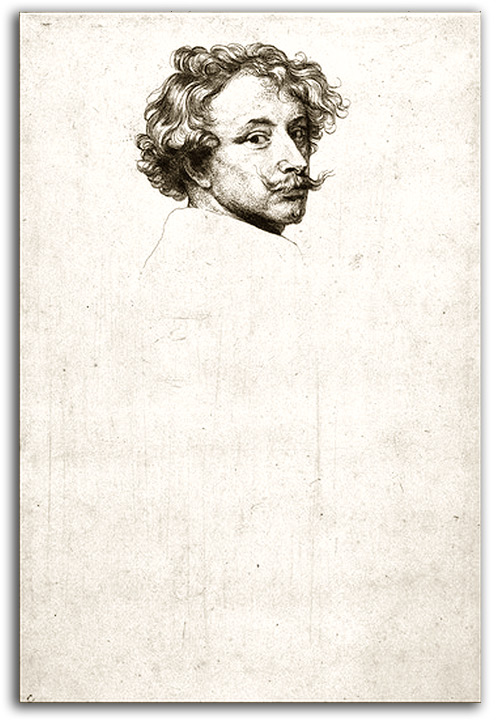
NOTE: There were many good artists working under or with Rubens, but the Flemish genius who stood out over all the others was Anthony van Dyck (1599-1641). In the 1630s (probably at the suggestion of Nicholas Lanier) he became the court painter of King Charles I of England, the leading art collector of his age. Van Dyck painted some of the most graceful portraits ever made. The output of his studio was enormous. Assistants did much of the work, but the faces usually were by the master himself. He received a knighthood and was the dominant influence of British painting for the next two centuries. Like his master, van Dyck lived in Italy as a young man and was deeply influence by Titian. Perhaps van Dyck’s best known portrait is his spectacular rendering of Charles I standing in front of his horse in the Louvre, but many major museums proudly display a van Dyck. He also was a printmaker. During the 1630s, in a series called Iconography, he took the art of the printed portrait to a new level. The series was devoted to half-portraits of distinguished contemporaries – artists, scholars, solders, and statesmen. Many think there has never been a finer series of printed portraits. Each was begun by van Dyck as a drawing or an oil sketch, and sometimes as an etching, and then was completed by a collaborator as an engraving. Of the plates that survive in the form of an original etching, the most famous is this self portrait. The plates for the series, which first appeared in an edition of 80 and eventually numbered over 200, were collected by the Louvre. They have been reprinted from time to time. Van Dyck and Rembrandt were the most brilliant etchers of the 17th century, and perhaps of all time. Only the etchings of Whistler and Picasso usually are discussed in the same conversation.
ANTHONY VAN DYCK
PORTRAIT of NICHOLAS LANIER
oil on canvas. c.1632
Collection: Kunsthistorisches, Vienna
Ex. Collection: King Charles I, & then Nicholas Lanier
click here or on portrait (above) for more detailed image
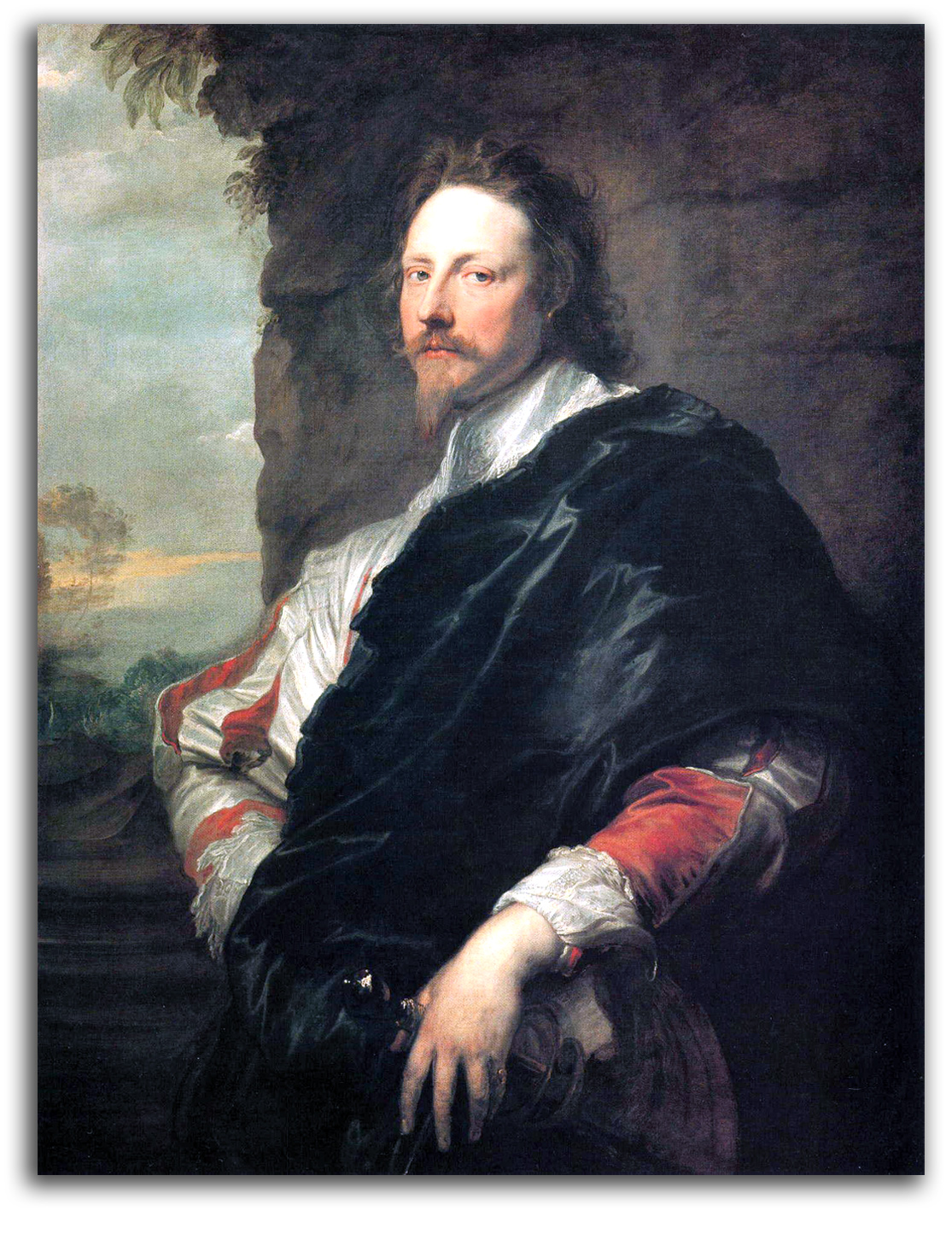
NOTE: Nicholas Lanier (1588-1666) was a prominent member of the court of King Charles the First (1600-1649) where a late phase of the Renaissance flourished in England. As a composer and musician, he was Master of the King’s Music. He collaborated with Ben Jonson and Inigo Jones on masques (as a composer, musician, singer, and set designer), and is credited with composing the first English opera. His singing voice was celebrated in a poem by Robert Herrick in the following lines:
Then if thy voice commingle with the string,
I hear in thee rare Lanier to sing.
He is also credited with composing the first English opera. He also was a painter, poet, and art collector. He is considered one of the first, and possibly the very first Englishman to collect Old Master drawings, especially those of 16th-century Italians. When buying paintings for the king, he bought drawings for his own collection. He engraved and published a number of these drawings himself. As the king’s curator, he is best remembered for selecting and arranging for the acquisition of the legendary “Mantuan Purchase.” This extraordinary collection of Renaissance Italian masterpieces is widely considered the most important purchase of paintings made in the Western world until the 20th century.
This portrait is the reason Van Dyck was invited to move to England. When King Charles saw this elegant portrait (of a man who resembled the king), King Charles asked Van Dyck to be his court painter. An unusually large number of Nicholas Lanier portraits survive, including ones attributed to Isaac Oliver, Guido Reni, Jan Lievans (Rembrandt’s friend), and Rembrandt himself. There also is a self-portrait at Oxford University. My 1966 biographical study of this ancestor was the standard reference for many years. A much more complete biography was published by Michael I. Wilson in 1994. The largest archive of the American and European branches of the Lanier Family is at Johns Hopkins University in Baltimore.
VOSTERMAN (after LIEVENS)
PORTRAIT of NICHOLAS LANIER
engraving. 1630s
Collection: FLG
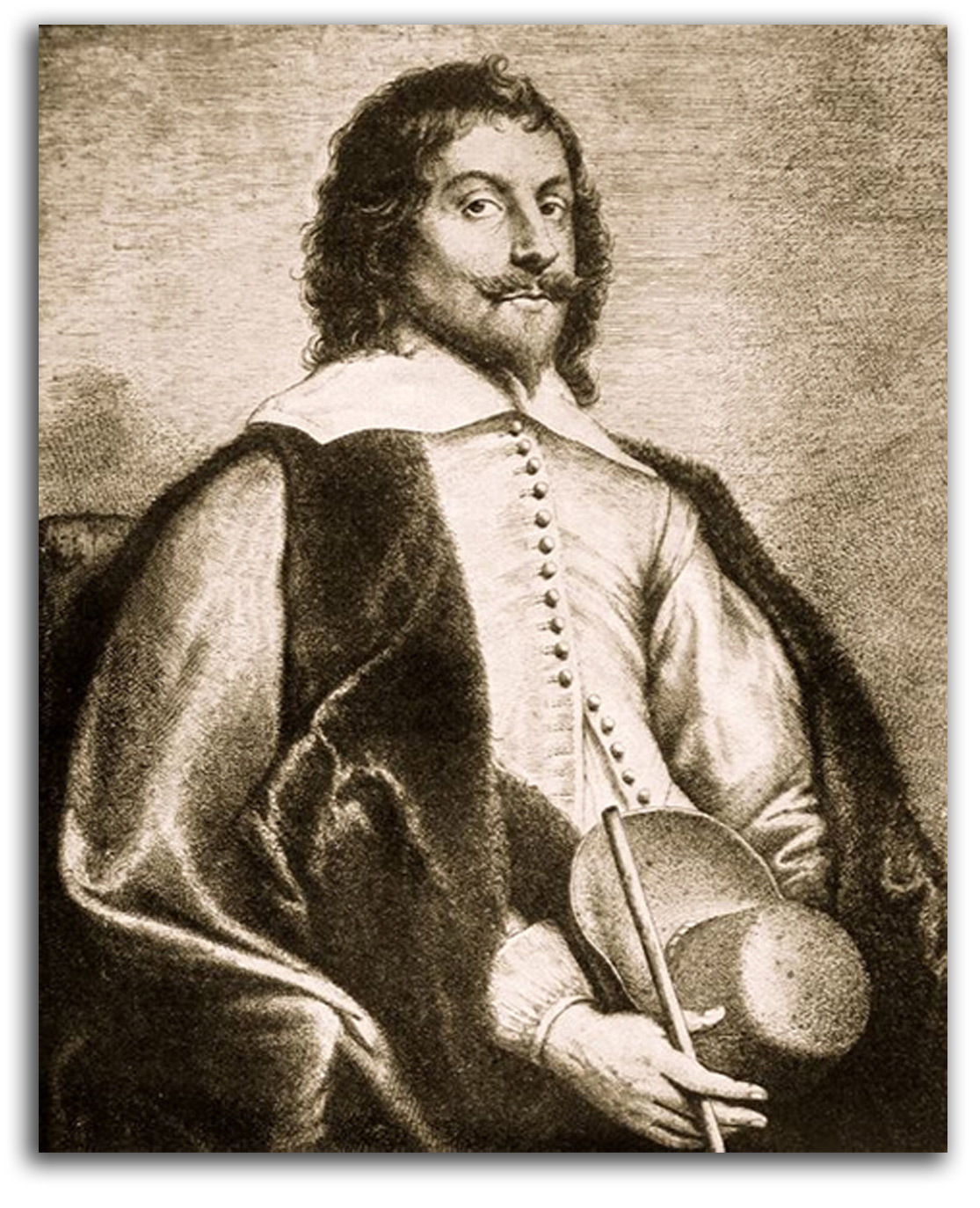
NOTE: Lucas Vosterman the Elder (1595-1675) was one of the most gifted engravers in the workshops of Rubens and then van Dyck. He later collaborated with Nicholas Lanier in England on a book of engravings after Italian drawings from Lanier’s collection. Jan Lievens (1607-1674) and Rembrandt shared a studio in their younger years when it was difficult to tell their work apart. The Lievens portrait of Lanier has been lost.
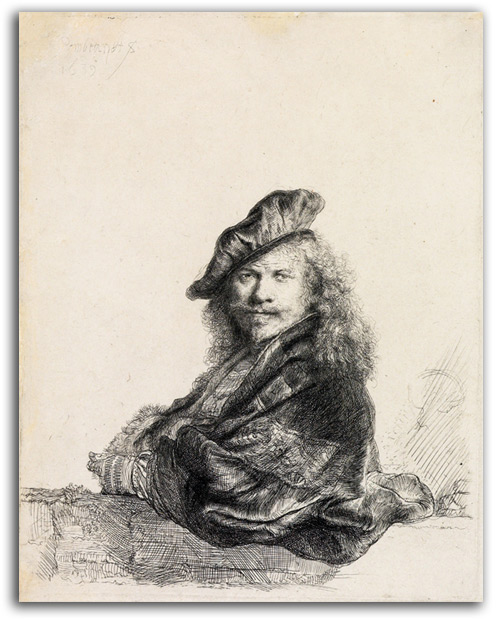
REMBRANDT
SELF PORTRAIT LEANING ON A SILL
etching. 1639 (signed)
Collection: FLG
Ex. Collection: Metropolitan Museum of Art, New York
NOTE: Today, the best-known artist of the 17th century is the Dutch master Rembrandt van Rijn (1606-1669). He is arguably the greatest portrait painter of all time. His name, and only a handful of other artist names, have become household words. As a painter of portraits, and as an “illustrator” of Bible stories, his use of light to articulate aspects of psychology and the depth of his humanity have never been exceeded. He also was a printmaker. No prints have been more avidly collected by a greater number of enthusiasts. If van Dyck was an etcher of consistent compositional structures and remarkable simplicity, Rembrandt was an etcher of enormous variety and often haunting complexity. This particular print is often considered the greatest of his early self portraits. He continued to explore this thing called “self” in a very long series of paintings and prints for the rest of his life. That series is arguably the most complete “self portrait” ever made by an artist. The fact that the Met had a collection of Rembrandt etchings made from his original plates in modern times was first told to me by A. Hyatt Mayor, curator of that print collection, when he was my professor at the Institute of Fine Art, New York University in 1966. They were later put up for sale. I purchased this impression at the Met in 1980. A Rembrandt portrait that many think is of Nicholas Lanier is in the Corcoran Gallery in Washington, D.C.
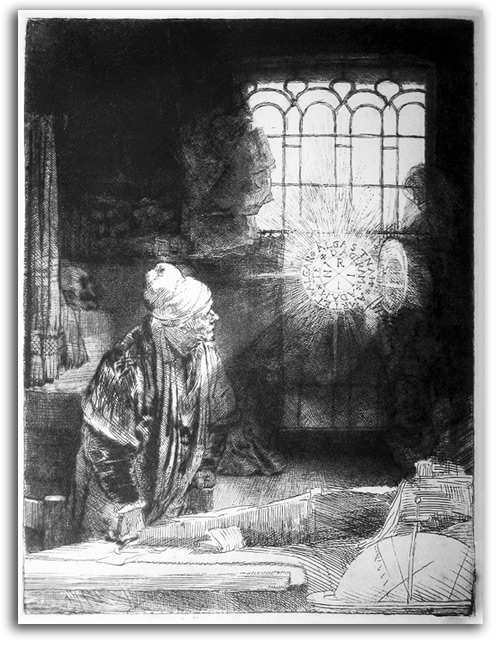
REMBRANDT
THE ALCHEMIST (aka FAUST). c.1650
Etching
Collection: FLG
NOTE: Rembrandt eventually had an international reputation as an etcher. The meaning of most of his portraits and narratives is clear. But this famous print is mysterious. Scholars have debated its meaning for centuries. An old man in a dark room looks up from his writing desk, pen in hand, and sees a luminous disc inside of which are words. The meaning of those words is a mystery. Most of the room is imprecise – the table, the books, the globe; but the words are quite precise. The whole scene is a mystery, and that may well have been just what Rembrandt wanted it to be. The title published in the 17th century was “The Practicing Alchemist.” Only in the 18th century did it start being known as “Faust.” To the uninitiated, Alchemy was little more than efforts by greedy people to turn lead into gold. There were such people during the Middle Ages and the Renaissance. However, true Alchemy was a meditative tradition within Christianty that had parallels with Asian yoga. During the 16th & 17th centuries, true Alchemy was a special interest of leading figures of the time including Sir Isaac Newton. By means of spiritual practices, one attempts to transcend lead-like selfishness and attain the Transcendent state of Golden Consciousness. {For further details, click here for “The Mystic Ladder: Parallel Stages of Consciousness in Alchemy & Tantra.”]
The legend of Faust probably was based on the life of J. G. Faust (c1480-1540) who was an alchemist and magician in Wurttemberg. In Goethe’s play/poem Faust (which occupied much of his life), the central character makes a “deal with the Devil.” For a number of years, Faust gets what he wants and then must surrender his soul to the Devil. If the subject actually is Faust, the scene probably is when a good angel warns Faust not to sign up with the Devil. What is the Devil actually? In a number of spiritual traditions, the Devil is understood to be one’s ego – selfishness personified.