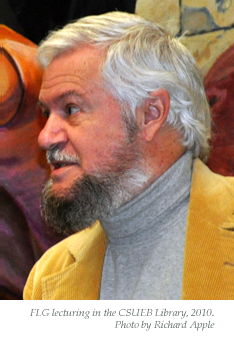
World Art Press has been publishing the educational writings of F. Lanier Graham since 1988. Graham is a widely respected Art Historian, Curator, and Cultural Planner. Also known as a poet, printmaker, sculptor, and philosopher, he thinks of life as an adventure and likes to discover new things, much like an archeologist. Many of his books and catalogues document subjects that have not been explored in depth before. Several of his books have become standard references.
His curatorial adventures started with his “Hector Guimard” exhibition at New York’s Museum of Modern Art in 1970. It traveled to San Francisco, Toronto, and Paris. Since then his exhibitions have been presented in a number of museums, including those where he has served as curator: The Fine Arts Museums of San Francisco, the National Gallery of Australia in Canberra, the Norton Simon Museum of Art in Pasadena, and the University Art Gallery of California State University, East Bay (CSUEB), in Hayward. He is primarily a Modernist, focused on the decades between Postimpressionism & Abstract Expressionism, and specializing in the Late Modernism of the 1940s & ‘50s. His second research field is the European Renaissance in Italy and England. His third field of research is cross-cultural symbols of the Transcendent.
Much of what Graham has written over the past 20 years has been for his students at California State University in both Arcata and Hayward where he has taught American Art, Ethnic Art, Contemporary Art, Modern Art, Technology & Art, World Art, Sacred World Art, Alchemy & Art, World Mythology, and World Religions. His continuous aim in lectures and study guides has been to simplify complexity. The same is true for his books. The trade books he has written or edited have sold over a million copies in five languages. Part of his unusual success is due to his ability to write essays so poetic that many call them “prose-poems,” or what he likes to call “proems.”
For a long time, his attention was fixed on Old Masters, Modern Masters, and ancient traditions of the Transcendent. Now he is expanding his focus to include younger contemporary artists. In quiet times, between public projects, he can often be found making prints, sculpture, and poems. These usually are combined in limited editions of Book Art.
Graham’s early poems were traditional “self-expressions.” Zen-inspired haiku became his favorite verse form. As he matured toward a more transpersonal “self,” his poems became teachings. The same is true of the sculpture he has exhibited for years in the Annual Art Faculty Exhibitions of his university. His “Sculpted Poems” (aka “Philosophical Objects”), which continue the Dada-Surrealist tradition of the objets poétique, have been especially popular among students at CSU, East Bay.
For generations, Graham’s ancestors have been art collectors. He continues that tradition. The family collection he inherited he has maintained and expanded as a special private pleasure. Many of the works illustrated on this website are from this private collection which he plans to pass on to his grandchildren. A much larger art collection he and his wife, Gloria K. Smith, worked together to form as an educational program of the Institute for Aesthetic Development. IAD is a charitable organization devoted to innovative visual education. IAD was started in 1975 with funding from Graham’s parents, Dr. Floyd Graham & Martha Lanier Graham. The IAD Teaching Collection of World Art consists of works from all the major eras and cultural areas of human history. Works of art from IAD’s Teaching Collection have been used for many years in colleges, universities, and museums as teaching aids. In 2010, most of this collection was donated to California State University, East Bay, to be the nucleus of a World History Learning Center. The Center is being planned as a unique “universal classroom” which could well become a national model. [CLICK for PROSPECTUS].
The World History Learning Center is one of a long line of innovative cultural plans for which he has been the primary planner, plans that have become national models for cultural institutions. He began with an Architecture & Design study center at New York’s Museum of Modern Art during the 1960s, then continued during the 1970s & ’80s with master plans for the Fine Arts Museums of San Francisco, the Fort Mason Center on the San Francisco waterfront, and the Headlands Center for the Arts in the Golden Gate National Recreation Area. Since the 1990s, the World History Learning Center at CSUEB has been his main focus as a cultural planner. Graham is credited with being one of the first to use the term “Cultural Planning” and one of the first to do this work as a profession.
Graham also has had a lifelong interest in the sciences. He was an active member of the Junior Astronomers in high school, and considered that profession under the encouragement of Albert Schatzel, Director of the Adler Planetarium in Chicago. In college his favorite subjects included Psychology and Anthropology. Encouraged by Gregory Bateson, his senior thesis was an exploration of Personality and Culture from the perspective of Systems Theory. Professor Beardsley, with whom he was studying International Communications, wanted him to do his graduate work in Psychological Anthropology, and invited him to present his senior thesis as a paper at the national conference of the American Psychology Conference in 1963. But Graham declined. He was headed for an M.A. in Art History at Columbia University.
During the 1970s he collaborated on a number of projects with the noted physicist and educator Frank Oppenheimer, the brother of J. Robert Oppenheimer, and founder of the Exploratorium in San Francisco. Graham was a member of the Advisory Board of the Exploratorium during its first 10 years. In 1975 Graham edited THE RAINBOW BOOK which was a concise encyclopedia of light and color from the viewpoints of art, physics, and metaphysics. This interdisciplinary survey sold over 100,000 copies. His poetry book, HEAVY LIGHT: HAIKU ON MODERN PHYSICS & ANCIENT WISDOM (1978) was warmly received by the Physics-Consciousness Research Group. Fred Wolf’s pioneering textbook, TAKING THE QUANTUM LEAP: THE NEW PHYSICS FOR NON-SCIENTISTS, which won the National Book Award, was agented to Harper by Graham. During the 1970s Graham continued to focus on Consciousness Studies, especially Bimodal Theory, in collaboration with Gregory Bateson.
Graham has been in love with computers most of his life. In 1967, at the invitation of David Vance, the Registrar of New York’s Museum of Modern Art, Graham was one of the original members of the Museum Computer Network. That was when the only computers were mainframes the size of rooms. The purpose of those early museum databases was Collection Management. The MCN organization now connects the IT staff of many museums in America. Artists also were starting to explore computers at that time. During the late ‘60s, doing research in preparation for the legendary MoMA exhibition of 1970 “INFORMATION” (the first major museum exhibition of digital art and conceptual art), Graham explored recent developments in the art/computer world at Bell Labs and in the studios of a number of electronic artists. During the 1970s he used the computer for book production, exhibited digital art at the Fine Arts Museums of San Francisco, and advised the Exploratorium on displays. During the 1980s he used the Internet (then words only) to teach his Museum Studies students how to compile bibliographies from data in the Library of Congress, and kept up with the technology as computers began to revolutionize the world into millions of personal informational environments.
During the mid 1990s, as soon as the Web made the Internet into a visual tool and RealAudio appeared to integrate a sound track, he pioneering a new stage in the use of the Internet as a teaching tool. The first generation of Internet courses were text only. The second generation used images but were still primarily text. RealAudio2.0 made possible the unification of images with the spoken word of lectures. Graham wrote, illustrated, and narrated the first asynchronous online courses of this type ever developed. They were celebrated by the RealAudio corporation as the first courses on the Internet to use RealAudio. During the late ‘90s he taught courses on the history of art & technology at CSUEB, and in the University Art Gallery of CSUEB developed a special space for the presentation of digital art. Graham now is designing a Science Information Wall in the University Library of CSUEB with iPads as the interactive “wall labels” for the exploration of each scientific discipline. From such portals, students and visitors from the surrounding community, can travel to the edges of their imagination.
During the 1970s, he also assisted two free-standing graduate schools to gain accreditation for their innovative programs in the science of consciousness – the California Institute of Asian Studies in San Francisco, and the Naropa Institute in Boulder. He also was a member of the original faculty of the Art & Consciousness MFA program at John F. Kennedy University, Orinda. In 1979 his profile was included in a world-wide study by Itsuo Sakane of notable figures working on the dynamic interface of art, science, and consciousness, along with Bohm, Capra, Kepes, Gombrich, Ornstein, and Oppenheimer. Sakane’s survey in book form appeared in 1984 under a Japanese title that translates as TRAVELING ON THE BORDERLINE: ART, SCIENCE, & CONSCIOUSNESS. Since the 1970s, at a number of universities, Graham has been teaching World Art, Sacred Art, World Religions, and World Mythology from a perspective that amplifies the traditional fields of the Humanities with insights from the new field of Consciousness Studies.
This CHECKLIST OF PUBLICATIONS, which contains just over 1,000 citations, was begun on the 55th anniversary of Graham’s first publication, STAR SONGS, in 1954. The CHECKLIST, together with its Appendix, constitutes a complete bibliographic record of his publications. Graham’s reputation as a curator, educator, and author is both national and international. His profile appears in the prestigious WHO’S WHO IN AMERICA. He also is one of the very few art historian/curators whose profile appears in WHO’S WHO IN THE WORLD.
Gloria K. Smith, Editor
ADDENDA:
When work on this CHECKLIST began, the plan was for it to be simply a list of titles, the way most professors do their CV online. I suggested it would be good to illustrate it with images from the books (at least the covers), as well as some images from the articles being listed. When we began working with Richard Apple on the design, he made the first images look so vibrant, that we decided to extend the image-idea to all parts of the CHECKLIST. This made the website look more like a book than a list. Graham’s daughter Jennifer went farther. She suggested a dry list of words, even an illustrated one, would be much more meaningful if there was commentary, some personal reflections, at least on the major publications. We agreed. As he had no desire to ever write an autobiography, this became an ANNOTATED CHECKLIST and as close to being a “memoir” as there would ever be. There are short comments on a large number of entries, and longer notes on other projects. Some of these notes he wrote alone, and many are (in effect) my interviews with him on projects that were particularly meaningful.
Many of the works in the IAD Teaching Collection of World Art have been catalogued in the three volumes of GLOBAL VISION: A SURVEY OF WORLD ART (Part 1, 2006; Part 2, 2008; Part 3, 2010). For a database of the images in these exhibition catalogues, visit the image base at San Jose State University @WORLDIMAGES.SJSU.EDU/Prt1627.
Those GLOBAL VISION photographs were skillfully made for IAD by Philip Ringler. The SJSU files were constructed by two gifted IAD interns at CSUEB: Sarah Naumann and Krystal Hasiak. Many of those works of art, and hundreds of other works of art, have since been donated to California State University, East Bay. [Click for INTERVIEWS of 2011].
Some works in those exhibitions were on loan to the IAD Collection from private collectors for the purpose of rounding out the student experience of each historical era. Some of those remain on loan. Images of many of the works on loan to IAD are on this WORLD ART PRESS site, primarily under AREA STUDIES and TOUCHING THE TRANSCENDENT under the PERIODICALS section of this website. Publications by IAD, and publications distributed by IAD, also are listed on the website of World Art Press. This site is well developed but is still under construction.
~ GKS
F. Lanier Graham
Art Historian & Curator
Résumé
CURATORIAL POSITIONS
Associate Curator of Collections,
Museum of Modern Art, New York, 1965-70
Curator of Paintings & Sculpture (Renaissance to Modern),
Vice Director for Collections & Chief Curator,
Fine Arts Museums of San Francisco, 1970-76
Curator (Renaissance to Modern),
Institute for Aesthetic Development, San Francisco, 1976-83
Curator of Prints & Books (Modern),
National Gallery of Australia, Canberra, 1984-87
Curator (Renaissance to Modern),
Norton Simon Museum of Art, Pasadena, 1987-91
Associate Curator (Modern),
Art Information Center, Antioch & Arcata, 1991-97
Director & Curator,
University Art Gallery, California State University, East Bay, 1998-2010
Curator of Art Collections,
University Library, California State University, East Bay, 2010-
TEACHING POSITIONS
Field Faculty, Museum Studies,
New York University, and Harvard University, 1972-75
Adjunct Faculty, Museum Studies,
University of California, Berkeley, 1973-74
Adjunct Faculty, Sacred World Art, California Institute of Asian Studies in San Francisco, and the Naropa Institute in Boulder. He also was a member of the original faculty of the Art & Consciousness MFA program at John F. Kennedy University, Orinda, 1974-79
Lecturer & Program Director, Museum Studies & Cultural Planning,
Institute for Aesthetic Development, San Francisco, 1977-83
Lecturer & Program Director, Museum Studies,
National Gallery of Australia, Canberra, 1984-87
Lecturer, Religious Studies (World Religions & Mythology),
Humboldt State University, 1995-2004
Lecturer, Art History, & Lecturer/Program Director
(World Art, Sacred World Art, Renaissance Art, American Art, Modern Art, Contemporary Art, Art & Technology, Museum Studies),
California State University, East Bay, 1993-94 & 1997-
RESEARCH FIELDS
Modern Art, Renaissance Studies, Iconography, and Museology
PUBLICATIONS written or edited (selections)
Click here for a complete illustrated checklist of books & exhibition catalogues
M.A. Thesis: Nicholas Lanier, Collector of Italian Renaissance Art.
Catalogues on Leonardo, Giorgione, Monet, van Gogh, Guimard, Duchamp, and de Kooning. THE RAINBOW BOOK (Shambhala 1975 & 1976; Vintage/Random House 1979); GODDESSES IN ART (Abbeville/Artabras 1997 in four languages); DUCHAMP & ANDROGYNY: ART, GENDER AND METAPHYSICS (No-Thing Press 2005); GLOBAL VISION: A SURVEY OF WORLD ART, (World Art Press, vol.1 2006; vol.2 2008; vol.3 2010). Graham’s purpose is to make fine art available to large audiences. Books he has written or edited have sold over a million copies.
Desktop Periodicals Edited
BOA: Bulletin of the Archives of the Art Information Center
ICONOGRAPHY OF INFINITY: Essays on Art & Philosophy
MUSE: A Quarterly Journal of Visual Education, Museology, & Cultural Planning
EXHIBITIONS curated (selections)
Click here for a complete checklist of articles on architecture & exhibition design
Leonardo’s Book Illustrations, Phillips Collection Library, Washington, D.C.; Early Flemish Paintings: Renaissance & Baroque, Fine Arts Museums of San Francisco; Giorgione & the Experts, Oglethorpe University Museum, Atlanta; Leonardo’s Light in “The Last Supper” and “Christ among the Doctors,” Fine Arts Museum of the South, Mobile; Looking at Leonardo: An Exhibition of Books, Facsimile Manuscripts, Models, & Websites, CSUEB; The Spirit of the Renaissance: A Re-Creation of the Urbino Studiolo, CSUEB; Flaming Pages: The Illuminated Books of William Blake, CSUEB; Three Centuries of French Art (Norton Simon collections), Fine Arts Museums of San Francisco; Vincent van Gogh, Norton Simon Museum, Pasadena; Hector Guimard, MoMA, New York; Impossible Realities: Marcel Duchamp & the Surrealist Tradition, Norton Simon Museum, Pasadena; The Spontaneous Gesture: Prints & Books of the Abstract Expressionist Era, National Gallery of Australia, Canberra; Global Vision: A Survey of World Art, CSUEB.
INSTITUTIONAL MASTERPLAN DESIGNS
Click here for details of FLG’s participation in institutional masterplan designs
Architecture & Design Division of the Bliss International Study Center, MUSEUM OF MODERN ART, New York 1966-68; General Collection Masterplan, FINE ARTS MUSEUMS (De Young & Legion of Honor museums), San Francisco 1970-74; Artists-in-Residence Program, EXPLORATORIUM, San Francisco 1970-81; General Masterplan, TEACHING MUSEUM OF WORLD ART, Institute for Aesthetic Development, San Francisco 1976-77; General Masterplan, FORT MASON CENTER, Golden Gate National Recreation Area, San Francisco 1977; General Masterplan, HEADLANDS CENTER FOR THE ARTS, Marin Headlands, Golden Gate National Recreation Area 1979-82; MORRIS GRAVES MUSEUM OF ART (in the old Carnegie Library), Eureka 1995; WORLD HISTORY LEARNING CENTER (project), California State University, East Bay, Hayward 2005 –
EDUCATION
Independent Study with A. E. Popham, author of THE DRAWINGS OF LEONARDO DA VINCI, London, 1960-61
B.A. in International Political & Cultural Relations
(2nd major in Art History)
School of International Service, American University, Washington, D.C., 1963
M.A. in Art History,
Columbia University, New York City, 1966
(Thesis Committee: Rudolf Wittkower, Julius Held, & Howard Davis)
Advanced Museum Training & Connoisseurship,
Institute of Fine Arts, New York University, 1966-67
(A. Hyatt Mayor & Robert Goldwater)
PROFILES
WHO’S WHO IN AMERICA (1980 –)
WHO’S WHO IN THE WORLD (1990 –)