A Quarterly Journal
of Visual Education,
Museology, &
Cultural Planning
SERIES I
CULTURAL PLANNING STUDIES BY FLG & ASSOCIATES OF THE INSTITUTE FOR AESTHETIC DEVELOPMENT,
A CENTER FOR THE ADVANCED STUDY OF VISUAL EDUCATION & CULTURAL PLANNING
1969 vol.1 VISUAL EDUCATION IN THE UNITED STATES.
Museum Studies & Art Education in the United States: A National Survey.
MoMA STUDY CENTER brochure cover, 1968
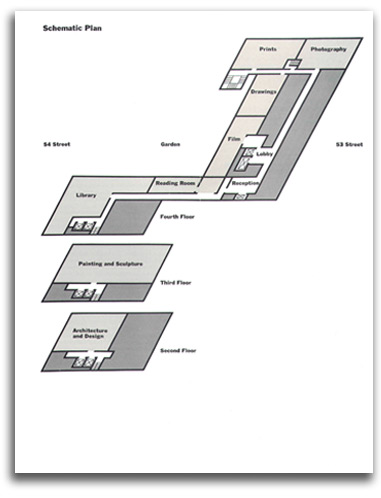
MoMA STUDY CENTER floorplan schematic, 1968
Click here for closer view of this image
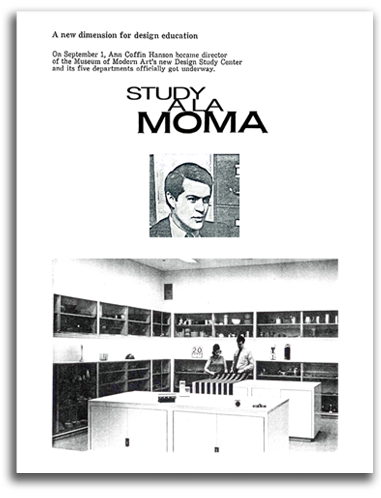 MoMA STUDY CENTER news clippings, 1968
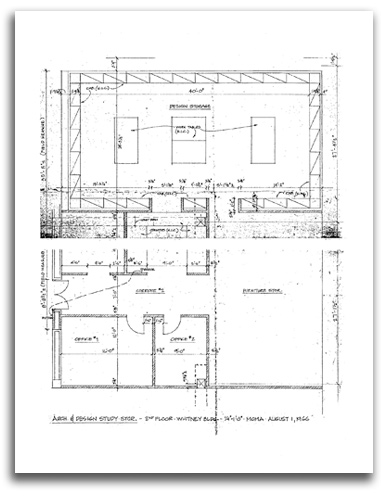
MoMA STUDY CENTER’s Architecture & Design Plan, 1966
Program Plan by FLG & Arthur Drexler. Design by FLG
Construction Drawing by Clyde Rich
Click here for a close-up of this image
1970 vol.2 MoMA’S NEW STUDY CENTER
The Planning of the Bliss International Study Center
at the Museum of Modern Art, New York
NOTE: Most museums exhibit about 10% of their collections. MoMA in 1965 decided to be first major museum in the world to make all its collections easily available for study. and purchased the building next door. Each curatorial department had its own section in the old Whitney Museum building that was connected to the MoMA building. FLG’s assignment was to design and manage the Architecture & Design division of the Study Center as an innovative “Library of Objects.” Each object could be clearly seen, and (if necessary) easily moved to a study shelf or study table for further examination by students and scholars. Around this new concept, which Alfred Barr named “study storage,” was developed a Center for the Advanced Study of Modern Art, the first of its kind, with visiting scholars from around the world.
1971 vol.3 CULTURAL PLANNING: A NEW PROFESSION.
Cultural Planning Today: A Status Report on a New Profession.
Planning Kenneth Clark’s “Civilisation” – the TV series.
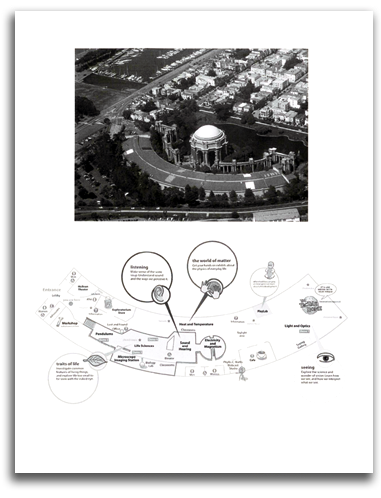
1972 vol.4 ART & SCIENCE AT SAN FRANCISCO’S NEW EXPLORATORIUM.
Artists & Scientists: A New Dialogue in Museum Education:
The Exploratorium Masterplan & Artist-in-Residence Program, San Francisco, A New International Model for Science/Technology Museums.
NOTE: The Exploratorium inside San Francisco’s historic Palace of Fine Arts began in 1969 as the vision of Frank Oppenheimer who developed “open learning systems” by which visitors learn about science and perception by means of stimulating interactive displays of various scientific principles. The displays are works-of-art in themselves, created by artists who love science, working on site. Oppenheimer in 1970 asked FLG to join the Advisory Board and write a master plan for the Artists-in-Residence Program. Oppenheimer’s vision was profound. There are now various kinds of “exploratoriums” in major cities around the world. There are now plans for the Exploratorium to move to the waterfront.
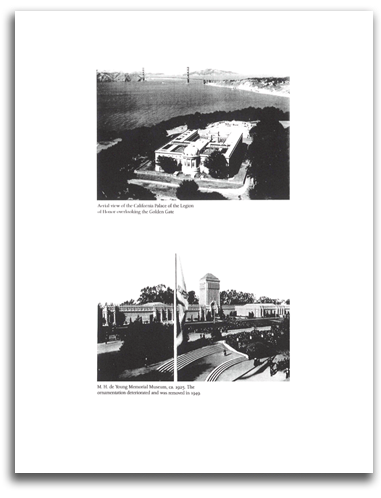
Exterior photographs of San Francisco’s two Old Master museums:
the M. H. de Young Memorial Museum and
the California Palace of the Legion of Honor
NOTE: These two museums, which has been competitive for many years, merged in 1972. This was to be the first time two art museums merged in order to be more efficient and better serve the public. That became a model of other museum mergers around the world. At FLG’s suggestion, the name of the combined museums became The Fine Arts Museums of San Francisco (FAMSF). As Vice Director for Collections & Chief Curator, FLG was charged with the design and execution of a masterplan to merge the collections of the two museums.
The most important action during Phase One of general masterplan for the new museum was establishing a gallery for the collection of Africa, Oceania, & the Americas at the de Young under the supervision of Thomas K. Seligman, FAMSF’s dynamic new curator of tribal art. (Tom went on to be Director of the Cantor Art Center at Stanford University.) Much of this material, including a giant totem pole, had been in the basement for decades. Tribal Art had long been displayed in anthropology museums but had little respect in American art museums. In the early 1970s, FAMSF was one of the first art museums to say tribal art is as important as any other art. Such actions changed the paradigm nationwide. Now most American museums in most major cities have tribal galleries. For the first time, coast-to-coast, many African Americas, Mexican Americans, and Native Americans had something they could relate to.
~ GKS
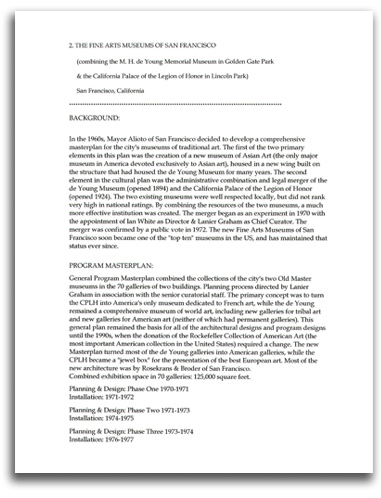
FAMSF MASTERPLAN: Summary Page by FLG
Click here for a close-up of this image
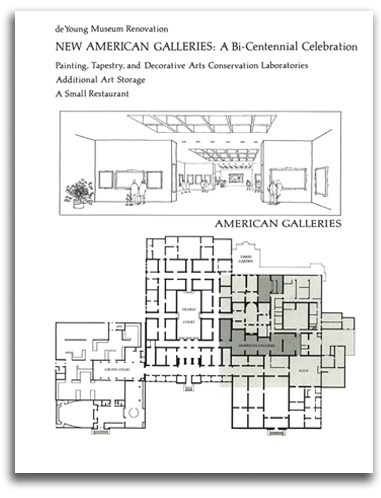
FAMSF MASTERPLAN:
Prospectus for the American Galleries at the de Young, 1974
Program Plan by FLG & Ian White
Architecture by Adolph S. Rosekrans
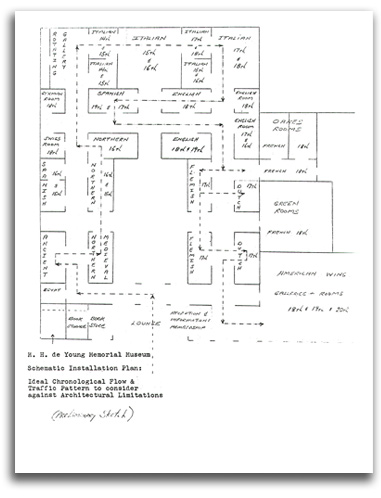
FAMSF MASTERPLAN: Preliminary Sketch of the de Young, 1970
Preliminary Program Plan by FLG. Sketch by FLG
Click here for a close-up of this image
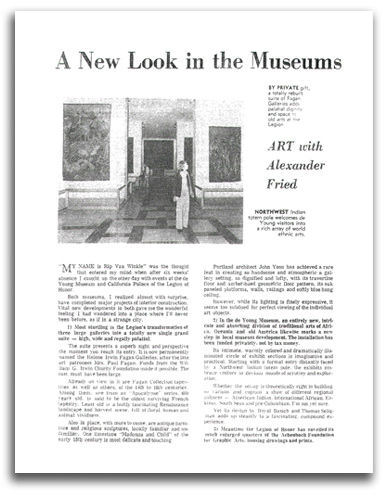
FAMSF MASTERPLAN: “New Look” of the Masterplan as realized by 1974
Article in the SAN FRANCISCO EXAMINER
with a photograph of the Medieval/Renaissance Galleries at the Legion
Final Program Plan by FLG & Ian White with Graeme Keith and Anna Bennett
Click here for a close-up of this image
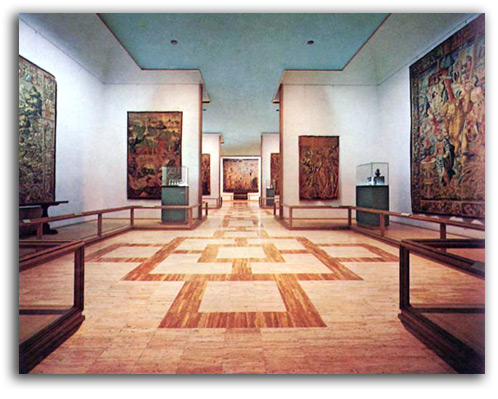
FAMSF MASTERPLAN: Medieval/Renaissance Galleries at the Legion
Program plan by FLG & Ian White, with Graeme Keith & Anna Bennett
Architecture by John Yeon
1973 vol.5 PLANNING THE FINE ARTS MUSEUMS OF SAN FRANCISCO.
The Masterplan for FAMSF, America’s first Art Museum Merger.
The Masterplan for the Bay Area Conservation Center.
Planning “Executive Order 9066” with the Japanese-American Community.
Planning the Galleries of Africa, Oceania, & the Americas at the de Young.
Planning the Bicentennial American Galleries at the de Young.
NOTE: FLG in 1970-71, as FAMSF’s Vice Director for Collections, wrote the program plan for the merging collections of the de Young & Legion of Honor museums. The complex implementation plan was completed in 1974, except for the American Galleries which later became the home of the Mr. & Mrs. John D. Rockefeller 3rd Collection of American Art – the most important private collection in the world. The Rockefeller donation was announced in 1978, after years of negotiations with Ian White (Director of FAMSF) & FLG (Chief Curator of FAMSF), negotiations that began in 1970. With the addition of this extraordinary collection, FAMSF started to become a world-class museum.
For the implementation schedule of the collection master plan click here
1974 vol.6 NORTON SIMON’S MUSEUM, A NEW HOME FOR OLD MASTERS?
America’s Leading Collector of Old Masters considers Museum Masterplans.
Click here or on above image for closer view
1975 vol.7 INSTITUTE FOR AESTHETIC DEVELOPMENT, A NEW THINK TANK.
Planning America’s first Think Tank for Cultural Planning & Visual Education in association with the National Endowment for the Humanities & the Norton Simon Foundation.
Planning the T.V. “Bicentennial Minute”.
NOTE: Concerned with the lack for strategic planning in the museum world, Graham resigned as Chief Curator of the Fine Arts Museum of San Francisco in 1976 to head a Center for the Advanced Study of Visual Education & Cultural Planning. His pioneering efforts to use Think Tank techniques in the cultural sector were endorsed by the National Endowment for the Arts and the National Endowment for the Humanities. He & his associates at IAD conducted innovative planning studies for the Simon Museum, the Getty Museum, the San Francisco Foundation, the Gerbode Foundation, Norton Simon Foundation, Naropa Institute, California Institute of Asian Studies, University of California at Berkeley, Lone Mountain College, the San Francisco Redevelopment Agency, the National Park Service, and the Louvre, before he returned to museum work in 1984 at the National Gallery of Australia. The first members of the Advisory Council of IAD included leading figures for many fields, e.g., Virgil Aldrich, philosopher; Frank Oppenheimer, Physicist; Meyer Schapiro, Art Historian; Pierre Rosenberg, Curator of The Louvre.
1976 vol.8 NEW M.A. PROGRAMS IN THE SAN FRANCISCO BAY AREA.
A Advanced Museum Studies: A small pilot course for UC/Berkeley Extension at IAD headquarters in San Francisco. An expanded version of this pilot program became a regular summer institute at the Berkeley campus. FLG designed and taught the pilot course.
B M.A. in Museum Studies at Lone Mountain College, San Francisco. This small pilot program became a major program when it moved to John F. Kennedy University in the East Bay. FLG was on the original faculty.
C M.F.A. in The Art of the Book at Lone Mountain College in San Francisco. FLG was on the planning group that was organized by IAD.
NOTE: FLG began teaching Museum Studies at MoMA’s Study Center during the late 1960s, continued at FAMSF during the 1970s, and the National Gallery of Australian during the 1980s. He became a member of the Training Committee of the International Council of Museums. In 1998 at California State University, East Bay, he started a Museum Studies certificate program. That became a graduate program in 2006.
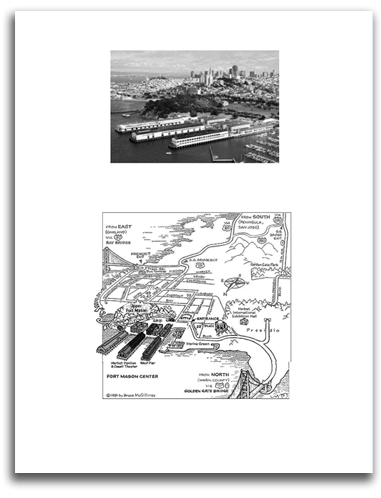
Masterplan for the Fort Mason Center, San Francisco, 1977
1977 vol.9 REGIONAL PROGRAMS & POLICIES FOR CULTURAL PLANNING.
A Inflatable Classrooms for the Handicapped, a study funded by the San Francisco Foundation.
B Live-Work Spaces: A Public Policy Proposal for San Francisco.
C Planning a state-wide Rainbow Train for Gov. Brown & Jacques Barzaggi.
D Planning a state-wide Cultural Masterplan; Each County to do its Own Plan.
E Planning an Endowed American Chair for both FAMSF & a local University
F Planning the FORT MASON CENTER as a community-based cultural center in an old Army Fort on the waterfront of San Francisco.
NOTE: Many organizations started innovative programs in the early days of the Fort Mason Center. FLG was called in to write a general master plan in 1977. That led to his being hired by the National Park Service in 1979 to write a master plan for the Headlands Art Center. Ft. Mason Center has become a national model for re-programming old Army forts.
1978 vol.10 TELEVISION & REGIONAL VISUAL EDUCATION.
A Planning America’s first PSA for an Art Museum: The Rockefeller Exhibition.
B Planning a 30-minute “Museum Magazine” for KQED.
C Planning “Art Education on T.V.” for the Norton Simon Foundation.
D Planning “Art of the Huichol Indians” at FAMSF.
E Planning the King Tut exhibition & guidebook at FAMSF.
NOTE: FLG had helped to bring this exhibition to San Francisco by participating in the negotiations with the Egyptian Minister of Culture. This record-breaking 1979 show would be his last FAMSF project. Having been in charge of FAMSF publications for several years, he had grown concerned that many museums were publishing catalogues that could only be afforded by the upper middle class. The economics of publishing tied the hands of most museum publishers. FLG wanted to develop publications that many visitors could afford. One of his early experiments was a catalogue of photo-journalists in the form of a $1 newspaper. For this King Tut show, he proposed a “$1 color catalogue.” It worked, and sold 300,000 copies.
1979 vol.11 ACCREDITATION OF CONSCIOUSNESS STUDIES.
A In 1975 FLG was asked by the Board of the Naropa Institute in Boulder, a free-standing graduate school based on Buddhist Studies, to write guidelines for how to become accredited. He did. After a long effort by Naropa Institute as a whole, the Institute is now accredited as Naropa University.
B In 1978 FLG joined the Board of Governors at the California Institute of Asian Studies (which is now the California Institute of Integral Studies) in San Francisco. This free-standing graduate school integrates Eastern & Western psychology and philosophy during training for licensing in Marriage & Family Counseling. FLG was asked to write guidelines for accreditation and to conduct a planning process that involved all the faculty and all the students. After a long effort by the administration, faculty, and student body, CIIS is now accredited.
C In 1979 FLG was invited by Dean Pascal Kaplan to join a planning group at John F. Kennedy University in Orinda, California. JFKU was one of the few universities that had an accredited graduate program in Consciousness Studies. The project was to design an MFA program called “Art & Consciousness.” The program began in 1980 with FLG and other members of the planning group as the original faculty. The program continues in Berkeley, California.
1980 vol.12 NATIONAL & INTERNATIONAL CULTURAL POLICY: NEW STUDIES.
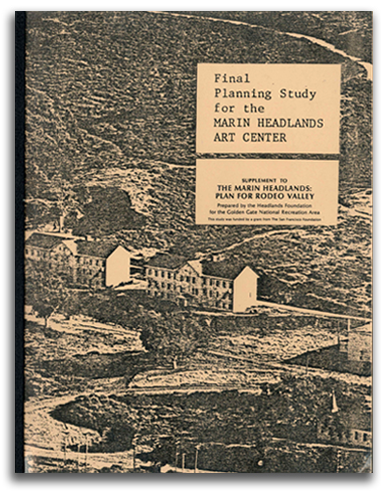
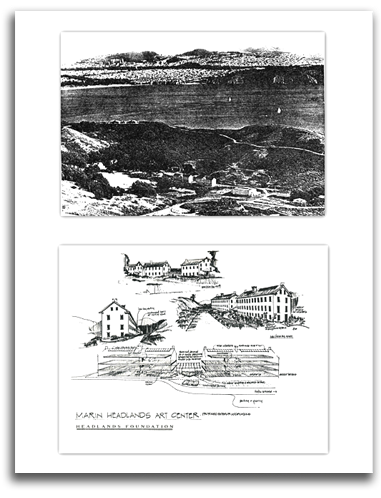
1981 vol.13 MARIN HEADLANDS ART CENTER, GGNRA, 1979-81
NOTE: MARIN HEADLANDS ART CENTER is now known as the HEADLANDS CENTER FOR THE ARTS. It is situated in a former Army fort in the Marin Headlands overlooking the Pacific Ocean, far from the sounds of the city. It is located near Sausalito, California, in the Golden Gate National Recreation Center – the largest “urban park” in the United States. Its Artist-in-Residence Program is centered on artists who focus on nature. FLG was its chief planner (1979-81) & first president in 1982. He was assisted by a team of specialists he recruited to be associates of the Institute for Aesthetic Development for this project. From modest beginnings, the Center is now widely respected nationally and internationally. Many artists compete to spend several months in this idyllic setting.
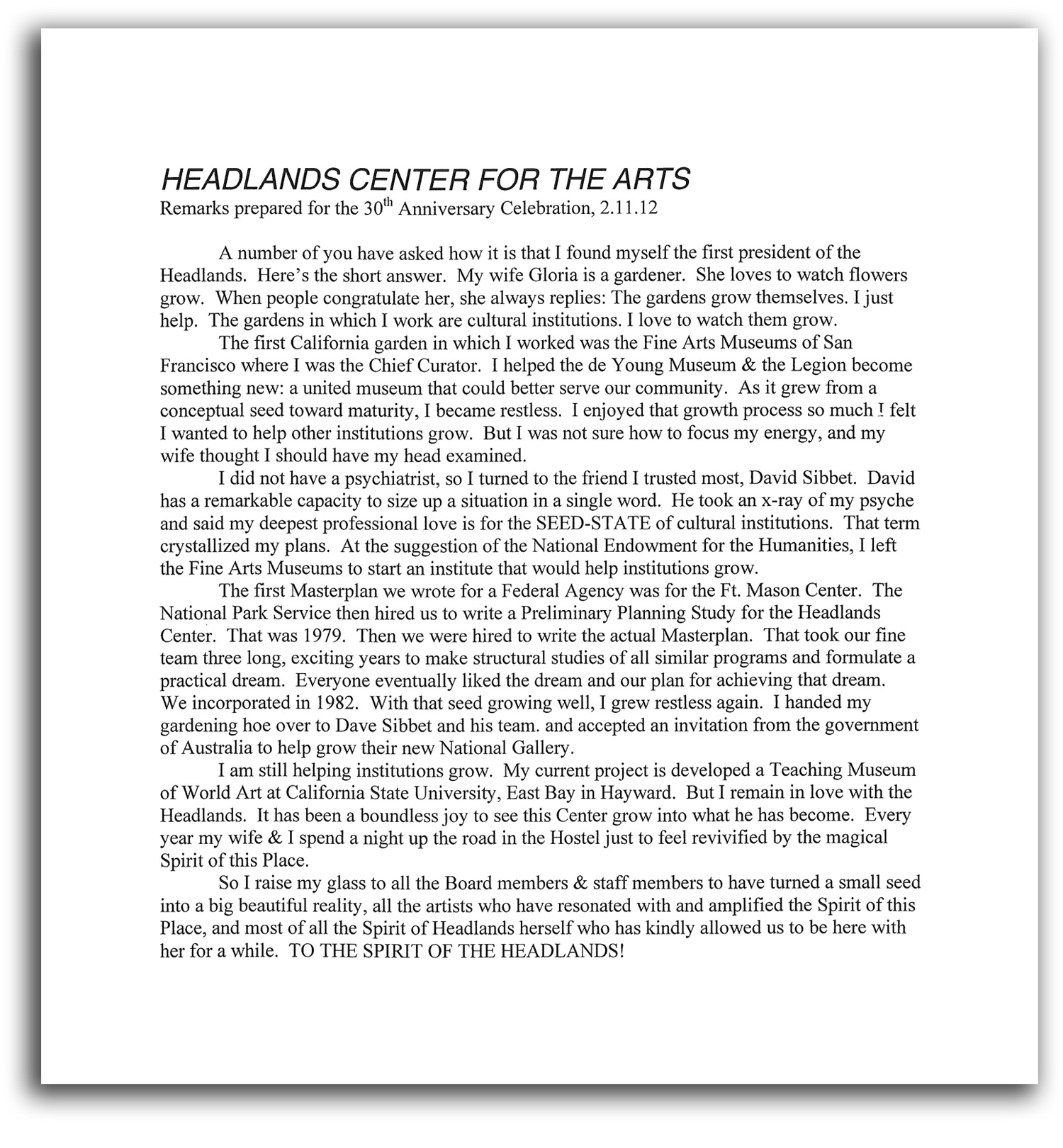
Click here for a PDF copy of remarks made by FLG at the 30th Anniversary of this project (above).
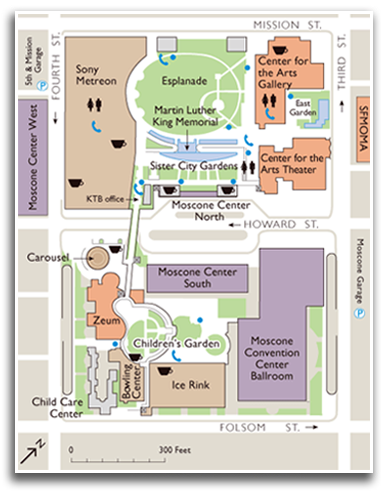
Present Site Plan of the Gardens
1982 vol.14 YERBA BUENA GARDENS, SAN FRANCISCO, A NEW CULTURAL PARK.
APlanning a cultural park in the heart of San Francisco, near the Moscone Center.
BReview Reports for the SF Redevelopment Agency, including plans for the Asian Art Museum, FAMSF, & a Community Cultural Center.
NOTE: The San Francisco Redevelopment Agency had responsibility for a large parcel of land in the heart of the city. The primary institution was to be the Moscone Conference Center. The adjoining areas were being set aside for cultural institutions around a large park called Yerba Buena Gardens just south of Market Street (the main axis of the city) between Mission and Howard, 3rd & 4th. But which institutions should be given the land to build on? Because many museums were expressing interest, FLG was called in by the Agency to evaluate the social benefit of each museum’s proposal and of the museum-complex as a whole. Those wishing to locate there included the S.F. Museum of Modern Art, Asian Art Museum of S.F., the Ansel Adams Museum of Photography, the California Historical Society, and the Legion of Honor Museum (in case the city accepted Norton Simon’s proposal that he take over that legendary building – on condition that it be filled with his collection). FLG’s report concluded that all were worthy, and that the combination of these museums (in what FLG called the “San Francisco Art Park”), together with a community-oriented cultural center and live-work spaces, would be a major benefit to the city and the region for generations. The simple act of approving the MoMA and the YBC would attract other museums to the area. Stress was placed on the value of using existing structures whenever possible. Not all those museums decided to move to Yerba Buena Gardens. The Asian moved across from City Hall into the old City Library. Mr. Simon acquired an existing structure in Pasadena. The Adams folded. But those that located there and have remained have proven to be dynamic, world-class institutions, especially the MoMA, the Yerba Buena Center for the Arts, and the recently opened Jewish Contemporary Museum that transformed an old power station at the north end of the complex. The Mexican Museum that started at Ft. Mason is planning to move next door. And the Cartoon Museum is not far away.
1983 vol.15 CULTURAL PLANNING FOR MARIN COUNTY.
Review Reports on a County Masterplan for Marin Center, Marin Arts Council, & the Marin County Board of Supervisors.
Preliminary Planning Studies for a Marin County Art Museum & Cultural Center in association with the Marin Arts Guild & the San Francisco Foundation.
1984 vol.16 EXHIBITIONS AT THE HEADLANDS ART CENTER:
Ansel Adams: Photographer of Nature.
The Image of Nature in Modern Art.
Nature Symbolized: Turn-of-the-Century Bookbindings.
Symbols of the Earth Spirit: Shamanism, Taoism, Hinduism & Buddhism.
Symbols of the Sky Spirit: Judaism, Christianity, & Islam.
Seasonal Markings: Season-Marking Earth Art from the Stone Age to Today.
1985 vol.17 MUSEOLOGY IN AUSTRALIA: A GUIDE TO PROGRAMS PLANNING A NATIONAL SCULPTURE GARDEN FOR AUSTRALIA.
1986 vol.18 CODES OF ETHICS IN NORTH AMERICA & AUSTRALIA.
NOTE: The museum profession did not have a Code of Ethics until the 1970s. FLG participated in writing codes for the College Art Association and the American Association of Museums during the 1970s, and was the lead author of the code for Australian Museums in the early 1980s. That code was one of a number of national codes used by the International Council of Museums in the formation of the code it published in 1986.
1987 vol.19 NEW TOOLS FOR ART EDUCATION: THE INTERNET IN AUSTRALIA.
1988 vol.20. A NEW TOOLS FOR ART EDUCATION: FILM, CABLE TELEVISION, VIDEOTAPES & VIDEODISCS.
A national survey for present & future uses by the Norton Simon Foundation. Planning Art Education programs with Home Vision, PBS, & the Arts & Entertainment Network.
SERIES II
VISUAL EDUCATION PAPERS WRITTEN BY FLG
1988 vol.20.B PERSONAL & TRANSPERSONAL ART
1 Spring An Art of Our Own: The Spiritual in Modern Art by Roger Lispey, A Book Review
2 Summer Matisse & the Psychological State of “Unlimited Being”
3 Fall MODERN ARTISTS: AN ARCHIVE OF PHOTOGRAPHIC PORTRAITS
4 Winter GREAT PHOTOGRAPHERS: AN ARCHIVE OF PHOTOGRAPHIC PORTRAITS
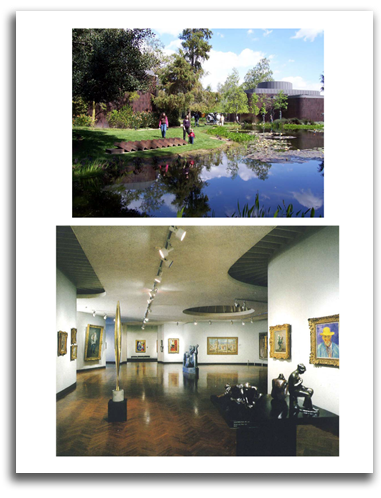
1989 vol.21.A EXHIBITIONS AT THE NORTON SIMON MUSEUM OF ART, PART 1
1 Spring Letters by Artists: Rubens to Picasso [labels/study guide]
2 Summer Dreaming in Color: The Art of Matisse [labels/study guide]
3 Fall Nature Studies: Photographs by Modern Masters [labels/study guide in ass’n with the Getty Museum for 150th anniversary of photography.
4 WinterThe Norton Simon Museum: A 30-second PSA for TV. Planning the Reinstallation of the Modern Wing of the NORTON SIMON MUSEUM.
NOTE: The general program plan for this museum in Pasadena, California, was the vision of Norton Simon in collaboration with his Director, Sara Campbell. Simon is widely considered the most important Old Master collector of the late 20th century. He asked FLG to become Curator of the museum in 1987 when FLG began to reinstall the modern wing in a chronological manner, along with a new kind of wall label for each work. FLG developed a “bi-focal” format. The concept is as follows. On the top of the label are a few words of identification in large type. Below that, in smaller type, is a contextual essay for serious visitors. He also added a photograph of each artist to each label. The NSM labels by FLG and Gloria Williams were cited as models in a national study of museum labels and signage by the J. Paul Getty Trust. The report was published in both CURATOR and MUSEUM EDUCATION in 1988. While at the NSM, FLG also started a new program of special exhibitions in the upstairs galleries (Van Gogh, Matisse, and Duchamp), and originated a publications program of collection monographs with his Van Gogh handbook of 1990.
1989 vol.21.B EXHIBITIONS AT THE NORTON SIMON MUSEUM OF ART, PART 2
1 Spring Vincent van Gogh [reprinted as Vincent van Gogh: Painter, Printmaker, Collector, an NSM ex. cat. & later reprinted as a trade book].
2 Summer Frederick Sommer: Master Photographer. [labels/study-guide]
3 Fall CITY SCENES
3a Manual Alvarez Bravo: Mexico’s Master Photographer. [labels]
3b Silent Cities: Atget & the Modern Urban Landscape. [labels]
4 Winter Masterpieces from the Norton Simon Museum
(co-author/Modern). 1st ed. of 1989 published w/o credits (at the demand of Mr. Simon).
1990 vol.22 DISCIPLINE-BASED ART EDUCATION, BOOKS, & MYTHS
1 Spring An Overview Report of DBAE Studies for the J. Paul Getty Trust.
2 Summer The Rise of the Livre d’Artiste in America:
Reflections on 21 Etchings & Poems and the Early 1960s
[reprinted in The Tamarind Papers: A Journal of the Fine Print].
3 Fall Comparative Mythology – A New Discipline: A Bibliography.
4Winter Still-Life Photographs by Edward Weston [wall label].
1991 vol.23 FREDERICK SOMMER & WILLEM DE KOONING
1 Spring The Art of Frederick Sommer, Part 1.
Master of the Combinatory Arts; written 1986.
2 Summer The Art of Frederick Sommer, Part 2; written 1989 Recent Work: “Elective Affinities”.
[both essays reprinted in Image as an article/ex.cat. for the George Eastman House / International Museum of Photography
3 Fall De Kooning the Printmaker
[reprinted as the Introduction to The Prints of Willem de Kooning: A Catalogue Raisonné, volume 1, Baudoin Lebon, Paris].
4 Winter The Early Prints of de Kooning: The Artist & His Printers
[reprinted as the Introduction to Willem de Kooning:The Printer’s Proofs.
Salander-O’Reilly. ex.cat., New York].
1992 vol.24 DE KOONING, BALTHUS, & VISUAL POETRY
1 Spring DE KOONING, FRANK O’HARA, & THE ILLUSTRATED BOOK IN AMERICA. [Commissioned by Limited Editions Club, NYC; draft]
2 Summer BALTHUS & THE ILLUSTRATED BOOK: A CATALOGUE RAISONNE. [Commissioned by Limited Editions Club, NYC; draft]
3 Fall VISUAL POETRY: A SURVEY OF MODERN PAINTING WITH POETRY BY THE ARTISTS, Part 1. 19th Century; draft.
4 Winter VISUAL POETRY: A SURVEY OF MODERN PAINTING WITH POETRY BY THE ARTISTS, Part 2. 20th Century; draft.
1993 vol.25EROS, DEITIES, & MULTICULTURAL ART
1 Spring Gods & Goddesses in World Art [CSUH ex. cat./wall case].
2 Summer Eros & The Mythology of Love:
3 Fall Multicultural Art in the USA: A Bibliography.
4 Winter RHYTHMS & REVERBERATIONS: MULTICULTURAL ART IN THE UNITED STATES [Reader] 1st edition.
1994 vol.26 HECTOR GUIMARD EXHIBITION, CATALOGUE, & SYMPOSIUM
1 Spring Planning the first Guimard Exhibition in Paris since 1971
2 Summer A Review of the Monumental Musée d’Orsay Exhibition Catalogue
3 Fall Etudes sur Guimard: Passé et Avenir [a Musée d’Orsay paper].
4 Winter Guimard, Viollet-le-Duc, et le Modernisme [a Musée d’Orsaypaper].
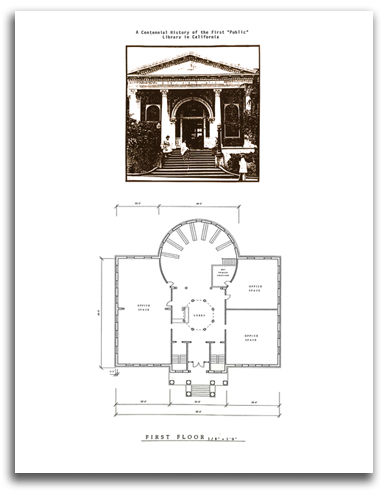
1995 vol.27 PLANNING THE HUMBOLDT COUNTY ART MUSEUM, Eureka, California. Later named the Morris Graves Museum of Art.
NOTE: FLG wrote a preliminary strategic plan in 1995 for a combined museum & performing arts center as a consultant to Holmes-Biord, Architects. The final plan was developed by the Humboldt Arts Council. They acquired the Morris Graves Collection to make this former Carnegie Library the most important California art museum north of San Francisco.
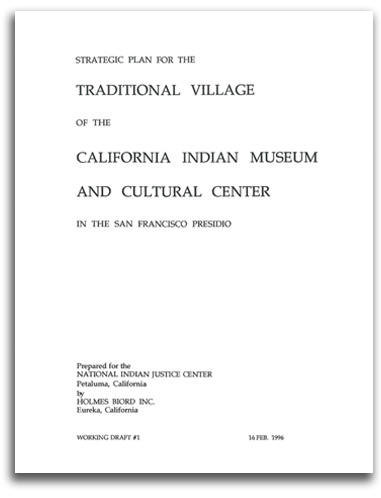
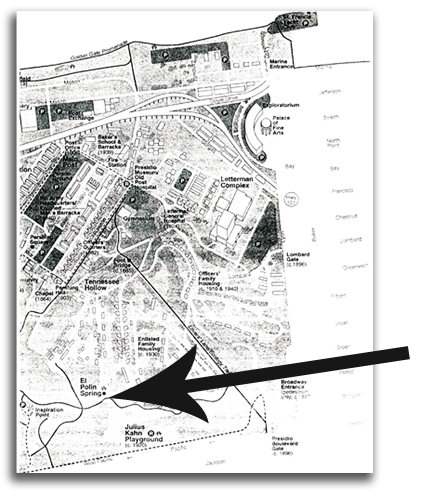
1996 vol.28 PLANNING THE CALIFORNIA INDIAN MUSEUM & CULTURAL CENTER in the San Francisco Presidio (project).
FLG wrote a Preliminary Planning Study in 1995-96 as a consultant to the National Indian Justice Center. It was not a good location. The NIJC has moved the site of their proposed museum to Petaluma.
1996 vol.29 MU CHI, MASTER OF THE CHINESE LANDSCAPE
1-2 Spring-Summer Mountain of the Flowering Moon: Analysis
3-4 Fall-Winter Mountain of the Flowering Moon: Letters from Experts
1996 vol.30 ART, THE INTERNET, & DISTANCE-LEARNING
1-2 Spring-Summer Mythic Art & Iconography of the Internet
3-4 Fall-Winter Internet Visual Education & Distance-Learning
1997 vol.31 ILLUSTRATED BOOKS BY FAMOUS ARTISTS
1-2 Spring-Summer FROM BOTTICELLI TO BLAKE: Illustrated Books by Great Artists [ ex. cat.]
3-4 Fall-Winter FROM DELACROIX TO DE KOONING: Illustrated Books by Great Artists [ ex. cat.]
1997 vol.32 SCIENCE, SACREDNESS, & CONSCIOUSNESS
1 Spring The Science of Consciousness: A Bibliography
2 Summer HEAVY LIGHT: Haiku on Modern Physics & Ancient Wisdom
3 Fall ELECTRO-MAGNETISM: Complementarity in Science, Society, & Self
4 Winter ART+TECHNOLOGY: A READER [CSUH]
1998 vol.33 ART MUSEUM STUDIES & THE MASAMI TERAOKA EXHIBITION (The start of the CSU series of Special Exhibitions)
1 Spring THE ART MUSEUM REVOLUTION IN AMERICA
2 Summer AN ART MUSEUM FOR CSUH? A Preliminary Planning Study
3 Fall Art Museum/Gallery Studies: A Certificate Program at CSUH
4 THE ART OF MASAMI TERAOKA
4a Lecture for Friends of the Arts
4b Opening Remarks by FLG & the Japanese Consul
1999 vol.34 SPECIAL EXHIBITIONS
1 Spring The “Fetishes” of David King [CSUH ex. cat./poster]
2 Summer Four Conversations with Andy Warhol [on file at Warhol Museum]
3 Fall THE ART OF THE BOOK: The Modern Livre d’Artiste [reprinted as a CSUH ex. cat.] (with a videotape of the installation)
4 Winter ANDY WARHOL & SOCIAL CONSCIOUSNESS: Another Side of Pop Art [reprinted as a CSUH ex. cat. (with videotapes of the installation)]
2000 vol.35 NICHOLAS LANIER, LORD ARUNDEL, & ANTHONY VAN DYCK
1 Spring How Van Dyck Came to England: Evaluating the Evidence
2 Summer Biographical Profiles of Nicholas Lanier:
3 Fall Portraits of Nicholas Lanier: An Illustrated Checklist
4 Winter Interwoven Destinies: A Chronology of Lord Arundel, van Dyck, & Nicholas Lanier in 17th century England
2001 vol.36 SPECIAL EXHIBITIONS:
1 The Lion’s Roar: Tibetan Thangkas from the Sakyas
2 The Art of the Book: Masterpieces from the Anderson Graphic Arts Collection at the Fine Arts Museums of San Francisco
2002 vol.37 SPECIAL EXHIBITIONS:
1 Marcel Duchamp: Artist, Humorist, Philosopher
2 Shamanic Power Objects
2003 vol.38 SPECIAL EXHIBITIONS:
1 Zen & Modern Art
2 Joseph Cornell (project)
2004 vol.39 SPECIAL EXHIBITIONS:
1 Miniature Museum of World Art: An Architectural Model Goes on Display, 2004-2010.
2 Robert Rauschenberg, Artist-Citizen: Posters for a Better World – starts in Hayward then travels from Coast to Coast via SITES, 2005-2008
2005 vol.40 ON THE EARLY DAYS OF FAMSF
1 Reflections of the First Chief Curator:
1a How Church’s “Rainy Season in the Tropics” came to San Francisco & Attracted the Attention of John D. Rockefeller 3rd
1b Acquisitions & Related Adventures
2 Reflections of the First Director
3 World History Learning Center, Plan #1: A Classroom in the Art+Education Building
2006 vol.41 SPECIAL EXHIBITIONS:
1 Flaming Pages: The Illuminated Books of William Blake
2 PLANNING Global Vision: A Survey of WorldArt, Part 1
2007 vol.42 SPECIAL EXHIBITIONS:
1 Spirit of the Renaissance (Little Gallery)
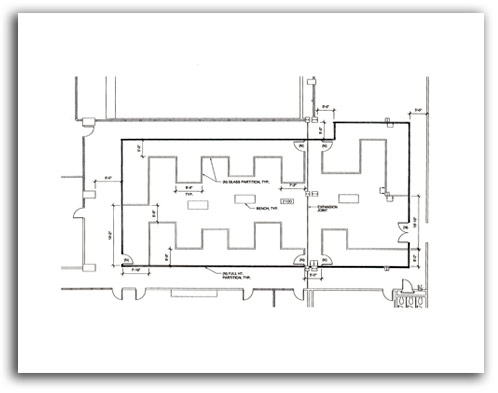
World History Learning Center,
Plan #2 on the Upper Mezzanine of the Main Library, CSUEB, 2007
Program Plan & Exhibition Design by FLG. Architecture & Drawing by Chuck Copus, AIA
Click here to view details of above plan in PDF format
Click here to view WHLC proposal in PDF format
2 World History Learning Center, Plan #2: Library, Upper Mezzanine
3 Internships: Visual Integration: African-American Art enters the Mainstream [exhibition planning (Jovenna Prince)]
4 Cataloging the Kahn Collection (Rachel Bush)
5 Feminism & the French Revolution (Darlene Taylor)
6 Cataloging the Native American Collection (Lyn Hedrick)
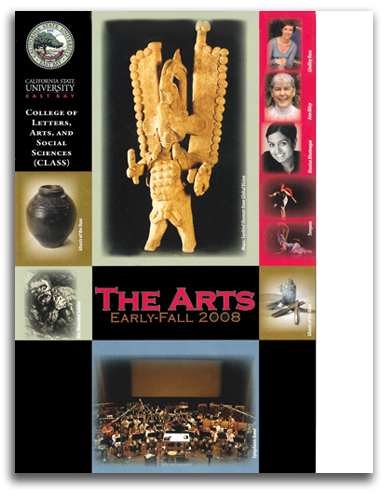
2008: vol.43 SPECIAL EXHIBITIONS:
1 PLANNING Global Vision: A Survey of WorldArt, Part 2
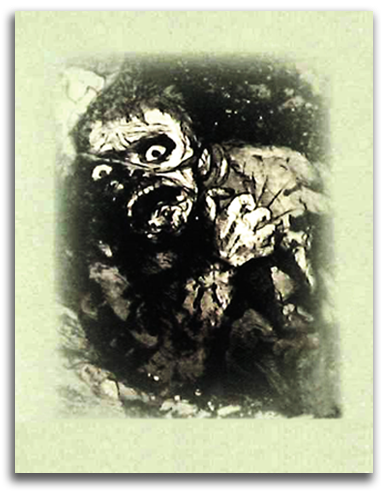
Wounded Soldier (detail) Etching by Otto Dix, 1916
Collection: FLG
Published in GLOBAL VISION: A SURVEY OF WORLD ART, Part 1, 2006
Collection: FLG on loan to IAD
2 The Cost of War: from the World Wars to Iraq.
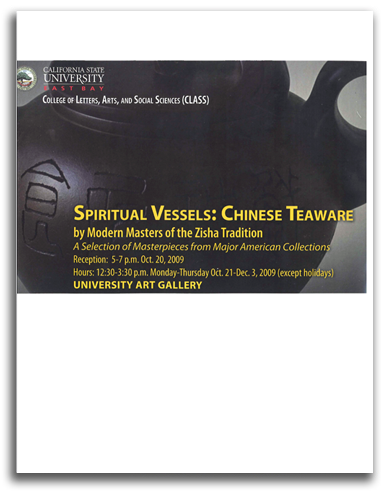
2009: vol.44 SPECIAL EXHIBITIONS;
1 Pre-Columbian Sculpture: Olmec, Maya, & Aztec
2 Stones & Bones that Speak: Inscribed Chinese Art
3 PLANNING Spiritual Vessels: Chinese Teaware by Modern Masters of the Zisha Tradition
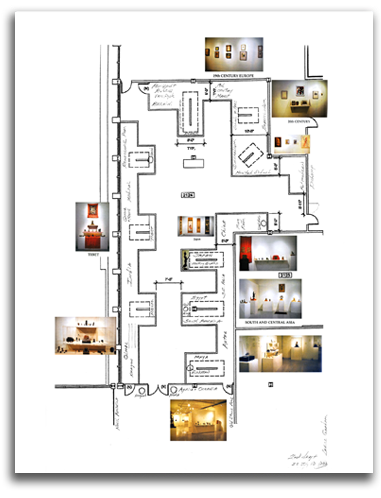
click here for a large version of the above floor plan
2010: vol.45 MUSEUM STUDIES EXHIBITIONS:
1 World History Learning Center, Masterplan #3, Library Reference Wing
2 Internships: Classroom Gallery for the Modern IAD Collection (Daniel Charm, Lisa King, & Joan MacLoughlin).
3 Classroom Gallery for the Tribal IAD Collection (Daniel Charm).
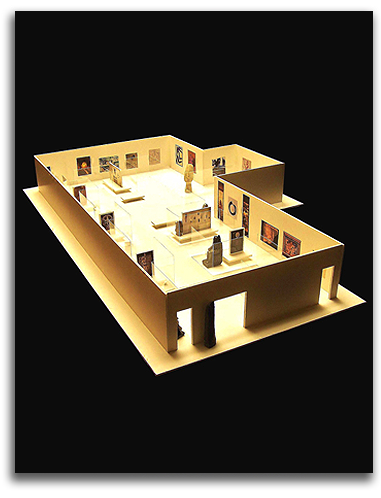
Preliminary Plan, Humanities Wing, 2011
Featuring Art Donated by IAD
click here for a large version of the above model
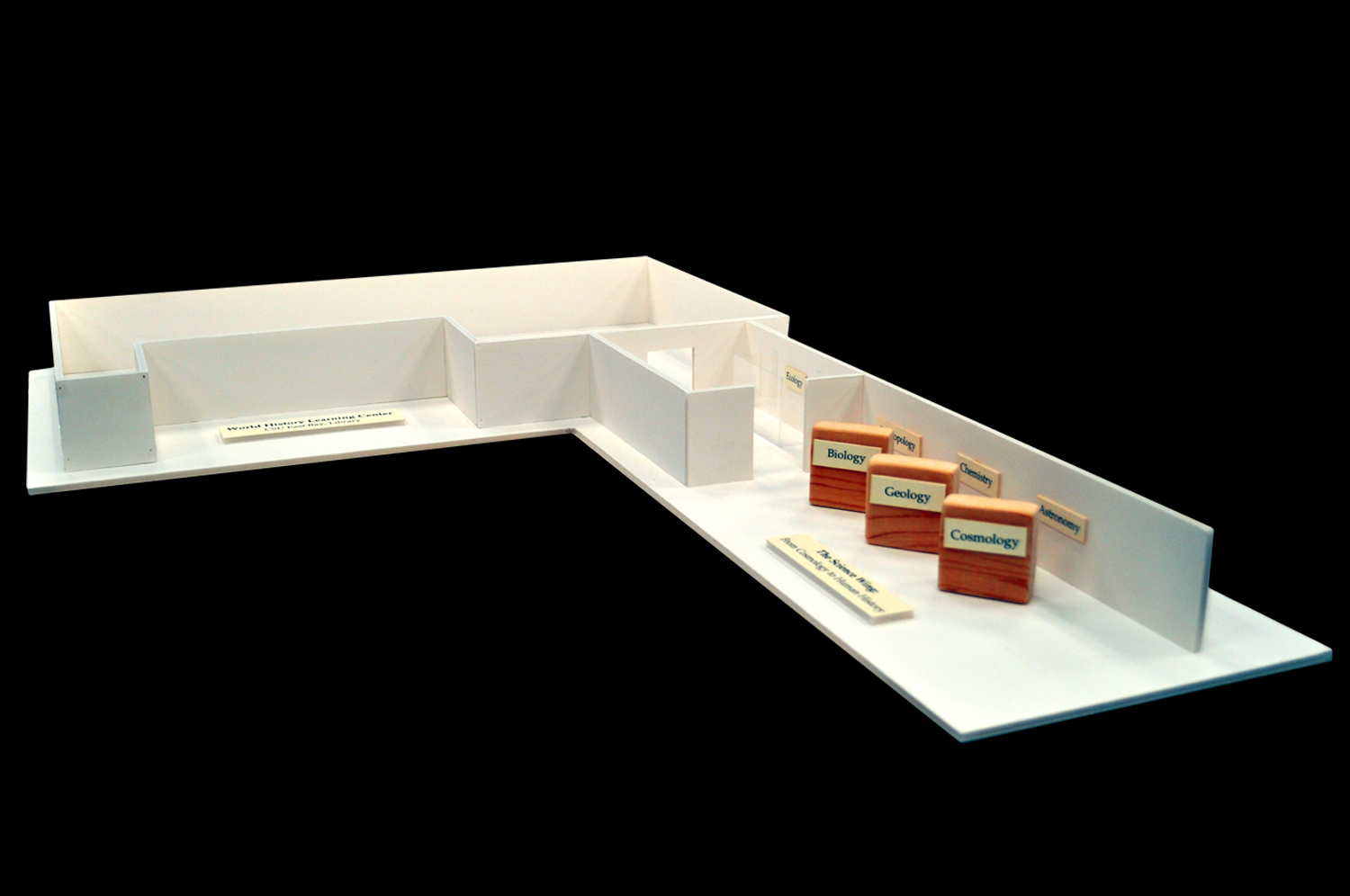
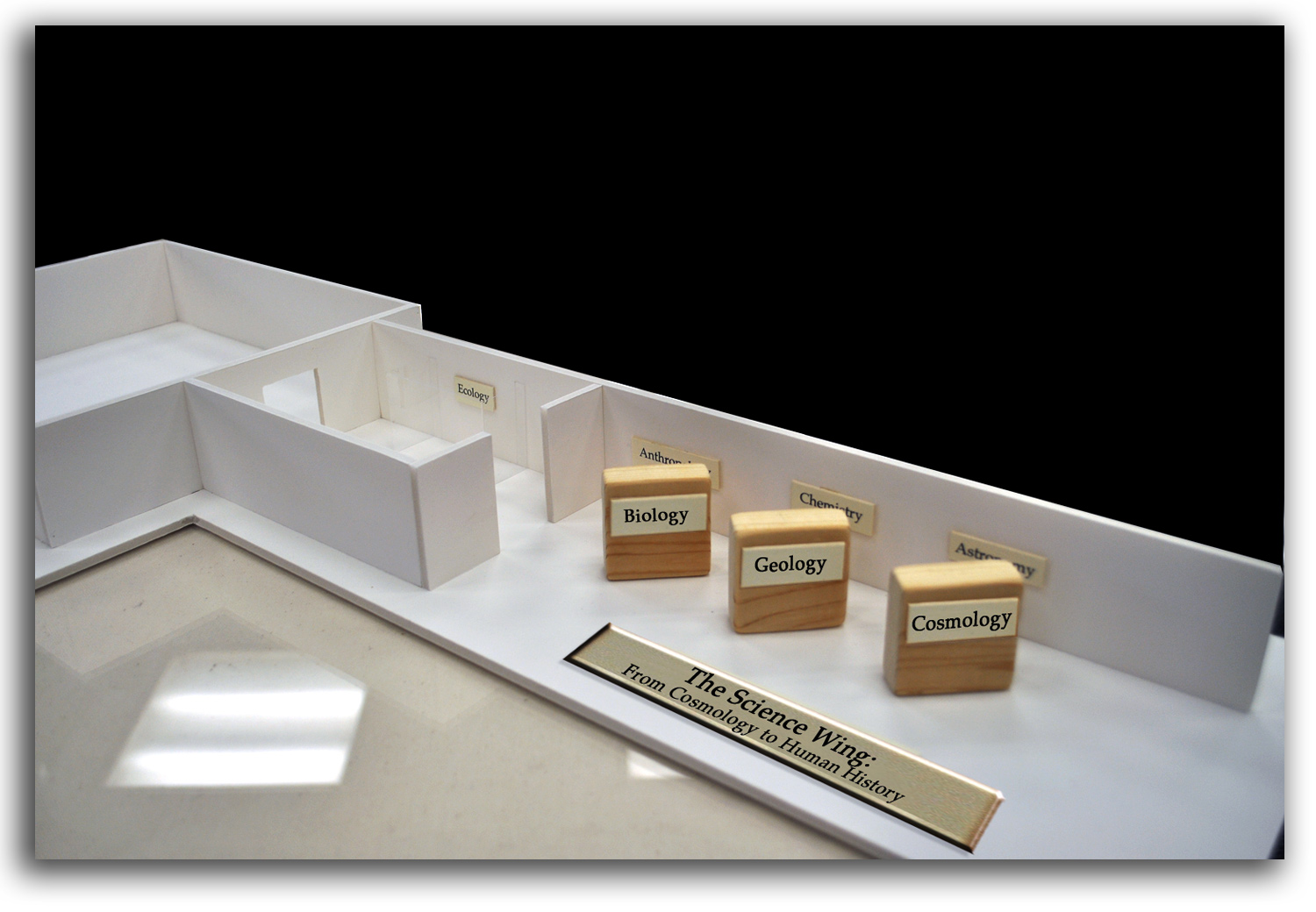
Preliminary Plan, Science Wing, 2012
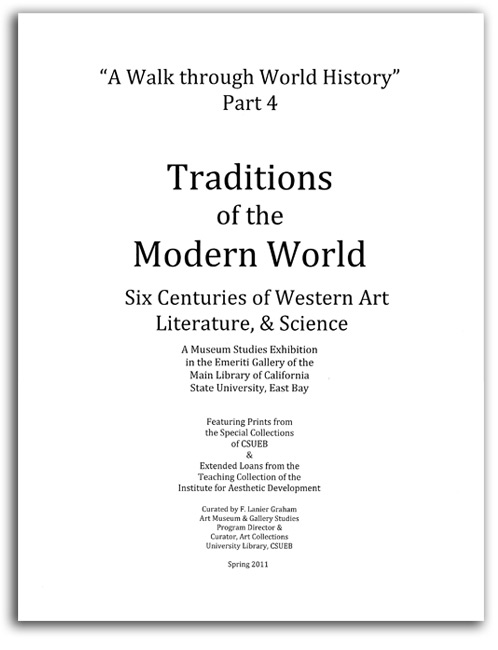
Click here for entire “Traditions of the Modern World” brochure in PDF format
THE WORLD HISTORY LEARNING CENTER
An interactive “Walk through World History”
Featuring the STORY OF THE COSMOS & the STORY OF HUMANITY
NOTE: This project started in the Art Department as the dream of an Art Museum. But the goal was to develop it in ways that could be useful to all Departments. After preliminary planning with the History Department, Anthropology Department, English Department, the Provost, and the President, the name of the expanded project became the “World History Learning Center.”
Located in the heart of the main library of CSUEB, it is being designed as a “book you can walk through.” By offering an overview of world history as a whole, students will have an integrated visual context for all their studies, and an ongoing opportunity to perceive unexpected relationships. Having seen the “global village” as an interconnected whole, they will be better prepared to be global citizens in the 21st century.
Most museums are devoted to art, or science, or history. This will be all three. Most university “teaching museums” have a narrow focus on selected areas. This Center will not. It will be the first “teaching museum” of its kind because of its comprehensive character. Thanks to the recent donation to the university of several hundred works of art, the visual art of all major cultural regions and traditions from the Stone Age to the present will provide the conceptual structure of the general experience.
The exhibition technique being developed for this project is called “Planimetric Perception.” The primary plane-of-perception is large and very vertical. Fine art will be located on this tall plane-of-perception, on the back walls of the glass enclosures. Art Museums often do little more than that. They hang the art and stop, often insisting no other effort is required because “the art can speak for itself.” This is an elitist position and part of the reason visitors to art museums are often limited to the middle and upper middle classes. People not educated in art appreciation or art history are left behind, and that includes most students at public universities. Most lower division students at CSUEB, for example, have never been to an art museum. Perceptual bridges must be constructed. “Planimetric Perception” is a bridge-building technique.
In front of each wall of fine art, in a 2nd intermediate plane-of-perception, will be small objects of a utilitarian character, e.g., arrowheads & baskets from the Stone Age, tools & weapons from the Bronze Age and Iron Age, and scientific instruments from the Modern Age – all from the same period as the fine art being seen behind them. The overlapping of content will encourage some to expand the traditional definition of what constitutes “art.” Creativity, at some level, is at the heart of all human activity. As Picasso said: “Art is whatever we add to nature.”
At the very front of the display spaces will be the 3rd plane – a small, thin, horizontal plane-of-perception that frames and introduces the two levels of display behind it. Many museums have found it most useful to place in this position most of the textual information in such horizontal strips. The more “educational” museums have added photographs to these strips. Graduate interns in the Museum Studies program of CSUEB have gone farther. Their research has determined that visitors are even more engaged in the process of information-absorption if these strips contain miniature, 3-dimensional objects that “picture” aspects of history, e.g., furniture, fashions, weapons, cars, planes, and telescopes. These interns are exploring how small objects and graphics from the history of astronomy, geology, biology, sociology, warfare, transportation, the decorative arts, etc., can provide a 3-dimensional chronology first of cosmic history and then of human history.
In this Learning Center the word “world” is being used in the widest sense. The reference is to the universe as a whole. The plan calls for Introductory Galleries to contain a series of display panels that trace the development of the universe from the Big Bang. This series on the “Story of the Cosmos” will progress through Cosmology, Astronomy, Geography, Chemistry, Biology, and Physical Anthropology. Each panel will explain the basic elements of each discipline and how that discipline contributes to our understanding of the development of humanity. Embedded in each wall panel will be an iPad that will offer Internet access to more aspects of each subject area.
After this general introduction to the history of natural sciences, the later galleries of human history begin. Here the “Story of Humanity” will be told in a chronological manner, from the Stone Age and the Bronze Age to the present. Information and insights will be used from the disciplines of Art History, Cultural History, the Social Sciences, Languages, Literature, World Religions, and Philosophy. The Deans of all four colleges of CSUEB have indicated their enthusiastic support for this unique educational resource. The faculty of all the Departments at CSUEB and other universities will be consulted on the material displayed and the educational labels that contextualize the artifacts. The University of California, Berkeley, and Stanford University have been part of the planning process from the beginning.
Most chronologies and identification labels in museums are simply small, flat panels placed on one wall. Studies have shown that most visitors spend about 15 seconds reading such texts. The chronology and label-set being developed for the World History Learning Center is an engaging “river” of tactile objects, from moon rocks to campaign buttons, running throughout the Center. Many of these objects will be from the daily life of the various eras, and thus provide not only historical context for the larger objects, but also function psychologically as pathways for students to think their way from the “ordinary reality” they see every day to the “extraordinary reality” of outstanding works-of-art, works that give vivid expression to the highest hopes and deepest dreams of every cultural tradition.
~ Lanier Graham, Art Curator, University Library, CSUEB
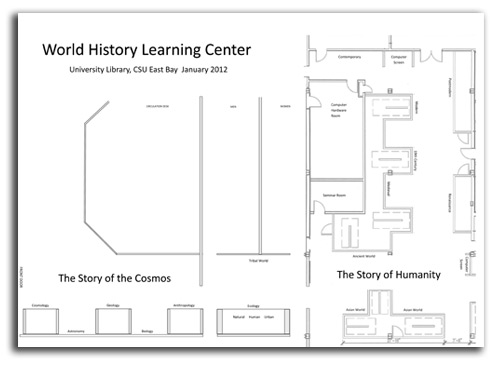
World History Learning Center, Masterplan #4.
Program Plan & Exhibition Design by FLG. Architecture & Drawing by Chuck Copus, AIA
Click here for a closer view of floorplan as a PDF file